Taxonomy & naming
Acantholebias quirogai was originally described by Malabarba and Isaia in 1992, based on specimens from Arroyo de las Palmas near Aceguá in Uruguay, and was placed in the genus Austrolebias. The Catalog of Fishes (Eschmeyer, Fricke & van der Laan) recognises the species under the current combination Acantholebias quirogai following the molecular and morphological revision by Loureiro and Bessonart (2023), which resurrected the genus Acantholebias to accommodate a clade of Uruguayan and southern Brazilian annual killies previously grouped within Austrolebias sensu lato. The authority remains in parentheses because the original generic assignment has changed.
A separate study by Loureiro, Duarte and Zarucki (2011) had already elaborated on the species' Uruguayan distribution and clarified its placement within the río Negro and Laguna Merín drainages. The species is sometimes still encountered in the literature and in hobbyist catalogues under its former Austrolebias combination; the American Killifish Association (AKA) species account uses the name Acantholebias quirogai following the 2023 revision. No subspecies or formally described geographic variants are currently recognised.
The species epithet honours Quiroga — most likely a reference to a locality or collector associated with the type material from the Aceguá region, though the etymology was not fully elaborated in the original description. The genus name Acantholebias combines the Greek akantha (thorn or spine) with the suffix -lebias used across many neotropical annual killifish genera.
Morphology
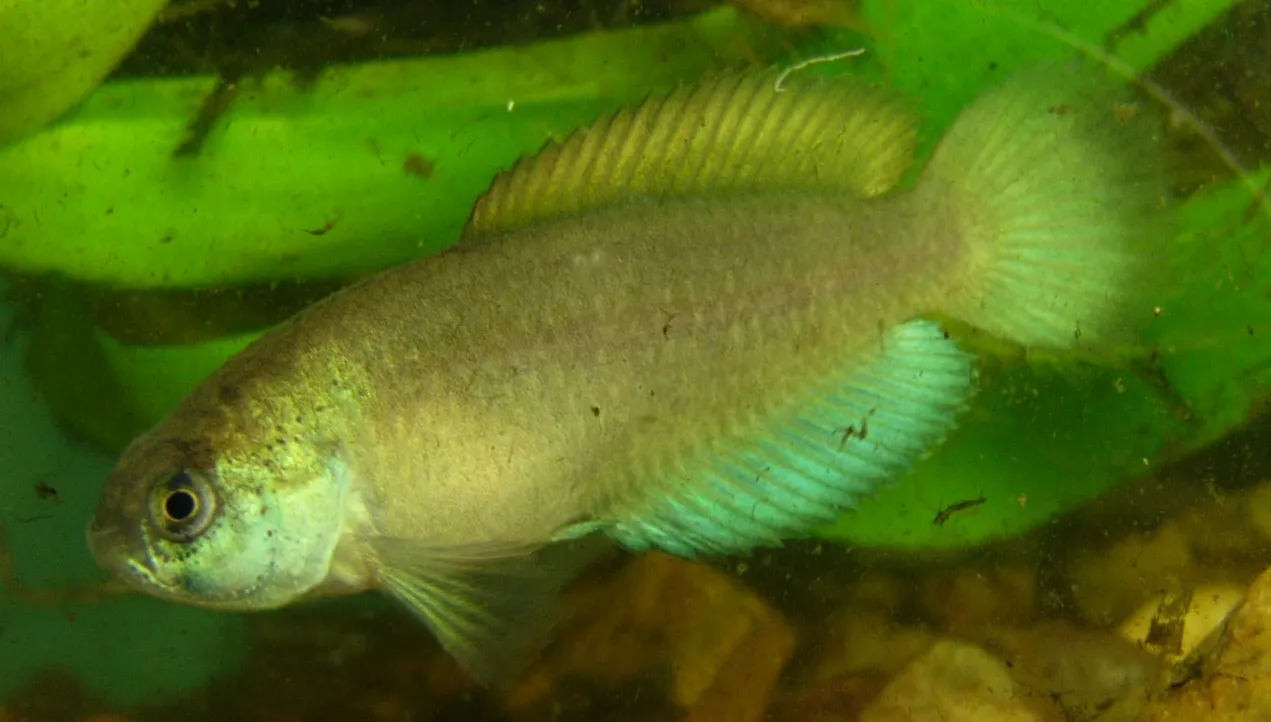
Acantholebias quirogai is a small annual killifish reaching approximately 2 in standard length (FishBase), which is modest even within the annual rivulid guild. The body form is typical of the Austrolebias alliance: moderately deep and laterally compressed, with a rounded snout, a large upturned mouth adapted for surface and mid-water prey capture, and the robust, blunt-headed profile shared by most South American peat-divers.
Sexual dichromatism is pronounced, as expected in annual killies where the male must court and compete intensively during a compressed breeding season. Males display the vivid iridescent body patterning — metallic blues, greens, and contrasting dark barring or spotting — characteristic of the genus, while females are cryptically coloured in muted browns with less-defined markings, providing camouflage in the dense aquatic vegetation and leaf litter of their shallow ponds. The dorsal and anal fins of males are extended and ornate; those of females are rounded and plain. Fin ornamentation and body depth can differ between individuals from different pond populations, though no formal variants have been described.
Habitat
This species is endemic to a narrow corridor spanning the Brazil–Uruguay border in the southern Pampa biome. In Uruguay it occurs in temporary ponds within tributaries of the río Negro (río Uruguay basin) and in the río Yaguarón drainage that feeds Laguna Merín; the type locality is Arroyo de las Palmas near Aceguá. In Brazil, confirmed records come from temporary wetlands in Aceguá municipality within the Jaguarão River basin — the same transboundary watershed zone, just north of the border.
The pools it inhabits are shallow, seasonal grassland ponds that form after seasonal rains and dry out completely each year. The Volcan et al. (2014) study in Brazil recorded water conditions of pH 5.94, temperature 82 °F, and hardness of just 0.136 dGH — exceptionally soft, mildly acidic water — within habitat characterised by dense aquatic vegetation and annual precipitation of approximately 63 in. The ponds are often set in open grassland or with fringing riparian vegetation; they receive full sun and warm rapidly, supporting the fast growth rate the fish requires to complete its annual cycle before the water disappears.
Annual precipitation in the region averages around 63 in spread across all months, but seasonal variation in evapotranspiration drives strong hydroperiod cycles. The species has no tolerance for permanent or perennial water bodies; it is obligately tied to the boom-and-bust rhythm of these temporary pools.
Feeding
Like other annual killies of similar body size, Acantholebias quirogai is a generalist carnivore in the wild, targeting small invertebrates available in the water column and at the surface of its shallow ponds: aquatic insect larvae, microcrustaceans, small worms, and other zooplankton. The upturned mouth is optimised for ambushing prey from below or snatching items from the surface film. Given the highly productive but short-lived nature of its seasonal pools — rich in invertebrate life immediately after flooding — feeding intensity during the active season is high; rapid growth is essential for reaching reproductive maturity before the pool dries.
In the aquarium the species accepts most small live and frozen foods — Daphnia, Artemia nauplii and adults, bloodworm, Tubifex, and mosquito larvae — and can be trained onto high-quality dry foods of appropriate size, though live and frozen prey typically elicit better condition and colouration. Feeding frequency should be high in young fish to promote the rapid growth rates that match the species' naturally compressed life history.
Mating
Acantholebias quirogai is an annual peat-diving killifish; the spawning mode that defines this group is substrate-diving rather than plant-spawning. Pairs do not scatter eggs among vegetation; instead, after a courtship display in which the male displays his iridescent flanks and extended fins to the female, the pair dive together into soft substrate — peat, mud, or detritus on the pond floor — where a single egg is deposited and buried per dive. Each successful embrace plants one egg several millimetres deep in the sediment, and the pair resurfaces to repeat the sequence.
Male competition for females is intense during the brief breeding window: males display vigorously and defend access to females against rivals. The compressed time available before the pool dries selects for early maturation and sustained spawning effort; wild fish may begin breeding within weeks of hatching. In the hobby, males should not be kept in groups without adequate females and visual barriers, as aggressive display and fin damage can occur.
Breeding
After each spawning dive, the fertilised egg is left buried in the substrate where it enters diapause — a state of arrested embryonic development that allows it to survive the complete desiccation of the pool through the dry season. Diapause in annual rivulids typically passes through two or three developmentally arrested stages (diapause I, II, and III), each offering a checkpoint that prevents premature hatching if the pool refills temporarily. Eggs in diapause can remain viable in dry or slightly damp substrate for months, sometimes over a year, ready to hatch rapidly when the pool floods again with the return of seasonal rains.
In the hobby, keepers simulate this cycle by allowing spawning on peat fibre or coconut coir substrate, then carefully removing and drying the substrate with eggs, storing it in a sealed container at room temperature for a minimum storage period — typically three to six months for species from temperate South America — before re-wetting to trigger hatching. Hatching occurs rapidly after re-wetting and the fry are immediately free-swimming and able to feed. First foods should be small live prey — freshly hatched Artemia nauplii or micro-worms — as fry are tiny at hatching. Growth is fast; surviving fish typically reach sexual maturity within eight to twelve weeks under good feeding, completing the life cycle that the species' natural calendar demands.
Adult fish in the wild rarely survive longer than one season; in the aquarium, water temperatures below the subtropical highs of summer can extend lifespan modestly, but the species is inherently short-lived and keepers should maintain egg stocks as their primary security against loss of a culture.
In the aquarium
Acantholebias quirogai is kept by annual killifish specialists and is available through the hobbyist trade primarily via species-society exchanges and breeders affiliated with the American Killifish Association. It is not a fish for the casual community aquarium. A small, dedicated breeding setup suits it best: a tank of 10–15 US gal with dark, subdued lighting, a layer of peat fibre or coconut coir on the bottom for spawning, and a gentle air-driven filter that does not disturb the substrate.
Water should be kept soft and slightly acidic, reflecting the field measurements from its natural habitat (pH approximately 6.0, very soft water, temperature in the low-to-mid 20s °C indoors; warmer summer temperatures up to 81–82 °F are tolerated and may improve spawning activity). Floating plants or surface cover reduce the stress of an exposed environment. A pair or small group (one male, two females) is the standard approach; keeping multiple males in a small tank without adequate space invites fin damage.
The keeping of annual killies is as much egg storage as fish husbandry. Keepers pull and dry the spawning medium every four to eight weeks, label and date the bags of damp peat, and maintain a rotation of eggs at different stages of development — ensuring a fresh batch is always available to restart a line if adult fish are lost. This careful management of diapausing eggs is both the challenge and the fascination of the group.
Conservation
Acantholebias quirogai is assessed as Endangered (EN) on the IUCN Red List (2021 assessment), reflecting the extreme narrowness of its known range and the rapid degradation of its seasonal wetland habitat. The Volcan et al. (2014) study on the Brazilian population applied criteria B2ab(ii,iii) — reduced area of occupancy below 3.9 mi², with the population severely fragmented and experiencing continuous decline in the extent and quality of habitat. These figures underscore just how precarious the species' situation is: the entire global range of one of the most habitat-specialised vertebrates in South America can be measured in a handful of seasonal ponds.
The threats driving decline are those facing seasonal wetland habitats throughout the southern Pampas: conversion of grassland for soybean and cattle agriculture, which destroys temporary ponds or alters the hydrology that creates them; drainage and channelisation of low-lying areas; introduction of non-native fishes (mosquitofish Gambusia affinis and other exotic cyprinids and characids are widely distributed in the region and devastate annual killifish populations); and the intensification of water use in the broader catchment. Because the species is restricted to the border zone of Uruguay and Brazil, coordinated transboundary conservation is theoretically required but has been difficult to implement.
The 2024 conservation strategies review (ResearchGate) identifies riparian wetland protection as the critical intervention for annual killifish in the Austrolebias sensu lato group, and notes that the hobbyist captive population — maintained through species-society peat-egg exchanges — represents a meaningful insurance stock for species like this one whose wild populations could collapse in a single dry year or following a single drainage event. Keepers of Acantholebias quirogai are encouraged to maintain accurate provenance records and share stock through AKA and affiliated organisations to preserve genetic diversity in captivity.