This section covers the rest of the characins (order Characiformes) — every family the hobby meets except the small tetras, which have their own Tetras section (Characidae, the hatchetfish, pencilfish, Congo tetra and their kin). What’s left is the big, predatory and oddball side of the order: the piranhas, pacus and silver dollars (Serrasalmidae), the headstanders, the wolf fish, the payara and pike characins, and the African characins. Following the Catalog of Fishes for valid names — Serrasalmidae is being split hard, so the silver-dollar genera in particular are in flux — we group the families by a friendly ecology axis rather than by clade. Four honest themes run through every account. The piranha myth: most are shy scavengers and fin-nippers that need a group, not a frenzy. The size trap: pacus and the big predators are sold tiny and grow into pond fish — the adult size is stated plainly, and the pacu warning includes never release. Tankmate honesty: silver dollars shred plants, headstanders and some Africans nip fins and eat scales, wolf fish and payara eat their neighbours. And breeding is mostly egg-scattering, with the big food-fish farm-bred rather than home-bred. Read each account before you buy.
Photos © Adobe Stock
Grouped by a friendly ecology axis — the piranhas, the pacus & silver dollars, the headstanders, the wolf fish & trahiras, the predatory characins (payara, freshwater barracuda and pike characins), the hemiodus & minor characins, the African characins and the South American darters — rather than by the shifting family boundaries, though each account names its current family and authority. This is the non-tetra half of one of the largest orders of fish; following the Catalog of Fishes and FishBase, the roster is deduplicated against the Tetras and Catfish sections, and new accounts are added as they are researched.
Species
Piranhas · 43
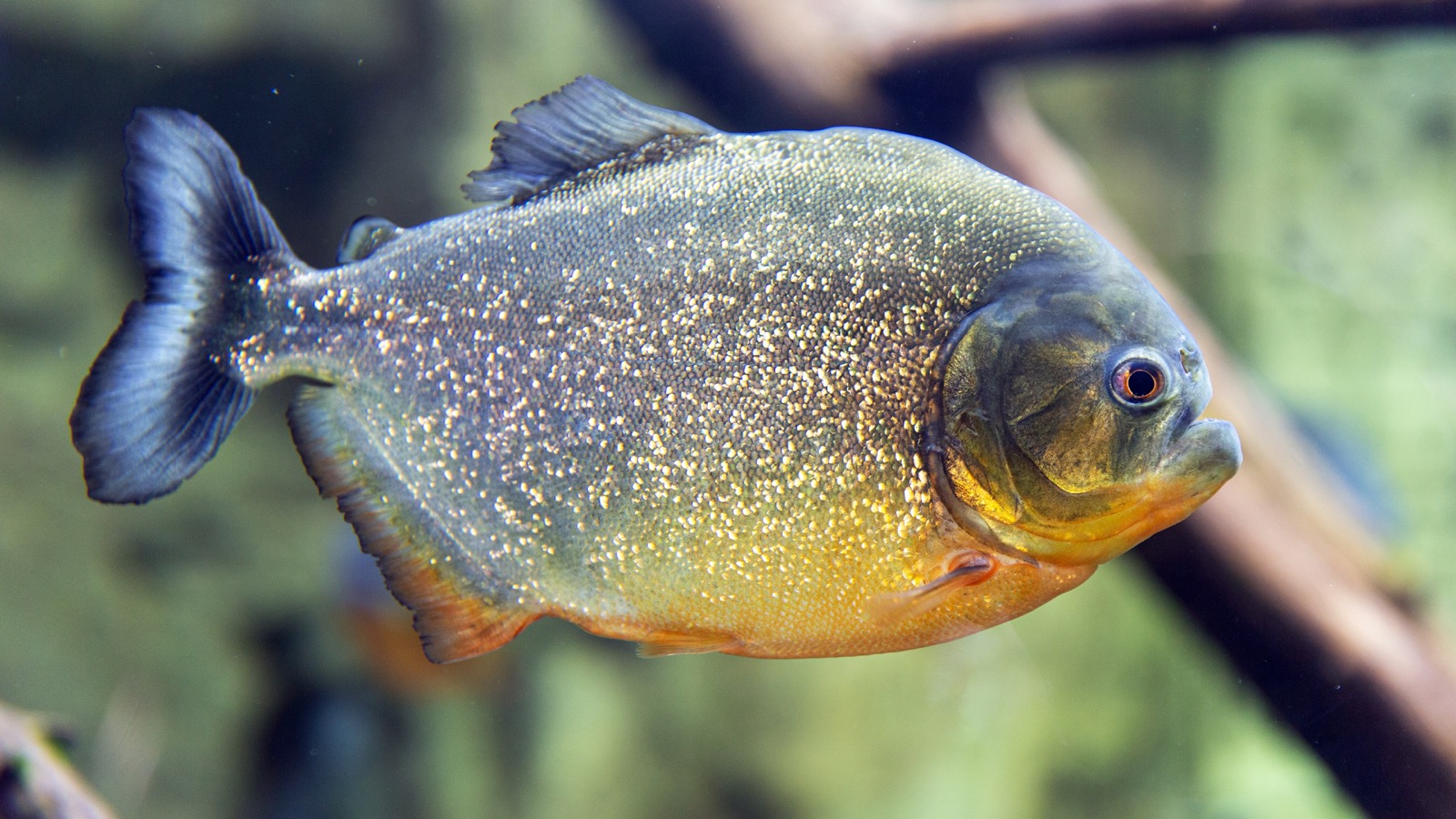
The true piranhas of family Serrasalmidae — the red-bellied shoaling Pygocentrus, the solitary Serrasalmus, and their kin (Pristobrycon, Pygopristis, and the scale-eating wimple Catoprion). The reputation is mostly MYTH: most piranhas are wary, opportunistic scavengers and fin-nippers, not the frenzy of film. The shoaling species (Pygocentrus nattereri) are nervous and need a GROUP and heavy cover to settle; the solitary Serrasalmus are territorial and kept one to a tank. Catoprion is a specialist scale-eater. The jaws demand respect at feeding and netting — but the honest risk is to tankmates and fingers, not a legend. Piranhas are restricted or banned in many regions; check local law before buying.
- Catoprion absconditus · Wimple piranha
- Catoprion mento · Wimple piranha
- Pristobrycon careospinus · Maripano
- Pristobrycon maculipinnis · Marbled piranha
- Pygocentrus cariba · Orinoco piranha
- Pygocentrus nattereri · Red-bellied piranha
- Pygocentrus palometa
- Pygocentrus piraya · Piraya
- Pygopristis denticulata · Lobe-toothed piranha
- Serrasalmus altispinis
- Serrasalmus altuvei · Caribe azul
- Serrasalmus aureus · Golden piranha
- Serrasalmus auriventris
- Serrasalmus brandtii · White piranha
- Serrasalmus calmoni · Dusky piranha
- Serrasalmus compressus
- Serrasalmus eigenmanni · Pinche Piranha
- Serrasalmus elongatus · Pike piranha
- Serrasalmus emarginatus
- Serrasalmus geryi · Violet-line piranha
- Serrasalmus gibbus · Gold piranha
- Serrasalmus gouldingi · Blue tiger piranha
- Serrasalmus hastatus
- Serrasalmus hollandi · Holland's piranha
- Serrasalmus humeralis · Black-shoulder spot pirambeba
- Serrasalmus irritans · Slender piranha
- Serrasalmus maculatus · Maculatus piranha
- Serrasalmus manueli · Manuel's piranha
- Serrasalmus marginatus · Marginate piranha
- Serrasalmus medinai · Medina's piranha
- Serrasalmus nalseni
- Serrasalmus neveriensis · Neveri piranha
- Serrasalmus nigricans
- Serrasalmus nigricauda
- Serrasalmus odyssei
- Serrasalmus rhombeus · Black piranha
- Serrasalmus sanchezi · Green tiger piranha
- Serrasalmus scapularis · Spotted piranha
- Serrasalmus scotopterus
- Serrasalmus serrulatus · Serrulated piranha
- Serrasalmus spilopleura · Speckled piranha
- Serrasalmus stagnatilis
- Serrasalmus undulatus
Pacus & silver dollars · 62
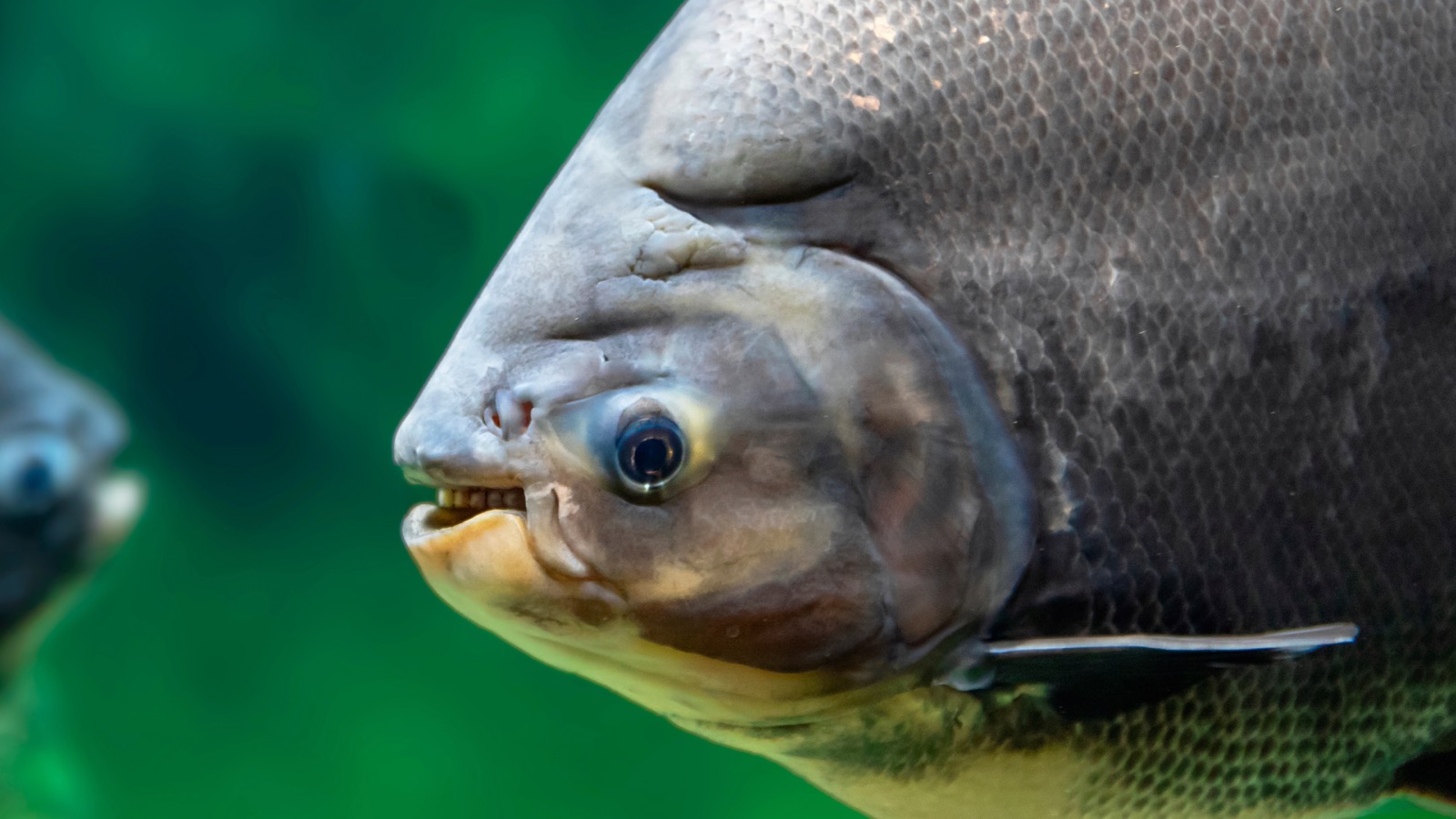
The plant- and fruit-eating side of Serrasalmidae. The pacus — Colossoma (tambaqui), Piaractus and Mylossoma — are the SIZE TRAP at its worst: sold at 5 cm, Colossoma reaches ~1 m and 30 kg, with human-like molar teeth for crushing seeds. They are pond and food-fish, never a living-room fish, and must NEVER be released — feral pacus turn up worldwide. The silver dollars — Metynnis, Myloplus, Myleus and kin — are peaceful, disc-shaped schoolers that need groups and open water, but they are committed PLANT-SHREDDERS that strip a planted tank bare. Mostly egg-scatterers; the big pacus are farm-bred.
- Acnodon normani
- Acnodon oligacanthus
- Acnodon senai · Sena's pacu
- Colossoma macropomum · Tambaqui
- Metynnis altidorsalis · Silver dollar
- Metynnis argenteus · Silver dollar
- Metynnis cuiaba
- Metynnis fasciatus · Striped silver dollar
- Metynnis guaporensis · Guaporé silver dollar
- Metynnis hypsauchen · Silver dollar
- Metynnis lippincottianus · Silver dollar
- Metynnis longipinnis · Silver dollar
- Metynnis luna · Moon dollar
- Metynnis maculatus · Spotted metynnis
- Metynnis melanogrammus · Silver dollar
- Metynnis mola · Silver dollar
- Metynnis orinocensis · Orinoco silver dollar
- Metynnis otuquensis · Silver dollar
- Metynnis polystictus
- Metynnis snethlageae · Silver dollar
- Mylesinus paraschomburgkii
- Mylesinus paucisquamatus
- Mylesinus schomburgkii · Schomburgk's silver dollar
- Myleus altipinnis · Silver dollar
- Myleus knerii · Kner's silver dollar
- Myleus micans · Pacu azul
- Myleus pachyodus
- Myleus pacu · Silver dollar
- Myleus setiger · Sailfin Red Hook Silver Dollar
- Myloplus arnoldi · Arnold's pacu
- Myloplus asterias · Redgill pacu
- Myloplus levis · Moon pacu
- Myloplus lobatus · Silver dollar
- Myloplus lucienae
- Myloplus nigrolineatus
- Myloplus planquettei
- Myloplus rubripinnis · Red hook silver dollar
- Myloplus schomburgkii · Disk tetra
- Myloplus taphorni
- Myloplus tiete · Tiete silver dollar
- Myloplus torquatus · Orangefin pacu
- Myloplus tumukumak
- Myloplus zorroi
- Mylossoma acanthogaster · Silver mylossoma
- Mylossoma aureum · Silver dollar
- Mylossoma duriventre · Silver mylossoma
- Ossubtus xinguense · Parrot pacu
- Paramyloplus ternetzi · Neon green silver dollar
- Piaractus brachypomus · Pirapitinga
- Piaractus mesopotamicus · Pacu
- Piaractus orinoquensis · Venezuelan pacu
- Prosomyleus rhomboidalis · Silver dollar
- Tometes ancylorhynchus
- Tometes camunani
- Tometes kranponhah
- Tometes lebaili
- Tometes makue
- Tometes siderocarajensis · Red and black sailfin pacu
- Tometes trilobatus
- Utiaritichthys esguiceroi
- Utiaritichthys longidorsalis · Green pacu
- Utiaritichthys sennaebragai
Headstanders · 174
Families Anostomidae and Chilodontidae — the headstanders, named for the oblique, head-down posture they hold while grazing algae and picking at the substrate. The striped Anostomus and Leporinus are handsome but often nippy and territorial; many Leporinus grow large and turn aggressive with age, and several are notorious FIN-NIPPERS. The spotted headstander (Chilodus) is a gentler, smaller nano-grazer. Mostly herbivorous grazers that also relish soft plants; egg-scatterers rarely bred in aquaria. Keep the nippy ones in numbers or not at all.
- Abramites eques · Headstander
- Abramites hypselonotus · Marbled headstander
- Anostomoides atrianalis · Spotted headstander
- Anostomoides passionis
- Anostomus anostomus · Striped headstander
- Anostomus brevior
- Anostomus longus
- Anostomus ternetzi · Ternetz's headstander
- Anostomus ucayalensis
- Arhinolemur garmani · Timburé
- Arhinolemur obtusidens · Boga
- Caenotropus labyrinthicus · Headstander
- Caenotropus maculosus · Spotted headstander
- Caenotropus mestomorgmatos
- Caenotropus schizodon
- Chilodus fritillus · Spotted headstander
- Chilodus gracilis · Petite headstander
- Chilodus punctatus · Spotted headstander
- Chilodus zunevei
- Gnathodolus bidens
- Hypomasticus despaxi · Striped headstander
- Hypomasticus lineomaculatus
- Hypomasticus megalepis · Jewel spotted anostomid
- Hypomasticus mormyrops
- Hypomasticus santanai
- Hypomasticus thayeri · Piau-beiçudo
- Insperanos nattereri
- Laemolyta fasciata · Banded headstander
- Laemolyta fernandezi
- Laemolyta garmani · Garman's headstander
- Laemolyta orinocensis · Black Banded Headstander
- Laemolyta proxima
- Laemolyta taeniata · Banded headstander
- Leporellus cartledgei
- Leporellus pictus
- Leporellus vittatus · Yellow rabbit characin
- Leporinus acutidens · Black-banded leporinus
- Leporinus affinis · Boga
- Leporinus agassizii
- Leporinus alternus
- Leporinus altipinnis
- Leporinus amae · Parrot leporinus
- Leporinus amazonicus
- Leporinus amblyrhynchus · Black-banded leporinus
- Leporinus apollo · Apollo leporinus
- Leporinus arcus · Lipstick leporinus
- Leporinus arimaspi
- Leporinus aripuanaensis
- Leporinus badueli
- Leporinus bahiensis
- Leporinus bimaculatus
- Leporinus bistriatus · Black-banded leporinus
- Leporinus bleheri · Bleher's headstander
- Leporinus boehlkei
- Leporinus brinco
- Leporinus britskii
- Leporinus brunneus
- Leporinus conirostris
- Leporinus copelandii
- Leporinus cylindriformis
- Leporinus desmotes
- Leporinus ecuadorensis · Ecuador leporinus
- Leporinus elongatus · Black-banded leporinus
- Leporinus enyae
- Leporinus falcipinnis
- Leporinus fasciatus · Banded leporinus
- Leporinus friderici · Threespot leporinus
- Leporinus geminis
- Leporinus gomesi
- Leporinus gossei
- Leporinus granti · Strawberry Leporinus
- Leporinus guttatus
- Leporinus holostictus
- Leporinus jamesi
- Leporinus jatuncochi
- Leporinus julii · Xingu headstander
- Leporinus klausewitzi · Clown headstander
- Leporinus lacustris
- Leporinus lebaili
- Leporinus leschenaulti · Leschenault's headstander
- Leporinus macrocephalus · Piauçu
- Leporinus maculatus · Spotted headstander
- Leporinus marcgravii · Marcgrave's headstander
- Leporinus maxakali
- Leporinus melanopleura · Spottail leporinus
- Leporinus melanopleurodes
- Leporinus melanostictus · Black-banded leporinus
- Leporinus microphthalmus
- Leporinus microphysus
- Leporinus moralesi
- Leporinus multifasciatus · Multibar headstander
- Leporinus multimaculatus
- Leporinus muyscorum · Liseta
- Leporinus nattereri
- Leporinus niceforoi
- Leporinus nigrotaeniatus
- Leporinus nijsseni · Spotted Leporinus
- Leporinus octofasciatus · Eight-banded leporinus
- Leporinus octomaculatus · Eight-spotted leporinus
- Leporinus ortomaculatus
- Leporinus pachycheilus
- Leporinus pachyurus
- Leporinus parae
- Leporinus paralternus
- Leporinus paranensis · Piau
- Leporinus parvulus
- Leporinus pearsoni
- Leporinus pellegrinii · Pellegrin's headstander
- Leporinus piau · Piau
- Leporinus piavussu · Piavuçu
- Leporinus pitingai
- Leporinus platycephalus
- Leporinus punctatus
- Leporinus reinhardti
- Leporinus reticulatus · Netted leporinus
- Leporinus santosi
- Leporinus sexstriatus
- Leporinus sidlauskasi
- Leporinus spilopleura · Threespot leporinus
- Leporinus steindachneri
- Leporinus steyermarki · Steyermark's toothpick leporinus
- Leporinus striatus · Striped headstander
- Leporinus subniger · Black-banded leporinus
- Leporinus taeniatus · Banded leporinus
- Leporinus taeniofasciatus
- Leporinus tepui
- Leporinus tigrinus · Tiger headstander
- Leporinus torrenticola
- Leporinus trifasciatus · Three-banded leporinus
- Leporinus trimaculatus · Three-spot headstander
- Leporinus tristriatus
- Leporinus uatumaensis
- Leporinus unitaeniatus
- Leporinus vanzoi
- Leporinus venerei
- Leporinus villasboasorum
- Leporinus wolfei · Wolf's headstander
- Leporinus y-ophorus · Y-striped leporinus
- Megaleporinus gaiero · Piau-gaiero
- Petulanos intermedius
- Petulanos plicatus · Plicatus Headstander
- Petulanos spiloclistron · Toothed headstander
- Pseudanos gracilis · Slender headstander
- Pseudanos irinae
- Pseudanos trimaculatus · Threespot headstander
- Pseudanos varii · Redfin headstander
- Pseudanos winterbottomi
- Rhytiodus argenteofuscus · Silver headstander
- Rhytiodus elongatus
- Rhytiodus lauzannei
- Rhytiodus microlepis · Silver headstander
- Sartor elongatus
- Sartor respectus
- Sartor tucuruiensis
- Schizodon altoparanae
- Schizodon australis
- Schizodon borellii · Borelli's headstander
- Schizodon corti
- Schizodon dissimilis
- Schizodon fasciatus · Banded headstander
- Schizodon intermedius
- Schizodon isognathus
- Schizodon jacuiensis
- Schizodon knerii
- Schizodon nasutus
- Schizodon paucisquamis
- Schizodon platae
- Schizodon rostratus
- Schizodon scotorhabdotus
- Schizodon succinctus
- Schizodon trivittatus
- Schizodon vittatus · Banded headstander
- Synaptolaemus cingulatus · Bristlenose headstander
- Synaptolaemus latofasciatus · Red-banded headstander
Wolf fish & trahiras · 25
Family Erythrinidae — the wolf fish and trahiras (Hoplias, Hoplerythrinus, Erythrinus), plus the recently described swampfish Tarumania. Solitary, cylindrical, air-breathing AMBUSH PREDATORS armed with heavy conical teeth. Hoplias are large, powerful and genuinely aggressive — single-specimen fish that kill anything they can catch and can inflict a serious bite; the giant H. aimara exceeds a metre. The smaller Erythrinus and Hoplerythrinus ('red wolf fish') are more manageable but no less predatory. They gulp atmospheric air and endure deoxygenated pools. A specialist's predator, never a community fish.
- Erythrinus cephalus
- Erythrinus erythrinus · Red wolf fish
- Erythrinus guavina
- Erythrinus kessleri · Kessler's trahira
- Erythrinus palustris
- Erythrinus trahira · Trahira
- Hoplerythrinus cinereus
- Hoplerythrinus gronovii · Gronovius's wolf fish
- Hoplerythrinus unitaeniatus · Striped trahira
- Hoplias aimara · Aimara
- Hoplias argentinensis
- Hoplias auri
- Hoplias australis
- Hoplias brasiliensis · Trahira
- Hoplias curupira · Black wolf fish
- Hoplias intermedius · Intermedius wolf fish
- Hoplias lacerdae · Giant trahira
- Hoplias malabaricus · Trahira
- Hoplias mbigua
- Hoplias microcephalus · Trahira
- Hoplias microlepis · Small-scaled trahira
- Hoplias misionera
- Hoplias patana
- Hoplias teres · Trahira
- Tarumania walkerae
Predatory characins · 41
The open-water hunters — the payara or vampire fish (Cynodontidae, Hydrolycus) with a pair of dagger-like lower fangs; the freshwater 'barracuda' (Acestrorhynchidae, Acestrorhynchus); and the pike characins (Ctenoluciidae, Boulengerella, Ctenolucius). Fast, streamlined, fragile-skinned pursuit predators of large rivers. Most are UNSUITABLE for home tanks: they need length to swim, panic and split their snouts against the glass, and eat fish tankmates. The payara reaches a metre and is a public-aquarium fish. Beautiful, demanding, rarely bred in captivity.
- Acestrorhynchus abbreviatus
- Acestrorhynchus altus · Red-tail barracuda
- Acestrorhynchus britskii
- Acestrorhynchus falcatus · Freshwater barracuda
- Acestrorhynchus falcirostris · Freshwater barracuda
- Acestrorhynchus grandoculis
- Acestrorhynchus heterolepis
- Acestrorhynchus isalineae · Striped barracuda tetra
- Acestrorhynchus lacustris
- Acestrorhynchus maculipinna
- Acestrorhynchus microlepis · Pike characin
- Acestrorhynchus minimus
- Acestrorhynchus nasutus · Dwarf redtail barracuda
- Acestrorhynchus pantaneiro · Pantanal pike characin
- Boulengerella cuvieri · Bicuda
- Boulengerella lateristriga · Striped pike characin
- Boulengerella lucius · Golden pike-characin
- Boulengerella maculata · Spotted pike characin
- Boulengerella xyrekes
- Ctenolucius beani · Beani's pike characin
- Ctenolucius hujeta · Hujeta gar
- Cynodon gibbus · Snub-nosed payara
- Cynodon meionactis · Adjeni
- Cynodon septenarius
- Gilbertolus alatus
- Gilbertolus atratoensis
- Gilbertolus maracaiboensis
- Gnathocharax steindachneri · Bite tetra
- Heterocharax leptogrammus
- Heterocharax macrolepis · Sardinita dientudo
- Heterocharax virgulatus · Blue flash glass tetra
- Hoplocharax goethei
- Hydrolycus armatus · Payara
- Hydrolycus scomberoides · Payara
- Hydrolycus tatauaia · Cachorra
- Hydrolycus wallacei · Payara
- Lonchogenys ilisha
- Rhaphiodon vulpinus · Trahira do rio
- Roestes itupiranga
- Roestes molossus
- Roestes ogilviei · Ogilvie's pike characin
Hemiodus & minor characins · 288
A broad catch-all of mid-water and bottom characins the hobby meets less often. The hemiodus (Hemiodontidae) are fast, silver, shoaling dashers. The flannelmouth characins (Prochilodontidae — Prochilodus, Semaprochilodus) are large detritus-grazing migrators and major food fish. The toothless curimatas (Curimatidae) and scrapetooth Parodon (Parodontidae) are quiet substrate grazers. Bryconidae holds the powerful Brycon and the golden dorado (Salminus), a prized game fish; Triportheidae the keeled hatchet-tetras (Triportheus). Sizes and temperaments vary widely; most are egg-scattering shoalers and several grow large.
- Agoniates anchovia · Anchovy characin
- Agoniates halecinus
- Anodus elongatus · Charuto
- Anodus orinocensis
- Apareiodon affinis · Darter characin
- Apareiodon agmatos
- Apareiodon argenteus
- Apareiodon cavalcante
- Apareiodon davisi
- Apareiodon gransabana
- Apareiodon hasemani
- Apareiodon ibitiensis
- Apareiodon itapicuruensis
- Apareiodon machrisi · Brazilian algae eater
- Apareiodon orinocensis
- Apareiodon piracicabae · Piracicaba characin
- Apareiodon tigrinus
- Apareiodon vittatus · Pearlscale characin
- Apareiodon vladii
- Argonectes longiceps · Jatuarana
- Argonectes robertsi
- Bivibranchia bimaculata
- Bivibranchia fowleri
- Bivibranchia notata
- Bivibranchia simulata
- Bivibranchia velox
- Brycon alburnus · Dama
- Brycon amazonicus · Matrinxã
- Brycon argenteus
- Brycon atrocaudatus
- Brycon behreae
- Brycon bicolor
- Brycon chagrensis · Chagres bryconid
- Brycon coquenani
- Brycon costaricensis
- Brycon coxeyi
- Brycon dentex
- Brycon devillei · Piabanha
- Brycon dulcis · Piabanha
- Brycon falcatus
- Brycon ferox · Piabanha
- Brycon fowleri
- Brycon gouldingi
- Brycon guatemalensis · Machaca
- Brycon henni · Sabaleta
- Brycon hilarii · Piraputanga
- Brycon howesi
- Brycon insignis · Tiete tetra
- Brycon labiatus
- Brycon medemi
- Brycon meeki
- Brycon melanopterus · Black-finned bryconid
- Brycon moorei · Golden Brycon
- Brycon nattereri · Pirapitinga
- Brycon obscurus
- Brycon oligolepis
- Brycon opalinus · Pirapitinga do Sul
- Brycon orbignyanus · Piracanjuba
- Brycon orthotaenia · Matrinxã
- Brycon pesu · Mourning tetra
- Brycon petrosus
- Brycon polylepis
- Brycon posadae
- Brycon rubricauda · Redtail brycon
- Brycon sinuensis · Dorada
- Brycon stolzmanni
- Brycon striatulus
- Brycon unicolor
- Brycon vermelha
- Brycon vonoi · Piabanha-do-pardo
- Brycon whitei · Palambra
- Chalceus epakros · Pinktail chalceus
- Chalceus erythrurus · Tucan fish
- Chalceus fasciatus · Banded pinktail characin
- Chalceus flavicolis
- Chalceus guaporensis
- Chalceus labrosus · Blacktail brycon
- Chalceus latus
- Chalceus macrolepidotus · Pink-tailed chalceus
- Chalceus spilogyros · Pinktail chalceus
- Chalceus taeniatus
- Chilobrycon deuterodon
- Clupeacharax anchoveoides · Anchovy characin
- Curimata acutirostris
- Curimata aspera · Boquiche
- Curimata cerasina
- Curimata cisandina
- Curimata cyprinoides
- Curimata incompta
- Curimata inornata
- Curimata knerii
- Curimata macrops
- Curimata mivartii · Vizcaína
- Curimata ocellata
- Curimata roseni
- Curimata vittata
- Curimatella alburnus · Llambina
- Curimatella dorsalis
- Curimatella immaculata
- Curimatella lepidura · Manjuba
- Curimatella meyeri
- Curimatopsis crypticus
- Curimatopsis evelynae
- Curimatopsis guaporensis
- Curimatopsis jaci
- Curimatopsis macrolepis · Shinyscaled curimata
- Curimatopsis maculosa
- Curimatopsis melanura
- Curimatopsis microlepis
- Curimatopsis myersi
- Curimatopsis pallida
- Curimatopsis sabana
- Cyphocharax abramoides
- Cyphocharax albula
- Cyphocharax aninha
- Cyphocharax aspilos
- Cyphocharax biocellatus
- Cyphocharax boiadeiro
- Cyphocharax caboclo
- Cyphocharax cramptoni
- Cyphocharax derhami · Chio chio
- Cyphocharax festivus
- Cyphocharax gangamon
- Cyphocharax gilbert
- Cyphocharax gillii
- Cyphocharax gouldingi
- Cyphocharax helleri
- Cyphocharax jagunco
- Cyphocharax laticlavius
- Cyphocharax leucostictus
- Cyphocharax lundi
- Cyphocharax magdalenae
- Cyphocharax meniscaprorus
- Cyphocharax mestomyllon
- Cyphocharax microcephalus · Dwarf curimata
- Cyphocharax modestus
- Cyphocharax multilineatus · Golden mascara tetra
- Cyphocharax muyrakytan
- Cyphocharax naegelii
- Cyphocharax nigripinnis
- Cyphocharax notatus
- Cyphocharax oenas
- Cyphocharax pantostictos
- Cyphocharax pinnilepis
- Cyphocharax platanus
- Cyphocharax plumbeus
- Cyphocharax punctatus
- Cyphocharax saladensis · Rosy curimata
- Cyphocharax sanctigabrielis
- Cyphocharax santacatarinae
- Cyphocharax signatus
- Cyphocharax spilotus
- Cyphocharax spiluropsis
- Cyphocharax spilurus
- Cyphocharax stilbolepis
- Cyphocharax vanderi · Saguiru
- Cyphocharax vexillapinnus
- Cyphocharax voga · Biru
- Engraulisoma taeniatum
- Hemiodus amazonum
- Hemiodus argenteus
- Hemiodus atranalis
- Hemiodus bimaculatus
- Hemiodus goeldii
- Hemiodus gracilis
- Hemiodus huraulti
- Hemiodus immaculatus · Immaculate hemiodus
- Hemiodus iratapuru
- Hemiodus jatuarana
- Hemiodus langeanii
- Hemiodus microlepis · Blackfin halftooth
- Hemiodus orthonops
- Hemiodus parnaguae
- Hemiodus quadrimaculatus · Barred hemiodus
- Hemiodus semitaeniatus · Halfline hemiodus
- Hemiodus sterni
- Hemiodus ternetzi · Ternetz's hemiodus
- Hemiodus thayeria
- Hemiodus tocantinensis
- Hemiodus tucupi
- Hemiodus unimaculatus · One-spot hemiodus
- Hemiodus vorderwinkleri
- Henochilus wheatlandii
- Ichthyoelephas humeralis · Bocachico
- Ichthyoelephas longirostris · Freshwater dolphin fish
- Lignobrycon myersi
- Micromischodus sugillatus
- Parodon alfonsoi
- Parodon apolinari
- Parodon atratoensis
- Parodon bifasciatus
- Parodon buckleyi
- Parodon caliensis
- Parodon carrikeri
- Parodon guyanensis
- Parodon hilarii
- Parodon magdalenensis
- Parodon moreirai
- Parodon nasus · Foxnose characin
- Parodon pongoensis · Peru scraper tetra
- Parodon suborbitalis
- Potamorhina altamazonica · Llambina
- Potamorhina laticeps
- Potamorhina latior
- Potamorhina pristigaster
- Potamorhina squamoralevis
- Prochilodus argenteus · Flagtail prochilodus
- Prochilodus binotatus
- Prochilodus brevis · Brazilian bocachico
- Prochilodus britskii
- Prochilodus costatus · Redfin prochilodus
- Prochilodus dobulinus
- Prochilodus harttii
- Prochilodus lacustris
- Prochilodus lineatus · Streaked prochilod
- Prochilodus magdalenae · Bocachico
- Prochilodus mariae · Flagtail prochilodus
- Prochilodus nigricans · Black prochilodus
- Prochilodus reticulatus · Netted prochilod
- Prochilodus rubrotaeniatus
- Prochilodus vimboides · Vimboides
- Psectrogaster amazonica
- Psectrogaster ciliata
- Psectrogaster curviventris
- Psectrogaster essequibensis
- Psectrogaster falcata
- Psectrogaster rhomboides
- Psectrogaster rutiloides · Chiochio
- Psectrogaster saguiru
- Pseudocurimata boehlkei · Dica
- Pseudocurimata boulengeri
- Pseudocurimata lineopunctata
- Pseudocurimata patiae
- Pseudocurimata peruana
- Pseudocurimata troschelii · Boquiche
- Saccodon dariensis
- Saccodon terminalis
- Saccodon wagneri
- Salminus affinis · Dorado
- Salminus brasiliensis · Dorado
- Salminus franciscanus · Golden dorado
- Salminus hilarii · Dorado
- Semaprochilodus brama · Jaraqui
- Semaprochilodus insignis · Flagtail prochilodus
- Semaprochilodus kneri · Yellow flagtail prochilodus
- Semaprochilodus laticeps · Silver flag prochilodus
- Semaprochilodus taeniurus · Flagtail prochilodus
- Semaprochilodus varii
- Steindachnerina amazonica
- Steindachnerina argentea · Stout sardine
- Steindachnerina atratoensis
- Steindachnerina bimaculata · Boquiche
- Steindachnerina binotata
- Steindachnerina biornata
- Steindachnerina brevipinna
- Steindachnerina conspersa
- Steindachnerina corumbae
- Steindachnerina dobula
- Steindachnerina elegans
- Steindachnerina fasciata
- Steindachnerina gracilis
- Steindachnerina guentheri
- Steindachnerina hypostoma
- Steindachnerina insculpta · Papa-terra
- Steindachnerina leuciscus
- Steindachnerina notograptos
- Steindachnerina notonota
- Steindachnerina planiventris
- Steindachnerina pupula
- Steindachnerina quasimodoi
- Steindachnerina seriata
- Steindachnerina varii
- Triportheus albus · Sardine
- Triportheus angulatus · Dusky narrow hatchetfish
- Triportheus auritus · Long sardine
- Triportheus brachipomus
- Triportheus culter
- Triportheus curtus
- Triportheus guentheri · Keeled hatchetfish
- Triportheus magdalenae
- Triportheus nematurus
- Triportheus orinocensis
- Triportheus pantanensis
- Triportheus pictus · Silver tetra-slash
- Triportheus rotundatus · Catalina tetra
- Triportheus signatus
- Triportheus trifurcatus
- Triportheus venezuelensis
African characins · 122
The African branch — families Distichodontidae, Citharinidae and Hepsetidae. Distichodus runs from the peaceful nano Neolebias and Nannaethiops to the big, boisterous D. sexfasciatus and D. lusosso, which grow large and shred plants. The odd Phago and Ichthyborus are FIN-EATERS that rasp scales and fins from other fish. The deep-bodied citharinids (Citharinus) are grazers and important food fish. Hepsetus, the African pike-characin, is a lurking ambush predator with sharp teeth. A mixed group — read each account, because size and aggression swing hard between genera.
- Belonophago hutsebouti
- Belonophago tinanti
- Citharidium ansorgii
- Citharinops distichodoides
- Citharinus citharus · Moon fish
- Citharinus congicus · Congo citharinid
- Citharinus eburneensis
- Citharinus gibbosus · Lake Tanganyika citharine
- Citharinus latus · African moon fish
- Citharinus macrolepis
- Congocharax olbrechtsi
- Distichodus affinis · Silver distichodus
- Distichodus altus
- Distichodus antonii
- Distichodus atroventralis
- Distichodus brevipinnis · Short-finned distichodus
- Distichodus decemmaculatus · Dwarf distichodus
- Distichodus engycephalus · Grass-eater
- Distichodus fasciatus · Six-banded distichodus
- Distichodus fasciolatus · Sharktail distichodus
- Distichodus hypostomatus
- Distichodus ingae
- Distichodus kasaiensis
- Distichodus kolleri
- Distichodus langi
- Distichodus lusosso · Longsnout distichodus
- Distichodus maculatus · Spotted citharinid
- Distichodus mbiniensis
- Distichodus microps
- Distichodus mossambicus · Mozambique distichodus
- Distichodus nefasch · Nefasch distichodus
- Distichodus noboli · Noboli distichodus
- Distichodus notospilus · Longsnout distichodus
- Distichodus petersii · Peters' distichodus
- Distichodus polli
- Distichodus rostratus · Grass-eater
- Distichodus rufigiensis
- Distichodus schenga
- Distichodus sexfasciatus · Six-banded distichodus
- Distichodus teugelsi · Green dwarf distichodus
- Dundocharax bidentatus
- Eugnathichthys eetveldii
- Eugnathichthys macroterolepis
- Eugnathichthys virgatus
- Hepsetus cuvieri · Kafue pike characin
- Hepsetus kingsleyae · African pike characin
- Hepsetus lineatus · African pike characin
- Hepsetus microlepis · African pike characin
- Hepsetus occidentalis · African pike characin
- Hepsetus odoe · African pike characin
- Ichthyborus besse
- Ichthyborus monodi
- Ichthyborus ornatus · Ornate fin nipper
- Ichthyborus quadrilineatus · Four-lined ichthyborus
- Mesoborus crocodilus · Crocodile tetra
- Microstomatichthyoborus bashforddeani
- Microstomatichthyoborus katangae
- Monostichodus elongatus
- Monostichodus lootensi
- Monostichodus mesmaekersi
- Nannaethiops bleheri
- Nannaethiops unitaeniatus · One-striped African characin
- Nannocharax altus
- Nannocharax angolensis
- Nannocharax ansorgii
- Nannocharax brevis
- Nannocharax dageti
- Nannocharax elongatus
- Nannocharax fasciatus · Barred nannocharax
- Nannocharax fasciolaris
- Nannocharax gracilis · Slender African characin
- Nannocharax hadros
- Nannocharax hastatus
- Nannocharax hollyi
- Nannocharax intermedius
- Nannocharax latifasciatus
- Nannocharax lineomaculatus
- Nannocharax lineostriatus
- Nannocharax luapulae
- Nannocharax machadoi
- Nannocharax macropterus · Broad-barred citharine
- Nannocharax maculicauda
- Nannocharax micros
- Nannocharax minutus
- Nannocharax monardi
- Nannocharax multifasciatus
- Nannocharax niloticus
- Nannocharax occidentalis
- Nannocharax ocellicauda
- Nannocharax ogoensis
- Nannocharax parvus · African broad-band darter
- Nannocharax procatopus
- Nannocharax pteron
- Nannocharax reidi
- Nannocharax rubensteini
- Nannocharax rubrolabiatus
- Nannocharax schoutedeni
- Nannocharax signifer
- Nannocharax taenia
- Nannocharax uniocellatus
- Nannocharax usongo
- Nannocharax wittei
- Nannocharax zebra
- Neolebias ansorgii · Ansorge's neolebias
- Neolebias axelrodi
- Neolebias gossei
- Neolebias gracilis
- Neolebias kerguennae
- Neolebias lozii
- Neolebias philippei
- Neolebias powelli · Domino tetra
- Neolebias spilotaenia
- Neolebias trewavasae · African emperor tetra
- Neolebias trilineatus · Three-lined pygmy characin
- Neolebias unifasciatus · One-banded Neolebias
- Paradistichodus dimidiatus
- Paraphago rostratus
- Phago boulengeri · Spotted phago
- Phago intermedius
- Phago loricatus · Fin-eater
- Xenocharax crassus
- Xenocharax spilurus
South American darters · 117
Family Crenuchidae — the South American darter tetras and sailfin characins. Small, often nano, bottom-perching fish that dart and rest like a true darter. The sailfin characins (Crenuchus spilurus, Poecilocharax) are prized blackwater nano-fish with fine finnage and a gentle, if shy, temperament — best in a species or quiet tank; Characidium are widespread stream-bed darters. Micro-predators on tiny invertebrates that often ignore flake — soft, acidic water and live or frozen foods suit them. Some are substrate egg-layers with brief male care.
- Ammocryptocharax elegans · Elegant sand darter
- Ammocryptocharax lateralis · Darter characin
- Ammocryptocharax minutus
- Ammocryptocharax vintonae
- Characidium alipioi · Flatfin darter
- Characidium amaila
- Characidium bahiense
- Characidium barbosai
- Characidium bimaculatum · Two-spot darter characin
- Characidium boavistae · Darter characin
- Characidium boehlkei · Darter characin
- Characidium bolivianum
- Characidium borellii · Darter characin
- Characidium brevirostre
- Characidium cacah
- Characidium caucanum · Cauca darter
- Characidium chancoense
- Characidium chicoi
- Characidium chupa
- Characidium clistenesi
- Characidium crandellii
- Characidium cricarense
- Characidium declivirostre
- Characidium deludens
- Characidium dule
- Characidium duplicatum
- Characidium etheostoma
- Characidium etzeli
- Characidium fasciatum · Darter characin
- Characidium gomesi · Gomes's darter
- Characidium grajahuensis
- Characidium hasemani · Hasemani's darter
- Characidium heinianum
- Characidium heirmostigmata
- Characidium helmeri
- Characidium iaquira
- Characidium interruptum
- Characidium japuhybense · Darter tetra
- Characidium kalunga
- Characidium kamakan
- Characidium krenak
- Characidium lagosantense
- Characidium lanei · Lane's darter tetra
- Characidium laterale · Piquira
- Characidium lauroi · Lauro's darter tetra
- Characidium litorale
- Characidium longum
- Characidium macrolepidotum · Darter tetra
- Characidium marshi
- Characidium mirim
- Characidium nambiquara · Darter characin
- Characidium nana
- Characidium noelkempffi
- Characidium nupelia
- Characidium occidentale
- Characidium oiticicai
- Characidium onca
- Characidium orientale
- Characidium papachibe
- Characidium pellucidum · Crystal clear tetra
- Characidium phoxocephalum
- Characidium pteroides
- Characidium pterostictum · Darter characin
- Characidium pumarinri
- Characidium purpuratum
- Characidium rachovii · Rachow's darter tetra
- Characidium roesseli
- Characidium samurai
- Characidium sanctjohanni
- Characidium satoi
- Characidium schindleri
- Characidium schubarti · Schubart's darter
- Characidium serrano
- Characidium steindachneri · Steindachner's darter tetra
- Characidium stigmosum
- Characidium summus
- Characidium tapuia
- Characidium tatama
- Characidium tenue · Darter tetra
- Characidium timbuiense
- Characidium travassosi
- Characidium urucum · Mocinha-vermelha
- Characidium vestigipinne
- Characidium vidali
- Characidium wangyapoik
- Characidium xanthopterum
- Characidium xavante
- Characidium zebra · Zebra darter
- Crenuchus spilurus · Sailfin characin
- Elachocharax geryi
- Elachocharax junki
- Elachocharax mitopterus
- Elachocharax pulcher · Black pygmy darter characin
- Geryichthys sterbai
- Klausewitzia ritae
- Leptocharacidium omospilus
- Melanocharacidium auroradiatum
- Melanocharacidium blennioides
- Melanocharacidium compressus
- Melanocharacidium depressum · Darter characin
- Melanocharacidium dispilomma
- Melanocharacidium melanopteron
- Melanocharacidium nigrum
- Melanocharacidium pectorale
- Melanocharacidium rex
- Microcharacidium bombioides
- Microcharacidium eleotrioides
- Microcharacidium geryi
- Microcharacidium gnomus
- Microcharacidium weitzmani
- Odontocharacidium aphanes · Green dwarf tetra
- Odontocharacidium varii
- Poecilocharax bovalii
- Poecilocharax callipterus
- Poecilocharax rhizophilus
- Poecilocharax weitzmani · Blackline tetra
- Skiotocharax meizon
What’s new
All updates →- Name change28 Piranhas & Pacus names updated to current Catalog of Fishes validity2026-09-04
- UpdatedAnostomoides atrianalis2026-09-04
- UpdatedCharacidium noelkempffi2026-09-03
- UpdatedCharacidium urucum2026-09-03
- UpdatedLeporinus maxakali2026-09-03