Taxonomy & naming
Baryancistrus xanthellus was formally described in 2011 by Rapp Py-Daniel, Zuanon, and Ribeiro de Oliveira in Neotropical Ichthyology (volume 9, number 2, pages 241–252), based on specimens from the Rio Xingu near the Cachoeira Buraco do Inferno (3°27'07"S, 51°41'53"W), Senador José Porfirio, Pará, Brazil. The description united several aquarium codes — L018, L085, L177, and LDA060 — that had been applied to the same species or closely related forms from different sections of the Xingu drainage.
Prior to formal description, the fish had been in the hobby trade for more than two decades under its L-number codes, a common situation for Xingu loricariids where scientific taxonomy lagged years behind the ornamental trade. The Catalog of Fishes (Eschmeyer, CAS) recognises Baryancistrus xanthellus Rapp Py-Daniel, Zuanon & Ribeiro de Oliveira, 2011 as a valid species with no currently listed synonyms.
Within Loricariidae, Baryancistrus is placed in the tribe Ancistrini of subfamily Hypostominae. It is classified close to Parancistrus and Hemiancistrus and within the broader Panaque clade of Ancistrini (Armbruster, 2008; Seriously Fish notes citing Armbruster, 2004). The genus Baryancistrus is distinguished from all other loricariids by possession of an enlarged membrane located posteriorly to the last branched dorsal-fin ray, a character that separates it from close relatives including Oligancistrus, Parancistrus, and Hemiancistrus. The name Baryancistrus means 'heavy Ancistrus' (Greek barys = heavy, agkistron = hook).
Morphology
Adults reach a maximum standard length of approximately 8.5–9.5 in, with the largest specimen examined in the official description measuring 9 in SL. The body is robust, dorsoventrally flattened as is typical of benthic loricariids, and covered in interlocking bony scutes. The head is broad with a large, disc-like sucking mouth positioned ventrally, and the pectoral fins are well-developed, aiding the fish in maintaining position against strong current.
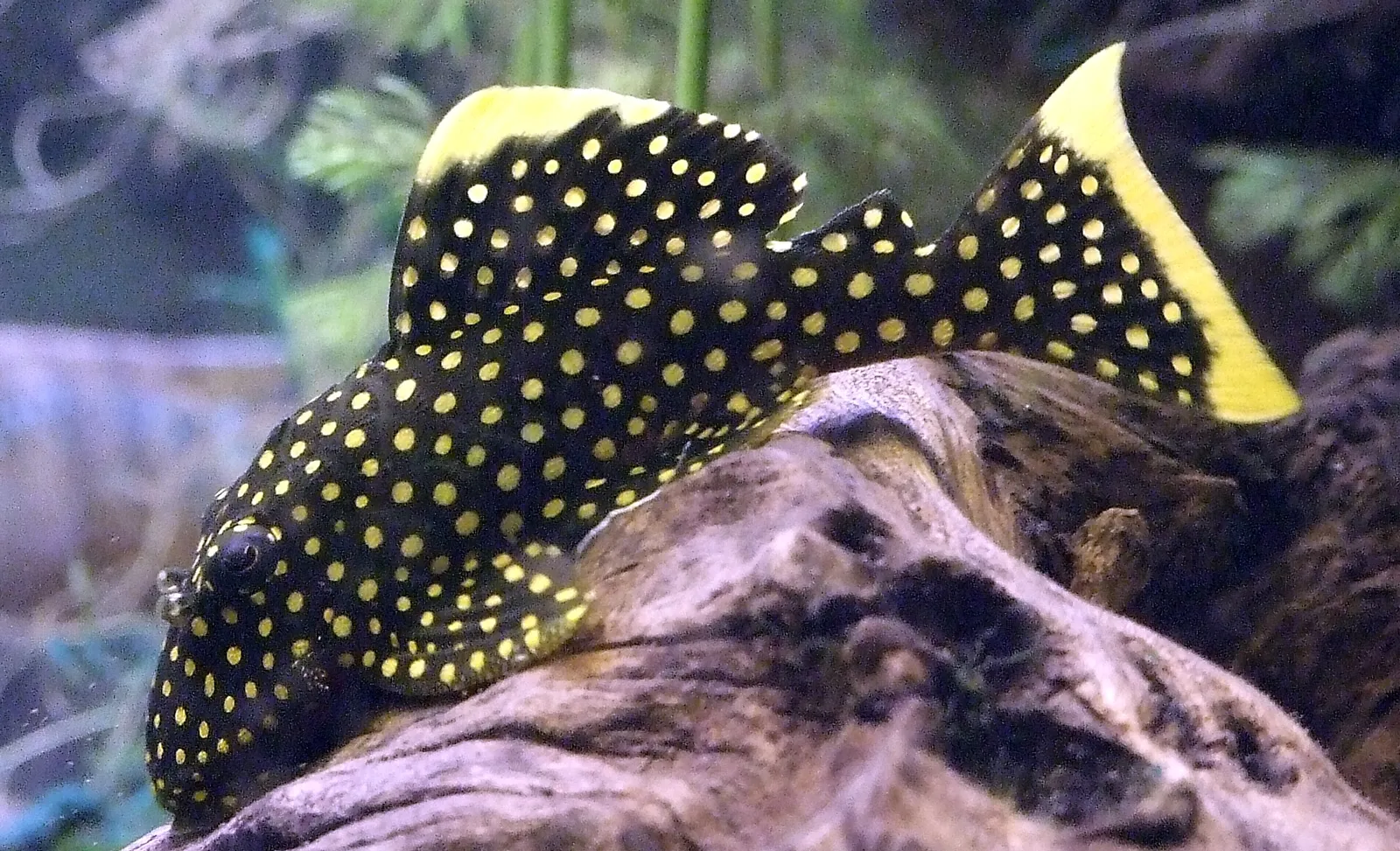
The diagnostic coloration is unmistakable: a black to dark grey base overlaid with a dense covering of rounded pale yellow to bright gold spots across the entire body and head. Juveniles additionally show a broad pale yellow to white band along the distal margin of the dorsal and caudal fins — this band is one of the characters used to diagnose the species in the description paper (Rapp Py-Daniel et al., 2011) — though it reduces to a smaller marking at the fin tips in adults. The 'naked' (unplated) abdomen is another diagnostic character.
Several forms circulate in the trade under different L-numbers: L018 and L085 are the principal Volta Grande do Xingu forms, with spot size and spacing varying between collection points; L177 is from the Iriri tributary. In practice visual differences between these forms are subtle and all are now referred to B. xanthellus. Adult males develop a broader, slightly flatter head profile and longer pectoral-fin spines than females.
Habitat
Baryancistrus xanthellus is endemic to Brazil and specifically to the Rio Xingu drainage. The primary population (L018, L085) inhabits the stretch known as 'Volta Grande do Rio Xingu' between Belo Monte falls and the mouth of the Rio Iriri, in Pará state. The L177 population has been recorded along the mid-to-lower course of the Iriri, a major Xingu tributary (Seriously Fish species profile).
Habitat is among the most demanding encountered by any commonly traded pleco: predominantly whitewater rapids with fast current, high dissolved oxygen, and water temperatures persistently warm (81–90 °F). Juvenile fish congregate under flat rocks at the bottom of shallow stretches; adults are found under and among submerged rocks and boulders at greater depth. Associated species from the same habitat include Baryancistrus aff. niveatus, multiple Ancistrus and Scobinancistrus species, Oligancistrus punctatissimus, Parancistrus nudiventris, Pseudancistrus sp., and various Hypostomus.
The Xingu rapids are among the most biodiverse loricariid habitats on Earth, and much of that biodiversity is directly tied to the hydraulic complexity and high DO levels of the rapids system. The construction of the Belo Monte hydroelectric dam has significantly altered the hydrology of Volta Grande do Xingu — the exact stretch where B. xanthellus is most abundant — raising major conservation concerns.
Feeding
Gut content analyses of wild B. xanthellus reveal a diet dominated by aufwuchs — the biofilm complex of attached algae (particularly diatoms and filamentous genera such as Spirogyra), bacteria, microinvertebrates, and organic particles that colonises submerged rocky surfaces in sunlit fast-flowing water. Invertebrates including chironomid midge larvae and bryozoans were found in smaller quantities (Seriously Fish, citing the description paper).
Baryancistrus xanthellus is therefore an aufwuchs grazer and scraper, not a wood-eater, and its feeding mode is quite different from the Panaque/Panaqolus xylophage clade. The fish uses its disc mouth to rasp hard surfaces, scraping algal films from rock faces and boulder surfaces. The mucous-covered rasped particles and associated microfauna constitute the primary nutritional input.
In the aquarium, bright lighting is recommended to promote algal growth on all non-viewing surfaces. The diet should be supplemented with high-quality sinking wafers with vegetable content, fresh fruit and vegetable slices, occasional defrosted bloodworm or prawn, and home-made gel foods containing a diverse mixture of ingredients. Post-importation specimens are often undernourished and may require frequent small meals during an extended quarantine. Baryancistrus spp. are particularly prone to post-import decline if nutritional needs are not addressed promptly.
Mating
In nature, spawning in B. xanthellus presumably coincides with changes in water conditions associated with the Xingu's seasonal hydrology — rising waters, possible temperature fluctuations, and shifts in flow rate. In captivity, adult males are known to become highly territorial and aggressive toward conspecific males as they age, defending favoured cave sites and sections of the bottom substrate. Females tend to be less aggressive.
Triggers for courtship and spawning in aquaria are poorly understood, but higher water flow, very high dissolved oxygen, pristine water quality, and a diet of varied high-quality foods are consistently reported as preconditions for any reproductive activity. Very large aquaria with substantial water movement and well-established colonies of algae appear to be necessary for any chance of breeding success.
Breeding
Breeding of Baryancistrus xanthellus in aquaria is extremely rare. PlanetCatfish records only two breeding reports for this species, and the possibly conspecific L081 has been bred on a single occasion. The rarity of captive breeding reflects the species' exacting environmental demands: very large tank dimensions, strong water flow, very high dissolved oxygen, temperatures of 81–90 °F, and pristine water chemistry are all required.
The fish is presumed to be a cave spawner in the loricariid manner, but the specifics of spawning, clutch size, incubation time, and fry care are essentially undocumented in reliable hobbyist records. Breeding attempts are generally confined to specialist Xingu catfish keepers operating large, species-specific systems with dedicated flow equipment.
For the vast majority of aquarists, the realistic aim is maintaining a healthy, long-lived adult — which can be rewarding in itself given the fish's striking appearance and engaging personality — rather than attempting to achieve captive reproduction.
In the aquarium
Baryancistrus xanthellus is a 'specialist' fish in the truest sense: not difficult to maintain if its specific requirements are met, but genuinely unsuitable for a general community aquarium. Seriously Fish recommends a minimum base dimension of 120 × 17.5 in for a single adult — that is roughly a 200-litre tank — reflecting an adult standard length of up to 9.5 in plus the current and oxygen demands of the species.
Current and oxygenation are the critical physical parameters. The fish originates in Xingu rapids; stagnant or low-flow aquaria cause it chronic respiratory stress. A combination of canister filters, powerheads, and surface agitation to maintain dissolved oxygen near saturation is essential. Weekly water changes of 40–70% are strongly recommended, both to maintain water quality and to replicate the constant water renewal of a river environment.
Temperature should be held at 81–90 °F — this species will not thrive in cooler water. pH 6.0–8.0 is a broad tolerance, but the Xingu at the collection sites is typically slightly acidic to neutral, moderately hard whitewater. Any accumulation of organic waste should be addressed immediately; this species is highly intolerant of poor water quality.
Aquascape with variably-sized rocks, gravel, and large boulders to replicate the rocky rapids habitat. Driftwood branches can be added, and tough attached plants (Microsorum, Bolbitis, Anubias on wood) are suitable. Bright lighting promotes algal growth on rocks, which the fish will actively graze.
Adult males are highly territorial toward conspecifics and sometimes aggressive toward similar-sized catfish. Mid-water characids or schooling fish that do not compete for bottom territory are good tankmates. Keep only one male unless the aquarium is very large with multiple visually separated territories.
Conservation
Baryancistrus xanthellus is assessed as Near Threatened on the IUCN Red List (assessed 2018), reflecting a genuinely restricted range — endemic to one river system, the Rio Xingu — and ongoing threats to its habitat. The Belo Monte hydroelectric complex in Pará, Brazil, has substantially altered the hydrology of Volta Grande do Xingu, the core range of the L018 and L085 populations. Diversion of water flow through the dam has reduced discharge through the rapids section, increased water temperatures, lowered dissolved oxygen, and altered sediment dynamics in exactly the habitat this species depends upon.
High collection pressure for the ornamental trade adds additional pressure to wild populations. The gold nugget's premium commercial value has historically driven intensive harvest from Altamira-area dealers. Brazil introduced export restrictions for many Xingu loricariids (including B. xanthellus) via the negative list (Lista Negativa do IBAMA) in recent years, though enforcement has been inconsistent.
The species is not yet on CITES appendices. Given its restricted endemic range and documented habitat loss, the Near Threatened assessment may be conservative if post-Belo Monte population surveys confirm decline in the Volta Grande section. Hobbyists who keep this species support conservation most directly by maintaining wild-caught animals responsibly and investing in the extremely rare captive-breeding successes that could reduce future wild harvest.