Taxonomy & naming
Farlowella acus was originally described as Acestra acus by Rudolf Kner in 1853 in the Denkschriften der Kaiserlichen Akademie der Wissenschaften, Wien, volume 6, pages 93 [29], Plate 8 (figure 1), from material collected near Caracas, Venezuela. The genus name Farlowella was erected by Carl and Rosa Eigenmann in 1889 to replace Acestra Kner, 1853 (preoccupied), and the current valid combination Farlowella acus (Kner, 1853) is recognised by the Catalog of Fishes (Eschmeyer, CAS). FishBase lists the synonyms Acestra acus Kner, 1853; Loricaria scolopacina De Filippi, 1853; Farlowella scolopacina (De Filippi, 1853); and Farlowella colombiensis Retzer & Page, 1997, all synonymised in the authoritative revision by Retzer and Page (1997).
Retzer and Page's 1997 monograph in the Proceedings of the Academy of Natural Sciences, Philadelphia (147: 33–88) is the definitive systematic treatment of the genus, recognising over 25 species. Their redescription of F. acus restricted it to the Lake Valencia basin and the Río Torito (Tuy system) of northern Venezuela — a narrow distribution with an isolated, non-Orinoco character. Farlowella colombiensis, previously described as a separate species from Colombian material, was placed in synonymy with F. acus in that revision.
The core hobbyist identification problem is this: aquarium literature and trade sources through the late twentieth century applied the name 'Farlowella acus' loosely to any slender, rostrum-bearing twig catfish. Most of these fish are in fact Farlowella vittata Myers, 1942 (Orinoco basin) or other described congeners, not the true F. acus. The geographic range of F. acus (Valencia basin, coastal northern Venezuela) is essentially non-overlapping with the Orinoco drainages from which the vast majority of traded fish originate. Aquarists wishing to work with the true F. acus should request provenance information; fish labelled 'F. acus' without Venezuelan coastal origin should be treated as indeterminate Farlowella sp. and likely F. vittata.
Morphology
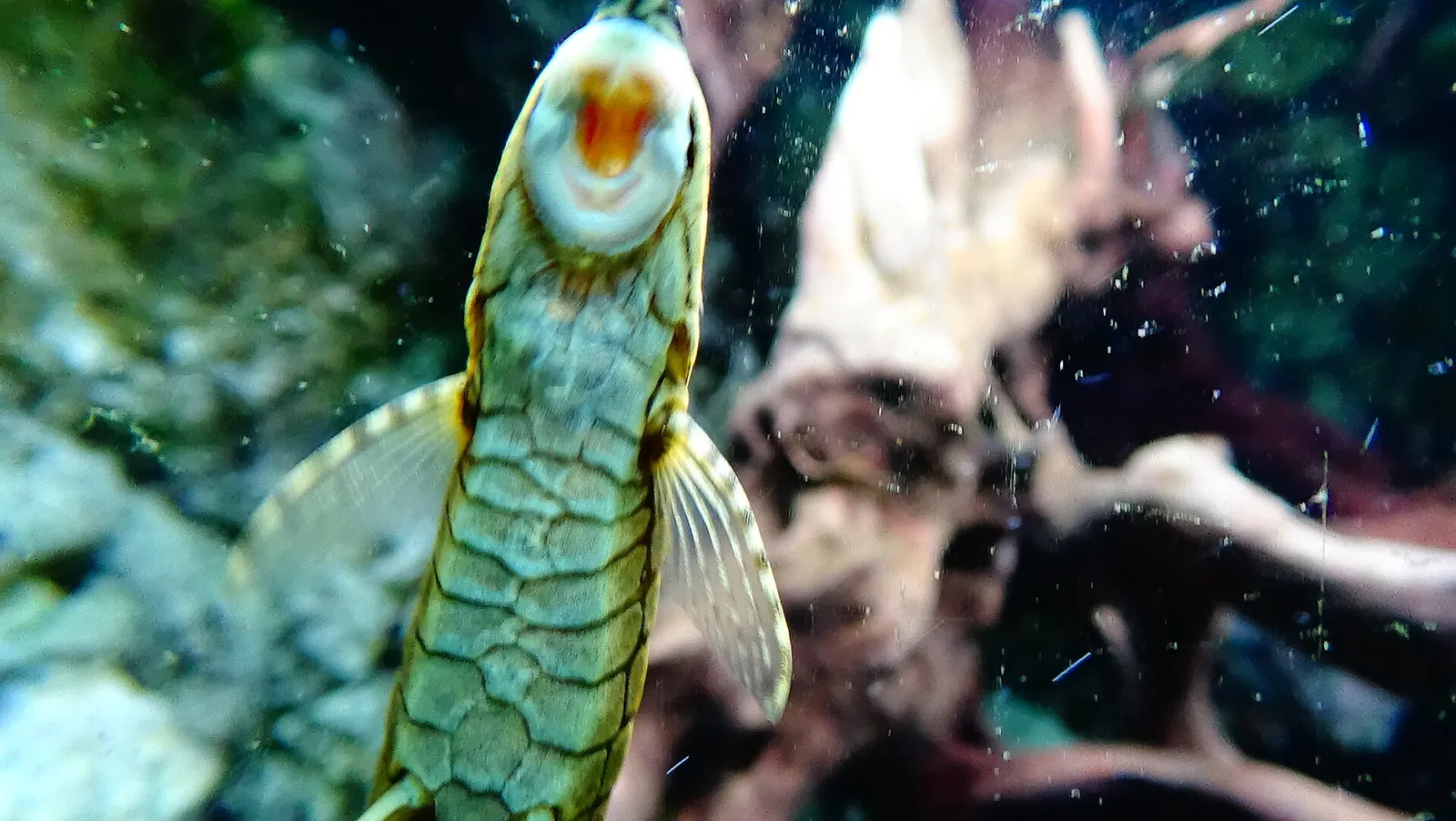
Farlowella acus shares the highly distinctive twig-like body plan of the genus: an extremely elongated, narrow, cylindrical profile with a pronounced rostrum projecting well beyond the mouth, a depressed caudal peduncle, and a fan-like, paired-fin arrangement that assists in pressing the fish flat against surfaces. Maximum standard length is 6.5 in (FishBase; PlanetCatfish gives 6.5 in SL), consistent with Retzer and Page's (1997) measurements, though aquarium specimens are commonly smaller.
Colouration follows the genus-wide pattern: the dorsal surface and flanks are medium brown, with two distinct lateral dark stripes running from the tip of the rostrum, through the eye, along the body length, and to the caudal fin. These twin stripes on a brown ground are the genus' visual signature. The ventral surface is pale cream or buff. No meaningful sexual colour dimorphism exists.
The most reliable morphological character separating F. acus from congeners is the ventral scute arrangement: the species has three rows of ventral scutes along the abdomen (a key diagnostic noted on the PlanetCatfish genus identification page). The rostrum length relative to body length, the snout breadth in males (broader and odontode-bearing) versus females (narrower and smooth), and the dorsal-to-anal fin position ratios are used in the Retzer & Page key to separate this species from syntopic congeners.
Sexual dimorphism is pronounced in adults: mature males develop rows of bristle-like odontodes along the rostrum (broadened snout), making sex determination straightforward. Females retain a narrow, smooth snout at all ages.
Habitat
The valid F. acus is restricted to a small number of drainages in northern Venezuela. FishBase records its distribution as Lake Valencia and the Torito River basins; Retzer and Page (1997) place it in the Valencia basin and the coastal Tuy drainage system. PlanetCatfish additionally lists Tuy, Middle Orinoco, and Meta as distribution areas — though some of these records may reflect the broader species-complex confusion rather than strictly the Retzer-and-Page concept of F. acus. The core natural range is inland coastal Venezuela, not the Orinoco main stem or its major tributaries.
Lake Valencia (Lago de Valencia) is a closed-basin lake with no outlet to the sea, sitting at approximately 1,312 ft elevation in Carabobo and Aragua States, Venezuela. Its tributary rivers and the surrounding stream systems form the core habitat of F. acus in the strict sense. The associated drainages are warm (73–79 °F per FishBase), slightly acidic to neutral (pH 6.0–7.0; PlanetCatfish gives 6.8–7.6), and soft to moderately soft (3–8°dGH per FishBase). The fish inhabits vegetated areas, submerged wood and root tangles in slow to moderately flowing water, associating closely with surfaces that carry biofilm.
PlanetCatfish field photography includes an image captioned 'Habitat: Rio Aragua, Venezuela' — a coastal stream in Aragua State, consistent with the Valencia/coastal drainage range. The species requires water high in dissolved oxygen (PlanetCatfish: 'Water should be clear and high in dissolved oxygen') and is associated with relatively undisturbed riparian environments.
Feeding
Farlowella acus is an aufwuchs and biofilm grazer, feeding continuously on the layer of diatoms, periphyton, soft algae, and micro-organisms that colonises submerged wood, plant leaves, root surfaces and rock. The mouth is elliptical and ventral, with fine bicuspid teeth adapted for delicate scraping of soft surface layers rather than for gouging hard substrate. FishBase notes the species feeds on 'plants and roots' in the aquarium, reflecting the range of surfaces it exploits.
In the aquarium the diet must replicate this continuous grazing lifestyle. A tank with substantial mature driftwood, smooth stones, and glass surface area that develops a healthy biofilm is essential — not merely helpful. Algae wafers (spirulina-rich, vegetable-based) should be provided daily; blanched vegetables (zucchini, cucumber, soft lettuce, spinach) are well accepted. Pre-soaked dried leaves (Indian almond leaf, oak leaf) provide surface biofilm and are excellent enrichment items.
Small invertebrate foods — frozen daphnia, occasionally bloodworm in small quantities — can be offered as supplements and are taken, but this is not primarily a carnivorous species. The dietary emphasis is on vegetable matter and biofilm. FishBase recommends keeping in groups of five or more individuals; while this reflects the species' social tolerance rather than dietary need, groups do tend to produce more active foraging behaviour and the fish appears more confident in numbers.
Mating
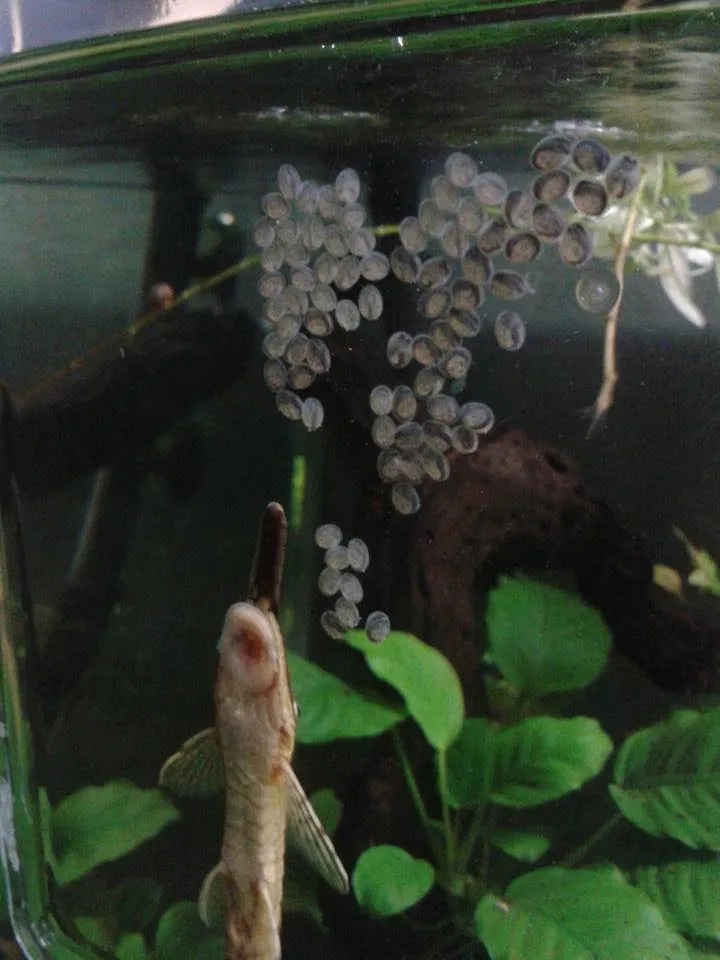
Breeding in Farlowella acus has been observed in captivity. FishBase records spawning at either dusk or dawn, consistent with the crepuscular spawning pattern noted across the genus. The mating system differs from cave-spawning Hypostominae plecos: Farlowella species deposit eggs on open vertical surfaces — typically aquarium glass, broad leaves of aquatic plants, or smooth flat rock — rather than inside caves or tubes.
Male courtship involves flanking the female and positioning alongside her; the male is distinguishable by his broad, odontode-bearing rostrum. Females are wider-bodied when conditioned and gravid. Pre-spawning conditioning on a varied vegetable-rich diet with frequent water changes and stable clean water is the most important husbandry factor; Farlowella species are more sensitive to water quality deterioration than most plecos, and a decline in condition following water quality stress is a common failure point in attempted breeding.
Spawning on plant leaves, as documented for the closely related F. vittata and other Farlowella species in aquarium accounts, appears to be the typical mode for the genus. Males of Farlowella are notably less territorial than cave-spawning loricariids; aggression between males is minimal in typical aquarium conditions.
Breeding
Farlowella acus breeds on open flat surfaces rather than in caves, with paternal brood care of the egg clutch. FishBase records that 'the male tends the clutch and helps freeing the fry from the eggs' — the male fans the egg mass with his caudal fin to oxygenate it and assists newly hatching fry in emerging from the egg capsule.
Fecundity data for F. acus specifically are scarce; FishBase mentions a fecundity of 40 eggs (from one study, ref. 120179). This is consistent with the cautious assessment of the species as having low resilience (minimum population doubling time 4.5–14 years at estimated fecundity of 40), suggesting modest reproductive output relative to species with large clutches. Eggs are deposited on the chosen vertical surface in a compact cluster and the male guards in position until hatching, which typically occurs in 5–10 days depending on temperature.
For practical breeding, the key requirements are: a well-matured tank with abundant biofilm, pristine water quality (the species is sensitive to nitrate accumulation), adequate height and surface area on glass or broad-leaved aquatic plants, and a conditioned, healthy pair. The species has been bred by hobbyists, but accounts specifically verified as the true F. acus (from the Valencia-basin range) are rare in the hobby literature, given the widespread misidentification problem. Most breeding accounts under the name 'Farlowella acus' likely describe F. vittata or other congeners.
In the aquarium
FishBase recommends a minimum aquarium size of 31.5 in (length) for F. acus, and keeping in groups of five or more. A tank of 25–30 US gal meets the minimum for a small group; 40–55 US gal is more appropriate for long-term maintenance of multiple fish, given the need for a well-established biofilm, adequate flow, and good water quality margins. Height and surface area matter more than base footprint for this glass-surface grazer.
The aquarium should have: a mature biofilm across all glass surfaces, driftwood (essential both as a grazing surface and for shelter), broad-leaved aquatic plants (java fern, Anubias attached to wood are ideal), and gentle to moderate current from a well-positioned filter outlet or small powerhead. Strong turbulent flow is not required and may stress the fish; gentle, well-oxygenated circulation is the aim. Excellent biological filtration and weekly water changes of 25–30% are essential — the species has low resilience to water quality decline.
Water parameters: temperature 73–79 °F, pH 6.8–7.6, soft to moderately soft water (preferably below 8°dGH). Avoid sustained elevated nitrate (keep below 15–20 ppm). The species is more cold-tolerant than some tropical plecos, and the lower end of the temperature range is appropriate for cooler seasons.
Compatibility: PlanetCatfish recommends smaller tetras or rasboras; hatchetfish are noted as especially suitable. Avoid fast or 'nippy' species (danios, barbs) and all large catfishes or cichlids. Corydoras are good companions. This is a shy, fragile species — not a robust community fish — and should be kept with slow, peaceful tankmates that will not harass it or outcompete it for biofilm surfaces.
Conservation
The IUCN Red List assessed Farlowella acus as Vulnerable (VU, B2ab(iii)) in November 2020. The criterion B2 (small geographic range by area of occupancy) with sub-criterion 'ab(iii)' (observed or inferred decline in the area, extent, or quality of habitat) reflects the restricted Valencia-basin and coastal Venezuelan distribution and the significant ongoing deterioration of that habitat.
Lake Valencia itself is one of the most environmentally degraded large lakes in South America. Decades of urban and agricultural expansion in Carabobo and Aragua States — among Venezuela's most densely populated regions — have produced severe eutrophication, sedimentation, introduction of exotic species, and water-quality degradation in the lake and its feeder streams. The lake's closed basin means that pollutants accumulate without dilution by flowing water. The coastal Tuy and Aragua stream systems that connect to the broader drainage have been similarly degraded by urban expansion around Caracas and Valencia.
These habitat pressures justify the Vulnerable assessment even in the absence of direct population counts. Captive management of the true F. acus in hobbyist collections has conservation value, though the widespread misidentification of Farlowella species means that verifying provenance of 'F. acus' stock is essential before claiming to maintain the conservation-relevant lineage. Exports from Venezuela have been restricted, and few if any fish reliably identified as true F. acus appear regularly in the trade.