Taxonomy & naming
Parancistrus aurantiacus was originally described by the French naturalist Francis de Laporte de Castelnau in 1855 as Hypostomus aurantiacus, based on specimens collected from the Amazon basin during his South American expedition. In 1862, Pieter Bleeker erected the genus Parancistrus and transferred the species to it, so the authority is correctly cited in parentheses — (Castelnau, 1855) — indicating that the species was described in a different genus from its current placement.
The Catalog of Fishes (Eschmeyer, CAS) lists Parancistrus aurantiacus (Castelnau, 1855) as a valid species. Parancistrus is now a monotypic genus: earlier species assigned to it — P. niveatus and P. punctatissimus — have been reassigned by revisionary work (Mees, 1974; subsequent authors) to the new genera Baryancistrus and Oligancistrus, leaving P. aurantiacus as the sole remaining member. Several synonyms exist from Castelnau's original work (Hypostomus nigricans Castelnau, 1855; Hypostomus vicinus Castelnau, 1855) and are treated as junior synonyms of P. aurantiacus.
The species was formally redescribed by Burgess (1989), who redefined the genus boundaries. The L-number L056 was assigned by Das Aquarium magazine (Germany) in the 1990s based on trade specimens from the Xingu, and is concordant with P. aurantiacus. Occasional references to 'L056Y' or 'yellow L056' reflect the colour-morph trade designation rather than a taxonomically distinct entity.
Parancistrus is placed in tribe Ancistrini, subfamily Hypostominae, family Loricariidae (order Siluriformes).
Morphology
Parancistrus aurantiacus is a robustly built, somewhat dorso-ventrally flattened loricariid. FishBase records a maximum standard length of 7.5 in SL; hobbyist and trade sources commonly cite adults reaching 8–8.5 in and occasionally larger in total length. The body is notably broad and heavy — the 'chubby' trade name is apt — with a wide, flat head and a particularly large, powerful sucker-disc mouth. Large, conspicuous gill openings are consistent with the species' high oxygen demands. The body is completely covered in large bony scutes bearing prominent odontodes (spiny projections), which are especially conspicuous on the head and caudal peduncle region.
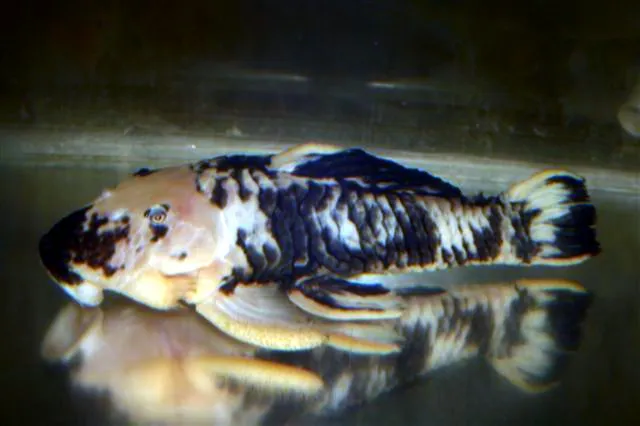
The species' most remarked-upon feature is its extraordinary capacity for colour change. The ground colour varies from near-black through dark slate-grey to pale grey-brown, and can transform to vivid golden-yellow or orange-yellow — or produce a calico patchwork of dark and yellow areas simultaneously. The fish can cycle through these states multiple times; unlike most loricariids that change colour only under stress (typically darkening), P. aurantiacus can display the yellow or calico pattern under apparently normal conditions. The physiological mechanism is not fully understood. Chromatophores (pigment cells) under hormonal and neurological control are the likely mediators, but the specific triggers — social cues, light intensity, temperature, health status — have not been definitively established.
Sexual dimorphism includes stouter odontodes on the pectoral-fin first ray and interopercular region in males; females are broader through the abdomen when gravid.
Habitat
Parancistrus aurantiacus is associated with fast-moving, well-oxygenated rocky sections of three major Amazonian drainage systems: the Rio Xingu (including the lower Rio Iriri, a major Xingu tributary, in Pará state, Brazil), the Rio Tocantins and its tributary the Rio Itacaiunas (eastern Brazil), and the Rio Ucayali in Peru. This distribution spans both the Brazilian shield and the Andean forelands, making P. aurantiacus one of the more broadly distributed loricariids in the region — though it is not ubiquitous within these systems.
Within these rivers, the species occupies shallow to moderate-depth reaches over rocky and boulder-strewn substrate with vigorous current. It shelters in crevices between rocks and under flat slabs during the day and forages at night. The Xingu and its tributaries are predominantly clear-water rivers draining ancient Precambrian crystalline basement, producing water that is warm, oxygen-saturated, and moderately acid to neutral. The Ucayali is a more turbid whitewater river but the species in that drainage is associated with clearer-water marginal habitats.
Typical water conditions in the species' Xingu range: temperature 77–86 °F (with 82–84 °F as an optimum widely cited by experienced keepers), pH 6.5–7.5, moderate hardness. The species requires high oxygen availability and does not tolerate stagnant or poorly aerated water.
Feeding
Parancistrus aurantiacus is an omnivorous bottom grazer with a preference for plant-derived material. The broad, strong sucking disc mouth and robust teeth are suited to rasping biofilm, periphyton, algae, and associated organic detritus from rocky surfaces. The large gill surface and powerful mouth musculature also suggest the capacity to process more resistant food items than many loricariids.
In the wild, the diet is primarily aufwuchs — the community of algae, diatoms, cyanobacteria, and microorganisms that coats submerged stone surfaces in flowing water — supplemented by detritus and plant material. Small invertebrates are taken opportunistically. The species is not a wood-feeder in the specialised Panaque sense.
In the aquarium, the dietary foundation should be high-quality sinking algae or spirulina wafers, supplemented generously with blanched vegetables: cucumber, courgette, sweet potato, spinach, and pumpkin are all accepted. Frozen bloodworm, brine shrimp, and high-quality sinking carnivore pellets can be offered occasionally as protein supplements. The species should not be kept on an exclusively algae diet or an exclusively carnivorous diet; variety is key to long-term health. Driftwood in the aquarium provides a grazing surface and may contribute to gut microbiome health, though this species is not a cellulose digester.
Mating
Parancistrus aurantiacus is believed to follow the standard cave-spawning pattern of Ancistrini: the male establishes and defends a territory centred on a spawning cavity, females visit to deposit eggs, and the male assumes sole responsibility for the clutch after the female departs. This is inferred from the species' tribal membership and from the basic pattern of captive observations, rather than from systematic field study.
Detailed mating behaviour has not been published for this species in the ichthyological literature, reflecting both its rarity in captivity and the practical difficulties of observing nocturnal loricariid behaviour. Males in aquarium groups develop more conspicuous odontodes on pectoral rays and interopercular region, consistent with intra-sexual competition for cave sites. The colour-changing ability of the species raises the intriguing possibility that colour state plays a role in mate assessment or status signalling, but this has not been investigated.
Captive breeders report that providing multiple substantial cave structures — flat slate bridged formations, large PVC tubes, or ceramic pleco caves — reduces male-male conflict and encourages territory establishment, which is a prerequisite for spawning.
Breeding
Captive breeding of Parancistrus aurantiacus is exceptionally rare in the hobby. The species grows large, requires a substantial aquarium, and its reproductive triggers appear to be poorly understood in captivity. Most aquarist reports describe the fish as 'not bred in captivity' or offer only isolated and poorly documented claims of success.
A breeding account is reported by the Biotope Aquarium Project, and isolated successes have been reported in European specialist circles. When spawning has been achieved, it involves egg deposition inside a cave or crevice, with the male brooding the clutch. Incubation period is presumed to be similar to related species — 5–7 days at 79–82 °F — and newly hatched larvae carry a yolk sac before becoming free-swimming a few days later.
The practical requirements inferred from related species and the few captive accounts: a large, stable aquarium of at least 65–80 US gal; excellent water quality with very low nitrate; temperature maintained at 81–84 °F; multiple cave structures allowing territory establishment; and conditioning of both sexes with varied, nutritious food over an extended period. The rarity of breeding success means that captive-bred specimens are almost never available in the trade, and the species in hobbyist hands is essentially wild-caught.
In the aquarium
Parancistrus aurantiacus is an intermediate to advanced aquarium species, principally due to its large adult size (8 in+ SL), substantial bioload, and high oxygen requirements. A minimum tank of 65–80 US gal with strong filtration is recommended for a single adult; groups require proportionally more space. Water temperature of 81–84 °F is most frequently cited by experienced keepers as optimal, though the species tolerates 77–86 °F; pH 6.5–7.5 and moderate hardness are appropriate.
Filtration must be powerful — a canister or sump rated for double or more the tank volume per hour — and surface agitation or spray bar output should maintain visible surface movement to ensure oxygen saturation. The species is sensitive to poor water quality; organic waste accumulation and high nitrate cause chronic stress that manifests as loss of colour vibrancy and increased disease susceptibility. Weekly water changes of 30–40 % are the practical minimum.
The aquascape should include large flat rocks, rounded boulders forming cave structures, and substantial pieces of driftwood for grazing and shelter. The fish is predominantly nocturnal and will spend most of the day in cover. Dimming the aquarium lights slightly or providing dense visual shelter often results in the fish being more active and visible during daylight hours.
The celebrated colour-changing ability is one of the principal attractions for hobbyists — the transformation from near-black to golden-yellow is visually dramatic and remains mysterious. In established aquarium specimens, the colour change is reported to occur less frequently than in recently wild-caught fish. Males may use colour as a status or stress signal; a fish that rarely displays the yellow phase but is otherwise healthy may simply be settled and calm.
Compatibility: P. aurantiacus is generally non-aggressive toward dissimilar fish but males can be territorial toward conspecifics and other cave-holding plecos. The species is safe with the vegetation of most community tanks.
Conservation
Parancistrus aurantiacus is assessed as Near Threatened (NT) by the IUCN Red List (assessed 22 October 2020, criterion A3c), reflecting projected future decline in habitat quality driven primarily by the construction and operation of large hydroelectric dams within its range. The Belo Monte hydroelectric complex on the Rio Xingu — where the species is associated with tributary rapids including the lower Rio Iriri — represents the most immediate large-scale threat. Belo Monte, completed in stages between 2011 and 2019, is one of the world's largest hydropower projects; it flooded substantial areas of Xingu rapids and altered the hydrology of the Volta Grande reach, the most biologically diverse section of the river.
The Rio Tocantins was fragmented by the Tucuruí dam decades earlier (completed 1984), which impounded the lower river and created a barrier for fish movement across a major part of the drainage. The cumulative effect of multiple dams on the Tocantins and its tributaries has fragmented loricariid populations throughout the system.
Ornamental fish collection also exerts pressure. P. aurantiacus is an attractive and distinctive species that commands a premium in the trade, and essentially all specimens in the hobby are wild-caught. Without a captive breeding supply, trade demand translates directly into collection from wild populations that are already under habitat pressure.
The species is not listed under CITES. Sustainable collection management, habitat protection for remaining free-flowing Xingu tributaries, and development of captive breeding techniques are the most important conservation levers currently available.