Taxonomy & naming
The German naturalists Johannes Müller and Franz Hermann Troschel described the threadfin acara in 1849 as Acara heckelii, working from material collected in the swamps of the Guyanese savannah. Their account was brief and, as the conventions of the day allowed, named no holotype and figured no specimen — the type locality alone anchors the name. In 1912 Carl H. Eigenmann judged the fish distinct enough for its own genus, Acarichthys, which has stayed monotypic ever since: heckelii is its only species. Eigenmann read it as allied to Retroculus but with only a feebly developed lobe on the first gill arch, a trait he saw as bridging Aequidens, which has no lobe, and Geophagus, which has a well-developed one. Two earlier names fall into synonymy — Geophagus thayeri Steindachner, 1875 and Acara subocularis Cope, 1878. Sven O. Kullander redescribed the genus in 1986 from Peruvian material and treated it again in his 2003 checklist. Placement within the eartheater subfamily Geophaginae remains unsettled: Kullander's 1998 morphological analysis grouped Acarichthys with Guianacara in a tribe Acarichthyini, and López-Fernández et al. (2005) recovered a weak Acarichthys–Guianacara sister relationship, but a mtDNA study by Chuctaya et al. (2022) instead allied Acarichthys with the Chaetobranchus–Chaetobranchopsis group near the base of the geophagine radiation. Thomas Weidner's monograph on the genus adds a useful piece of nomenclatural detail to how the brooding style of Acarichthys and its tribe-mate Guianacara should be described: because Guianacara species attach their adhesive (l-type) eggs to vertical surfaces and never to the roof of a cavity, he argues they are better termed concealed-spawning substrate-brooders than true cave-brooders, reserving the latter term for Acarichthys heckelii, whose p-type eggs are attached directly to the ceiling of its tunnel chamber — making heckelii, on this reading, the only genuine cave-brooder among the geophagine cichlids covered in the monograph.
Morphology
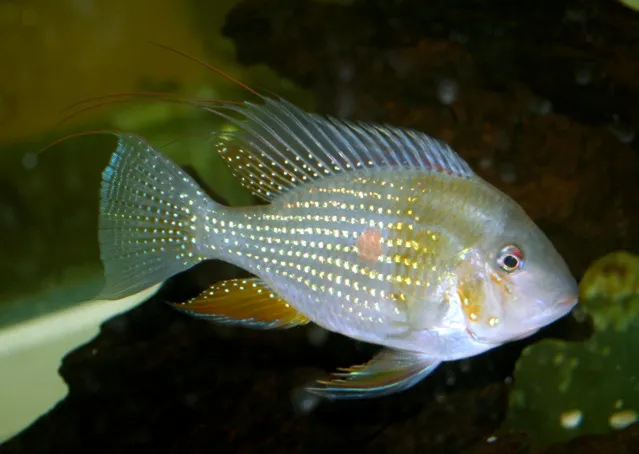
Acarichthys heckelii is a deep-bodied, laterally compressed cichlid with a steeply rising forehead. Reported maximum size varies with the source and with how length is measured — standard length (SL, snout to tail base) versus total length (TL). FishBase lists 7.5 in SL and about 8 in TL, but field workers record smaller wild fish: Cichocki (1976) gave roughly 4.5 in SL for Guyanese specimens and Kullander (2003) about 5.5 in SL, while well-kept aquarium fish can reach the upper figures or beyond. The body is a warm brassy-tan to olive, often lit with iridescent blue-green flecking and rows of pearlescent spots across the flanks and fins. Two markings are diagnostic: a single, nearly circular black blotch centred on each side, which never runs up into the dorsal fin, and dark bands or stripes across the cheek and gill cover. The common name is literal — in mature fish the first soft rays of the dorsal fin draw out into long thread-like filaments, and the leading anal-fin rays may lengthen too; Weidner adds that the outer rays of the caudal fin can carry similar thread-like extensions, a detail easily missed alongside the more conspicuous dorsal streamers. Diagnostic even in small juveniles, well before the filaments appear, are the deep black anterior dorsal spines — a character Acarichthys shares only with its tribe-mate Guianacara among the eartheaters. Wild populations are not uniform in head shape: importers in the late 1980s brought in a distinctly pointed-snouted form, but most fish reaching the trade today have a rounder head, since that pointed-headed population is centred in Guyana, from where relatively few exports now originate. Sexual dimorphism is modest: ripe females are noticeably deeper- and thicker-bodied, while males grow larger and carry the longest filaments. Juveniles add a twist of their own, wearing a cryptic mottled pattern plus a bright white-pink fluorescent patch on the dorsal fin; against their brassy flanks it makes a school look like a cluster of blinking lights in turbid water, a signal that fades to a vestige in adults.
Habitat
The species ranges through the lowlands of the Amazon basin and the neighbouring Essequibo drainage of the Guianas, an estimated area exceeding three million square kilometres. It runs along the mainstream Amazon from western Peru near Iquitos to the river mouth, in the lower Putumayo, Trombetas, Negro and Xingu rivers, the lower Tocantins and Capim, and throughout the Branco (Amazonas basin) into Guyana and the Essequibo; an introduced population is established in Singapore. Within that range it favours quieter lowland water — lakes, flooded forest (igapó), savanna ponds, swamps and marshes — pushing into seasonally inundated forest and grassland when the wet season arrives. Its chemical tolerance is broad: it is most typical of soft, acidic clear- and blackwater, but also turns up in whitewater and in moderately mineralized, near-neutral to alkaline conditions. In Guyana's Rupununi, Cichocki (1976) found it in permanent spring-fed ponds up to about 7 ft deep over silica-sand bottoms, in water that ran clear, soft and acidic — pH roughly 6 to 6.75, some populations to 7–8 — at about 82–87 °F. In the Rio Negro's blackwater igapó near Barcelos, Artigas Azas measured acidic, soft water around 81 °F, and Stawikowski & Werner reported habitats as soft as 20 µS/cm conductivity, pH from 4 to 7, and temperatures spanning 81–93 °F. By the basin's standards, these are warm-water fish. Cichocki's Rupununi fieldwork (1971–72) also fixed the scale of a breeding territory: a pair defending its tunnel and chamber holds a patch of bottom roughly 8 ft across, a useful benchmark for how much floor space a spawning pair needs even in the aquarium.
Feeding
Acarichthys heckelii sits low on the food web — FishBase puts its trophic level near 2.7 — as a benthic omnivore and detritivore. Lowe-McConnell (1969) examined the gut contents of preserved Guyanese specimens and found detritus and chironomid (midge) larvae, the staples of a fish that works the bottom for small invertebrates and organic matter. It does take mouthfuls of sediment, processing and expelling them through the gills and mouth in the winnowing style of its geophagine relatives, and it is a tireless digger. Even so, it is no substrate specialist like Satanoperca: observers describe a mid-water fish that feeds across the whole column rather than confining itself to the bottom. (An IUCN habitat note calling the species 'piscivorous' contradicts the dietary and trophic evidence and is best read as an error.) In its community it works as a generalist forager of the leaf-litter and soft-sediment zones of lowland Amazonian still waters.
Mating
Outside the breeding season the threadfin acara is a loosely social, largely peaceful fish, but reproduction reorganizes the population around female-held territories. From his snorkel observations in Grani Pond, Guyana, Cichocki reported juveniles and non-breeding adults holding the vegetated margins while breeding adults moved to a central area floored with compact black peat. There it is the females, not the males, that establish and defend the territories and do the digging. A ripe female courts passing males; once a pair forms, both fish jointly defend a comparatively large territory centred on her tunnel through a drawn-out courtship. Those pair bonds can be volatile. Adults are prone to sudden, severe bouts of intraspecific aggression, and in captivity a spawning attempt can end with one mate killing the other unless the tank is large and the fish are well matched. That mix of complex female-led territoriality and unpredictable violence is much of why the species is reputed to be hard to breed despite decades in the hobby.
Breeding
Acarichthys heckelii is a biparental cave or tunnel spawner, and its natural nest is unlike anything else in the family. In compact substrate the female digs a burrow that drops more or less vertically, then turns to run horizontally for some 5–21 in and ends in an enlarged breeding chamber; the system often carries extra entrances — some of them false — and blind side-chambers. The eggs, about 200 in the wild nest Cichocki counted, are laid on the walls of that deep chamber, where the female guards and fans them while the male patrols the territory above. Spawning sealed at the bottom of a tunnel shelters the brood from open-water egg predators. Once hatched, the free-swimming fry are guarded by both parents and bolt back into the burrow at any threat; the adults abandon them at roughly 0.5 in total length, though the young may go on using the burrow, and vacated tunnels are sometimes reoccupied by a new female. In the aquarium the full sequence is essentially impossible to reproduce, and success depends on offering a suitably enclosed cave with a restricted entrance so that at least one fish can be completely out of sight — breeders have used an old covered jar shaded with roots and rock (Baran, 1981), two flowerpots positioned mouth-to-mouth with a piece broken from the base of one (Lucas, 1996), or a length of clay drainage pipe. Triggers that have worked in captivity include large, frequent water changes and brief temperature swings — raising to the mid-30s °C for a few days, then dropping — on a rich live-food diet. During spawning the pair take turns entering the cave; the male typically fertilises the eggs directly inside it, though he may instead release milt at the entrance for the female to fan in with her own movements. Leibel's celebrated 1984 account records a flowerpot spawning of about 2,000 small whitish eggs attached to the chamber's ceiling and walls, matching figures from Cichocki (1976); at 81 °F the larvae hatch in roughly 60 hours and are free-swimming after about five days, after which they take newly hatched brine shrimp within a further three days. Even so, no more than about 250 fry have ever been raised to free-swimming from a single spawn under aquarium conditions — a striking gap against a clutch of 2,000 whose cause (low fertilisation, or simply an overestimate of the original egg count) has never been resolved. Parental care is comparatively brief — brood care has been recorded ending within 14 days at the outside — but once the eggs are safely past, the fry are not hard to grow on.
In the aquarium
Acarichthys heckelii has been kept, and now and then bred, for decades, but it is not a beginner's fish. The hazard is not water chemistry so much as the fish themselves.
Tank: The minimum workable footprint for a pair is about 150 × 19.5 in (roughly 100 US gallons), and a larger tank — 71 in or more — makes life much easier by giving each fish room to retreat; intraspecific aggression among breeding adults is the single most common reason keepers lose fish. The tank should be biologically mature before the fish go in, since threadfin acaras are sensitive to dissolved-waste build-up and prone to head-and-lateral-line erosion and stunted growth when maintenance lapses. Over-filter with an external canister or a sump and change 50–70 % of the water weekly, but keep flow gentle — these are fish of calm, warm floodplain waters — by aiming the returns to circulate without a current.
Substrate: This is non-negotiable. Use fine silica sand, deep enough for normal digging. Gravel gets rearranged relentlessly and can injure gill tissue if drawn in, and coarse material is simply unkind to a compulsive burrower.
Décor: Keep it sparse — scattered driftwood, a few roots, subdued lighting. The one furnishing that matters most for anyone hoping to breed the fish is at least one large upturned terracotta flowerpot, an entrance hole chipped into the rim, buried partway in the sand; it is the proven stand-in for the deep earthen tunnel a wild female would dig, and without it captive spawning attempts rarely go anywhere. Potted or pebble-edged background plants help break sightlines and cool tempers.
Water: Mirror the soft, warm Amazonian lowlands — 79–86 °F, with the upper end preferred, and pH 5.5–7.5 for maintenance, trending to pH 6.0–7.0 for long-term health and breeding. The species has been bred for several generations in harder, more neutral water and does not strictly need soft, acidic conditions to survive, but a lower pH (around 6.0–6.5) and very soft water are consistently reported to sharpen breeding readiness. Keep hardness modest; conductivity much above 200–300 µS/cm pushes the fish outside its comfort zone.
Diet: Easy. Threadfin acaras are opportunists that take most standard foods. A varied menu of live or frozen chironomid (bloodworm) larvae, daphnia, brine shrimp and small earthworms, backed by good sinking pellets or flake and the odd vegetable (blanched spinach, spirulina foods), brings the best colour and condition. Because this species feeds throughout the water column rather than sifting sand like Satanoperca, surface and mid-water foods are taken as readily as anything on the bottom.
Tankmates: Manageable with thought. Away from spawning, threadfin acaras are relatively peaceful and will not bother anything too large to swallow. Good company means medium-to-large, calm South Americans — other quiet geophagines such as Biotodoma and Satanoperca, larger tetras or headstanders, and similarly sized cichlids that are not fin-nippers, since the long dorsal filaments are an obvious target. Potamotrygon stingrays are sometimes housed with them but have proven unpredictable after dark. The real incompatibility is with each other: aggression between adults, above all rival females in breeding condition, can escalate to a kill with no warning. That said, reports of temperament vary more than the fish's fearsome reputation suggests — several published keeper accounts (Bader, 1973; Baran, 1981; Lucas, 1996; Morche, 1993; Schneider, 1987) describe their own Acarichthys heckelii as generally peaceful, which points to tankmates and tank layout, not just the fish itself, shaping how much aggression actually surfaces. A group in a large tank, where subordinate fish can slip away, works better than a pair, and two evenly matched fish in tight quarters is a recipe for loss — keep a divider ready when introducing unfamiliar fish. Sexual maturity also arrives late in this species (Cichocki, 1976), so patience is needed before a young group settles into breeding condition. One further husbandry note worth flagging: older specimens not infrequently develop growths on the head and around the mouth; the cause is undetermined and it is not known whether the condition can be treated, so any such growth is best monitored rather than assumed to be routine.
Conservation
The IUCN Red List assesses Acarichthys heckelii as Least Concern (assessed 28 October 2020 by R.G. Frederico, published 2023), citing a wide distribution across the Amazon and Essequibo basins, an apparently abundant and stable population, and occurrence within at least one protected area — the Pau Rosa National Forest in Amazonas, Brazil. It carries no CITES listing. The species is harvested for the ornamental trade in Brazil, but at a level the assessment does not flag as a population-level threat; the only specific concerns raised are local — predatory fishing and the removal of marginal aquatic vegetation. As a widespread habitat generalist it is far less exposed than the basin's many narrow-range endemics. The wider picture is less reassuring: work reviewed by Castello and colleagues documents how dam building, deforestation, gold-mining and its mercury contamination, overfishing and altered flood-pulse regimes are degrading Amazonian aquatic ecosystems, even as freshwater habitats stay comparatively neglected in regional conservation planning. None of this is recorded as a present danger to this particular cichlid, but it is the backdrop against which its long-term prospects should be read.