Taxonomy & naming
The three-striped dwarf cichlid was described in 1903 by the American ichthyologists Carl H. Eigenmann and Clarence Hamilton Kennedy in their account 'On a collection of fishes from Paraguay, with a synopsis of the American genera of cichlids' (Proceedings of the Academy of Natural Sciences of Philadelphia, vol. 55). They named it Biotodoma trifasciatus — not Heterogramma, as is sometimes stated; the Heterogramma trifasciatum combination belongs to Regan's 1906 cichlid revision and later usage. The type locality is the Arroyo Chagalalina in Paraguay, and the unique holotype is held at the California Academy of Sciences (CAS 36302, ex Indiana University 10065). The genus Apistogramma was erected later, by Regan in 1913, and the species was duly transferred into it; it now sits in the eartheater tribe Geophagini and anchors its own species group and lineage, the trifasciata group, which also contains relatives such as Apistogramma cacatuoides, Apistogramma atahualpa and Apistogramma nijsseni. Two later names fall into synonymy — Heterogramma trifasciatum maciliense Haseman, 1911 (type locality São Antonio de Guaporé, Brazil) and Apistogramma trifasciatum haraldschultzi Meinken, 1960. There is a real taxonomic wrinkle here that the hobby has wrestled with for decades: Sven Kullander's work restricts true Apistogramma trifasciata to the Rio Paraguay system, with a diagnostic spotted caudal fin, while the very similar Guaporé-Mamoré populations are referable to Apistogramma maciliense and to an undescribed form traded as Apistogramma sp. 'Mamoré'. In the trade the species carries the DATZ code A204, with the related Argentine and Guaporé forms coded A205 and A206.
Morphology
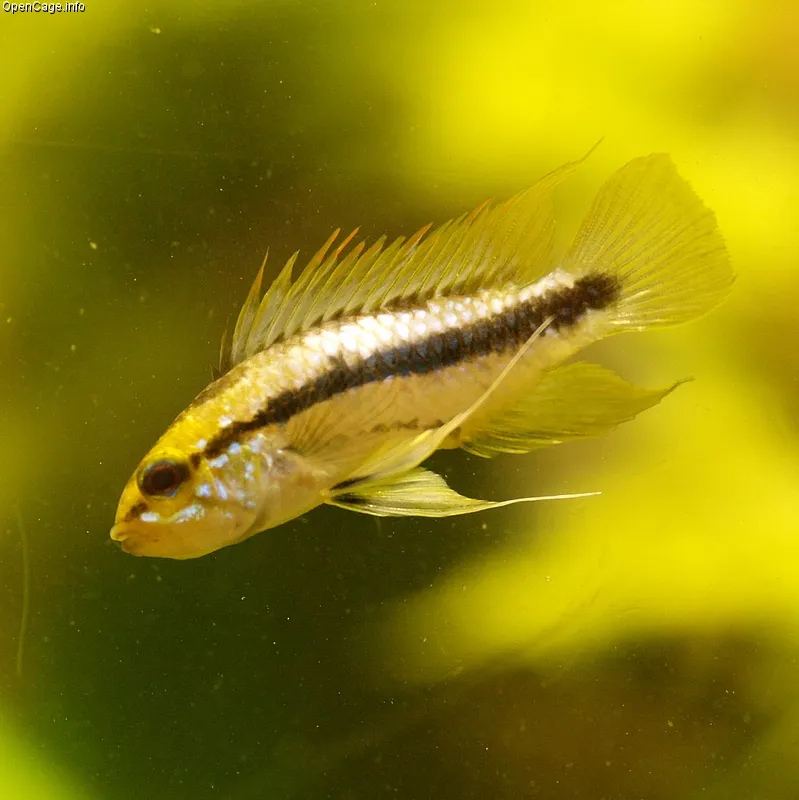
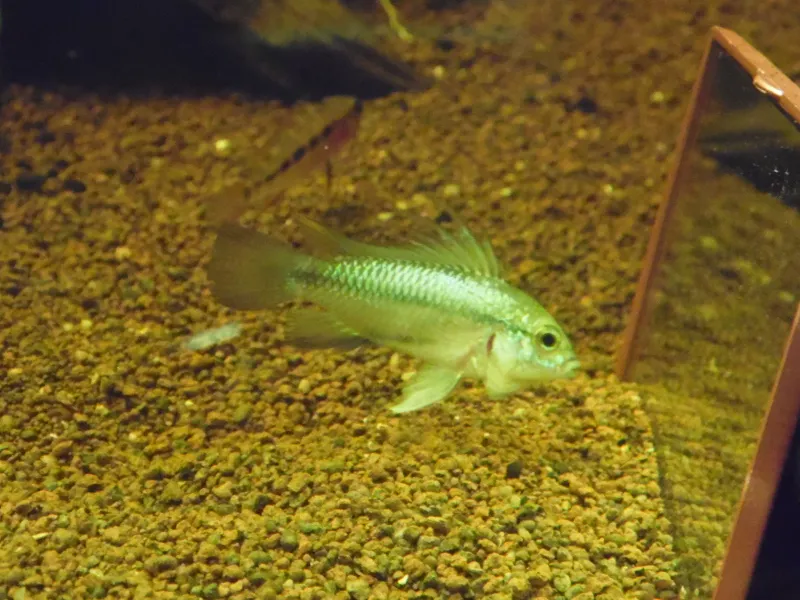
This is a genuinely small fish, and reports of its maximum size vary with how it is measured and whether wild or aquarium stock is meant. FishBase lists 1.5 in standard length for males and 2 in for females, while Seriously Fish gives a larger 2 in for males and about 1.5 in for females; either way, wild fish are often well under an inch and a half when they first spawn. The body is moderately elongate with a rounded caudal fin. A breeding male is the showpiece: the flanks glow steel-blue to emerald, the head turns yellow, the dorsal fin is partly washed in red, and the first four to six dorsal-fin membranes draw out into long, pointed lappets that are the species' signature. Following Römer's diagnosis, the pattern is the three-band scheme the name advertises — a stripe running along the base of the dorsal fin, a bold lateral band roughly one scale wide that runs from behind the eye onto the caudal base, and a third, oblique band slanting from the pectoral-fin base toward the front of the anal fin — plus a narrow dark bar across the cheek below the eye. There is no spot at the base of the caudal fin. Sexual dimorphism is pronounced: males are markedly larger, more colourful and longer-finned, while females are smaller, plainer, and turn an intense yellow with a blunt-tipped anal fin when in breeding condition. The hobby has long debated whether soft water or low pH is needed to grow out the male's long dorsal lappets; the experienced keeper Mike Wise has argued the filaments owe more to age, clean water and good feeding than to any particular chemistry.
Habitat
Apistogramma trifasciata has an unusually wide range for a dwarf cichlid on the traditional, broad species concept, spanning two great drainage systems that have no present-day connection. Ad Konings singles this species out in Enjoying Cichlids as a notable exception to the general rule that South America's river basins act as fairly clean-cut boundaries between cichlid populations, precisely because trifasciata sensu lato turns up in two permanently separated major basins. On that broad concept it occurs in the Rio Guaporé and Rio Beni of the upper Amazon basin (Brazil and Bolivia) and southward through the connected Rio Paraguay watershed (Brazil and Paraguay) and on into the middle Paraná basin in Argentina — an estimated extent of occurrence near two million square kilometres. This sits in tension with the narrower, Kullander-defined species concept discussed in Taxonomy & naming, which restricts true A. trifasciata to the Rio Paraguay system and reassigns the Guaporé–Mamoré populations to A. maciliense and an undescribed form; the sources are not reconciled here, and the wide two-basin range should be read as reflecting the older, broader usage rather than a settled modern distribution for the strict species. Across that span it is a fish of the quieter margins: sluggish creeks, side channels, vegetated backwaters, oxbow pools and the calm bends of larger rivers, very often where leaf litter and fine sand collect and visibility is low. The water is typically clear (less often whitewater), warm and soft. Field and biotope data from the Pantanal and upper Paraguay put it in water around 77–86 °F with pH near 6.5-7.5 and low conductivity over very fine sandy bottoms, while FishBase summarises its preferred envelope as 79–84 °F, pH 6.0-6.5 and 2-5 dH. As a small benthic fish of shallow marginal habitats it lives in no more than a metre or two of water; no precise depth band has been published, which is normal for a wetland-margin species of this kind. The IUCN classifies its habitat simply as permanent inland wetlands — rivers, streams and creeks.
Feeding
Like its congeners, Apistogramma trifasciata is a micropredator that works the bottom for small invertebrates. In the wild it takes insects and their larvae, worms, microcrustaceans and other small benthic prey, and it feeds in the classic eartheater manner — taking up mouthfuls of the fine sand it lives over, sorting edible items inside the mouth and pharynx, and expelling the spent substrate through the gill openings. FishBase places it at a trophic level of about 3.3, squarely among the small carnivores rather than the herbivores or detritivores. In the aquarium it readily takes live and frozen foods — brine shrimp (Artemia), Daphnia, Moina and bloodworm (chironomid larvae) — and most specimens will in time accept good dried foods, with small sinking pellets generally taken more willingly than flake. Within its leaf-litter and sand-margin community it is one of the many small-bodied invertebrate feeders that thread between the larger characins and eartheaters.
Mating
The social system is harem polygyny: a dominant male holds a comparatively large territory overlapping the smaller territories of several females — FishBase gives a typical structure of one male to about three females. Courtship is vigorous and visual, the male flaring every fin to its fullest extent and chasing, the display repeating until a female is ready. This is where the species earns its difficult reputation. For a fish barely two inches long, the male is exceptionally territorial, and the aggression sharpens when he is seeking a partner; keepers consistently report that a male will harry — and can kill — a female that is not yet ready to spawn. The standard remedy, echoed across the community and by genus specialists, is space and structure: a long tank, abundant cover and broken sightlines, and ideally several females so that no single one absorbs the brunt of his attention. Wild fish are touchier than aquarium-bred stock, and the species is best not mixed with other Apistogramma, which invites both fighting and hybridisation between the confusingly similar trifasciata-group forms.
Breeding
Apistogramma trifasciata is a cave-spawning substrate brooder. The female selects a sheltered cavity — a rock crevice, a hollow under wood, a half coconut shell or a flowerpot in the aquarium — and the eggs are typically attached to its ceiling. Clutches are modest, generally on the order of 60 to 100 eggs. Care follows the asymmetric pattern usual for harem-forming Apistogramma: the female tends and defends the eggs and then the brood within the cave while the male reverts to guarding the wider territory and courting other females, so that 'biparental' here means a division of labour rather than two equal nest-tenders. Depending on temperature the eggs hatch in roughly 36 to 72 hours, with the fry free-swimming a few days later; a guarding female leads her cloud of young out to forage and shepherds them back to cover at any disturbance. Konings (Enjoying Cichlids) describes the signalling behind that guarding in some detail: a female uses her black markings, particularly the pelvic fins, to communicate with the brood, and when danger threatens she 'tells' the fry to drop and rest on the bottom beneath her — he records watching a female A. trifasciata eat several fry that ignored this command, while sparing the rest, consistent with disobedient fry being the ones least likely to survive regardless. Filial cannibalism is a normal, if unwelcome-looking, part of this species' reproductive strategy more broadly: a female may eat an entire clutch at the egg stage (Konings notes this can indicate an artificially hatched female that never learned brood care from her own mother, a reason to treat hand-hatching as a last resort rather than routine practice) or cull fry when too few remain to make their survival likely, typically re-spawning after 10 to 14 days; the longer a brood survives, the less likely a female is to abandon or eat it, since she has invested more in it by that point. It is, by Apistogramma standards, an easy and willing breeder — keepers have raised broods of forty to fifty fry from newly imported wild pairs in modest soft, tea-coloured water around pH 6.5 — and it does not demand the extreme blackwater conditions some of its relatives need. Conductivity does appear to matter for hatch rate, with soft water (roughly 120-130 µS/cm) improving the proportion of eggs that develop; warming the tank gradually after a soft-water change is a reliable spawning trigger.
In the aquarium
Apistogramma trifasciata is one of the most established dwarf cichlids in the hobby — first imported in the early twentieth century and continuously bred in captivity ever since — and its care falls squarely in the manageable-to-moderately-challenging range. The species has been kept successfully in tanks as small as 15 US gal for a pair, but a 90–120-litre footprint is a more honest recommendation for a harem of one male with two or three females, and longer tanks (31.5 in or more) serve the species better than tall ones. The male is genuinely territorial for his size and will run down a female that is not receptive; a long tank with broken sightlines does more to prevent female harassment than any chemistry adjustment.
Water conditions for routine maintenance can be broader than field data suggest: many aquarium-bred stocks thrive at pH 6.5–7.0, soft to moderately hard water, and temperatures of 75–82 °F, and will spawn willingly under those conditions. Where fish are wild-caught, or where maximum breeding success and egg fertility are wanted, working toward the softer end of their range — pH near 6.5, hardness well under 5 °dH, conductivity around 100–150 µS/cm — noticeably improves hatch rates. A gradual water change with cooler, softer water is the classic spawning trigger and reliable enough that experienced keepers build it into their routine. Temperature should not be pushed above 84 °F except briefly; the species is from subtropical latitudes and chronic warmth shortens lifespans and stresses the immune system.
Substrate and decor are important. A fine sand bottom — ideally river sand — lets the fish sift in the natural way and protects the delicate oral mucosa that gets roughed up on coarse gravel. A scatter of Indian almond (Terminalia catappa) leaves or dried oak leaves serves multiple purposes: it darkens the water with mild tannins, acidifies very slightly, harbours infusoria that newborn fry can graze, and gives females a degree of visual cover from the male. Caves are non-negotiable for breeding; small ceramic caves, halved coconut shells, unglazed flowerpots on their sides and stacked flat stones all work. A thicket of fine-leaved plants (Java moss, fine-leaved Hygrophila, Cabomba) at one or both ends of the tank provides additional cover.
Dither fish help considerably, both by calming the cichlids and by occupying the male's attention so that females can move freely. Small, peaceful tetras from similar soft-water systems — rummy-noses (Petitella bleheri), black phantoms (Megalamphodus megalopterus), cardinal tetras (Paracheirodon axelrodi) — are natural companions and share the chemistry requirements. Avoid combining Apistogramma trifasciata with other Apistogramma species in the same tank: the trifasciata-group forms are confusingly similar in appearance and will hybridise, and cross-species male aggression in a small space is reliably destructive. Other small cichlids should be chosen with care; corydoras catfish and dwarf loaches on the bottom are generally compatible.
Sexing is easy once fish are adults: males run noticeably larger, carry the elongated front dorsal-fin filaments, and colour up steel-blue to emerald with a yellow head; females are smaller, plainer, and develop an unmistakable bright-yellow breeding dress. Young fish are harder to distinguish until about three months of age. The most common keeper mistakes are overcrowding females into too small a space, keeping a lone pair without enough cover so the male injures the female, and feeding only dried food — live and frozen invertebrates (Daphnia, Artemia nauplii, bloodworm) produce noticeably better colour, conditioning and spawning behaviour. For newly free-swimming fry, Artemia nauplii is an appropriate first food for this species — unlike some smaller-mouthed relatives such as A. nijsseni, for which it is often too large — though in an established, mature tank with some algae and mulm left undisturbed, fry will generally find enough naturally occurring micro-organisms to graze on, making a dedicated infusoria culture unnecessary. With proper setup the species spawns freely and raises fry without much intervention; it is an excellent introduction to harem-spawning Apistogramma.
Conservation
The IUCN Red List assesses Apistogramma trifasciata as Least Concern (assessed 4 November 2020 by R.G. Frederico, reviewed by T.J. Lyons, published in the 2025 update). The justification is straightforward: although little is known about its populations, the species is widespread — an extent of occurrence of nearly two million square kilometres across four countries — and appears common and abundant, with no specific threats identified. It carries no CITES listing. It is collected for the aquarium trade, regulated nationally in Brazil among ornamental species, but at a level the assessment does not treat as a population concern, and it breeds so readily in captivity that much of the supply is tank-raised. The broader caution is at the basin scale rather than the species: the Pantanal and the upper Paraguay-Paraná wetlands it depends on are exposed to agricultural expansion, altered hydrology and water-quality decline, pressures that bear on the whole community of marginal-habitat fishes even where no single small cichlid is yet flagged as at risk.