Taxonomy & naming
Jacques Pellegrin described Astatoreochromis alluaudi in 1904 in the Mémoires de la Société Zoologique de France, naming both the species and the genus that has only ever held a handful of fish. The type material came from Kavirondo Bay, in the far northeastern arm of Lake Victoria; Peter Humphry Greenwood — the British Museum ichthyologist who spent a career untangling the lake's cichlids — designated the lectotype (MNHN 1904-0137, in the Paris museum) in his 1959 review, with paralectotypes split between Paris and London. Eschmeyer's Catalog of Fishes and FishBase both carry the name as valid, in the subfamily Pseudocrenilabrinae, the great African branch of the cichlid family.
The genus name is itself a small statement about the fish's place in the family tree: Pellegrin built Astatoreochromis as a portmanteau of Astatotilapia and Oreochromis, having judged it intermediate between those two genera (the ETYFish Project records this directly, correcting the looser root-by-root reading that some databases give). That intermediacy has since been given real phylogenetic weight: early mitochondrial DNA work (Meyer, Kocher, Basasibwaki & Wilson 1990) found that Astatoreochromis sits outside, and is sister to, the combined species flocks of Lake Victoria and Lake Malawi taken together — meaning this one geographically modest, ecologically unglamorous fish is, on that reading, more basal than either of Africa's two most celebrated cichlid radiations. It has at various times been folded into the catch-all genus Haplochromis (Haplochromis alluaudi remains a much-used synonym). Greenwood named a western form, subspecies occidentalis, in 1959, from the Lake Edward and George system; modern checklists treat it within a broadly variable single species. The only close relative is the bluelip haplo, Astatoreochromis straeleni, separated chiefly by its lower fin-spine counts (3-4 anal spines versus 4-7 in alluaudi).
Morphology
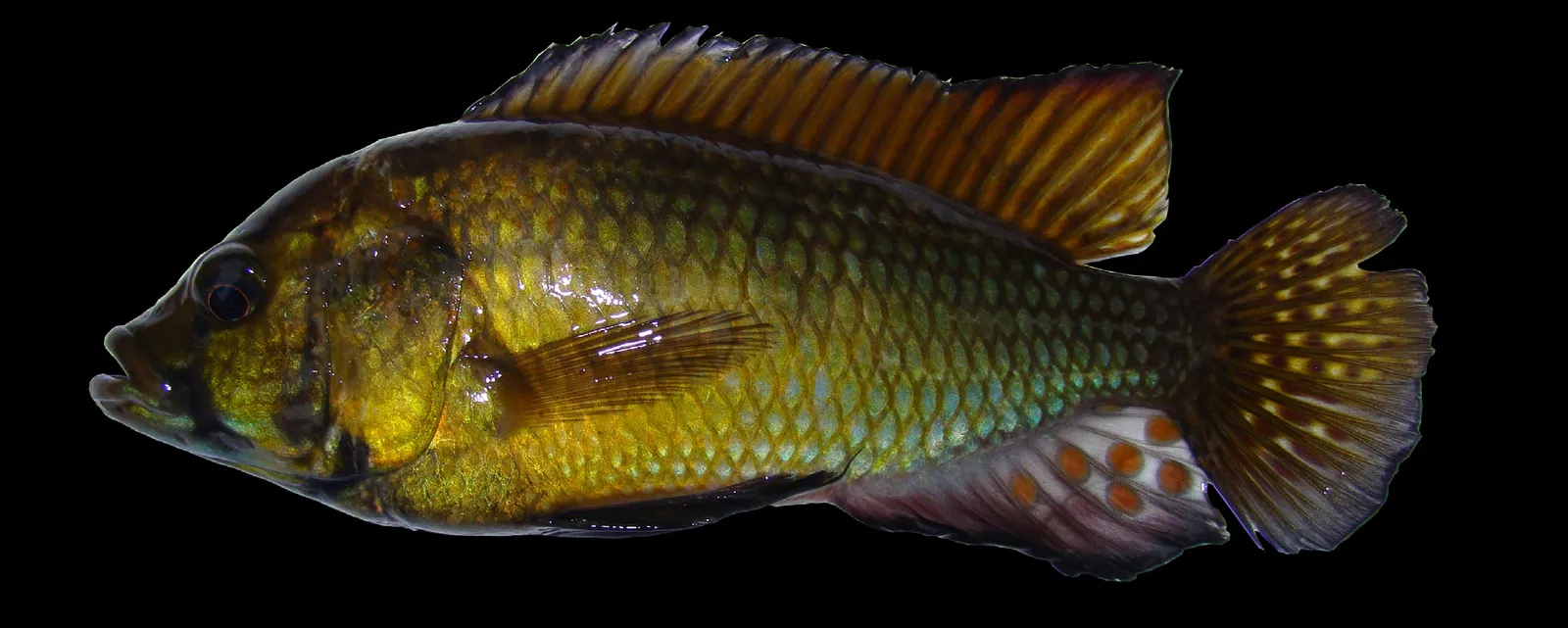
This is a robust, deep-headed cichlid of fusiform shape, reaching about 7.5 in in standard length — large for a haplochromine, and noticeably stocky, with the heavy skull and thick nape of a fish that makes its living by force rather than finesse. The fin formula spans 16-20 dorsal spines (typically 17-19) over 6-9 soft rays, and 4-7 anal spines over 6-9 soft rays. Ground colour is an unshowy olive-grey to brassy brown, often with faint vertical barring and a scattering of dark blotches; in spawning condition males flush darker and more iridescent, carrying the yellow-to-orange egg-spots (anal-fin ocelli) typical of the haplochromine lineage, while females stay plainer and more cryptic. As in the wider group, sexual dimorphism is real but understated outside the breeding season — males run slightly larger and more vividly marked, females smaller and duller.
The feature that matters, though, is hidden in the throat. Like all cichlids Astatoreochromis alluaudi has a second set of jaws — the pharyngeal jaws, formed from modified gill arches deep in the pharynx — and in this species the lower pharyngeal jaw is developed into a heavy, broad triangular bone armed with stout, blunt, molariform teeth: a purpose-built nutcracker. What makes the fish famous is that the size and build of that bone, and the number and shape of its teeth, are not fixed by its genes alone. They respond to what the fish actually eats while it grows, so that two individuals of identical ancestry can carry radically different crushing apparatus. This is the trait, more than any colour or fin count, that defines the species in the scientific literature.
Habitat
Astatoreochromis alluaudi is native to the lakes and rivers of the Lake Victoria region of East Africa — Victoria itself, plus Kyoga, Edward and George, the smaller satellite lakes Nakavali and Kachira, and the streams and rivers that connect them, including the Semliki. In the Edward–George system it is recorded from both lakes and the Kazinga Channel that links them, where it is one of only four non-endemic haplochromine species (alongside Pseudocrenilabrus multicolor, Haplochromis nubilus and H. erythromaculatus) sharing the water with the system's much larger flock of endemic Haplochromis. The whole native range falls within a single freshwater ecoregion, the Lake Victoria Basin (FEOW 521), which also takes in Lake Kivu. It is genuinely catholic about where it lives: unlike the rock-bound or sand-bound specialists of the lake's cichlid flock, this fish is not tied to any one substrate and turns up almost anywhere shallower than about 66 ft, from open lake margins to river channels to the dense papyrus swamps that fringe the shoreline. That tolerance — for low oxygen, for vegetation, for marginal water — is part of why it persists where flashier endemics have crashed.
The water it occupies is alkaline and buffered, the chemistry of the East African lakes: FishBase gives a pH band of roughly 7.5-8.5, hardness around 15 dH, and a tropical temperature range near 24-28 degrees Celsius. The species is also one of the most widely moved fish in Africa. From the early twentieth century onward it was deliberately introduced across Kenya, Tanzania, Uganda and into the Bugesera lakes of Burundi and Rwanda, and even to the Benue basin in Cameroon, in the hope it would control disease-carrying snails (see Feeding). The IUCN treats its core native countries as Burundi, the Democratic Republic of the Congo, Kenya, Rwanda, Tanzania and Uganda, and notes that several of the more distant introductions appear to have failed to establish.
Feeding
Astatoreochromis alluaudi is the classic molluscivore of its region — a snail and bivalve crusher. It gathers shelled prey from the bottom, takes them back into the throat, and mills them between the heavy lower pharyngeal jaw and a matching upper plate, spitting out shell fragments and swallowing the soft bodies. Its diet is dominated by gastropods and small bivalves, and it is the only common cichlid of the Victoria basin equipped to deal with hard-shelled snails on a routine basis. Yet it is not an obligate specialist: FishBase and the field literature describe it as an opportunist that will switch to whatever is most abundant — insect larvae, crustaceans, detritus and plant matter — when molluscs are scarce, and its estimated trophic level sits around 3.6.
This is where the famous plasticity becomes more than a curiosity. Peter Greenwood showed in 1965 that the crushing apparatus develops in response to diet: fish that grow up grinding hard snails build a hypertrophied, heavily-toothed pharyngeal mill, while fish raised on soft food develop a weak, slender jaw with smaller, more numerous teeth. Later anatomical work (Hoogerhoud, Smits and colleagues in the 1990s; Huysseune's 1995 study of the tooth dentition) pinned down the mechanism — hard-food fish maintain their tooth count but replace each tooth with a larger successor and thicken the bone, while soft-food fish simply add more small teeth. The plasticity carries a sharp practical lesson. Because Astatoreochromis alluaudi crushes the snails that host the schistosomiasis (bilharzia) parasite, it was repeatedly introduced and pond-reared as a biological control agent. It largely failed, and Slootweg's work explained why: fish bred and raised in ponds on soft food never develop the powerful jaw needed to make snails worth eating, so they ignore the very prey they were imported to destroy. A textbook example of adaptive plasticity turned, in the field, into a textbook example of why it backfires.
Mating
Like the haplochromine cichlids it sits beside, Astatoreochromis alluaudi is a polygynous, maternal mouthbrooder with no lasting pair bond — the breeding system that helped drive the explosive radiation of cichlids across the East African lakes. Males develop the brighter spawning colours and the egg-spots on the anal fin, and court females actively, the spots functioning in the lineage's well-known spawning ritual: as the female turns to take up the eggs she has just laid, she snaps at the dummy 'eggs' on the male's fin, drawing milt over the real clutch already in her mouth and fertilising it there. The male's role effectively ends with fertilisation.
Detailed wild observations of courtship in this particular species are thin in the literature — it has been studied far more as a piece of developmental biology than as a behaving animal — but its membership in the haplochromine group, its mouthbrooding habit and its male ornamentation all place it squarely within that mating system. One sobering footnote comes from the conservation work: in the turbid, eutrophied waters that now cover much of Lake Victoria, the visual cues females use to recognise and choose mates break down, and Astatoreochromis alluaudi has been recorded hybridising where it can no longer tell suitable partners apart.
Breeding
Spawning follows the haplochromine pattern. The female lays a clutch on the substrate, takes the eggs into her mouth, and broods them there through hatching and the early free-swimming stage, releasing the fry once they can fend for themselves and gathering them back into her mouth at the first sign of danger. There is no biparental care; the female alone carries the burden, which limits clutch size to what will fit in her buccal cavity but greatly improves each egg's odds of survival. Precise fecundity figures for the species are not well documented in the public literature, and are best left unstated rather than guessed.
FishBase notes that the breeding season is poorly recorded but that spawning may peak at the end of the short rains, around November to December. In aquaria the fish breeds readily — one of the few easy things about keeping it — needing little more than mature, alkaline, buffered water and the warmth of its native range to trigger a female into spawning, after which she can be left to brood undisturbed. Its high reproductive resilience (a population doubling time under fifteen months, in FishBase's estimate) reflects this dependable, repeatable mouthbrooding.
In the aquarium
Astatoreochromis alluaudi is an adaptable, robust fish that does not demand unusual equipment, but it repays honest assessment of what it is: a large-headed, moderately aggressive haplochromine that reaches close to 7.5 in and produces a substantial bioload. A single adult needs a footprint of at least 47 in, and a breeding group of one male to two or three females warrants a 180-cm tank or larger. Height and width matter less than floor space, because the fish forages actively across the bottom, turning over substrate in search of prey. A tight lid is sensible — like most haplochromines it will jump at dusk.
Water chemistry should mirror the alkaline, buffered conditions of the Victoria basin: pH 7.8–8.5, temperature 75–82 °F, with total hardness in the range of 10–20 dH as a common keeping target. Standard East African rift-lake maintenance works here — crushed coral or aragonite substrate buffers pH passively, and regular water changes of around 25–30 percent weekly keep nitrates in check without destabilising the hardness the fish needs. Soft or acidic water is genuinely unsuitable; even fish that survive it rarely colour up or spawn well. Good circulation and filtration matter more than in the specialist rock-dwelling cichlids, because this species tolerates turbid, low-oxygen water in the wild and keepers can inadvertently let conditions degrade further than they should. It is a forgiving fish, not an indestructible one.
For decor, a sandy or fine-gravel substrate is ideal because the fish sifts through it constantly. Snails placed in the tank as a food source will be systematically demolished — which is worth knowing before the aquarist adds decorative Nerite snails. Rock piles and cave structures provide retreats for subordinate fish and give females somewhere to hold a brood undisturbed, but the layout need not replicate any specific rocky biotope; the species is not a rock specialist in the wild. Robust plants can be included along the tank margins, though a dedicated molluscivore will inevitably uproot fine-leaved specimens during its foraging. Floating plants are left alone and appreciated.
Suitable tankmates are other East African haplochromines or robust Tanganyikan cichlids of broadly similar size. Konings specifically documents Astatoreochromis alluaudi housed successfully alongside Ptyochromis sauvagei, another large Victorian molluscivore, in rocky-biotope aquaria alongside algae-scraping and insect-picking haplochromines — a real, published pairing rather than a guess. Very small fish will be eaten or harassed, and the peaceful open-water cichlids that share its native lake are poor companions with a consistently dominant male present. Its inter-species aggression is lower than in the more pugnacious mbuna, and a well-structured tank with visual breaks usually keeps tensions at a tolerable level. Conspecific aggression between males is real, however; in a tank much under 71 in two adult males will fight until one is badly damaged. The most common mistake keepers make is understocking females relative to males, which concentrates male attention on one or two fish and wears them down. A ratio of at least two, and ideally three, females per male buffers this.
Breeding in captivity is straightforward. Mature females in appropriate water will spawn repeatedly without any special conditioning beyond good diet and stable chemistry. After spawning, the female holds the clutch for approximately two to three weeks (the precise duration is not well-published for this species; haplochromine-typical timing is cited here as a generalisation). She can be left to brood in the main tank if it is large enough and the male's attention is spread across multiple females, or moved to a separate container once she is clearly holding. Fry are released at a small but independent size and can be started immediately on Artemia nauplii and fine powdered foods. The young do not require hard-food snails to develop normally; their pharyngeal jaws will simply track whatever they are fed, producing the soft-food phenotype in captivity — which is fine for aquarium purposes but means tank-raised fish are not the crushing specialists that wild adults become. This is worth noting, not as a failing of captive husbandry, but as a reminder of the developmental plasticity that makes the species scientifically remarkable.
Conservation
The IUCN Red List assesses Astatoreochromis alluaudi as Least Concern, most recently evaluated on 17 February 2021 and published in 2022 (Natugonza, Musinguzi, Witte, de Zeeuw & Brooks). The reasoning is straightforward: the species is widespread across the Victoria, Kyoga and Edward basins, easily found in surveys, and ecologically flexible enough that the threats it faces are localised rather than range-wide. It is not a target of commercial fisheries, though it is taken locally for food and as live bait and appears modestly in the aquarium trade.
That relatively comfortable status, however, sits inside one of the most disrupted freshwater systems on Earth. Lake Victoria's cichlid flock suffered a catastrophic collapse in the late twentieth century — hundreds of endemic species lost or driven to the brink — under the combined weight of the introduced Nile perch (Lates niloticus), heavy fishing pressure, and runaway eutrophication from shoreline deforestation, sewage and agricultural runoff. Astatoreochromis alluaudi has weathered all this far better than its narrowly-specialised cousins, precisely because it is a generalist that breathes poor water and eats almost anything. But it is not immune: the assessors flag the same eutrophication and sedimentation as its principal threats, because murky water both exposes it to Nile perch predation and degrades the visual mate-recognition that keeps it a distinct species, pushing it toward hybridisation. A potential future bait fishery, feeding the Nile perch long-line industry, is noted as an emerging pressure. The honest summary is the one the lake itself demands: this is a resilient survivor in a wounded ecosystem, common today largely because it is tougher and less particular than the fish that vanished around it.