Taxonomy & naming
Albert Günther described this fish in 1894 as Chromis burtoni, the species epithet honoring the British explorer, linguist and polymath Sir Richard Francis Burton (1821–1890), who with John Hanning Speke reached the shores of Lake Tanganyika — the type locality — in 1858 while searching for the source of the Nile. The ETYFish Project notes that the patronym was never explicitly stated by Günther but is almost certainly for Burton; FishBase records the same eponymy. For most of the twentieth century aquarists and ichthyologists alike knew the fish as Haplochromis burtoni, and that name still circulates in the hobby and across the older scientific literature. The currently accepted combination, recognized by Eschmeyer's Catalog of Fishes and FishBase, is Astatotilapia burtoni (Günther, 1894), with Chromis burtoni and Haplochromis burtoni listed as synonyms.
The genus name itself is telling: astato derives from the Greek for "unstable," joined to tilapia — a fitting label for a fish defined by its shifting phenotypes. Astatotilapia is a genus of riverine and lake-margin haplochromines, a lineage distinct from the famous endemic species flocks of the open lake. Astatotilapia burtoni sits at the ecological and evolutionary doorway of Lake Tanganyika rather than in its rocky heart, which is part of what makes it interesting: it is a generalist haplochromine living alongside, but not within, one of the planet's great adaptive radiations.
Morphology
This is a small cichlid. FishBase records a maximum of about 6 in (6 in) standard length, with males commonly around 4.7 in (4.5 in) total length and females smaller, near 2.8 in (3 in); aquarium fish are usually toward the lower end of that range. The body is fusiform and unremarkable in outline, with 13 to 15 dorsal spines.
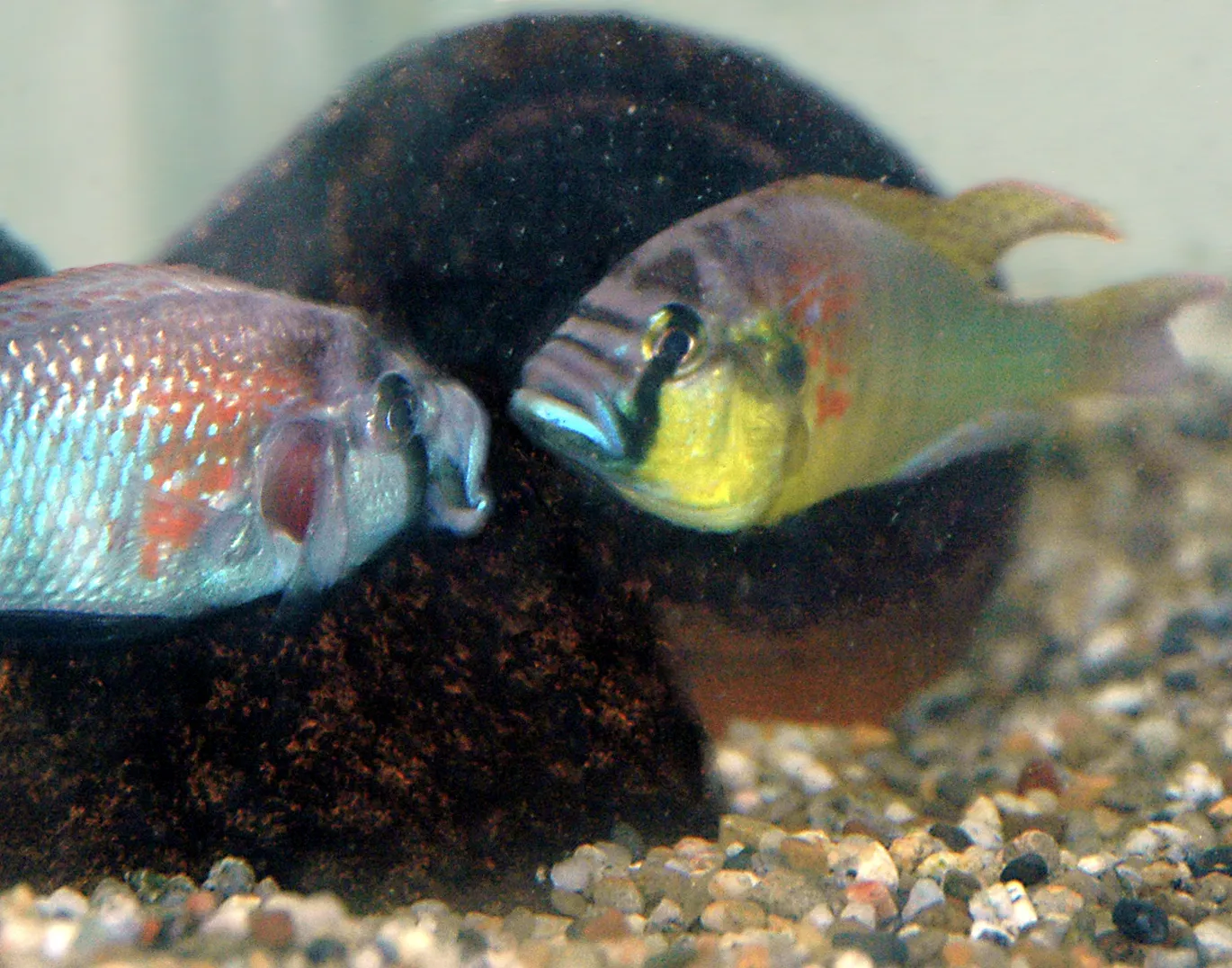
The color is where the fish earns its reputation, and the sexual dimorphism is strong. Dominant, territorial males are vivid — bodies of yellow or blue, a dark vertical bar through the eye, a black blotch at the tip of the gill cover, and a red shoulder (humeral) patch. Strung along the anal fin are several orange-yellow "egg-spots," ocelli traditionally described as "dummy eggs" involved in spawning — though, as detailed under Breeding, experimental work has shown the spots are not strictly necessary for the mechanism they were long assumed to drive. Subordinate males, by contrast, are dull and female-like: gray-brown, drab, lacking the bold markings. The remarkable part is that a single male is not locked into one look. When a dominant male is removed, a subordinate can brighten and assume the full territorial livery within minutes, and the reverse happens when he loses status. Females and non-breeding fish are cryptically colored, a brooding female recognizable by the distended throat pouch.
Habitat
Astatotilapia burtoni is native to Lake Tanganyika and its associated river systems, spanning the lake's riparian nations — Burundi, the Democratic Republic of the Congo, Tanzania and Zambia. Within the basin it follows the rivers: the Lukuga (the lake's only outflow, draining toward the upper Congo), the Malagarazi, and the Rusizi. It also turns up in the Akagera system, Lake Kivu, and waters of Rwanda and Uganda, where the IUCN judges it most likely introduced rather than native. Crucially, this is not a fish of the deep, clear, rocky reefs that define Tanganyika in the popular imagination. It is an edge specialist, living in slow streams, river mouths and deltas, lagoons, marshes, ponds, and the warm, shallow inshore fringe of the lake itself.
That habitat preference shows in the numbers. The IUCN places it in the top 0–16 ft (0–16 ft) of the water column — effectively the surface skin of the lake and its feeder waters. FishBase gives an in-situ profile of hard, alkaline water (pH about 8.5–9.0, hardness 12–16 dH) at tropical temperatures of roughly 68–77 °F (68–77 °F), consistent with Tanganyika's famously buffered, mineral-rich chemistry. The shore pools and estuaries this fish occupies can be turbid, fluctuating environments — a world apart from the stable depths a few hundred meters offshore. Ad Konings' Enjoying Cichlids describes the species' habitat more bluntly still, as "rather sluggish or still waters, often with a low oxygen content and murky water" — conditions distinctly harsher than the clear, well-oxygenated rocky littoral the lake is known for — and notes that Astatotilapia as a genus shares much of this marginal-water range with the related genus Pseudocrenilabrus and with tilapiine cichlids, all three groups often found together.
Feeding
Burton's mouthbrooder is an opportunistic omnivore, which suits the variable nearshore habitats it occupies. The IUCN assessment lists a broad menu — small fishes, insect larvae, diatoms, algae, and plant debris — and FishBase places it at a trophic level of about 3.1, squarely in the middle of the food web rather than at the top or bottom of it. In practice it grazes, picks and snaps at whatever the shallows offer, behavior consistent with a generalist haplochromine that thrives where conditions shift with the seasons and the rivers.
Ecologically, Astatotilapia burtoni is a connector species. Living at the interface between the rivers and the lake, it forms part of the productive littoral and estuarine community that supports larger predators and subsistence fishing, rather than the offshore pelagic system dominated by sardine-like clupeids. Its high reproductive resilience — FishBase estimates a population doubling time under fifteen months — reflects a fast-living, edge-of-the-lake strategy.
Mating
The social system of Astatotilapia burtoni is the single reason laboratories around the world keep it, and it has made the species the model organism for the neuroscience of social behavior — the focus of decades of work by Russell Fernald, Hans Hofmann, Karen Maruska and many others, on a fish whose genome has been sequenced. Males occupy one of two states. Dominant males hold and defend a territory, dig a spawning pit, court constantly, and wear the full bright coloration. Subordinate males give up the territory and the colors, shoal with females, and dodge the dominant's attacks. The two states are not fixed castes but a reversible switch tied to the social environment: open a vacancy and a subordinate ascends within minutes, triggering a cascade of behavioral, hormonal and even gene-expression changes that reaches from the brain — the gonadotropin-releasing-hormone neurons of the hypothalamus physically enlarge or shrink with status — all the way down to the gonads. This social control of reproduction, in which a male's fertility is gated by his rank, is the phenomenon that put the fish on the laboratory map. Researchers have also shown that in all-female groups some females take on male-typical dominance behavior, so the plasticity runs in both directions and is not strictly tied to sex.
Courtship is a visual and multimodal performance. A courting male leads a gravid female to his pit with quivering displays, adding pulsed courtship sounds and chemical (urine) signals to his visual show; gravid females both hear and respond to those sounds. Pair bonds are not maintained, and males provide no parental care, leaving the rearing entirely to the female — but the system falls short of a true lek. Males dig their spawning-pit territories fairly close together, which can look lek-like from a distance, yet Konings' Enjoying Cichlids specifically notes that A. burtoni "does not form a pair bond, nor, it appears, does it emulate the arena breeding of its lacustrine cousins": neighboring males do not appear to actively compete with one another for passing females the way classic lek species do. The result is better described as a polygynous mouthbrooder with loosely clustered individual territories than as a contested display arena in the mold of its rock-dwelling Tanganyikan and Malawian relatives.
Breeding
Astatotilapia burtoni is a maternal mouthbrooder, and its spawning sequence is the textbook illustration of the haplochromine "egg-dummy" mechanism — though the mechanism itself is less settled than the popular version suggests. After the male leads a gravid female to his pit, she lays a clutch of eggs and immediately takes them into her mouth; the male then spreads his anal fin, and the female mouths at its orange ocelli using the same lip-and-suction movement she used moments earlier to pick up her own eggs, drawing in his milt in the process. Wolfgang Wickler's classic interpretation held that the female is "fooled," mistaking the dummy spots for stray eggs she has missed. But a 1975 experiment by Paulo, in which a male's anal fin was removed entirely, showed that oral fertilization in A. burtoni still proceeds without the fin or its egg-spots present — evidence that the dummy pattern is not strictly necessary for the behavior. A more mundane explanation is at least as plausible: the same suction technique would be used to collect either eggs or sperm, and the male's fin at that moment is likely coated in milt regardless of whether its spots are visible. Compared to some related riverine haplochromines, which are more flexible and sometimes let the male fertilize eggs directly on the substrate before the female collects them, A. burtoni appears comparatively rigid in its reliance on this oral sequence — with or without visible spots.
The female then carries the developing young in her buccal cavity for roughly two weeks, often fasting through much of that period, before releasing free-swimming fry; clutches are modest, on the order of a few dozen eggs in a small female. For a brief time after release she may continue to shelter the fry in her mouth when threatened. The male contributes nothing beyond his genes, and a single dominant male may fertilize the broods of several females in succession. In captivity, given a settled group, females hold so reliably that colonies can produce fry almost continuously.
In the aquarium
Astatotilapia burtoni is one of the most straightforward African cichlids to keep, which is part of why it ended up in laboratories worldwide before it became widely appreciated in the hobby. A single male with two or three females can be managed in a tank as small as 36 in, but a group of one male and five or more females does best in at least 48 in of length — the dominant male's territory expands to fill whatever space is available, and insufficient horizontal run is the most common cause of chronic aggression. Additional horizontal length matters far more than extra depth; the fish inhabit the top 16 ft of the water column in the wild and treat the upper half of the tank as their main social arena. Provide a sand or fine gravel substrate — males dig spawning pits against the bottom and will redistribute sand constantly — and break the tank visually with rocks, clay pots, and slate arranged into alcoves. The goal is a mosaic of territories so that no single subordinate male or female is cornered in a dead end.
Water chemistry should closely mirror the hard, alkaline conditions of the Tanganyika basin: pH 8.5–9.0, general hardness around 12–16 dH, and temperature 68–77 °F. Crushed coral or aragonite substrate and occasional doses of Rift Valley salt mix will buffer the pH reliably; in soft or neutral tap water, the chemistry drifts acidic quickly and dominant males lose color. Astatotilapia burtoni is otherwise tolerant — it handles a wider range of conditions than most strict Tanganyikans — but consistently hard, alkaline water keeps the fish in full color and supports reliable breeding. Efficient filtration and weekly partial water changes of 25–30% are standard; the fish are undemanding feeders but produce waste proportional to how aggressively they eat, which is very.
For tankmates, the honest advice is caution. Astatotilapia burtoni is a haplochromine and behaves like one: males harass other fish relentlessly, and during spawning the whole group becomes hair-trigger aggressive. In a dedicated Tanganyika biotope tank, they work alongside robustly sized shell-dwellers — Neolamprologus ocellatus, Neolamprologus multifasciatus — provided the tank is large enough that the burtoni group has one end and the shell colony another, separated by open space or a rock partition. Mixing with other mouthbrooding haplochromines invites hybridization; trade stock already contains uncertain provenance fish, and allowing further crossing is not good husbandry. They are not suitable with the smaller, slower Tanganyikan cichlids or with any fish they can fit in their mouths. A species-only or haplochromine-free Tanganyika setup is safest. Overall difficulty is low: they eat anything, tolerate moderate keeper error, and forgive brief lapses in water quality better than the obligate rock-dwellers from the same lake.
Breeding is a near-certainty in a settled, well-fed group. The dominant male will court constantly; a gravid female will hold a clutch of a few dozen eggs for roughly two weeks, often ceasing to eat during this time. The most common keeper mistake is stripping or disturbing a holding female too early — she needs the full two weeks undisturbed. A second common mistake is leaving fry in the main tank: fry released among adults disappear quickly. A small, seasoned keeper sets up a bare-bottomed 40-litre holding tank and moves the female there a few days before her due date, releasing her back to the main group after she has released the fry. Colonies in good condition cycle through multiple simultaneous broods; the fish's population doubling time in the wild is estimated under fifteen months, and captive colonies will exceed that pace without management.
One dimension of keeping Astatotilapia burtoni that has no parallel in most of the hobby is the model-organism angle. If you are curious about the behavioral switch — the minute-scale shift from drab subordinate to full dominant male — it is directly observable at home. Remove the dominant male, and watch a subordinate begin to color up within a quarter-hour. The fish does not know it has been studied for fifty years; it simply performs the behavior, every time, predictably. That makes it one of the most intellectually interesting small cichlids available in the trade, irrespective of its straightforward husbandry.
Conservation
On the IUCN Red List, Astatotilapia burtoni is assessed as Least Concern (assessment by Sibomana, assessed 11 March 2025, published 2025; the species has been listed LC since 2006). It is widespread across the Tanganyika basin, abundant, and even more common in the Akagera system where it appears to have been introduced; its population trend is recorded as unknown, with no major range-wide threat identified. The one species-specific pressure the assessment flags is sedimentation around river mouths — directly relevant for a fish that lives in exactly those estuarine shallows. In trade, it is collected for the aquarium hobby and taken incidentally as fishing bycatch, but it is not specifically targeted, and its fishing vulnerability is rated low. It carries no CITES listing.
That reassuring status, however, sits inside a lake under real and growing strain — and honesty requires holding both facts at once. Lake Tanganyika has warmed measurably over the past century; O'Reilly et al. (2003, Nature) linked that warming to stronger stratification, weaker mixing and an estimated ~20% drop in primary productivity, with knock-on declines on the order of roughly 30% in fish yields. Cohen et al. (2016, PNAS) used sediment-core records to document an associated loss of oxygenated benthic habitat — on the order of 38% — alongside declines in commercially important fishes and endemic molluscs. Shoreline sedimentation and nutrient loading from deforestation and agriculture degrade the nearshore littoral. Most of these pressures bear hardest on the deep, oxygen-dependent and offshore communities — including the clupeid (Stolothrissa, Limnothrissa) and Lates pelagic fishery that feeds millions across four nations. Astatotilapia burtoni, as a shallow, warm-tolerant, fast-breeding generalist of the river-lake interface, is among the better-buffered members of this fauna against warming and deoxygenation. The caveat is its own habitat: the very river mouths and deltas it depends on are where land-use change and sedimentation hit first. So the accurate statement is the careful one — the species itself is currently secure, but the lake it belongs to is not, and the fish's fortunes are tied to keeping its shallow, riverine edges clean.
A practical aquarium note belongs here too. Astatotilapia burtoni is hardy, prolific and inexpensive, but dominant males are relentlessly territorial; keepers consistently recommend a long tank, broken sightlines of rock and structure, and a group skewed heavily toward females so aggression is diffused rather than focused on one fish. Water should mirror the lake's hard, alkaline chemistry. Note that trade stock labeled "Haplochromis burtoni" can include look-alike or hybridized fish, so provenance matters if it matters to you.