Taxonomy & naming
Albert Günther described this fish in 1894 as Chromis callipterus; it now sits in the genus Astatotilapia within the haplochromine cichlids (subfamily Pseudocrenilabrinae, order Cichliformes). The genus name pairs the Greek astatos, "unstable" or "variable," with tilapia (from a Tswana word for fish) — a nod to the unsettled, variable look of these generalized haplochromines. English-speaking hobbyists and East African fisheries both call it the "eastern happy," "happy" being an old trade name for the genus; FishBase and the IUCN also record "eastern river bream."
Its placement carries unusual weight. Of the roughly 700 to 1,000 cichlid species in the Lake Malawi basin, nearly all are endemic to it; Astatotilapia calliptera is one of a small handful of non-endemics and the only Astatotilapia native to the lake itself (Turner, Ngatunga & Genner 2021). Whole-genome work — Malinsky, Durbin and colleagues' 2018 survey of Malawi cichlids in Nature Ecology & Evolution, and later analyses with George Turner of the radiation's hybrid origin — repeatedly recovers Astatotilapia calliptera as a generalist lineage sitting near the base of, or closely allied to, the explosive Malawi flock, and shows that it interbreeds at the radiation's root. In plain terms, it resembles the kind of unspecialized riverine cichlid the whole radiation seems to have come from, which is why it has become a reference organism for cichlid evolution and development. The IUCN assessors and Turner's group both flag a complication that follows from this: Astatotilapia calliptera is really a species complex, with several distinct populations differing in male breeding colour, geographic limits that are still poorly mapped, and a formal taxonomic revision still outstanding.
The question of where exactly this fish sits relative to the radiation has a longer, more contested history than the recent genomic consensus suggests. Through the twentieth century most morphologists treated the Malawi haplochromines as likely polyphyletic — descended from more than one riverine ancestor — with Humphry Greenwood arguing as much in 1979, while others, notably Dennis Tweddle in 1982, called Astatotilapia "an obvious candidate for an ancestor" of the flock. A molecular study by Moran, Kornfield & Reinthal (1994) complicated the picture further: working from mitochondrial DNA, they placed Astatotilapia calliptera not outside the radiation but embedded within it, and — on the strength of shared anal-fin egg-spots, a feature it carries like almost all the rock-dwelling mbuna — closer to the mbuna lineages than to the open-water and sand-dwelling non-mbuna genera. That placement was disputed even at the time (Axel Meyer's own molecular work gave inconsistent answers on the point) and does not match the later, far more comprehensive genome-wide sampling of Malinsky et al. (2018), which favours the ancestral-generalist reading over any deep nesting inside the mbuna clade. The 1994 result is worth knowing as a historical marker of how unsettled this question has been, not as the current best answer.
Morphology
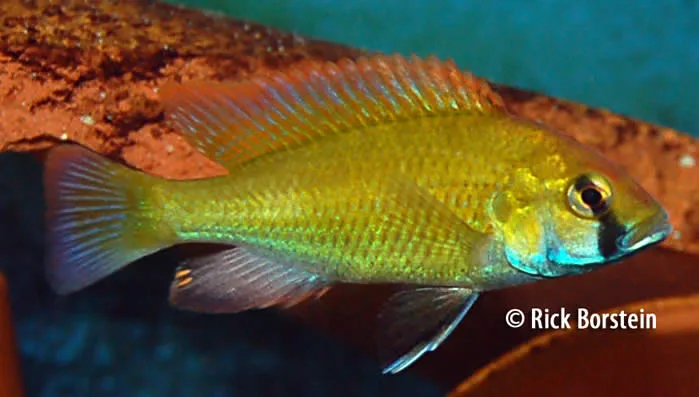
This is a modest fish by Malawi standards: FishBase, following Skelton (1993), gives a maximum of about 6 in standard length, and most aquarium specimens are smaller. The body is the classic deep-bellied haplochromine shape, and the quickest field marks are a dark bar running through the eye and across the operculum plus often-bluish lips — a pattern that genuinely fools people into thinking they are looking at a Lake Victoria haplochromine rather than a Malawi fish.
The species is sexually dichromatic. Dominant, breeding males flush green to yellow with red and blue highlights and carry yellow-orange "egg spots" (ocelli) on the anal fin — the very feature Günther's epithet calliptera, "beautiful-finned," was coined to describe; females and subordinate males stay a more subdued green-gray. Coloration in haplochromines is mood- and status-dependent, so the vivid male is the breeding male, and a stressed or low-ranking individual can look almost drab. Like a number of haplochromines, Astatotilapia calliptera also throws orange-blotched (OB) and blotched-female colour morphs, and because its colour pattern is both variable and genetically tractable it features in the comparative literature on cichlid colour (Maan & Sefc 2013). The several geographic populations of the complex differ enough in male breeding colour that the IUCN assessment treats those differences as evidence the species needs revision.
Habitat
Astatotilapia calliptera has the broadest natural range of almost any fish associated with Lake Malawi. Beyond the lake and its catchment it occupies the Shire River, the satellite Lakes Chilwa and Chiuta, and the east-coast rivers of the Mozambique coastal plain from the Rovuma/Ruvuma south to the Save, including the Lower Zambezi, Buzi and Pungwe systems. That distribution is the heart of its story — this is a fish equally at home in a great rift lake and in the muddy streams and marshes around it.
Within Lake Malawi it is a shallow-water, nearshore animal, favouring vegetated and weedy margins and quiet lagoons rather than the open rocky reefs or sand flats where the famous mbuna and utaka live; it also moves freely into the inflowing rivers and the marshes of the Lower Shire. Field accounts describe males holding territory within stands of Vallisneria rather than on open ground, while females tend to move in small, loosely organized foraging groups through the same weed beds rather than defending fixed sites of their own. The IUCN records it as most common at 7–13 ft depth, with observations down to about 30 ft, and FishBase lists it as benthopelagic in warm, tropical water of roughly 75–82 °F; like its lake-mates it wants alkaline, well-buffered Malawi water (broadly pH 7.5–8.5), but its river and lagoon populations tolerate softer, more variable conditions than a strict lake endemic could. Crucially, populations across this range differ in more than colour: Parsons and colleagues (2017) found that Astatotilapia calliptera populations from the lake and from peripheral rivers and lagoons diverge in life-history traits, and that those differences don't fall neatly along a simple "lake versus river" line — a reminder that the species is really a mosaic of locally adapted populations rather than one uniform fish.
Feeding
Ecologically, Astatotilapia calliptera is a generalist — the opposite of the narrow trophic specialists that define much of the Malawi radiation. FishBase and survey work list a catholic diet of aquatic invertebrates, algae, plant material, small fishes and plankton, and assign it a trophic level near 3.0, squarely omnivorous. The IUCN assessment notes that it has been observed feeding from plants, within the sand, and on rock surfaces — three foraging modes that in the endemic flock are usually split among separate specialist species — which is exactly the behavioural signature of an unspecialized feeder.
That generalism is the ecological flip side of its evolutionary role. A lineage that can eat a bit of everything and live in both river and lake is well placed to colonize new habitats and, over evolutionary time, to throw off specialized descendants — the raw material of an adaptive radiation. In the community it functions as a small, abundant nearshore omnivore: prey for larger predators, and itself a consumer of invertebrates, algae and plant matter along the productive, weed-fringed margins.
Mating
Like the great majority of Malawi haplochromines, Astatotilapia calliptera has no pair bond and a polygynous, lek-like mating system. FishBase records it as agamous — males and females associate only to spawn. A male in breeding condition colours up, defends a small spawning site against rival males, and courts passing females with displays of his ocellated anal fin; outside breeding the species is gregarious and far more tolerant, but a conditioned male becomes territorial and intolerant of other males. There is no biparental care and no lasting bond: once a female has spawned, the male's involvement ends.
The egg-spot ritual is the heart of courtship and the reason for the "beautiful fin." The female lays a small batch of eggs on the substratum, which the male begins to inseminate, and she then collects the eggs into her mouth almost immediately. Drawn to nip at the yellow-orange ocelli on the male's anal fin — which mimic her own eggs — she takes up his milt at the spawning site, fertilizing the clutch she is already carrying. From that point she broods entirely alone.
Breeding
Astatotilapia calliptera is an ovophilic maternal mouthbrooder — the default reproductive mode of the Malawi haplochromines and one more trait it shares with the radiation it sits near the base of. Following fertilization at the male's site, the female incubates the eggs in her mouth for about 12–14 days at 79 °F, fasting through the brood, then releases free-swimming fry. For a further five to seven days she continues to guard them, gathering the young back into her mouth when a predator — or a diver — approaches; aquarium accounts often report somewhat longer holding periods at cooler temperatures. Reported clutch sizes are modest, on the order of a few dozen eggs, the trade-off a small mouthbrooder makes between brood size and the safety of oral incubation.
In captivity the species breeds readily and on its own schedule, which is part of why it became a laboratory model: a single male with several females will spawn repeatedly given warm, alkaline, well-buffered water and a little structure, and holding females are a routine sight. Because the populations of the complex diverge in life-history traits (Parsons et al. 2017), details such as size at maturity and brood frequency vary from one source population to another rather than holding to a single species-wide figure.
In the aquarium
Astatotilapia calliptera is an honest beginner-to-intermediate cichlid — hardy and adaptable compared with most Malawi specialists, but still a cichlid that will rearrange a tank, harass its tankmates, and swallow anything that fits in its mouth. A single pair or a small group of one male and two or three females can be housed in a 120-litre (about 30-gallon) aquarium; if you want to keep multiple males or mix it with other medium-sized cichlids, 55 US gal or more is realistic. The tank should be filtered generously — these fish eat well and produce accordingly — and the water should match the Malawi-basin profile: 75–82 °F, pH 7.5–8.5, and alkaline, well-buffered water. If your tap supply runs soft or acid, a blend of sodium bicarbonate and magnesium sulphate in the water changes, or a commercial Rift-lake salt mix, brings it into range without complication. Water movement from the outlet is welcome but not mandatory; good oxygenation matters more.
Unlike the mbuna of the rocky shoreline, Astatotilapia calliptera in the wild favours weedy, vegetated margins and sandy inshore shallows, and the tank decor can reflect that. A sand or fine-gravel substrate — which the fish will sift — works better than coarse gravel. Smooth rocks or slate arranged into loose piles give subordinate fish and gravid females somewhere to retreat, but the setup need not be elaborate. Robust plants such as Vallisneria or Anubias will survive; finer-leaved or softer plants will be uprooted or grazed. Unlike many mbuna, Astatotilapia calliptera is not a dedicated herbivore, so plants are not decorative camouflage for a relentless lawn-mower — but the fish does nip, and its generalism means no plant is entirely safe.
In the community tank, tankmate selection needs care. Astatotilapia calliptera is broadly compatible with other medium-sized, similarly-assertive Lake Malawi haplochromines from the open-water and sand-dwelling assemblages — utaka, peacocks (Aulonocara), and sand-cichlid generalists — but it is large enough and aggressive enough during breeding that small or timid species will be bullied or eaten. It should not be kept with mbuna in a small tank because mbuna aggression tends to escalate in tight quarters. It also interbreeds easily with closely related haplochromines, so co-housing it with confusable relatives will produce hybrid offspring — a concern if any kind of line-purity matters to the keeper. As a generalisation for Malawi haplochromines, keeping two or more males requires enough territory and enough females that the dominant male cannot camp on the only spawning site. One male to three or more females is the conventional Malawi-haplochromine recommendation and it holds here.
Feeding in captivity is uncomplicated. A quality flake or micro-pellet as the base diet, supplemented with frozen or live invertebrates — bloodworm, Artemia, daphnia, brine shrimp — produces fit fish and good colour. Because the wild diet is genuinely omnivorous, occasional plant-matter offerings (spirulina flake, blanched spinach) are welcome. Overfeeding is the most common keeper mistake, and with a productive filtration setup it is easy to drift into it: aim for what the fish clean up in a couple of minutes, twice a day, and conduct weekly 20–25% water changes to keep nitrates low. The second most common mistake is housing a single male with only one female, which concentrates his persistent reproductive attention on her to the point of chronic stress and sometimes death; more females diffuse the pressure.
Breeding happens readily and without much encouragement beyond warm, well-buffered water and a stable routine. A female that has been mouthbrooding for the full 12–14-day incubation period will look noticeably thinner and slightly hollow-cheeked compared with a well-fed non-brooding female; if she is still eating, she is not holding. Once fry are released, the female continues to take them back into her buccal cavity for several more days at any perceived threat, so the tank should be kept quiet during this period. Separating the holding female into a small, bare-bottomed hatching tank avoids fry loss to other tankmates and lets her fast and brood in peace; removing her before the fry are free-swimming is not advised because the tactile stimulus of the fry inside the pouch is part of what governs the hormonal cascade that ends brooding on schedule. Fry accept finely crushed flake or baby brine shrimp nauplii from the first days. Because this species is genuinely variable across its range — reflecting the mosaic of locally adapted populations described by Parsons et al. (2017) — minor differences in behaviour, coloration, and spawning frequency between individuals from different source populations are normal and not a sign of poor husbandry.
Conservation
The IUCN Red List assesses Astatotilapia calliptera as Least Concern (Tweddle, Bills, Kazembe & Marshall; assessed 22 May 2018, version 2018-2). That status is well earned: the species is widespread and abundant across lakes and river systems in several southeastern-African countries, tolerates a broad range of conditions, and is a generalist rather than a narrow-range endemic; the population trend is stable and the assessors note no known widespread threats. It occurs in Lake Malawi National Park and many other reserves, supports a modest local subsistence fishery and a steady aquarium trade, carries no CITES listing, and its fishing vulnerability is rated low. The one caveat the assessors raise is taxonomic rather than demographic — the complex needs revision, and the conservation status of individual populations could change once their limits are mapped.
Native-range reporting is not perfectly consistent: the IUCN and FishBase list Malawi, Mozambique, Tanzania and Zimbabwe (the last via the Save and Pungwe systems), while USGS and USFWS factsheets add Zambia through the Lower Zambezi — a difference that reflects exactly the unsettled population limits the assessors flag. Either way the fish is secure, but it lives in a basin under real strain. The Chavula et al. (2023) review of the Lake Malawi/Niassa/Nyasa basin (Journal of Great Lakes Research 49(6):102241) documents over-fishing and the collapse of the chambo tilapia fishery, heavy sediment and nutrient loading washing off deforested catchments, roughly 33 °F of shallow-water warming that strengthens stratification and cuts productivity, and a growing risk from invasive species. Those pressures fall most heavily on exactly the habitat Astatotilapia calliptera occupies — the shallow, vegetated, nearshore margins and the rivers and marshes feeding the lake. So the honest reading is a split one: the species itself is adaptable and secure, but the inshore Malawi habitat it depends on, and that gives us our clearest living window onto how the radiation began, is being degraded at its edges.