Taxonomy & naming
Guianacara owroewefi was described by the Swedish ichthyologist Sven O. Kullander and the Dutch ichthyologist Han Nijssen in their 1989 monograph The Cichlids of Surinam (Teleostei: Labroidei), published by E. J. Brill in Leiden, where the species account begins on page 97. The same work erected the genus Guianacara itself to receive an unusual Guianan acara, Aequidens geayi Pellegrin 1902, together with three newly described species — oelemariensis, owroewefi, and sphenozona. The holotype (IRSNB 749) and an exceptionally large type series of more than 1,800 paratypes, split among the Brussels (IRSNB), Stockholm (NRM), Leiden (RMNH), and Amsterdam (ZMA) collections, came from the Marouini (Marowijne/Maroni) River below the first rapids, in the Maroni system of French Guiana. Eschmeyer's Catalog of Fishes lists the name as valid with no junior synonyms. Within the eartheater subfamily Geophaginae, Kullander (1998) placed Guianacara as the sister genus of the threadfin acara Acarichthys, the two forming a small tribe Acarichthyini; subsequent molecular studies (Farias et al. 1998; López-Fernández et al. 2005) have broadly supported a close relationship near the base of the geophagine radiation, though the exact arrangement remains debated. The genus is a Guiana-Shield group: the six described species are all very similar in form and are separated chiefly by the size and position of the black mid-flank bar and spot and by whether the front of the dorsal fin carries dark membrane.
Morphology
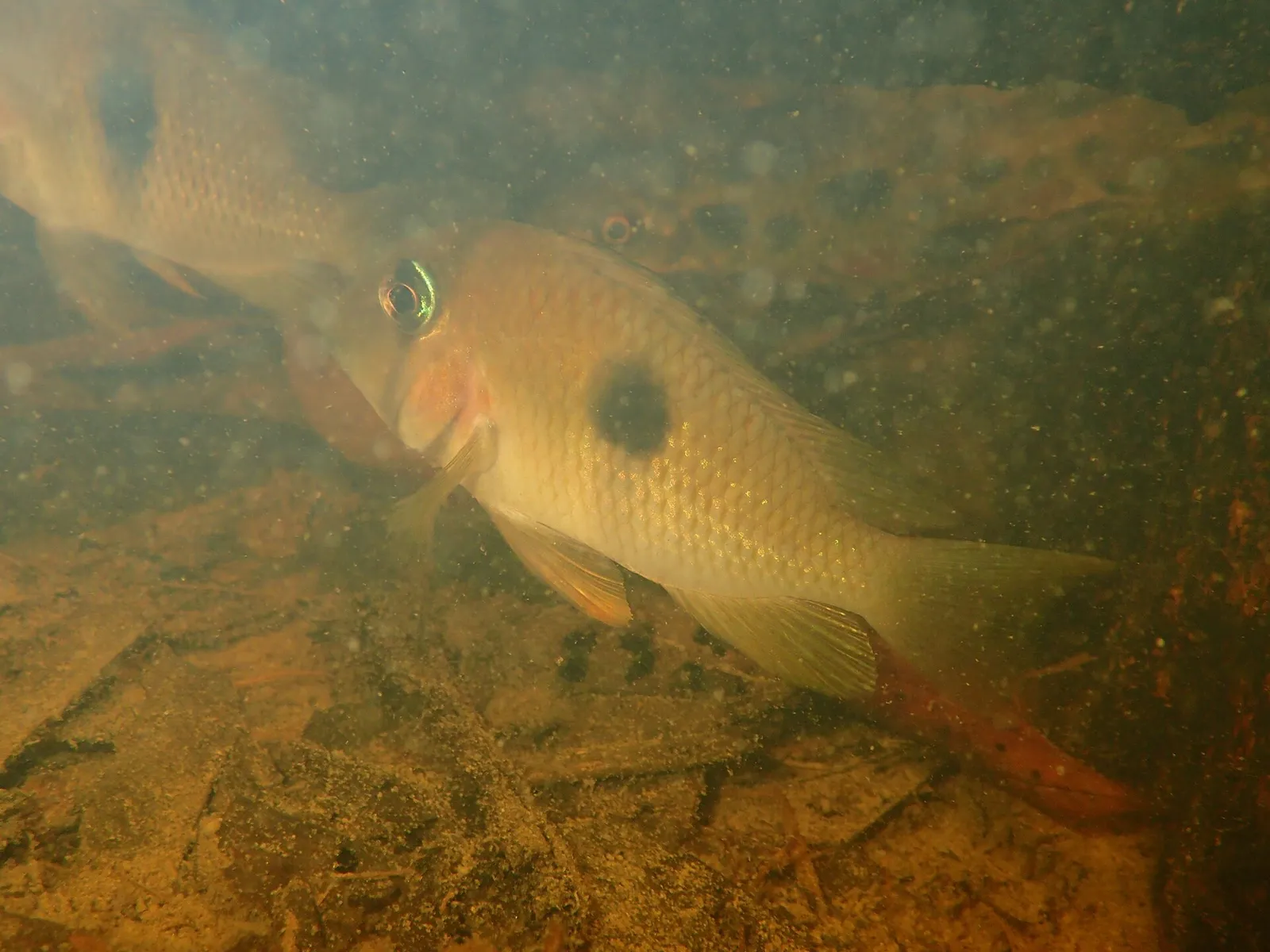
Guianacara owroewefi is a small, moderately deep-bodied cichlid; FishBase records a maximum of about 4 in standard length, with mature males reaching the larger sizes and females typically only about two-thirds the length of males. The ground colour is a muted beige to yellowish or pinkish-green, overlaid in good condition with rows of iridescent gold-green scales and faint spotting on the unpaired fins. Three dark markings define the genus and diagnose the species. The first is the 'bandit mask' — a dark bar running from the nape down through the eye to the lower edge of the gill cover — which gives the bandit acaras their hobby name. The second is the mid-lateral bar, a wedge-shaped vertical saddle on the flank, and the third is the mid-lateral spot, the darkest patch within that bar. In Guianacara owroewefi the bar is broad and the spot sits both on and below the upper lateral line; this combination, together with dark membrane on the front rays of the spiny dorsal fin, separates it from its congeners (Guianacara sphenozona, for instance, carries the spot above the lateral line and lacks the dark dorsal lappets). Juveniles wear a uniformly dark bar without a distinct spot, which resolves into the adult bar-and-spot pattern as the fish matures. A further mark used to separate this species from close relatives is a suborbital stripe about as wide as the pupil, running straight down across the cheek and the edge of the preoperculum; some preserved specimens also show pale, silvery centres to the flank scales not seen in other Guianacara. The whole pattern is markedly mood-dependent, more so than in many cichlids. A calm, undominant or non-displaying fish can lose the black markings almost entirely, replacing the bandit mask and mid-lateral bar with a diffuse, mottled pattern that gives little away; the bold bar-and-spot look is a state the fish switches into, not a fixed livery. A third, intermediate pattern shows only part of the mid-lateral bar as an isolated round spot rather than the full wedge — this partial pattern has been specifically noted in parents actively leading free-swimming fry, suggesting it may function as a lower-intensity signal during brood-guarding rather than territorial display. Colour is otherwise hard to sex by outside of breeding. During brood care, females sharpen into a more contrast-rich pattern — the suborbital stripe, throat and lips turning shiny black while the reddish head colour fades — whereas males brighten instead, and once the fry are free-swimming a male's head pattern becomes especially bold, plausibly serving the young as a visual rallying point. Sexual dimorphism is clearest in size: males grow noticeably larger, with longer, more pointed tips to the unpaired fins, and bull males develop a heavier, blockier head, while ripe females are smaller and rounder.
Habitat
The species is a Guiana-Shield endemic of the eastern Guianas. FishBase gives its range as the Marowijne (Maroni), Suriname, Saramacca, and Coppename River basins of Suriname together with the Maroni basin of French Guiana; the IUCN assessment extends the documented range marginally into Brazil (Amapá), so the native range spans Suriname, French Guiana, and Brazil. Kullander & Nijssen's original description places it specifically in the Maroni, the upper Coppename drainage, and the middle Saramacca, and records it from the Oelemari River sympatric with its congener Guianacara oelemariensis and, further west, from the Brokopondo reservoir on the dammed upper Suriname River. All of this falls within the Guianas freshwater ecoregion, the independent rivers draining the northern and eastern slope of the Guiana Shield to the Atlantic. Guianacara owroewefi is a fish of the cascade and rapids zones of clear, flowing creeks and rivers, where it is described as abundant in quiet, shallow, sunlit pockets among the rocks, sharing that habitat with Krobia itanyi, the armoured catfish Corydoras guianensis, and the characiforms Characidium fasciadorsale and Cyphocharax spilurus. The water is the soft, weakly mineralised, slightly acidic clear- and blackwater characteristic of the Shield; the genus as a whole favours clear, soft, mildly acidic water over a bottom of large rocks interspersed with sandy patches, frequently at sites with appreciable current. Field observers describe sandy, mud- and mulm-covered bank zones sheltered by driftwood, vegetation-draped boulders and rock piles, which cut the current and supply the crevices, overhangs and crannies pairs use to tend their broods; at one Suriname site (Petit Laussat) recorded water temperature was a relatively cool 77 °F, while a Maroni-mainstem population encountered at the end of the rainy season was found in extremely murky, mud-bottomed water at 90 °F, a spread that shows the species tolerates a considerably wider thermal range in the wild than the aquarium-husbandry figures below suggest. Because it keeps to the shallow, sunlit margins of cascade pools, the species is essentially a shallow-water inhabitant rather than a fish of deep channels.
Feeding
Guianacara owroewefi is a benthic invertivore. FishBase records it as feeding on small invertebrates and estimates a trophic level of about 3.5, consistent with a fish that works the rocky bottom and the sediment-filled pockets between stones for insect larvae, micro-crustaceans, and other small prey. Like other geophagines it takes mouthfuls of sand and fine substrate and sorts the edible fraction, expelling the cleaned grit through the gills and mouth, but it is more a rock-and-crevice forager than a dedicated open-sand sifter such as Satanoperca. In the cascade communities it inhabits it occupies the small-invertebrate niche of the shallow, well-oxygenated margins, foraging through the day in the sunlit pockets where it is most often seen.
Mating
The bandit acaras are biparental cleft- or cave-spawners, and their reproductive behaviour is organised around a defensible rocky hollow. Field observers report Guianacara owroewefi as an unambiguously monogamous cichlid inclined to nest colonially — netting typically turns up mated pairs of two large fish rather than loose groups, and where broods have been found, several guarding pairs have been seen spaced only a short distance apart among the same pile of rocks. Pair formation involves mutual display, and in this genus the sexual size difference is pronounced — the female is markedly smaller than the male — which shapes the division of labour at the nest: the smaller female can retreat deep into a narrow crevice where she broods, while the larger, more conspicuous male holds and defends the wider territory around it. Once a pair has settled a territory, low-grade boundary disputes with neighbours recur daily but rarely escalate past frontal and lateral threat displays; brief bouts of mouth-fighting occur only occasionally and, like the threat displays, are almost always between two fish of the same sex, a male only very rarely persisting in a fight with a neighbouring female. Courtship in aquarium pairs follows the familiar acara pattern of trembling displays and substrate cleaning, after which the female actively solicits the male at the chosen site. Most pairs are reported to be compatible and to cooperate at the nest, though a belligerent male can be a hazard to a female confined with him in a small space, which is why hobbyists rely on a brood chamber whose entrance admits the female but excludes a bullying male.
Breeding
Spawning takes place in the recesses of rocks — the female lays her eggs on the vertical or overhung surfaces inside a crevice or under a stone, where the confined space makes guarding straightforward for the smaller fish. The male fertilises the clutch, directly if he can enter or by spraying milt in through the opening, and then defends the surrounding territory while the female tends the eggs and, later, the wrigglers and free-swimming fry. FishBase notes that breeding may occur three to four times a year and that parental care — both protection and helping the young find food — extends over a relatively long period of roughly one to three months, which is unusually prolonged for a small cichlid and reflects the protection the rocky nest affords the brood. Wild spawning has not been described in detail in the literature, but the aquarium account is consistent: an inverted clay flowerpot with the base knocked or chipped out makes an ideal surrogate crevice, the hole sized so the female can pass freely but a large male cannot crowd in. One detailed keeper's account from wild-caught Tapanahoni River stock describes a pair that took roughly eight months in the tank to settle and spawn, eventually excavating a natural cave under driftwood rather than using a flowerpot; that spawning produced a documented brood of about 35 free-swimming fry, with the pair defending a compact territory only about 12 in across — small compared with many substrate-spawning cichlids, and consistent with a nest tucked into a confined crevice rather than an open patch of gravel. In that account the fry were raised on newly hatched brine shrimp nauplii from the first days after becoming free-swimming. Both parents patrolled close around the cave without straying, and other tankmates sharing the aquarium went unmolested outside the immediate nest area. Aggression around breeding is not uniform across the species' range: aquarists working with fish from different Suriname river systems have found the Surinam River population noticeably more pugnacious than fish collected from the Tapanahoni or Coppename. Clutch sizes are not separately published for this species; congeneric Guianacara are moderately fecund cleft-spawners producing on the order of a few hundred eggs, of which a documented captive brood of around 35 surviving free-swimming fry represents the young that made it past the egg and wriggler stages rather than a full egg count.
In the aquarium
Guianacara owroewefi is an undemanding and rewarding aquarium fish, although it reaches the hobby less often than its westerly relatives because its range — the Maroni and central Suriname rivers — is not a major commercial collecting area; most 'geayi' or 'bandit acaras' in the trade are in fact Guianacara sphenozona or the Venezuelan red-cheek form. When Guianacara owroewefi is available it is kept exactly as the other bandit acaras. A pair is comfortable in a tank of around 47 in (roughly 55 US gallons) and more; the fish are stocky and active but not large, and they hold their own in a busy community of medium-sized cichlids without being bullies. The single most important furnishing is structure: a layout of large rounded rocks arranged to form caves and crevices, over a substrate of sand the fish can shift, with driftwood and open swimming space. For breeding, an inverted terracotta flowerpot with a hole knocked in the base is the proven cave, the entrance sized to admit the female but bar a heavy-handed male. Water should follow the soft, clear, slightly acidic Shield streams the species comes from — temperature about 75–82 °F, pH on the acidic side of neutral (roughly 5.5–7.0), and modest hardness — though Guianacara are adaptable and tolerate harder, more neutral tap water in maintenance. Good current and high oxygenation suit these rapids-zone fish well. Feeding is simple: they take sinking pellets, flake, and a varied menu of frozen and live foods such as bloodworm, brine shrimp, and small crustaceans. Suitable tankmates are peaceful-to-robust medium South Americans — other geophagines, larger tetras, headstanders, and characins — while the main caution is conspecific: outside the trade's catch-all 'geayi' label, this is a territorial cleft-spawner, and a settled pair will hold a corner of the tank firmly during breeding.
Conservation
The IUCN Red List assesses Guianacara owroewefi as Least Concern (assessed 28 December 2020 by D. C. Taphorn and D. Rodríguez-Olarte, published 2022), with a population trend judged stable across its range in Suriname, French Guiana, and adjacent Brazil (Amapá). The species is reported as abundant in suitable cascade habitat and is harvested for the ornamental trade, but at a level the assessment does not flag as a population-level concern; it carries no CITES or CMS listing. The threats noted are localised and tied to the wider degradation of Guiana-Shield rivers — energy production and, in particular, mining and quarrying, with gold-mining and its associated sedimentation and mercury contamination being the chief pressures on the clear, rocky creeks this fish depends on. As a relatively widespread Shield species it is far less exposed than narrow-range endemics, but its reliance on clean, clear, flowing water makes it sensitive to mining-driven turbidity should that pressure intensify in its catchments.