Taxonomy & naming
Maylandia phaeos was formally described by Jay R. Stauffer Jr., N.J. Bowers, K.A. Kellogg, and K.R. McKaye in 1997, in their landmark revision of the blue-black Pseudotropheus zebra complex, published in the Proceedings of the Academy of Natural Sciences of Philadelphia (volume 148, pages 189–230). That paper simultaneously described ten new species and erected the new genus Metriaclima, into which the authors placed phaeos as its original combination. The holotype (Penn State University collection, PSU 3054) was collected at Cobwé — the Mozambican coastal town widely spelled Cobue in English — at a depth of one to five metres; paratypes are held at ANSP (176197), MFU (26), PSU (3055, 5 specimens), and USNM (341923).
The genus name has been a long-running nomenclatural dispute. Stauffer et al. 1997 coined Metriaclima (from the Greek metriaklima, moderately sloping, for the head profile). However, a name applied in 1984 by Meyer, Riehl and Zetzsche — Maylandia, honouring German ichthyologist and aquarist Hans-Joachim Mayland (1928–2004) — predates it and, under strict application of priority, is the senior synonym. Eschmeyer's Catalog of Fishes (updated May 2026) accordingly lists the species as valid under Maylandia phaeos, the combination used here. Ad Konings, the foremost field authority on Lake Malawi cichlids, followed Metriaclima in the fifth edition of Malawi Cichlids in their Natural Habitat (2016), and that usage persists on the IUCN Red List and in much of the specialist literature. Both names remain actively used; readers will encounter the fish as Metriaclima phaeos in the older and European-oriented cichlid press.
The species belongs to the zebra (or BB — blue-black) group within the genus, and is diagnosed chiefly by the dusky submarginal band in the dorsal fin of both sexes, a feature shared with very few congeners. Its closest relatives in the central-eastern lakeshore fauna include Maylandia aurora and Maylandia glaucos; all three occur together at Cobwé. In the aquarium trade the species has circulated as 'Pseudotropheus Shauri', a pre-description label now entirely superseded.
Morphology
This is a moderately sized mbuna. FishBase records a maximum of 3.5 in standard length (SL) from the original description; malawi.si documents wild males of about 4.5 in total length (TL), and aquarium males regularly exceed that, with some individuals reported at 6–6.5 in TL under generous feeding. Fin-ray counts are 17–18 dorsal spines and 9 soft rays, 3–4 anal spines and 8 soft rays, and 11–13 gill rakers on the first ceratobranchial; these figures are consistent across the species' range. Body shape is fusiform, moderately compressed, and typical of the mbuna guild — built for manoeuvrability among boulders rather than open-water cruising.
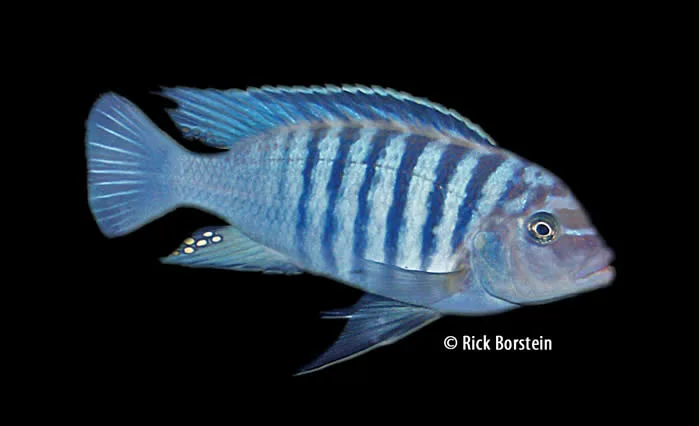
Sexual dimorphism in Maylandia phaeos is among the most pronounced in the genus, placing it squarely in the Flavifemina (yellow-female) group. Territorial males are light blue to steel-blue on the body and head, overlaid with 7–9 narrow, clearly defined black vertical bars; the pelvic fins are black, the anal fin carries a broad black band with yellow egg-spots, and the dorsal fin is blue-grey with the diagnostic dusky submarginal band that runs its full length. Females — and non-territorial males — are typically an unmarked yellow to golden, covering body and fins alike, with the dusky dorsal band still faintly present in both sexes if you look carefully. The population at Londo Bay shows a variant in which females are bluish-beige with yellow fins rather than uniformly yellow; the Cobwé and Undu Reef females conform to the typical yellow pattern. Juveniles are yellow regardless of sex, meaning young males only acquire their blue coloration as they mature and, if circumstances allow, establish a territory.
Habitat
Maylandia phaeos is confined to Lake Malawi — a lacustrine endemic in the full sense — along the central-eastern shoreline between Cobwé in Mozambique (the type locality) and Undu Point in Tanzania, a stretch of roughly 62 mi that is not occupied as a continuous population but rather as a series of discrete reef populations. Named localities where the species has been confirmed include Cobwé, Chiwindi, Londo Bay, Hai Reef, and Undu Reef (malawi.si; IUCN 2018). Countries: Mozambique and Tanzania.
The species inhabits the intermediate zone — the transitional band where rocky slopes give way to a mix of rocks, coarse sand and silty sediment at moderate depth. At Cobwé, malawi.si documents the biotope as rocky substrate with sandy and muddy patches at approximately 23–66 ft; the IUCN assessment gives a range of 16–98 ft and notes that the fish is most common at 33–49 ft. The type-locality collection at Cobwé ran 3–16 ft, but field observations consistently place the bulk of the population deeper. The bottom often slopes gently rather than dropping off steeply, and sediment can cover portions of the rock surface — a sediment-rich substrate typical of the intermediate zone that makes this fish's diet of aufwuchs-covered rocks especially accessible.
Lake Malawi's chemistry sets the frame: the lake is ancient, deeply stratified, and strongly buffered, with surface waters of around 75–82 °F, pH routinely 7.7–8.6, and moderate hardness. These conditions are stable across the intermediate zone and vary little between the Mozambican and Tanzanian portions of the species' range.
Feeding
Maylandia phaeos is an aufwuchs scraper, the dominant trophic guild among mbuna. Aufwuchs is the biofilm of algae, diatoms, filamentous cyanobacteria, invertebrates, and detritus that accumulates on rock surfaces — a packed matrix rather than discrete plants. Maylandia phaeos combs this material at a near-perpendicular angle to the substrate, using its bicuspid outer teeth to rake loose diatoms and short strands of blue-green algae from the algal matrix without necessarily excavating the rock surface as the more forceful scrapers do. When wave action or current dislodges algal material into the water column, the fish will take it there too.
The diet is overwhelmingly plant-based — herbivorous in the practical sense — and this has direct consequences for aquarium feeding. Like all aufwuchs specialists, Maylandia phaeos is susceptible to digestive problems and potentially fatal bloat ('Malawi bloat') when fed high-protein animal-based foods. Spirulina flake, vegetable-based pellets, and occasional blanched greens reflect the natural diet far better than meaty foods, and experienced keepers consistently flag protein overfeeding as the most common mistake with this and related species.
Mating
Social organisation in Maylandia phaeos follows the standard mbuna pattern of dispersed male territories visited by loosely grouped females, but the intensity of territorial defence is notable even within an aggressive genus. Males hold and actively defend territories among the rocks of the intermediate zone, excavating a burrow beneath a suitable boulder that serves as the focal point of both the territory and the eventual spawning site. Females are typically solitary or move in small groups of two to four individuals; they are courted at the perimeter of male territories, with the male displaying his full blue-and-black breeding coloration and performing lateral displays and shimmering movements characteristic of haplochromine mbuna courtship.
Males are aggressive toward conspecific rivals and toward other territorial mbuna occupying the same depth zone, and that aggression does not diminish noticeably outside the breeding season. The species is documented as the most abundant Maylandia in the intermediate habitat at many of its sites (malawi.si), which likely reflects both the ecological fit of the zone and competitive success against sympatric congeners. Because females are yellow and males are blue, pair identification and mate choice are visual and unambiguous — the sexual dimorphism effectively means the two sexes present entirely different colour signals.
Breeding
Maylandia phaeos is a maternal mouthbrooder, the reproductive mode of virtually all Lake Malawi haplochromine cichlids. Once a female is ready to spawn she enters the male's burrow beneath a rock; the pair circles in the classic mbuna spawning sequence, the female depositing eggs on the substrate and immediately taking them into her buccal cavity, while the male fertilises them as she mouths at the egg-spot markings on his anal fin. This sequence repeats until the clutch is complete. Clutches are relatively small — typically 10–30 eggs according to malawi.si field data — in keeping with the species' intermediate size and the energetic cost that three weeks of non-feeding mouthbrooding imposes on the female.
Incubation lasts roughly three to three and a half weeks, after which the female releases free-swimming fry; she then abandons them. The male plays no further role after fertilisation. In the aquarium the cycle replicates easily once a dominant male is settled and females are in condition; a 1:2–3 male-to-female ratio distributes harassment and allows females to recover between broods. The fry are large relative to those of many cichlids and accept crushed flake food from the start. If the main tank is occupied by other boisterous fish, moving the brooding female to a bare-bottom rearing tank on day 16–18 and returning her once she has released the fry is standard practice among keepers.
In the aquarium
Maylandia phaeos is rarely encountered in the aquarium trade — far less so than the ubiquitous Maylandia estherae or Maylandia zebra — and most keepers who maintain it have sourced it deliberately from specialist mbuna breeders rather than finding it casually on a fish-store shelf. Where it does appear, it is sometimes still labelled under the old collector name 'Pseudotropheus Shauri'. That obscurity is a shame, because the species is a straightforward mbuna to keep for anyone who has met the genre before, and the male-female colour contrast — blue and black beside unmarked yellow — is among the most striking in the genus.
A 200-litre (roughly 48-gallon) tank is a workable minimum for a single-species group of one male and two or three females, and 80 US gal is better if you intend to mix it with other mbuna. Like all rock-dwellers from the intermediate zone, Maylandia phaeos expects alkaline, well-buffered water: a pH of 7.8–8.6, temperature 75–82 °F. Standard Lake Malawi practice — crushed coral or aragonite substrate, a canister or sump providing high turnover, and weekly water changes of at least 25–30 % — keeps the water column in the right envelope. Soft, acidic, or low-mineral water is incompatible with long-term health and should not be attempted.
Decoration should be overwhelmingly rock. Large flat stones stacked into caves, ledges, and passages replicate the boulder fields and intermediate-zone rocky slopes the fish occupies in the lake. A sand or fine-gravel base between the rocks allows natural foraging behaviour and lets females rest away from male attention. Dense rockwork is not decoration — it is the functional architecture that distributes aggression by fragmenting sightlines and multiplying territory boundaries. For that reason, leave open swimming space in the central column rather than filling the entire tank from floor to surface; mbuna are not open-water fish but they do use mid-water, especially females circulating between shelters.
Tankmate selection follows ordinary mbuna rules. Maylandia phaeos is aggressive and territorial, and a single male will dominate smaller or shyer species. Suitable companions are other mbuna of similar size and temperament — Labeotropheus, Pseudotropheus, or other Maylandia species — provided they are sufficiently different in colour to avoid triggering male hostility through mistaken identity. Two conspecific males in the same tank is a recipe for sustained, damaging fighting unless the tank is unusually large and the rockwork complex enough to break line of sight; in most home aquaria, one male is the correct number. Peacock cichlids (Aulonocara) and the larger Haplochromini are generally too passive or occupy a different ecological niche to be threatened, but the reverse problem — the mbuna bullying Aulonocara into chronic stress — is common and should be monitored. Avoid keeping Maylandia phaeos with soft-water cichlids or any fish that cannot tolerate the alkaline, well-buffered conditions of Lake Malawi.
Diet is the most consequential management decision. Maylandia phaeos is an aufwuchs scraper and its digestive system is adapted for plant material — the long intestine typical of herbivorous mbuna is not well suited to metabolising high-protein animal foods. Spirulina-based flake or pellet, vegetable-enriched mbuna pellets, and occasional blanched spinach or nori are the appropriate staples. Beefheart, bloodworm fed frequently, and other high-protein live or frozen foods have been linked in the hobbyist literature to the condition colloquially known as Malawi bloat — a rapidly progressing, often fatal abdominal distension probably involving intestinal bacterial dysbiosis. This is the most common keeper mistake with this species and the entire mbuna guild. Breeding is straightforward once a compatible group is established: the male courts females into his burrow, the female broods the eggs buccally for approximately three weeks, and released fry are large enough to take crushed spirulina flake immediately. Separating the brooding female into a quiet, bare-bottomed tank from around day 16 improves fry survival in a community setting.
Conservation
The IUCN Red List assessed Maylandia phaeos as Least Concern (LC) on 20 June 2018, a reassessment by Ad Konings and reviewed by Jos Snoeks — an upgrade from Vulnerable (VU) in 2006 and again in 2017. The reasoning is distribution-based: the species occupies roughly 62 mi of the central-eastern shoreline and is described as common at most sites within that range. The IUCN notes that no major, widespread threats are currently documented; potential pressures identified are sedimentation from agricultural and forestry runoff and some extraction for the ornamental aquarium trade, where the species has circulated as 'Pseudotropheus Shauri'. Neither is considered a current population-level threat. There is no CITES or CMS listing.
The honest caveat is that the distribution, while geographically extended, is a single lakeshore corridor without any known refugial populations outside it. A persistent sedimentation gradient along the Mozambican coast — driven by catchment deforestation — or a targeted surge in collection pressure could affect populations across the range simultaneously. The IUCN assessment itself flags continuing population-trend data as a research need. That concern sits within the wider context of Lake Malawi's condition: basin-scale reviews, most recently Chavula et al. (2023) in the Journal of Great Lakes Research, document accelerating threats including heavy and growing fishing pressure, sediment and nutrient loading from deforestation, and climate-driven warming that reduces the lake's seasonal mixing and threatens the productivity of the upper water column where mbuna live. None of these is recorded as an active, verified decline for Maylandia phaeos specifically, but they are the pressures against which the long-term security of every Malawi endemic — including this one — should be measured.