Taxonomy & naming
Ethelwynn Trewavas and Max Poll described this fish in 1952, originally as a subspecies, Lamprologus savoryi pulcher, from a type specimen collected at Kasanga at the lake's southern end. It was later moved into the genus Neolamprologus, where the Catalog of Fishes and FishBase now list it as the valid Neolamprologus pulcher (Trewavas & Poll, 1952), in the cichlid subfamily Pseudocrenilabrinae. The species epithet pulcher is simply Latin for "beautiful."
The name carries baggage. For decades hobbyists and many ichthyologists treated the fairy cichlid "Neolamprologus brichardi" as a separate, closely allied species, distinguished mainly by the dark T-shaped marking on its gill cover. A molecular study by Duftner and colleagues (2007, Molecular Phylogenetics and Evolution) found that the facial-stripe patterns used to tell brichardi from pulcher had evolved repeatedly and independently, and that the genetics did not match the taxonomy or even the geography of the lakeshore. The authors concluded the two belong to a single species; under the rules of priority, the older name pulcher wins, and brichardi is now widely treated as a synonym. The IUCN likewise folds Neolamprologus crassus and Neolamprologus olivaceous (both Brichard, 1989) into pulcher, while noting the crassus synonymy is not entirely settled.
How tangled this complex already looked before the molecular resolution is worth spelling out. In the early 1990s Konings distinguished the species chiefly by the shape of the gill-cover markings: T-shaped bars for brichardi, a chevron shape directly behind the eye for pulcher itself, V-shaped bars for the (then-recognized) N. splendens, and — among the unmarked forms — black-edged unpaired fins for N. falcicula versus white-edged fins and a notably slimmer body (25–28% of standard length in body depth, against 30–35% in N. crassus) for N. gracilis (Cichlids Yearbook Vol. 3). That is precisely the species-level framework Duftner and colleagues' 2007 genetics would go on to undercut: the marking patterns turned out to have evolved repeatedly and independently of lineage. In the trade, "daffodil," "daffodil II," and "Princess of Zambia" are color forms and marketing labels rather than distinct taxa; the original "daffodil" was itself a Konings field designation for a population at Kalambo, on the Tanzania/Zambia border, which he proposed as a geographical race of N. pulcher on the strength of its gill-cover pattern, distinguished from other pulcher populations by yellow (not merely orange) unpaired fins present in both juveniles and adults (Cichlids Yearbook Vol. 3).
Morphology
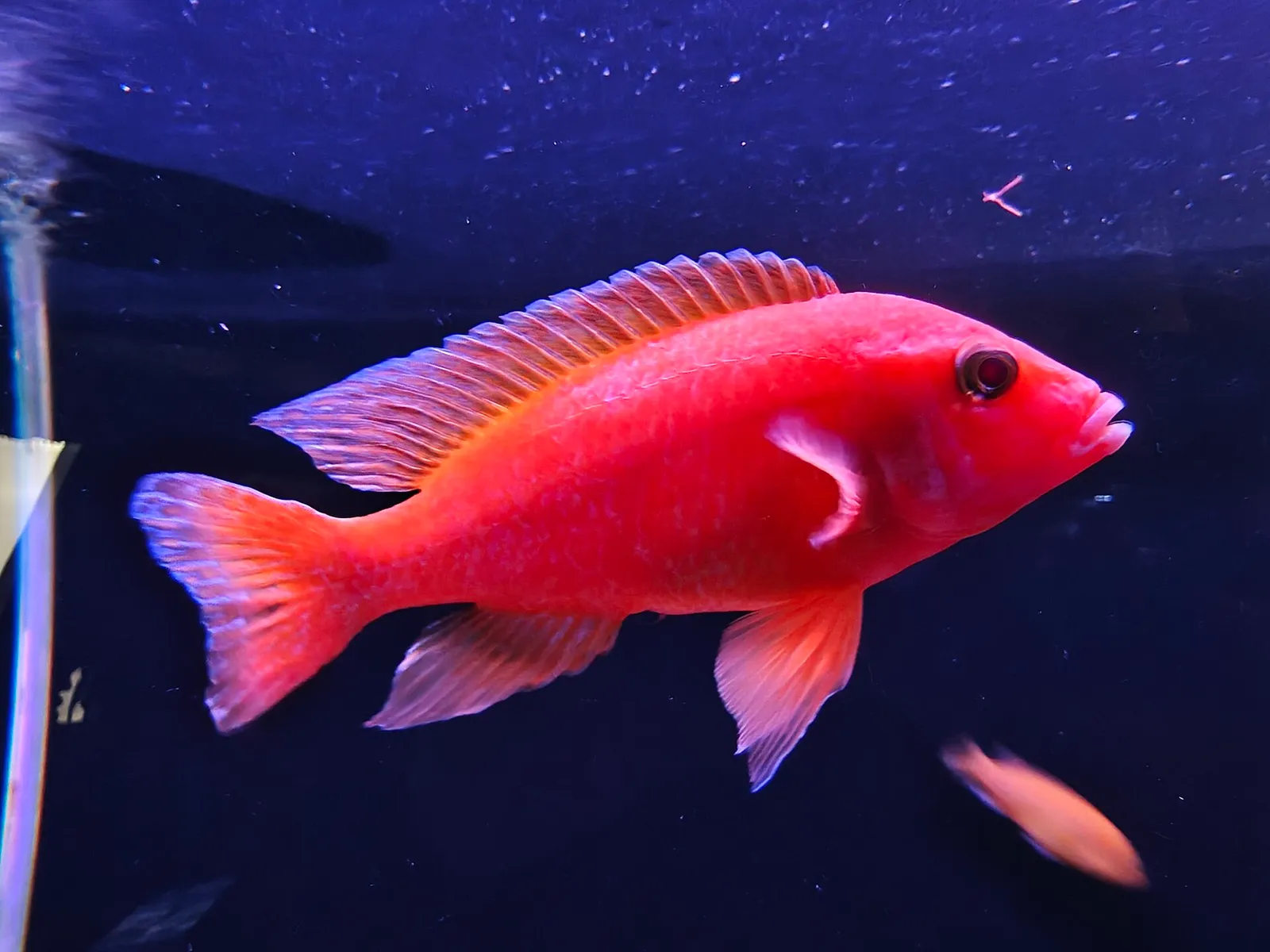
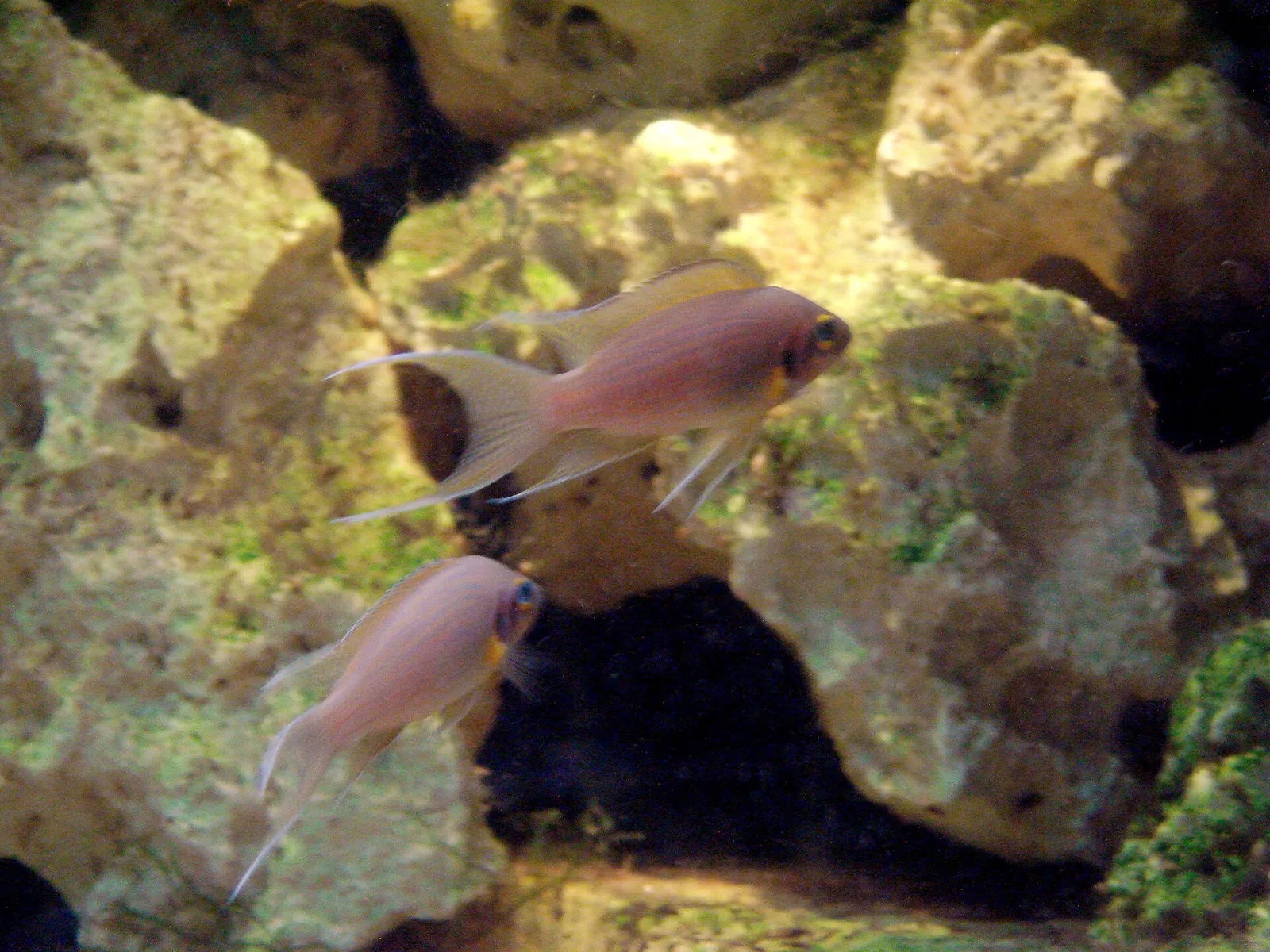
This is a slender, elegantly proportioned cichlid rather than a flashy one. FishBase gives a maximum of about 2.8 in (3 in) total length for measured specimens, though aquarium fish are routinely reported at 4-5 in (4–5 in) including the trailing fins, so reports of "size" depend heavily on whether the lyre-shaped tail is counted. Konings's own early-1990s field measurements put the wild maximum closer to 2.5 in (Cichlids Yearbook Vol. 3) — smaller than FishBase's later figure, most likely a difference in sampling rather than a real conflict, but worth noting rather than silently dropping. The body is a warm tan to fawn, overlaid with fine blue and yellow spangling, with a yellow flush at the base of the pectoral fins and along the dorsal edge. Juveniles can differ from adults in fin colour by locality: at Cap Tembwe in the DRC, juvenile N. pulcher show orange dorsal fins, while at the Kalambo 'daffodil' locality both juveniles and adults carry yellow (not merely orange) unpaired fins.
The most consistent field mark is on the head, though its shape is not uniform across the species now that brichardi has been folded into it: a pair of dark bars on the operculum (gill cover) that historically took either of two forms — a T-shape lying on its side (the pattern formerly used to diagnose "brichardi") or a chevron directly behind the eye (the pattern originally used to diagnose "pulcher" itself) — both now understood to occur within the single species, often set off by iridescent blue and, in the daffodil forms, yellow. All the unpaired fins are edged in a thin, ice-blue filigree, and the caudal fin is drawn out into points top and bottom. Sexual dimorphism is subtle. Males tend to run slightly larger and heavier-bodied with a marginally steeper forehead, but the difference is modest, and pairs are usually identified by behavior at spawning time rather than by looks alone.
Habitat
Neolamprologus pulcher is endemic to Lake Tanganyika, the great rift lake shared by the Democratic Republic of the Congo, Zambia, Tanzania, and Burundi. Within the lake it occupies the southern to central basin, with records from the Congolese, Zambian, and Tanzanian shores. It is a rock-dweller: groups settle over rocky and rubble-strewn bottoms, frequently in sediment-rich areas where the boulders give way to sand. Konings notes that the distribution is discontinuous rather than a single unbroken band — pulcher, along with N. brichardi and N. gracilis, turns up on both the west (Congolese) and east (Zambian/Tanzanian) shores of the lake, with gaps between (Cichlids Yearbook Vol. 3).
Reported depths span roughly 20-130 ft (20–131 ft) in the IUCN assessment, with field observers noting the densest colonies in shallower water, around 13-65 ft (13–66 ft), and FishBase citing a usual band of about 20-40 ft (20–39 ft). Konings's own early field surveys likewise found most individuals below 33 ft (Cichlids Yearbook Vol. 3), consistent with this deeper-leaning picture. The lake's water is hard and alkaline and exceptionally stable; relevant figures for this species are a pH around 7.3-8.5, high carbonate hardness, and temperatures near 75-79 F (24-26 C). Tanganyika's clarity and chemical constancy are part of what makes its rocky littoral such productive cichlid habitat.
Feeding
In the wild, Neolamprologus pulcher is essentially a plankton-picker tethered to a rock pile. The IUCN and FishBase describe a diet of zooplankton and small invertebrates, and FishBase places it at a trophic level of about 3.4, mid-way up the food web. Colonies hang in the open water just above their home rocks, individuals facing into the current and plucking drifting zooplankton, then dropping back into crevices when a predator passes.
That dual life, foraging in open water but never far from a hole, shapes everything about the fish. Because suitable shelter is limited and predators are abundant in the rocky zone, safe refuge is a scarce resource worth defending and worth sharing. The species is itself prey for larger Tanganyikan predators, and the constant threat of predation is the ecological engine behind its famous social system: experiments have shown that the level of predation pressure helps drive how social these fish become.
Mating
Neolamprologus pulcher is one of the textbook examples of cooperative breeding in fishes. A group is built around a single dominant breeding pair plus a string of subordinates, often a mix of their own grown young and unrelated immigrants; reported group sizes range from about 3 to nearly 40 fish, organized by a strict size-based dominance hierarchy.
What sets the species apart is that older offspring do not leave. Instead they stay in the natal territory as "helpers," defending the colony against egg predators, cleaning and fanning the brood, and maintaining the shelter, while their own reproduction is suppressed. Researchers led by Michael Taborsky and colleagues have used this fish for decades as a model for the evolution of helping: helpers appear to "pay rent" for the safety of the territory through their work, and they weigh staying as a subordinate against the slim, predator-exposed odds of dispersing to breed independently.
Breeding
The pair spawns in a crevice or cave, laying on the order of 20-60 adhesive eggs that both parents guard and fan. The spawning site is typically a rock crevice or cave at the heart of the group's defended territory. Both parents attend the clutch, and the helpers actively participate in brood defense and maintenance of the spawning shelter.
For the keeper, the practical upshot is straightforward and sometimes startling: a single pair can found a multi-generational colony in one tank, and they breed more or less continuously, with juveniles helping rear the broods that follow.
In the aquarium
This is one of the more accessible Tanganyikans and a genuinely good introduction to rift-lake cichlids, but "accessible" is not the same as "peaceful." A pair or small group can be housed in a 30-40 gallon (30–40 US gal) tank, though anyone hoping to watch a full colony develop should plan on something in the 4-foot, 55-gallon (55 US gal) range or larger, because the fish will expand to fill the rockwork. Provide stacked rock, slate, and caves so every fish can claim a defensible crevice; this is the single best insurance against bloodshed. Match the lake's water: hard, alkaline (pH roughly 7.8-8.5), well filtered, and clean, with the rift-lake mineral content that keeps these fish in condition.
The honest caveat, echoed consistently by experienced keepers, is aggression. These fish are mild enough day to day, but a spawning colony becomes ferociously territorial and will harass, corner, and sometimes kill tankmates and even their own surplus offspring as the group runs out of room. They are best kept either as a species tank or with robust, non-Neolamprologus Tanganyikans that occupy different zones. Avoid crowding multiple unrelated pairs into a small footprint, and expect to thin out or rehome juveniles. Hybridization is the other pitfall: because the "brichardi" complex is a single interbreeding species with many regional forms, keepers who care about line purity should not mix daffodil, brichardi, and the various locale variants in one tank.
Conservation
Neolamprologus pulcher was assessed as Least Concern on the IUCN Red List in 2025 (Haambiya, assessed 24 February 2025). It is endemic to Lake Tanganyika but widely distributed across the southern and central basin, with no known major lake-wide threats; its population trend is recorded as unknown. The assessment flags sedimentation and pollution from soil erosion and agricultural runoff as the relevant local pressures, and notes that it is collected for the ornamental trade (national and international) while being only incidentally taken for food. There is no targeted fishery and no CITES listing.
That clean bill of health belongs to the species, not to the lake. Tanganyika as a whole is under measurable strain. O'Reilly and colleagues (2003, Nature, doi:10.1038/nature01833) documented climate-driven warming and reduced vertical mixing that has cut primary productivity by roughly 20%, with knock-on declines in fish yields estimated near 30%. Cohen and colleagues (2016, PNAS, doi:10.1073/pnas.1603237113) found that warming has shrunk the oxygenated benthic habitat available to lake animals by on the order of 38% over the past century, and earlier work (Cohen et al. 1993) showed that shoreline deforestation and sedimentation degrade exactly the rocky littoral this fish depends on. The lake's commercial fishery, built around the pelagic clupeids (Stolothrissa and Limnothrissa) and the predatory Lates, feeds millions across the four riparian nations and is managed jointly through the Lake Tanganyika Authority. For Neolamprologus pulcher, a shallow rocky-shore specialist, the most direct of these pressures is sedimentation: silt smothering the rock crevices that its colonies depend on for shelter and spawning. So the accurate framing is this: the species itself is currently secure, but the rocky habitat that sustains it sits inside a basin whose chemistry, oxygen, and shoreline are all trending the wrong way.