Taxonomy & naming
Ethelwynn Trewavas described this fish in 1931 as Lethrinops laticeps in her monographic revision of the cichlid genus Lethrinops Regan, published in the Annals and Magazine of Natural History (Series 10, vol. 7: 133–152). Her description was based on thirteen syntypes collected from Lake Malawi (then called Lake Nyasa), now registered as BMNH 1930.1.31.212–224 at the Natural History Museum, London, with a duplicate at the Muséum National d'Histoire Naturelle Paris (MNHN 1937-0248 ex BMNH). The type locality is simply given as Lake Malawi, without a more precise site.
The species remained in Lethrinops for nearly six decades. In 1989 David H. Eccles and Trewavas herself, in their joint monograph Malawian Cichlid Fishes: The Classification of Some Haplochromine Genera (Lake Fish Movies, Herten, Germany), erected the genus Taeniolethrinops to accommodate Lethrinops laticeps and a small cluster of relatives distinguished by a prominent oblique or diagonal dark band running from the nape toward the caudal-fin base and a Lethrinops-type dentition. The resulting combination, Taeniolethrinops laticeps (Trewavas 1931), has been accepted by all subsequent authorities — Maréchal (1991) in CLOFFA vol. 4, Ngatunga and Snoeks (2004), and Konings (2016) — and is validated in Eschmeyer's Catalog of Fishes as the current valid name.
Taeniolethrinops currently contains five described species (Taeniolethrinops laticeps, Taeniolethrinops praeorbitalis, Taeniolethrinops furcicauda, Taeniolethrinops cyrtonotus, and Taeniolethrinops macrorhynchus), all Lake Malawi endemics and all sand-sifting haplochromines placed in tribe Haplochromini. Taeniolethrinops laticeps is the largest of the group and is most likely to be confused with Taeniolethrinops praeorbitalis, from which it differs by its deeper, more robust body, a larger mouth, the presence of a bold black diagonal flank band in all age classes (including juveniles), and the absence of yellow coloration in breeding males. The Cichlids Yearbook vol. 1 (Konings, Cichlid Press) notes that some authors have treated Taeniolethrinops laticeps as synonymous with Taeniolethrinops praeorbitalis, but current consensus and formal taxonomy reject that synonymy.
No established English common name exists for this species. It has occasionally entered the aquarium trade under the provisional labels 'broad-headed hap' or 'big sand sifter', but neither is settled in the hobby literature.
Morphology
Taeniolethrinops laticeps is a deep-bodied, moderately compressed cichlid with a notably broad head and a large terminal mouth suited to engulfing mouthfuls of sand. FishBase records a maximum total length of 12 in TL for males, making it among the largest of the Lethrinops-allied sand-sifters; the IUCN assessment gives a maximum of approximately 11 in TL, and malawi.si reports typical adults at up to about 10 in TL, with males reaching slightly larger sizes than females. The discrepancy likely reflects both geographic variation and the difficulty of sampling large adults in the wild.
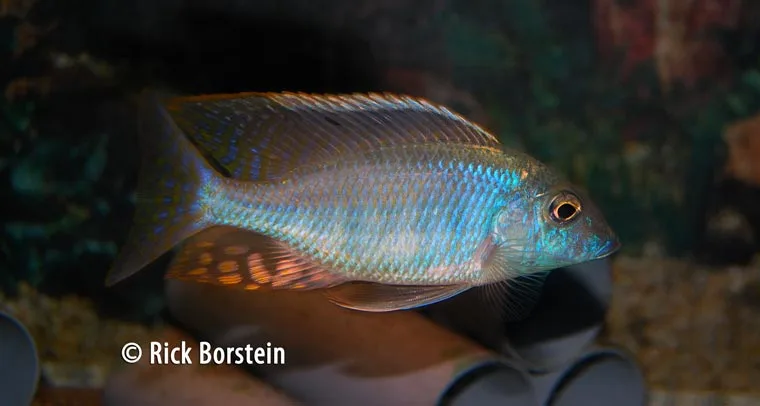
Sexual dimorphism is pronounced. Breeding males develop a striking metallic blue or blue-green sheen across the body, with translucent orange finnage; the dorsal and anal fins are well developed, and the anal fin carries large ocellated egg-spots. Non-breeding males and females are a cryptic silvery or sandy grey-brown. Females remain smaller than males across all size classes and retain the plain coloration throughout their lives.
The diagnostic feature shared by all age classes — including juveniles — is a bold black diagonal band running obliquely from behind the head down toward the posterior flank. This band, combined with the large mouth and broad interorbital width, separates Taeniolethrinops laticeps from Taeniolethrinops praeorbitalis (no consistent diagonal band in adults, yellow tones in breeding males) and from Taeniolethrinops furcicauda (deeply forked caudal fin). The genus name itself references this band: Greek tainia (stripe or band) prefixed to Lethrinops.
Habitat
Taeniolethrinops laticeps is endemic to Lake Malawi, the ninth-largest lake in the world and one of the African Great Rift Lakes, shared between Malawi, Mozambique, and Tanzania. The IUCN assessment records the species as lake-wide in distribution, with records from Malawi, Mozambique, and Tanzania — including the southern part of the lake, the Chizumulu Island area, and Liuli in Tanzanian waters (malawi.si). Breeding localities have been documented at Mumbo Island and Tsano Rock on the Malawian side.
The species is strictly associated with sandy-bottom habitats and is absent from rocky reefs and vegetated margins. Non-breeding individuals are most commonly encountered at around 66 ft depth over open sand, while Turner (1996, Offshore Cichlids of Lake Malawi, Cichlid Press) reported the species as sometimes common in trawl catches at 59–115 ft in the southeastern arm. The IUCN assessment records a depth range of 16–256 ft, making it one of the deeper-ranging members of the group. Mouthbrooding females, which retreat to shallow intermediate habitat, are the individuals most often observed by scuba divers at less than 66 ft.
Lake Malawi's chemistry is alkaline and well-buffered. Published in-situ values for the main lake body run pH 7.7–8.6 and water temperatures of approximately 75–82 °F in the upper water column, with the epilimnion warmest near the surface and cooler conditions in the deeper sandy habitat where this species feeds. Hardness data specific to the species' sand habitat are not published; the habitat-typical range for the lake's open sandy zones is broadly consistent with the lake-wide values cited above (flagged as habitat-typical, not species-specific measurements).
Feeding
Taeniolethrinops laticeps is a specialist sand-sifter. Like its congener Taeniolethrinops praeorbitalis — whose feeding mechanics have been studied in detail by Stauffer, LoVullo, and Han (1996, Transactions of the American Fisheries Society) — it forages by swimming low over sand and periodically driving its broad snout into the substrate, engulfing a mouthful of sediment, retaining macroinvertebrate prey against the gill rakers and mucous membranes, then expelling the sand through the gills. The IUCN Red List assessment records that it feeds on chironomid (midge) larvae, detritus, and algal remains; the dominance of chironomids in the diets of Lake Malawi sand-sifters at this depth is consistent with the documented benthic community of the lake's sandy plains.
The feeding method generates a small plume of disturbed sediment and expelled material that draws opportunistic attendants: species such as Protomelas annectens and Cyrtocara moori are well documented in the literature as commensals that follow sand-sifting Taeniolethrinops, foraging on invertebrates suspended in the water column by the disturbance. Stauffer et al. (1996) documented this relationship in detail for Taeniolethrinops praeorbitalis and note that Taeniolethrinops furcicauda plays the same role in other parts of the lake; field observations by Konings and by Stauffer independently confirm that Taeniolethrinops laticeps feeds in the same manner. The large interraker gap of Taeniolethrinops relative to its commensals means it targets larger chironomid larvae while finer particles are left to the followers.
FishBase assigns a trophic level of 3.0 ± 0.4 SE to the species, placing it as a secondary consumer consistent with a diet of benthic invertebrates.
Mating
Taeniolethrinops laticeps males are strongly territorial around their spawning structures during the breeding season. The core of male social behavior is nest construction and advertisement: a male excavates a large crater bowl in the sand and then defends it against rivals while courting passing females. Breeding aggregations at sites such as Mumbo Island and Tsano Rock (documented by Konings and recorded at malawi.si) consist of multiple males with adjacent or nearby craters, resembling a loose lek in spatial arrangement, although whether females choose among males based on bower quality or male display has not been formally studied for this species.
Females, which spend most of their time foraging over the sand, approach the male's bower area for courtship. The GCCA hobbyist account (Borstein 2012) notes that males do not exhibit the intense aggression toward females typical of some Malawi haplochromines — chasing occurs but damage is rarely inflicted — consistent with the open-courtship dynamics of a lek-type mating system. Outside the breeding season, both sexes appear to range more widely over the sandy habitat without establishing territories.
Breeding
Taeniolethrinops laticeps is a maternal mouthbrooder — the female alone incubates and guards the eggs and larvae, with no paternal participation after spawning. This is the universal reproductive mode among Lake Malawi haplochromines.
The most distinctive aspect of the species' reproductive biology is the male's bower. Males excavate a deep crater in the sandy substrate that serves as the spawning dish; craters documented at Mumbo Island and Tsano Rock (malawi.si, citing Konings' field observations) measured approximately 5 ft in diameter and roughly 23.5 in deep, constructed at depths of 98–115 ft. The scale of these structures — the largest known spawning bowers among Lake Malawi cichlids — appears to be a reliable advertisement signal to females. After spawning at the crater, the female takes the eggs into her buccal cavity and retreats to the shallow intermediate habitat, where she continues to brood and later guards free-swimming fry.
Captive breeding data are sparse given the species' rarity in the hobby. The GCCA account (Borstein 2012) describes a successful captive spawning in which the female held eggs for 14 days before being stripped of seven large fry at the 'heads and tails' stage; the fry were free-swimming after approximately another ten days and immediately accepted baby brine shrimp. The very small clutch size — seven fry from a large female — is consistent with the pattern seen in large-bodied haplochromines, which tend to produce fewer, larger offspring. Notably, the male in captivity showed no bower-digging behavior, consistent with Konings' observation that males build their structures at depth over large sandy expanses — conditions essentially unreproducible in an aquarium.
In the aquarium
Taeniolethrinops laticeps is rarely kept in the hobby. Its size — males can reach 12 in TL — its strict habitat requirements, and its general scarcity in the aquarium trade mean most aquarists encounter it only in the specialist cichlid literature, if at all. That said, experienced Malawi haplochromine keepers who can meet its space and substrate demands report it as a rewarding, behaviorally interesting fish.
Tank size is the first and non-negotiable requirement. A single adult male with one or two females needs at minimum a 560-litre (150 US gallon) tank with a footprint no smaller than 180 × 23.5 in; 240 × 29.5 in or larger is strongly preferred. The genus is named for the diagonal flank band its members carry into adulthood, but the common name 'sand-sifter' better describes what shapes every aspect of its care. The substrate must be a deep bed — 4–6 in minimum — of fine-grained, silica-free sand. River sand or commercially available rift-lake sand in the 0.5 in grain range is appropriate. This is not optional: the fish feeds by driving its broad snout into substrate and straining invertebrates through its gill rakers, and on gravel or coarse substrate it cannot feed normally and will almost certainly decline. The bulk of the floor space should be open sand. Rock structures can be used to define territory boundaries at the tank ends or back corners, but piling rock across the main floor area defeats the purpose of keeping this species.
Water chemistry must match Lake Malawi: pH 7.8–8.6, temperature 75–82 °F, and well-buffered water (a general hardness of roughly 10–20 °dGH is a common keeping target; a carbonate hardness of 6–10 °dKH brackets the lake's own ≈7). These are standard Malawi haplochromine parameters and straightforward to maintain in most hard tap-water areas; soft or acidic water will cause chronic stress and susceptibility to disease. Efficient, high-flow filtration is important because a large sand-sifting cichlid generates substantial waste, but return flow should be directed to avoid disturbing the deep sand bed.
Tankmates should be chosen carefully. Taeniolethrinops laticeps is a peaceful, non-aggressive haplochromine that does poorly when bullied. Aggressive mbuna — the rocky-shore specialists such as Melanochromis, Pseudotropheus crabro, or Labeotropheus — should be avoided entirely; they will harass this species relentlessly and can prevent it from feeding. Compatible companions include other large, peaceful Malawi haplochromines: Copadichromis species, Placidochromis species, and Aulonocara (peacocks) of similar size work well. The commensal relationship documented in the wild — species such as Protomelas annectens and Cyrtocara moori following sand-sifters to exploit the invertebrates they disturb — can be replicated in a large enough tank, and many keepers find it one of the more striking natural behaviors observable in captivity.
The most common keeper mistakes with Taeniolethrinops laticeps, and with large Malawi sand-sifters generally, are inadequate substrate depth and Malawi bloat. Malawi bloat is a serious, often fatal metabolic condition linked to feeding inappropriate foods — particularly high-protein, meaty diets — combined with water-quality lapses. Taeniolethrinops laticeps is an invertivore, not a piscivore; in captivity it should be fed sinking invertebrate-based foods (chironomid larvae, daphnia, cyclops, quality cichlid pellets with moderate protein content), not large chunks of fish or beef heart. Variety is important: a diet of exclusively one food type, even an appropriate one, can lead to nutritional deficiencies over time. If the fish goes off food, bloats, or develops stringy white feces, act immediately — Malawi bloat progresses fast. For any keeper considering this species, the difficulty rating is intermediate to advanced: its requirements are not exotic, but the tank footprint, the substrate depth, and the dietary discipline are all genuine commitments.
Conservation
Taeniolethrinops laticeps is assessed as Least Concern (LC) on the IUCN Red List, evaluated on 19 June 2018 by Ad Konings and J. Kazembe (published 2019 as an amended assessment). The justification cites a lake-wide distribution, a common and stable population in sandy habitats, and the absence of any known major widespread threat specific to the species. It is noted as not uncommon in the shallow sandy habitat of Lake Malawi National Park, which provides some de facto protection. Subsistence fishing and occasional collection for the aquarium trade are listed as threats, but at levels the assessment does not regard as driving population decline.
The broader picture for Lake Malawi is more sobering. Chavula et al. (2023, Journal of Great Lakes Research 49: 102241) identify fishery resource decline, invasive species, and climate change as the three priority challenges for the Lake Malawi/Niassa/Nyasa basin, with sedimentation and nutrient loading — driven by catchment deforestation and intensive agriculture — degrading fish habitat across the lake. The 2018 IUCN Red List update of Lake Malawi cichlids found that approximately 9% of the 458 species assessed are at high risk of extinction, reflecting the cumulative pressure of overfishing (particularly of the open-water chambo fishery), habitat degradation, and the spread of introduced species such as Nile tilapia into marginal habitats.
For Taeniolethrinops laticeps specifically, its dependence on open sandy substrates at moderate depth means it is exposed to the trawl fishery — Turner (1996) documented it in trawl catches — and to sedimentation that can smother sandy habitats and reduce invertebrate prey availability. Its breeding bowers at 98–115 ft are below the depth typically affected by nearshore human activity, offering some buffer. The species' lake-wide distribution and apparently common status provide resilience that many narrow-range endemics lack, and its current Least Concern status reflects that. Continued monitoring, particularly of deep trawl pressure and of sandy-habitat quality, is the primary research need flagged by the IUCN assessment.