Taxonomy & naming
The orange chromide was first described by the German physician and naturalist Marcus Elieser Bloch in 1795, in the ninth volume of his great work on foreign fishes (Naturgeschichte der ausländischen Fische). Bloch placed it in Chaetodon — the butterflyfish genus — as Chaetodon maculatus, a reflection of how little the disc-bodied cichlids of Asia resembled anything European naturalists then knew. The type locality is given as 'Coromandel, India', regarded as an error, since the species is essentially absent from that southeastern coast; the surviving types (lectotype ZMB 2783 in Berlin, with two paralectotypes) anchor the name. The species was later moved to Etroplus, the genus Cuvier erected in 1830, and for most of the twentieth century it was universally known as Etroplus maculatus — the name under which it entered the aquarium hobby and the bulk of the scientific literature. A wrinkle of priority dogs the name: Bloch's Chaetodon maculatus is a junior primary homonym of Chaetodon maculatus Scopoli 1788, but because the older name fell out of use, the International Code permits Bloch's name to stand under reversal of precedence. The modern genus is Pseudetroplus, erected by Pieter Bleeker in 1862 with maculatus as its type species; for over a century it lay dormant as a synonym of Etroplus. In their 2014 revision of the Asian cichlids, Pethiyagoda, Maduwage and Manamendra-Arachchi resurrected Pseudetroplus for this species, separating it from the two true Etroplus (suratensis and canarensis) on dental and osteological grounds, and Eschmeyer's Catalog of Fishes and FishBase now list the valid name as Pseudetroplus maculatus (Bloch, 1795); the genus is monotypic. The fish remains best known to hobbyists and to most of its older literature as Etroplus maculatus. Whatever the genus, the lineage is extraordinary: the subfamily Etroplinae — comprising the Asian chromides and their sister group, the Malagasy genus Paretroplus — is an ancient, Gondwanan relict that the phylogenetic work of Sparks and Smith (2004) recovered as the sister group to all other cichlids on Earth.
Morphology
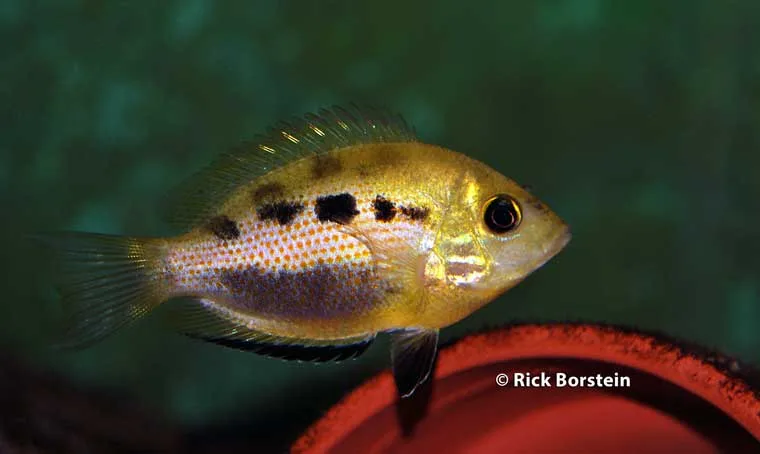
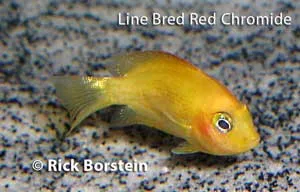
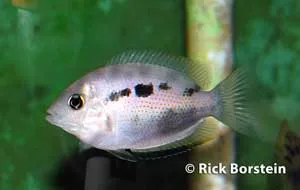
Pseudetroplus maculatus is a small fish: maximum standard length is about 3 in, with FishBase citing a maximum of roughly 3.5 in total length and a published weight of about 14 grams. The body is deep, strongly compressed and almost circular in outline — the classic 'chromide' disc — with a small, slightly protrusible, spout-like mouth suited to picking at surfaces. The defining feature of the lineage, hidden in the fin formula, is an elevated number of spinous rays in the anal fin, the armament that gives Etroplus (and by extension its segregate Pseudetroplus) its name. Coloration is what sets the species apart from its larger relatives: wild fish are pale gold to coppery, with the majority of body scales bearing an orange-red centre, producing an overall freckled, glowing effect quite unlike the barred green-brown of Etroplus suratensis or the buff-grey of Etroplus canarensis. Dark markings are reduced to one to three sooty blotches set just above mid-body; under stress the fish can throw short dark bars across the upper flank plus a solid dark patch toward the rear belly. Sexual dimorphism is real but notoriously inconsistent between populations, and the published accounts genuinely conflict — variously reporting red fin pigment in one sex or the other, white fin striping in females, or no difference at all. The most reliable nuptial cue, documented in breeding studies, is behavioural-chromatic: ripe males darken and intensify, while spawning females develop conspicuous black spots and blotches on the ventral surface between the pelvic and anal fins — a 'black belly' signal shown to coordinate the pair during egg-laying. The familiar solid-orange 'red chromide' of the aquarium trade is a selectively bred ornamental strain in which both sexes lose the dark elements and hold a permanent orange-red colour.
Habitat
The orange chromide is native to peninsular India and Sri Lanka and occurs nowhere else. In India its range runs down the western (Malabar) coast from roughly Maharashtra and Goa through Karnataka and Kerala to the southern tip of the peninsula in Tamil Nadu; in Sri Lanka it is recorded mainly from the lowland north, northwest, north-central and western provinces. It is a euryhaline, amphidromous fish most at home in brackish water — estuaries, tidal lagoons, backwaters and the lower reaches of rivers — but it also penetrates pure freshwater, including inland reservoirs and Sri Lanka's dry-zone tanks, and the man-made freshwater lakes around Chennai where it shares the water with a long list of native cyprinids, catfishes and the snakehead Channa punctata. Within these habitats it favours sheltered margins, hiding among submerged roots, marginal vegetation and weed beds. FishBase reports it as benthopelagic, tolerant of a wide chemical envelope, and — characteristically for an estuarine fish — happiest in hard, alkaline water (FishBase gives a pH range of roughly 8.0–9.0 and dH of 9–19, with temperatures around 68–77 °F; aquarium sources broaden this to about 68–82 °F and pH 7.0–8.5). As a shallow-water shoreline and backwater fish it lives within the top metre or two of the water column rather than at depth. Throughout much of its range it is found in sympatry with the much larger pearlspot, Etroplus suratensis, and the two are not merely co-occurring neighbours — the relationship between them is unusually intimate (see Feeding and Breeding).
Feeding
FishBase places the orange chromide at a trophic level near 2.7 — an omnivore tilting toward the herbivorous and detritivorous end. Wild fish are best described as generalist grazers: they work solid surfaces for aufwuchs (the felt of algae, diatoms and micro-invertebrates that coats submerged objects) and filamentous algae, and also take small invertebrates, zooplankton and the occasional fish fry. The most celebrated facet of its feeding is interspecific. In the tidal Negombo Lagoon of southwestern Sri Lanka, orange chromides have been observed acting as 'cleaners' for their giant relative Etroplus suratensis, grazing parasites, fungus and dead tissue from the larger fish's body and fins. The nutritional payoff of this cleaning is thought to be modest; the deeper logic, as detailed below, is reproductive. The species' spout-like mouth and fine, multi-rowed tricuspid teeth are well suited to this scraping-and-picking lifestyle. In aquaria it readily accepts prepared foods but shows a clear preference for small live and frozen items — bloodworm, Tubifex, Artemia, mosquito larvae — and benefits from a vegetable component such as Spirulina-based flake or blanched greens, a nod to its grazing habit in the wild.
Mating
Outside of reproduction the orange chromide is a loosely gregarious, largely peaceful fish that moves in groups, the juveniles in particular showing a strong, coordinated social response when threatened. Reproduction reorganises this society into monogamous pairs. Field studies in Sri Lanka by Ward and Wyman (1977) and Ward and Samarakoon (1981) found two breeding periods a year, tied to the pre-monsoon dry season (roughly December to April) and the monsoon (June to September, which is comparatively dry in parts of Sri Lanka) — periods when rising salinity and falling turbidity improve the visual contact between parents and fry that this species depends on. Pair formation is signalled by colour change: males deepen and darken, females develop the diagnostic black ventral blotching. A pair selects and cleans a spawning site — a rock, a pebble, even bare aquarium glass — and defends the surrounding territory. The species' mating strategy is shaped by a striking ecological pressure: foraging, non-breeding conspecifics actively prey on chromide eggs and fry. To counter this, orange chromides do something unusual for a substrate cichlid — at the peak of the season they often spawn in loose colonies, packing their territories close together. Counter-intuitively, this clustering reduces both successful and attempted cannibalism, because massed parents collectively swamp and repel the egg-eaters. It is a different solution from that of Etroplus suratensis, which always nests in isolated, well-defended pairs and never leaves its eggs unattended.
Breeding
Pseudetroplus maculatus is a biparental substrate spawner that forms a temporary but genuinely monogamous pair bond, maintained intact through the whole brood-care cycle. Both partners clean the chosen surface, and the female then attaches her eggs one at a time, pressing each oval, pale-yellow egg (about 0.5 in) onto the substrate by a short adhesive stalk that lets it sway in the current; the male fertilises in passes of milt, the whole spawning taking around half an hour. Clutch size is modest and, importantly, asynchronous: a careful captive study by Bindu and Padmakumar (2012) recorded 140 to 231 eggs per spawning (mean ~183), the female ripening and releasing successive batches across a season rather than all at once — which is why an older fecundity figure of ~1,378 (Jayaprakas et al. 1979) reflects total ovarian count rather than a single clutch. The parents excavate several small nursery pits in the sand near the nest and tend the eggs by fanning (driving oxygenated water across them with the pectoral and caudal fins) and 'mouthing' (gently sucking away debris and removing fungused eggs). Critically, one parent always remains on guard while the other forages, the roles swapped every few minutes — a 50/50 division of labour that contrasts with Etroplus suratensis, where both parents stay glued to the brood and spend far more of their time budget guarding. At about 81 °F the eggs hatch in roughly 48 hours; the wrigglers are shuttled between the nursery pits, absorb their yolk over about three days, and become free-swimming around the fourth day, after which they move beneath the parents in a guarded shoal. Then comes the species' signature behaviour: the free-swimming fry graze a protective mucus secreted from the parents' flanks, biting at the adults' bodies (so-called 'micronipping' or contact-feeding) and ingesting the protein-rich epidermal slime even when other food is offered — the same parental-mucus feeding seen, by remarkable convergence, in the South American discus. Parental care is extraordinarily prolonged: a pair may continue to defend and lead their young until the fry approach the size of the adults, and in nature the bond is held until the parents are ready to breed again.
In the aquarium
The orange chromide has a long history in the hobby and is not difficult to keep, but it is routinely kept badly. The fish sold in most shops is the selectively bred solid-orange 'red' or 'yellow' chromide rather than the freckled wild form, which is rarely traded. The first common mistake is keeping too few: Pseudetroplus and Etroplus are loosely gregarious, and a group of eight or more is the sensible minimum, since in small numbers a dominant individual will single out and harass the weak, or the group simply fails to settle and behaves nervously. That argues for a reasonably large tank — base dimensions of around 120 x 23.5 in (roughly 400+ litres) are appropriate for a proper group, though a single well-matched pair can be bred in less. The second and most important mistake is water chemistry. This is an estuarine, hard-water fish, and the single rule that matters is to avoid soft, acidic conditions: maintain it in hard, neutral-to-alkaline water (pH about 7.0–8.5), at 72–82 °F. It can be kept in pure freshwater or in genuinely brackish water (a specific gravity of around 1.005–1.010 suits it well) and does well either way; many breeders find that the addition of marine salt sharpens colour, firms condition, and noticeably improves spawning success and fry survival. What it will not tolerate is the soft, acidic 'blackwater' setup suited to many tetras and dwarf cichlids. The third mistake is neglecting water quality — the species is intolerant of dissolved organic pollution and rewards spotless husbandry, so weekly water changes of 25–50% should be treated as routine. Décor is flexible: a sandy substrate, smooth rocks and some driftwood suit it, and the fish will appreciate a flat rock, slate or broad pebble or two as potential spawning sites. Outside of breeding it is peaceful and will not molest anything too large to swallow, but a spawning pair becomes territorial and will defend a patch of the tank vigorously. Good tankmates are robust, non-aggressive, non-acidophilic species: in freshwater, sturdy schooling cyprinids such as larger Danio, Devario or rasboras make excellent dither fish that draw the chromides out and calm them; in a brackish setup, salt-tolerant livebearers such as mollies or the occasional knight goby do the same job. Avoid soft-water specialists, fin-nippers, and other cichlids unless the tank is large. Diet is undemanding — a quality prepared staple with a vegetable component, supplemented generously with live and frozen bloodworm, Artemia and the like. For anyone wanting to breed them — and this is one of the more rewarding small cichlids to breed — the recommended approach is to buy a group, let a pair form naturally, and provide hard, clean, warm (ideally lightly brackish) water and flat spawning surfaces; the pair will do the rest. The free-swimming fry can be left with their parents and will graze the protective body mucus, but they also take newly hatched brine shrimp and powdered fry food readily, and the spectacle of a brood feeding from its parents' flanks is one of the more remarkable things a freshwater aquarist can witness.
Conservation
The IUCN Red List assesses the orange chromide (under the valid name Pseudetroplus maculatus) as Least Concern, assessed on 11 August 2019 by Abraham, de Alwis Goonatilake, Fernado and Kotagama, with a population trend reported as stable. The species is widespread across the coastal lowlands of peninsular India and Sri Lanka, occurs across a range of fresh and brackish habitats, breeds readily, and is a high-resilience fish with a short generation time — all factors that buffer it against decline. It carries no CITES listing. It is harvested both as a food fish (a commercial estuarine fishery in parts of its range) and for the ornamental aquarium trade, and the wild populations are not currently considered threatened by this use. That said, regional studies sound notes of caution: Indian authors working in Kerala have linked declines in some local populations to overexploitation of wild stock for the ornamental trade and to pollution of the backwaters and the Vembanad Lake system by agricultural and industrial effluent, where pesticide concentrations have at times exceeded permissible limits. None of these pressures rises to a range-wide threat, and the establishment of reliable captive-breeding protocols for the species offers a route to supply the ornamental market without drawing on wild stock — but they are the local backdrop against which a generally secure species should be read.