Taxonomy & naming
Plesiopuntius bimaculatus was described by the Dutch-Belgian ichthyologist Pieter Bleeker in 1863. The Catalog of Fishes (Eschmeyer, the authority for valid names) records the valid combination as Plesiopuntius bimaculatus (Bleeker, 1863), with the parenthetical authority indicating the original placement was in a different genus.
A synonym of note is Puntius puckelli (Day, 1868), described from Bangalore; this name may apply if Indian populations eventually prove to be a distinct species from the Sri Lankan ones, as has been suggested in some morphological literature. The species has also been placed under the genus name Gnathopogon bimaculatus in older literature. The large Puntius complex has undergone extensive revision since Pethiyagoda et al. (2012), with many South Asian species reassigned to Pethia, Dawkinsia, Systomus and other reinstated genera; however, P. bimaculatus is retained in Puntius under the current Catalog of Fishes treatment. The name bimaculatus is Latin for 'two-spotted', referring to two dark spots often visible on the flanks.
This fish was long listed as Puntius bimaculatus; Eschmeyer's Catalog of Fishes places the species in Plesiopuntius, and the current combination Plesiopuntius bimaculatus is followed here.
Morphology
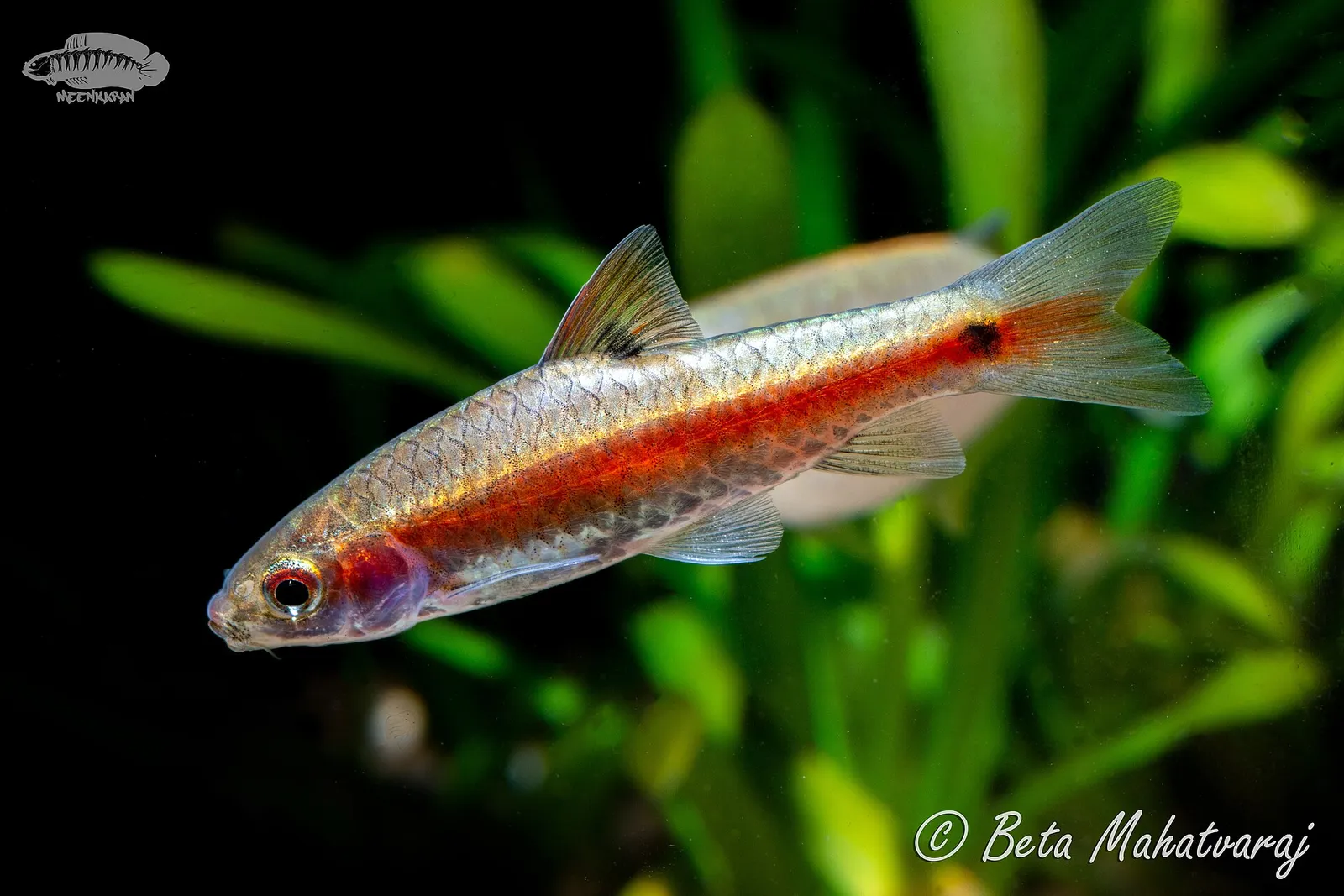
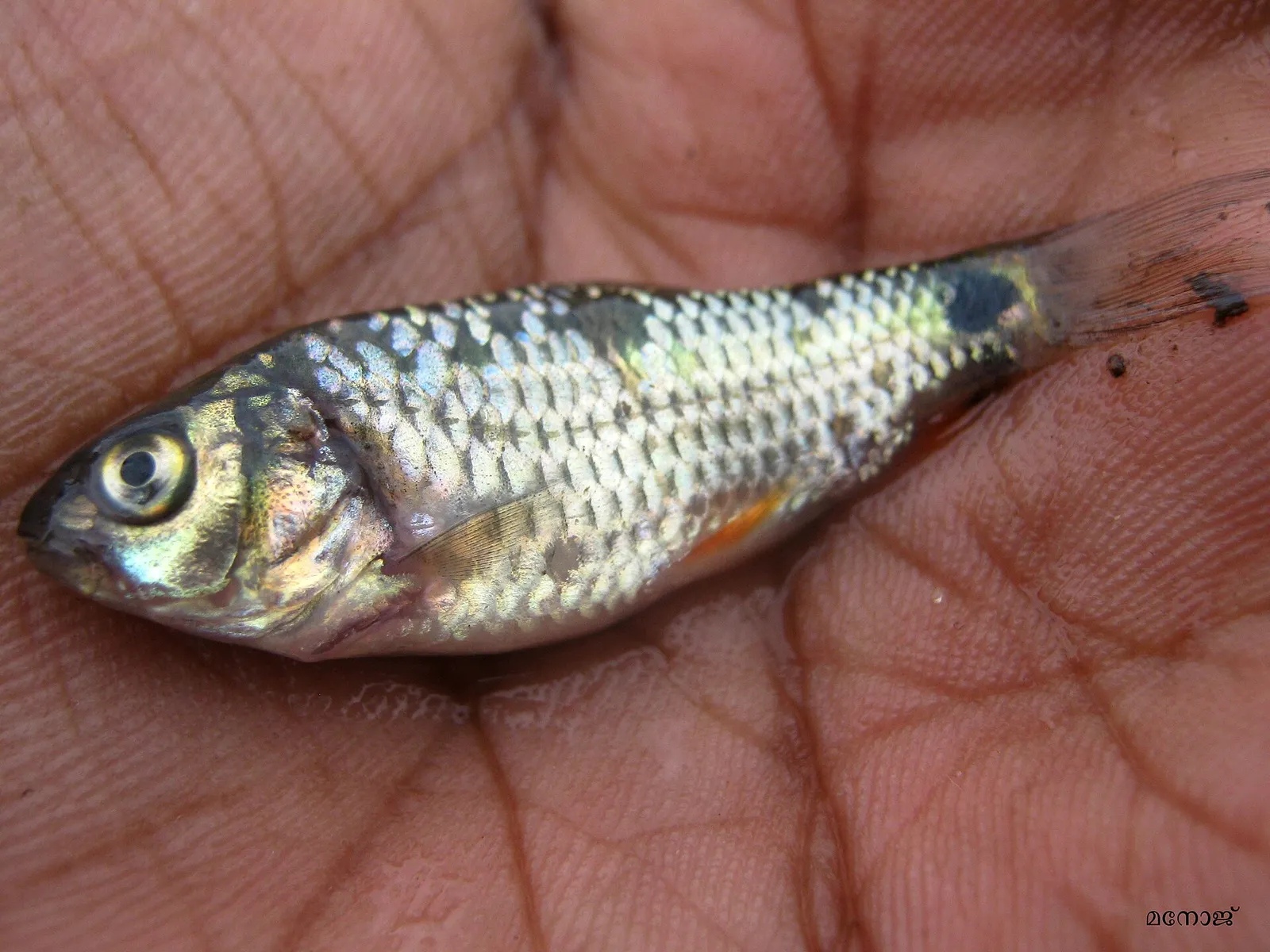
Plesiopuntius bimaculatus is a small barb reaching approximately 3 in in total length (FishBase), though aquarium specimens more typically reach 2 in standard length. The body is moderately deep and laterally compressed, with the streamlined, torpedo-like form suited to flowing water.
Colouration is silvery to yellowish, typically with two distinct dark spots — one at the shoulder behind the gill cover and one at the base of the caudal peduncle — that give the species its epithet. The flanks may show reddish or orange tones, particularly in mature males, which lends the fish its common name 'redside barb'. Fins are generally hyaline to faintly orange. Females become noticeably deeper-bodied when gravid, while males tend to be slimmer and may display more intense colouration during the breeding season.
Habitat
Plesiopuntius bimaculatus inhabits flowing hill streams, upland rivers, and their quieter reaches across peninsular India — including Tamil Nadu, Kerala, Karnataka, Andhra Pradesh, and Maharashtra — and throughout Sri Lanka, where it is recorded from the Nilwala River drainage among others. It is notably absent from lowland environments and is one of very few freshwater fishes documented in Sri Lankan mountain streams at elevations above 4,921 ft.
Water conditions in its native haunts are cool, clear, fast-flowing, and well-oxygenated. Seriously Fish records a temperature range of 64–75 °F, a pH of 6.0–7.5, and a hardness of 36–268 ppm, reflecting the range of substrates from soft hill streams to harder dry-zone rivers. FishBase gives a somewhat narrower thermal range of 72–75 °F for the species. The fish is a benthopelagic schooling species typically found over rocky or sandy substrates in clear-running water with moderate current.
Feeding
Plesiopuntius bimaculatus is an omnivore. FishBase records green algae and detritus as primary diet components, consistent with a grazing fish of rocky hill streams where aufwuchs is abundant. Seriously Fish broadens this picture to include diatoms, other algal matter, organic detritus, small insects, worms, crustaceans, and zooplankton — a typical opportunistic small-barb diet that adapts to whatever organic material is available in the current.
In the aquarium, the species accepts good-quality flake and micro-pellet foods readily. Regular offerings of live or frozen items such as daphnia, micro-worms, and brine shrimp nauplii keep the fish in good condition and encourage natural foraging behaviour. A vegetable component — blanched spinach, algae wafers, or spirulina-enriched foods — rounds out the diet and mirrors the algal grazing central to its wild feeding.
Mating
Like all barbs, Plesiopuntius bimaculatus is an egg-scattering, non-guarding spawner. There is no pair bond, no nest construction, and no parental care of any kind. Spawning is typically prompted by a rise in temperature or a generous feeding regime of live foods, and males in good condition intensify in colour as they compete to drive gravid females.
A ready male pursues a female through fine-leaved vegetation or over the substrate, the two pressing briefly together as eggs and milt are released simultaneously. The eggs are adhesive and sink or lodge among plants and gravel. Once spawning is complete the adults take no further interest in the eggs — and will readily consume them if given the opportunity.
Breeding
Plesiopuntius bimaculatus can be bred in captivity using methods standard for small egg-scattering barbs. A dedicated shallow spawning tank is recommended, with soft, slightly acidic to neutral water (pH 6.0–7.0) in the lower end of the thermal range (around 72 °F), fine-leaved plants or a spawning mop, and a mesh or marble substrate to allow eggs to fall out of the parents' reach.
Well-conditioned adults — ideally separated by sex for several days beforehand and fed on live or frozen foods — are introduced to the spawning tank, and spawning usually follows within a day or two. Eggs hatch in approximately 24–36 hours at suitable temperatures, and the larvae become free-swimming a few days later. At that point infusoria or commercial fry foods are appropriate, transitioning to freshly hatched brine shrimp nauplii as the fry grow. The adults should be removed after spawning is complete to prevent predation on the eggs and newly hatched larvae.
In the aquarium
Plesiopuntius bimaculatus is a peaceful, shoaling species best kept in groups of six or more. Seriously Fish recommends a minimum group of six to ten individuals; a larger shoal produces more natural behaviour and reduces any within-group squabbling. Its modest size and gentle temperament make it a good candidate for a community aquarium with similarly sized, non-aggressive species.
Because the species originates in cool, flowing hill streams, it performs best in well-filtered, well-oxygenated water with a moderate current and temperatures in the 64–75 °F range. A pH of 6.0–7.5 with soft to moderately hard water suits it well. Aquascape elements — smooth pebbles, some fine-leaved plants, and open swimming areas — reflect the rocky hill-stream habitat and are appreciated. The species is not demanding in terms of diet and will thrive on a varied menu of quality prepared foods supplemented with small live or frozen items.
Conservation
Plesiopuntius bimaculatus is assessed as Least Concern (LC) on the IUCN Red List, with the assessment dated 11 August 2019. The species has a reasonably broad distribution across peninsular India and Sri Lanka and is not considered to face any major range-wide threat at present.
Nonetheless, the freshwater ecosystems of the Western Ghats and Sri Lankan hill country are under sustained pressure from deforestation, agricultural run-off, sand mining, damming of rivers, and water abstraction — all of which degrade the clear, well-oxygenated hill streams that this species depends on. The species' presence in Sri Lankan mountain streams at very high elevations may make highland populations particularly vulnerable to watershed changes. While not currently threatened, ongoing monitoring of its upstream montane populations in the context of land-use change and climate-driven hydrology shifts is warranted.