Taxonomy & naming
Rohanella titteya was formally described by the Sri Lankan zoologist P. E. P. Deraniyagala in 1929, the parenthetical authority in the current combination marking that the species has been moved from his original genus placement. The Catalog of Fishes (Eschmeyer, CAS) records the valid name as Rohanella titteya (Deraniyagala, 1929), retaining the fish in Puntius rather than reassigning it to one of the post-2012 segregate genera erected by Pethiyagoda and colleagues — a reflection that the Sri Lankan lineage to which titteya belongs was not among the groups split out at that revision.
The specific epithet titteya is a Sinhalese vernacular name for the fish. In older and popular aquarium literature the species occasionally appeared under the trade name "cherry barb", which has never been formalised as a scientific synonym but is now the nearly universal English common name. No subspecies are recognised, though decades of ornamental breeding have produced albino, long-finned and other strains that circulate widely in the hobby.
This fish was long listed as Puntius titteya; Eschmeyer's Catalog of Fishes places the species in Rohanella, and the current combination Rohanella titteya is followed here.
Morphology
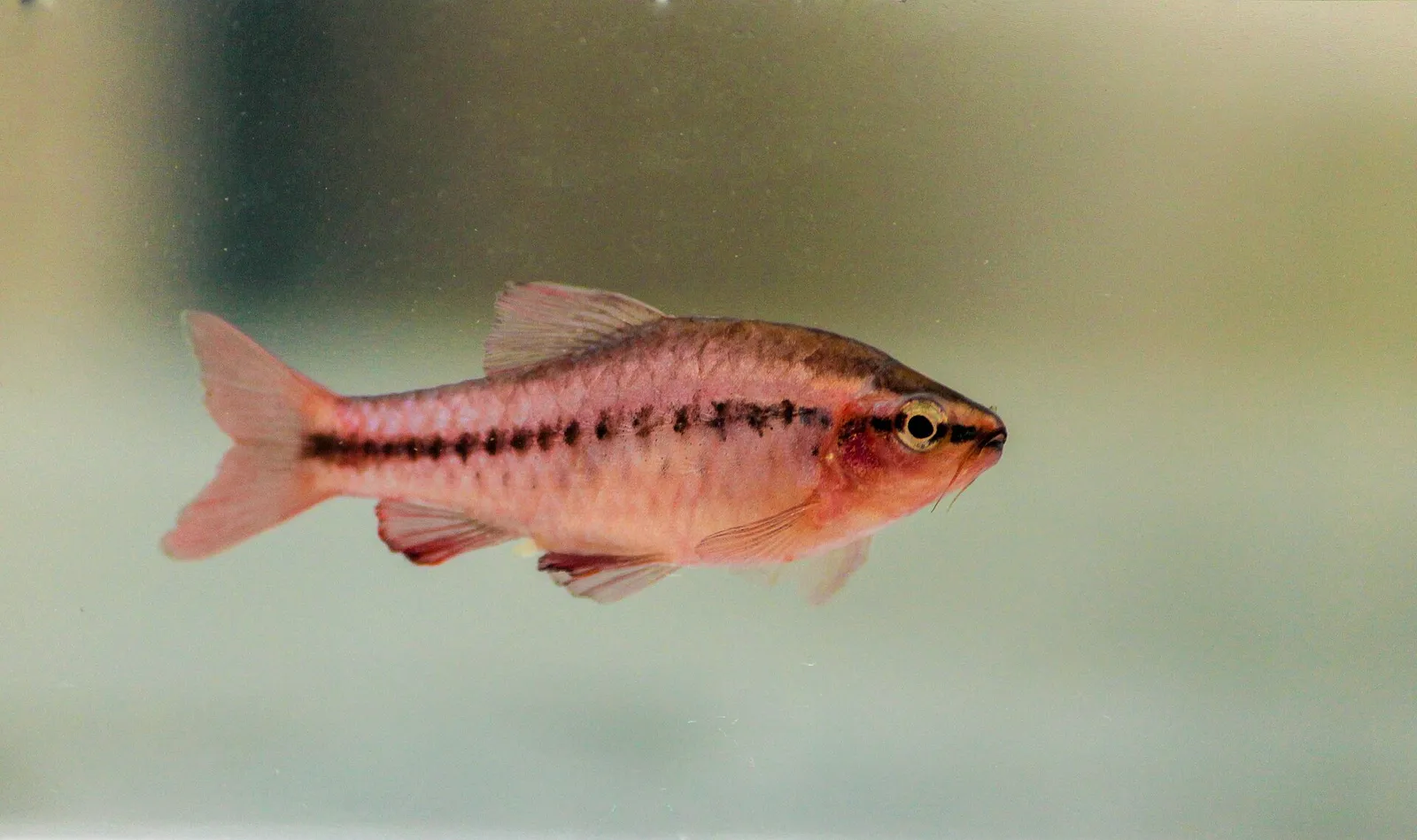
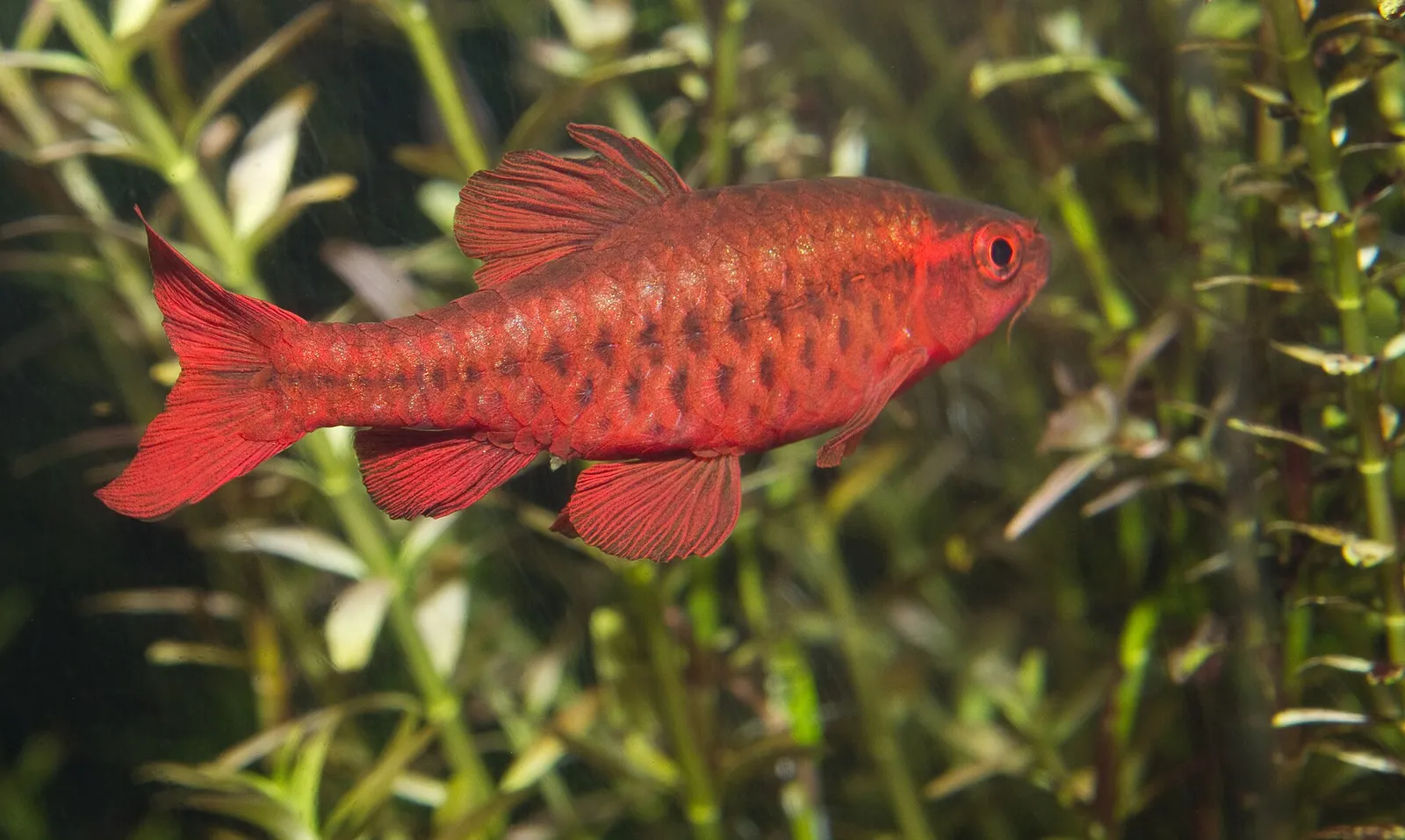
The cherry barb is a slender-bodied barb reaching about 2 in in total length, more elongate and less deep-bodied than many of its relatives. A single prominent dark lateral stripe runs from the tip of the snout to the base of the caudal fin; above this stripe the flanks are bronze-olive, below it cream to silver. The base of the lateral stripe, the fin bases, and the lower body often carry a faint iridescent sheen in good light.
Sexual dichromatism is pronounced. Males in spawning condition become intensely red over the entire body — the "cherry" of the common name — with the dark lateral stripe reduced to a contrasting bronze or maroon band. Females are a soft yellowish-brown, their lateral stripe remaining darker and more distinct, and their abdomens rounder when gravid. The difference is visible even in juveniles, and experienced hobbyists can often sex fish at around a centimetre of length. Aquarium albino strains lack the dark stripe and express a pale pink to cream colouration with red eyes.
Habitat
Rohanella titteya is endemic to the southwestern wet zone of Sri Lanka, recorded from the Kelani River basin in the north of the range through to the Nilwala basin in the south — a relatively narrow coastal lowland strip of perhaps 93 mi. Within this zone it inhabits heavily shaded, slow-flowing streams and rivulets, typically with soft silty or muddy substrates, dense leaf litter, overhanging riparian vegetation, and abundant submerged and emergent plant growth. The water is soft, stained by leaf tannins, and tends to be warm and sluggish — very different from the fast, clear highland streams preferred by many Asian barbs.
FishBase records a temperature range of 73–81 °F and a pH of 6.0–8.0 for the species, consistent with the Seriously Fish profile that notes approximately 77 °F and a hardness around 36 ppm as preferred conditions. The species is a benthopelagic shoaler; groups move through mid-water and just above the substrate in the filtered shade of forest or riparian cover, feeding and resting among leaf litter and root tangles.
Feeding
The cherry barb is an omnivore with a bias toward small invertebrates and organic surface films. In the wild it browses on diatoms, filamentous algae, and biofilm scraped from leaf litter and wood, and supplements this plant and detrital matter with small insects, zooplankton, and other tiny invertebrates encountered in the water column and on the bottom.
In the aquarium the species is straightforward to feed. It accepts high-quality flake and small pellets readily, and benefits from regular offerings of live or frozen foods — brine shrimp, daphnia, mosquito larvae, and micro-worm are all taken eagerly and help bring females into condition for spawning. Vegetable-based foods and spirulina flake should be included to reflect the algal component of the natural diet and to maintain body condition in captive fish.
Mating
Rohanella titteya is an egg-scattering, non-guarding spawner typical of the barb subfamily. There is no nest, no pair bond, and no territory held beyond the brief moment of courtship. A ready male — displaying the deepest cherry-red he can muster — pursues a gravid female persistently through fine-leaved vegetation or over substrate, pressing close alongside her and driving her through plant stems and root tangles.
At the peak of the chase the pair press together and simultaneously release eggs and milt, the adhesive eggs falling and clinging to plant leaves, root fibres, or settling into leaf litter below. The act may be repeated many times over several hours of a spawning session. Afterwards both fish lose interest in the eggs entirely, and given the opportunity will eat what they have just scattered — a behaviour universal in the barb family and one that drives the aquarium practice of removing adults after spawning.
Breeding
Cherry barbs breed readily in captivity and have been successfully maintained in the ornamental trade through captive reproduction for decades. A standard approach uses a separate shallow tank of soft, slightly acidic water (around 77 °F, pH 6.0–6.5) furnished with fine-leaved plants such as Java moss or spawning mops to catch the adhesive eggs; a layer of mesh or marbles at the bottom reduces egg predation by the adults. A conditioned pair or trio (one female, two males) is introduced and spawning typically follows within a day.
Females scatter a few hundred small adhesive eggs per session among the plants. Adults are removed promptly after spawning. The eggs are sensitive to fungus and benefit from a small amount of water movement and, optionally, a mild antifungal treatment. At 77 °F eggs hatch in approximately 24–48 hours; the fry become free-swimming within two to three days and are initially fed infusoria or commercial fry foods, progressing to newly hatched brine shrimp nauplii. Growth is moderately rapid. Commercially farmed stocks — including albino and long-finned strains — are produced at scale in Asia and Eastern Europe and supply the global ornamental trade.
In the aquarium
The cherry barb is one of the more beginner-friendly barbs: small, peaceful, robust, and easy to feed. It is best kept in groups of six or more — the shoaling instinct is strong, and individuals kept alone or in pairs become shy and pale. In a group the males interact in restless, low-level display, their red intensifying whenever a female is present, producing a dynamic and colourful spectacle without the fin-nipping aggression associated with more pugnacious barbs.
A setup reflecting the natural habitat — soft, slightly acidic water at 73–81 °F, subdued or dappled lighting, plenty of fine-leaved planting, and a dark substrate that deepens the red colouration — suits the species well. It is compatible with other peaceful small fish: small tetras, rasboras, dwarf cichlids, and bottom-dwellers such as Corydoras are all suitable companions. Its calm temperament and modest size make it one of the few barbs that works reliably in a planted community tank with delicate species. The wide availability of captive-bred stock means wild fish need not be purchased.
Conservation
Rohanella titteya is assessed as Vulnerable (VU) on the IUCN Red List, with the current version of the assessment dated to 2019 (version 2025-2) noting a decreasing population trend. The species is endemic to a narrow strip of southwestern Sri Lanka — the wet-zone basins from the Kelani in the north to the Nilwala in the south — and this restricted range has been heavily modified by agriculture, urbanisation, and infrastructure development over the past century.
The primary threats are habitat loss and degradation: the shaded, slow-flowing forest streams that the cherry barb requires have been cleared for paddy cultivation, cinnamon and rubber estates, and human settlement throughout the lowland wet zone. Hydroelectric projects affecting Sri Lankan river systems, confirmed by field surveys as a significant threat in 2019, fragment and reduce available habitat further. Water quality degradation from agrochemical runoff and domestic pollution is an additional pressure.
The ornamental fish trade historically drove collection of wild cherry barbs, but the current supply to the hobby is almost entirely captive-bred, which substantially reduces harvest pressure on wild populations. Despite this, the wild population continues to decline as its habitat contracts. Conservation of remaining wet-zone riparian forest in Sri Lanka's southwestern lowlands is the key requirement for the species' long-term survival in the wild.