Taxonomy & naming
Erpetoichthys calabaricus was described by the naturalist Andrew Smith in 1865 from the Old Calabar region, near the Nigeria–Cameroon border, and remains the sole species in its genus — the only living representative of Erpetoichthys. It sits in the family Polypteridae alongside the Polypterus bichirs, within the order Polypteriformes, the most basal surviving lineage of the ray-finned fishes (Actinopterygii). Like its bichir relatives it is a true living fossil, carrying a body plan and internal anatomy that predate almost everything else swimming today.
Older aquarium and scientific literature frequently refers to the species under the now-obsolete genus name Calamoichthys calabaricus, and this synonym still turns up on older tank labels and in older texts. Two anatomical characters set Erpetoichthys apart from every Polypterus bichir and justify its own genus: it entirely lacks pelvic (ventral) fins, and it lacks the subopercle, a small skull bone present in all Polypterus species — both are diagnostic, technical markers of just how far this lineage has diverged from its stockier cousins.
The common names track the fish's shape and habits: "reedfish" for the dense reed and marginal vegetation it lives among, and "ropefish" or "snakefish" for its long, cylindrical, limbless-looking body. The genus name Erpetoichthys is built from the Greek herpeton, a creeping animal or reptile, and ichthys, fish — literally "creeping fish," a fair description of how it moves. The species epithet calabaricus is a Latinised form of Calabar, marking the type locality.
Morphology
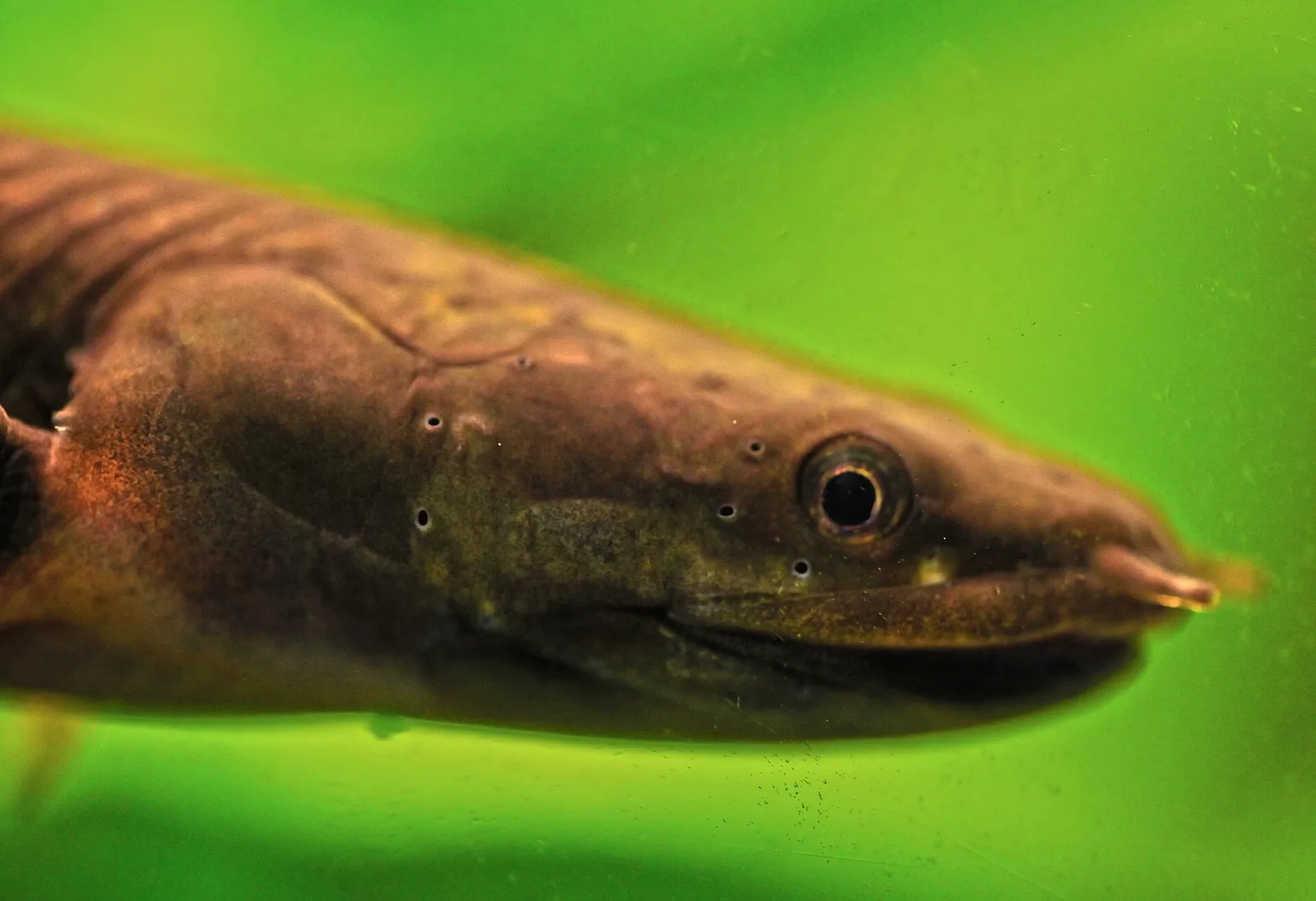
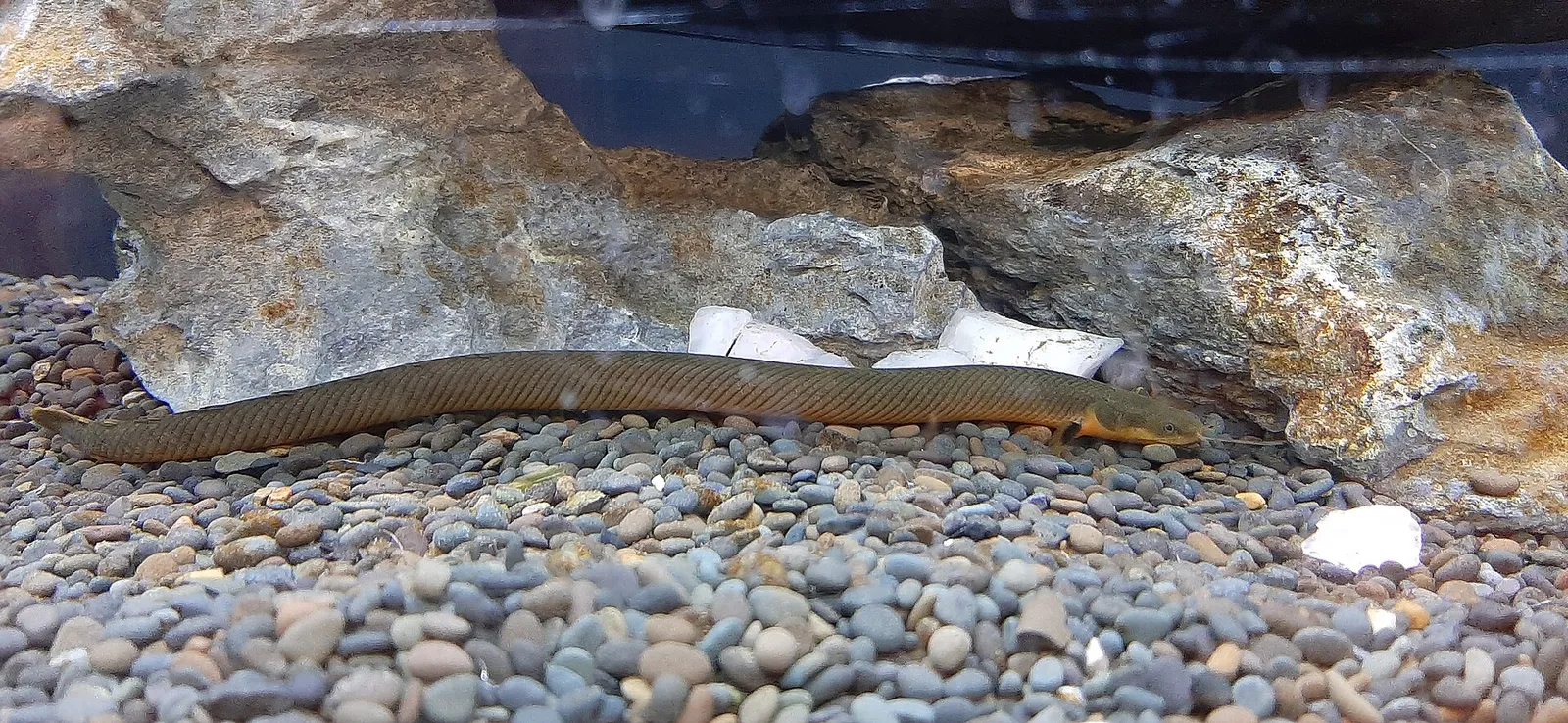
The reedfish's body is the most obviously distinctive feature in the family: long, slender and cylindrical, almost anguilliform (eel- or snake-shaped), quite unlike the more torpedo-bodied Polypterus bichirs. FishBase records a maximum total length of about 14.5 in, and aquarium accounts put typical adult size close to that figure — a modest size for a bichir, but a long, slim one. Colouration is a plain olive to brownish-grey above, paling toward a cream or yellowish belly, with no strong pattern.
As in every Polypteridae, the skin is sheathed in heavy, interlocking ganoid scales — rhombic bony plates capped with a hard, enamel-like layer — that form a flexible suit of armour running the length of the body. Along the back runs the family's signature row of separate dorsal finlets, each a short spine trailing a flag of membrane; in Erpetoichthys the count runs from about 7 to 13, useful as an identification character. Unlike Polypterus, the reedfish has no pelvic fins at all, and internally it lacks the subopercle bone — both losses that go with its more elongated, less limb-propped way of moving. It retains the same pair of primitive lungs behind the gills that defines the whole family, breathing air gulped at the surface as a facultative supplement to gill respiration, and like its relatives it has poor eyesight and hunts largely by smell.
Habitat
The reedfish is a coastal West African endemic with a narrow range compared to the widespread Polypterus bichirs: FishBase records it from river estuaries between the Ouémé River in Benin and the Sanaga River in Cameroon, while the IUCN assessment describes its core range as effectively restricted to three river systems — the Ouémé in Benin and the Ogun and Cross Rivers in Nigeria. It is a fish of slow-flowing rivers, standing swamp water and reedy, densely vegetated margins, exactly the habitat its common name describes.
As in the rest of the family, its facultative air-breathing is an adaptation to these warm, still, often oxygen-poor blackwater habitats, where a fish that can rise and gulp air at the surface can persist long after gill-only fish would struggle. It is a nocturnal species, spending daylight hours hidden among reeds, roots and marginal vegetation and becoming active to hunt after dark.
Feeding
Like the rest of the bichir family, the reedfish is a nocturnal ambush predator with poor eyesight and an acute sense of smell, which it uses to locate prey while moving slowly through cover after dark. Recorded prey includes worms, small crustaceans and aquatic insects — soft-bodied, slow-moving animals it can engulf whole with a quick snap of the jaws rather than run down.
In the aquarium it takes the same meaty foods that suit other bichirs — earthworms, prawn, mussel and bloodworm — and many individuals will learn sinking pellets over time. Because it hunts by smell rather than sight and moves deliberately, it can be out-competed by fast, bold tankmates at feeding time, so meaty food is often best offered after the lights go out or dropped close to where the fish is resting.
Mating
Erpetoichthys calabaricus shares the reproductive mode of the whole bichir family: external fertilisation built around a distinctive courtship. The male cups his thickened, muscular anal and pelvic-region fins — modified into a shallow pouch — beneath the female as she releases a few eggs at a time, fertilising them as they pass through the cradle before they are scattered, small and adhesive, onto plants and the substrate. As in other bichirs, the clearest sign of sex is this spawning apparatus: males carry a visibly broader, thicker anal fin than females. No pair bond or territory persists once spawning is finished.
Breeding
As in the rest of the Polypteridae, the reedfish is an egg-scatterer with no parental care: adhesive eggs are deposited among vegetation and left, and adults will consume both eggs and fry if given the opportunity. Larvae hatch bearing feathery external gills behind the head, much like a newt's tadpole, which are absorbed as the young mature.
Unlike the Senegal bichir, which is now farmed commercially with hormone induction, the reedfish has no established aquarium-breeding record — Seriously Fish notes no captive spawning has been documented — and essentially all stock in the trade is wild-caught. Its restricted natural range and the specific seasonal or flood cues that likely trigger spawning in the wild make it a much harder species to reproduce in captivity than its more adaptable, wide-ranging cousins.
In the aquarium
The reedfish needs a long aquarium scaled to its snake-like body rather than a tall or narrow one — Seriously Fish recommends a minimum of around 145 US gal (roughly 59 in × 23.5 in × 23.5 in, or 60×24×24 inches) for an adult, furnished with dense planting or vegetation, a soft substrate, driftwood and hiding places, and gentle rather than strong water movement to reflect its slow-water native habitat. Suitable water is warm and on the soft, slightly acidic side: roughly 73–86°F, pH 6.0–7.5, and moderate hardness of about 5–20 dH.
A tight-fitting, gap-free lid is not optional. The reedfish's slender, limbless-looking body lets it push through gaps that would stop a stockier Polypterus, and it is widely regarded as the most accomplished escape artist in the whole family — a fish found dried on the floor is the single most common way keepers lose one. The lid must still leave the fish clear access to the surface to breathe air. It is a predator that will swallow any tankmate small enough to fit in its mouth but is otherwise peaceful with similarly sized fish, and its ganoid armour makes it a hardy, relatively disease-resistant aquarium resident once settled — though nearly every individual in the trade is wild-caught rather than farm-raised.
Conservation
Erpetoichthys calabaricus is assessed by the IUCN Red List as Vulnerable, under criteria B1ab(ii,iii) reflecting a small, fragmented geographic range. Unlike the broadly distributed Senegal bichir, the reedfish's known range is effectively confined to a handful of river systems — the Ouémé in Benin and the Ogun and Cross Rivers in Nigeria — which makes it far more exposed to local habitat loss.
The IUCN assessment identifies habitat degradation as the principal threat: conversion of wetlands and floodplain forest for oil palm plantations and agriculture, deforestation, and urban development around its coastal river systems. Because the species depends on reedy, vegetated margins and cannot simply relocate within a wider range the way a Sudano-Sahelian generalist bichir can, continued wetland loss across its narrow West African range is a genuine long-term concern, and the fact that the aquarium trade still relies entirely on wild-caught stock adds a further, if secondary, pressure.