Taxonomy & naming
Gymnarchus niloticus was described by the French naturalist Georges Cuvier in 1829. It is the only species in its genus and the only species in family Gymnarchidae, itself one of several families placed in the order Osteoglossiformes — the bonytongues, among the most ancient living lineages of bony fish, a deep-time radiation now scattered across four continents: South America (arapaima and the silver/black arowanas), Africa (Gymnarchus and the mormyrids), Southeast Asia (the Asian arowana) and Australasia (the saratogas). All bonytongues take their name from a bony, toothed structure on the floor of the mouth that bites against toothed plates on the roof of the mouth, an unusual dental arrangement found in no other group of fish. In the trade and older literature the aba is also known as aba aba or frankfish.
The genus name is usually parsed from Greek gymnos, "naked, bare", combined with a root referring to the tail or hindquarters — a nod to the fish's finless rear end, which simply tapers to a point instead of ending in the caudal fin every other freshwater fish has. The species epithet niloticus means "of the Nile", after the Nile basin population, even though the species' full range extends far beyond the Nile into West Africa. Because Gymnarchus is monotypic and structurally unmistakable, it is rarely confused with other fish at the genus level. It is, however, worth being precise about its relatives: Gymnarchidae is only distantly linked to the similarly elongate, knife-shaped Old World featherback knifefishes (family Notopteridae), which are also bonytongues, and it is entirely unrelated to the New World electric knifefishes of order Gymnotiformes — the aba's weakly electric, finless body plan resembles those groups only by convergent evolution, not common ancestry.
Morphology
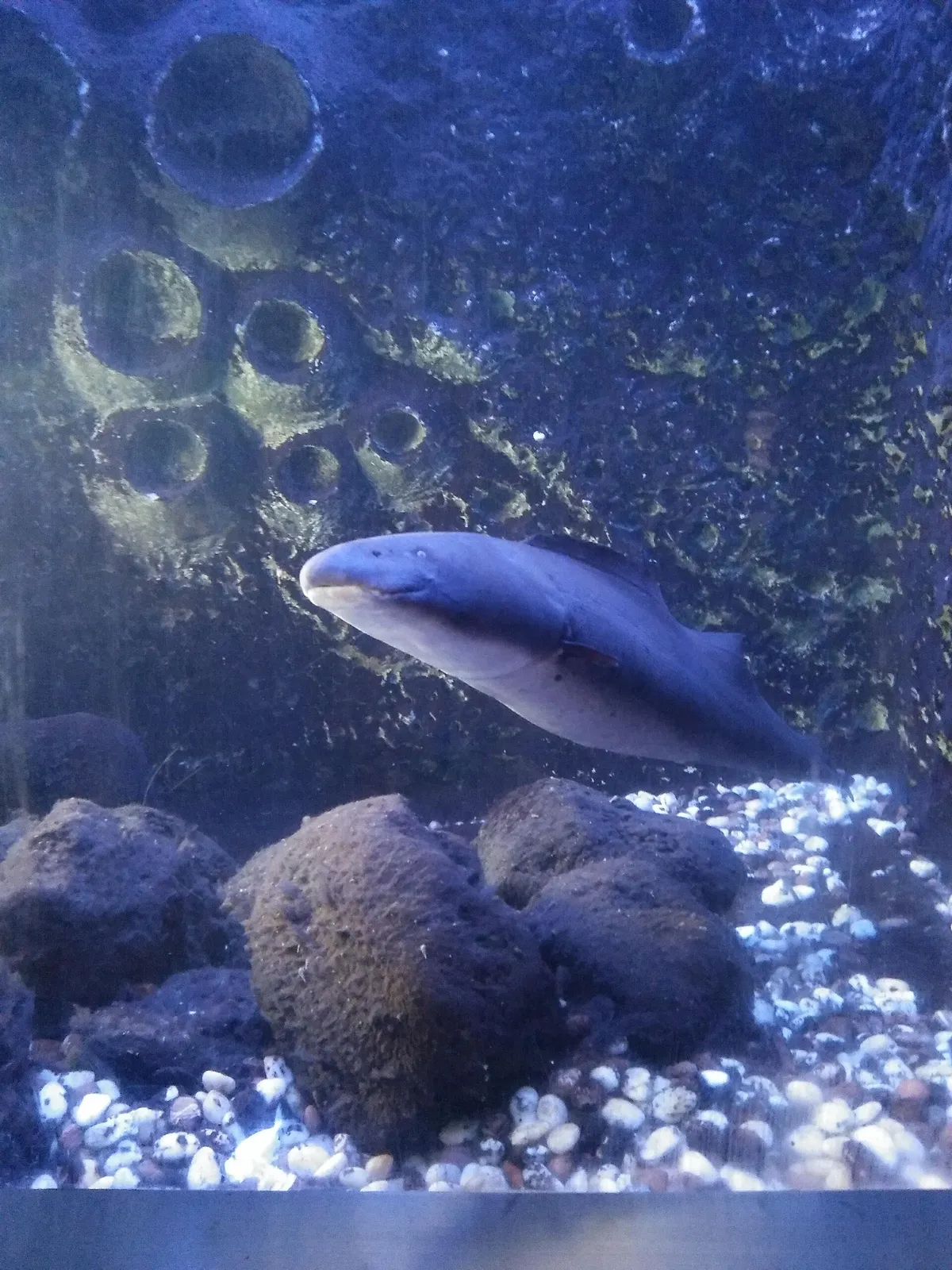
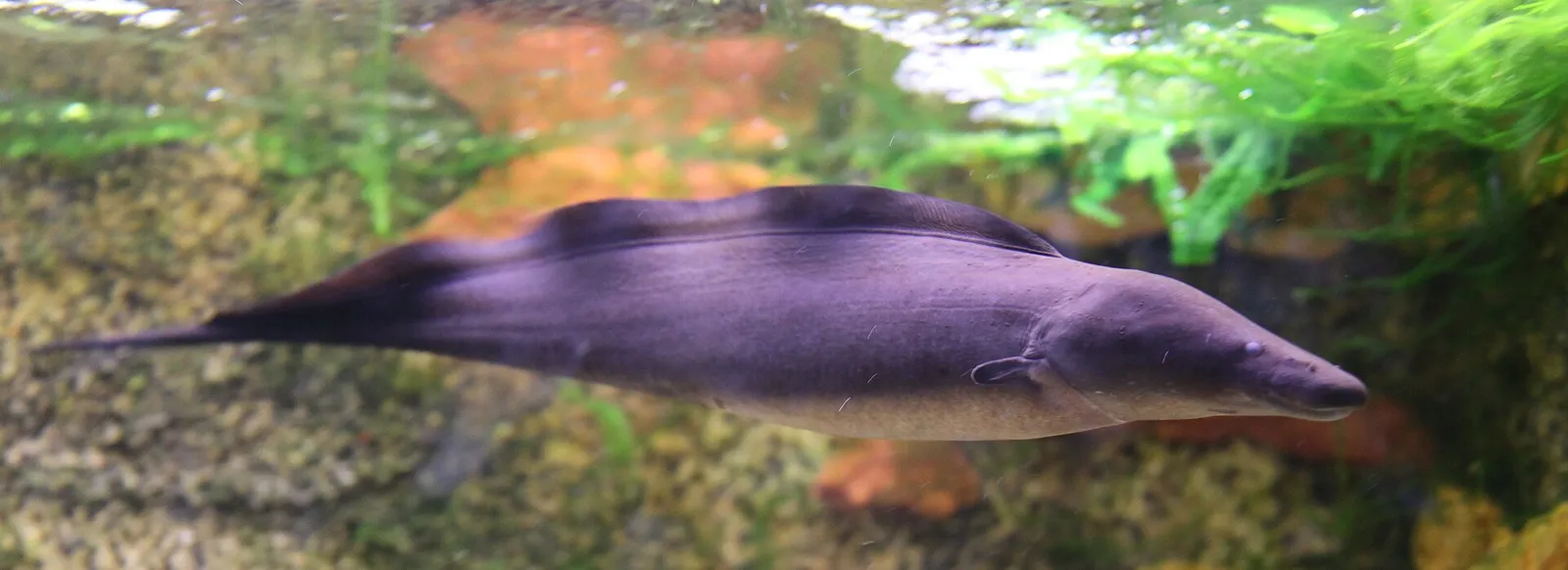
The aba has a body plan unlike almost any other freshwater fish: an elongate, cylindrical, eel-like form that tapers smoothly to a naked point at the tail, with no caudal fin and no anal fin whatsoever. Locomotion comes entirely from a long dorsal fin running most of the length of the back, which the fish undulates in a wave to move forward or backward with equal ease while holding its body rigid and straight — a posture that keeps the self-generated electric field around it stable and undistorted. The head is elongate with a modest mouth and small eyes; the body is covered in small cycloid scales, and coloration is a plain olive-brown to grey above, paling toward the belly, sometimes with faint vertical banding in younger fish.
The species is a weakly electric fish: an electric organ near the tail, built from modified muscle tissue, produces a near-continuous, high-frequency wave-type discharge — quite different from the intermittent pulses many mormyrid relatives use — which the fish reads through electroreceptors across its skin to locate obstacles, prey and other Gymnarchus in murky or vegetation-choked water where eyesight is of little use. Reported maximum size is around 65.5 in total length (FishBase; Seriously Fish gives a closely matching 65–65.5 in), making the aba one of the largest weakly electric fish in the world and a genuinely big predator, not a novelty-sized oddball.
Habitat
Gymnarchus niloticus is African and nowhere else, but it spans two widely separated drainage systems on the continent. In West Africa it is recorded from the Senegal, Gambia, Volta, Niger and Lake Chad basins, reaching countries including Senegal, Mauritania, Gambia, Sierra Leone, Ghana, Benin, Nigeria, Niger, Cameroon and Chad. Separately, in East Africa, it occurs through the Nile River basin and in Lake Turkana, extending into Sudan, Egypt and Kenya. It does not occur in the great rift lakes of East Africa (Malawi, Tanganyika, Victoria) or anywhere outside Africa.
Within those basins it favors slow-moving streams, vegetated swamps and seasonally flooded marshland rather than open river channel — habitat that is often warm and low in dissolved oxygen owing to dense plant growth and decay, which is part of why the species evolved to breathe air. Water conditions reported across its range run warm and only mildly mineralized: roughly 73–82 °F, pH 6.5–8.0, and moderate general hardness (around 10–25 °H per Seriously Fish) — not the hard, alkaline water of a rift lake, but the soft-to-moderate, tannin-tinted water typical of African floodplain swamp.
Feeding
The aba is an air-breather by necessity as much as by choice. It has a highly vascularized swim bladder that functions as an accessory breathing organ, and it rises to the surface at intervals to gulp air — an adaptation to the oxygen-poor swamps and flooded marsh it inhabits, where dissolved oxygen can run low even though the water itself is warm and productive. This means unobstructed access to the surface is a genuine physiological requirement, not just a preference.
It is a highly predatory carnivore, feeding chiefly on other fish and taking additional aquatic invertebrates opportunistically. Hunting is largely nocturnal and solitary: the aba relies on its continuous electric field to detect and track prey through dense vegetation and turbid water where vision offers little help, striking from ambush rather than actively chasing. In captivity it takes whole fish and other meaty frozen foods readily and needs no coaxing onto a carnivorous diet.
Mating
Gymnarchus niloticus breeds seasonally, timed to the flood pulse of its African wetlands. As rising water inundates marsh grasses and other floodplain vegetation, adults construct a large nest woven from aquatic plant material and anchored among the flooded growth at the surface — accounts describe nests on the order of a metre or more across, substantial enough to be a conspicuous feature of the flooded marsh. A mate is drawn to the finished nest to spawn.
The species is naturally solitary and aggressive outside the breeding season, and that combativeness intensifies sharply around the nest, where the guarding adult defends both the structure and the surrounding territory against intruders, including other Gymnarchus. Seriously Fish notes explicitly that this breeding behaviour has not been documented in home aquaria — unsurprising given that it depends on a flood-season marshland setting far beyond what any tank can replicate.
Breeding
Once the pair has spawned into the floating nest, a guarding adult — most accounts point to the male — stays close by and defends the nest fiercely against anything that approaches, a level of active, aggressive nest-guarding that stands out among the bonytongues generally, where many relatives (the mouthbrooding arowanas, the largely nest-indifferent mormyrids) invest parental effort very differently. The young that hatch are unusually large and, distinctively, bear long external filaments extending from the gill region — a striking, almost larval-fish-out-of-water look that persists until the gills and the accessory air-breathing swim bladder mature enough to take over respiration on their own.
Because this whole reproductive strategy hinges on a large, flood-season, open-water nest defended within a natural marsh territory, it has essentially never been reproduced in captivity, home or public. Virtually every aba seen in the aquarium trade or on public display is wild-collected rather than captive-bred, and detailed breeding biology beyond nest construction and guarding remains sparsely documented in the literature surveyed here.
In the aquarium
Be blunt about scale before anything else: an adult aba can reach roughly 5–6 ft total length, and Seriously Fish puts the minimum realistic tank volume at over 2,115 US gal. That is a public-aquarium fish, not a home-tank prospect — very few private keepers have the footprint, filtration capacity, or ability to source large enough whole-fish meals to responsibly keep one to adulthood. Where it is kept, dim lighting and dense planting or cover mimicking its native swamp vegetation suit it, and unobstructed access to the surface is a physiological necessity, not decoration, since it must breathe air.
Temperament reinforces the size problem: this is a solitary, territorial, highly predatory fish that is aggressive toward its own kind and will eat any tankmate small enough to swallow, so it is essentially a species-only exhibit. Water should track its native swamp and floodplain chemistry — roughly 73–82 °F, pH 6.5–8.0, moderate hardness — rather than the harder, more alkaline water associated with many other African cichlid and mormyrid setups. Given the combination of adult size, predatory needs, and specialist husbandry, the aba is best regarded as a public-aquarium and dedicated-specialist fish rather than a general hobby species.
Conservation
The IUCN Red List assesses Gymnarchus niloticus as Least Concern, an assessment reflected consistently across FishBase, Seriously Fish, GBIF and other sources reviewed for this profile. That status fits a fish with a genuinely wide range spanning two separate major African drainage systems — the West African rivers from Senegal to Lake Chad, and the Nile basin together with Lake Turkana in the east — rather than a narrow, single-basin endemic vulnerable to one localized threat.
No dedicated population-trend study surfaced in the sources consulted here, so this profile makes no claim about range-wide trajectory beyond the current Least Concern status. As with many wide-ranging African wetland and floodplain fish, the general long-term pressures on its swamp and marsh habitat — drainage, damming that alters the seasonal flooding it depends on for breeding, and sedimentation — are the plausible concerns worth watching, even though the species is not currently considered threatened.