Taxonomy & naming
Tanichthys albonubes was described by the Chinese ichthyologist Lin Shu-Yen in 1932. It belongs to the family Danionidae (the danios and their relatives), within the small genus Tanichthys, which also contains T. micagemmae and, depending on classification, the recently split-off genus Alligarina. The Catalog of Fishes (Eschmeyer, California Academy of Sciences) treats Tanichthys albonubes as the valid combination.
According to the often-repeated origin story, the species was first collected around 1930 by a young Chinese Boy Scout named Tan Kam-fei on White Cloud Mountain (Baiyun Shan) near Guangzhou (Canton), and brought to the attention of a local aquarium dealer and, subsequently, to Lin for formal description — a story that gives the genus its name: Tanichthys, combining the collector's surname Tan with the Greek ichthys (fish). The species epithet albonubes is Latin, from albus (white) and nubes (cloud), directly referencing the White Cloud Mountain type locality. Approximate pronunciation: tan-IK-thiss al-boh-NOO-beez.
Morphology
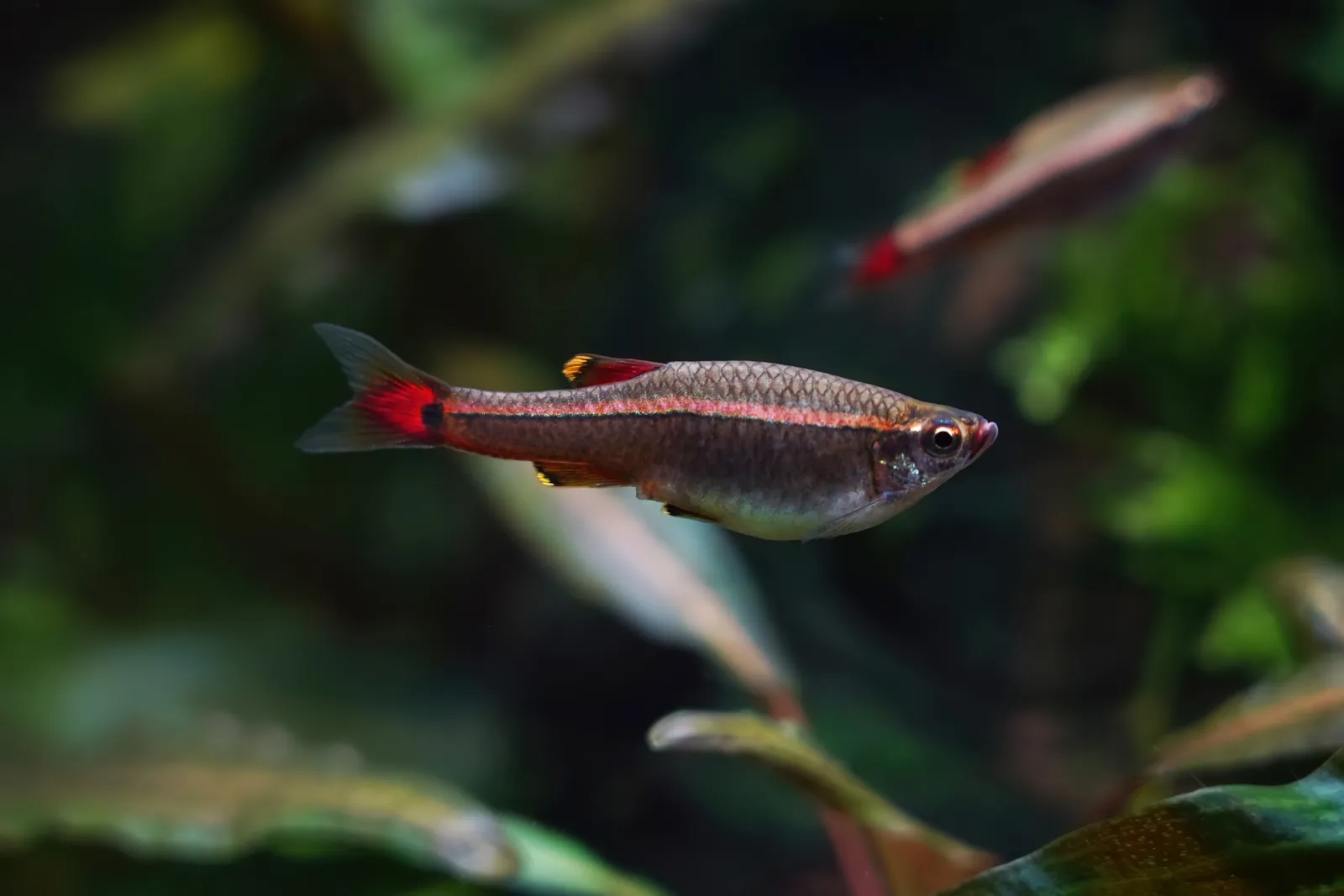
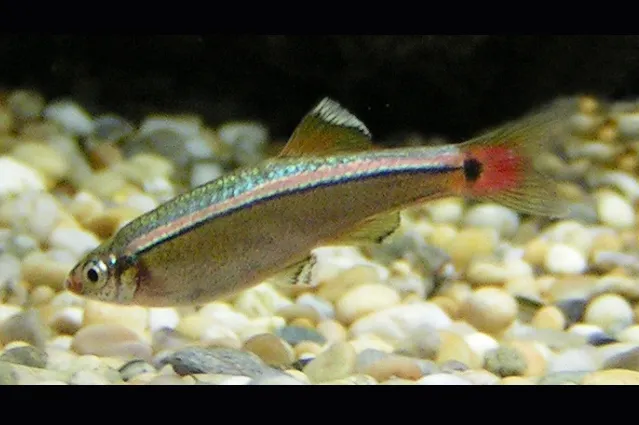
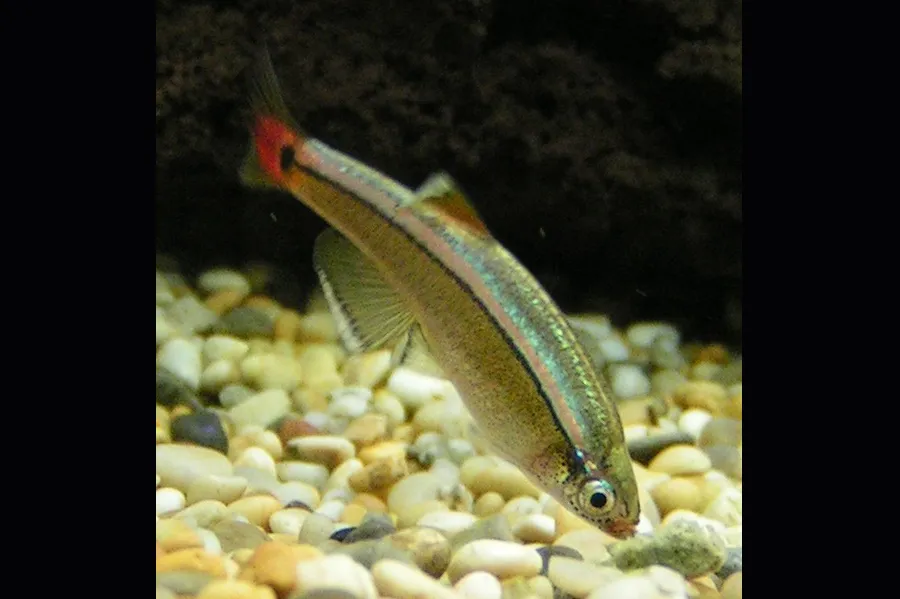
The White Cloud Mountain minnow is a slender, torpedo-shaped micro-cyprinid reaching only about 1.5 in in length. The body is olive to golden-brown along the back, with a bright, iridescent gold-to-green horizontal stripe running from behind the eye to the base of the tail, above a paler, silvery belly. The dorsal and caudal fins carry red tips, and males typically show more intense fin colour and a slightly more slender profile than females.
Selectively bred aquarium strains have expanded on the wild colour pattern considerably, including long-finned forms and a gold (xanthic) variant with much-reduced dark pigment; the standard wild-type pattern described above remains the most widely kept form.
Habitat
Tanichthys albonubes is native to hill streams around White Cloud Mountain near Guangzhou in Guangdong Province, southern China, and to related populations described from parts of northern Vietnam. It occupies clear, cool, well-oxygenated streams and pools at moderate elevation — a habitat notably cooler than the tropical lowland waters typical of most popular aquarium fish, which is the basis for the species' famous cold tolerance.
The original White Cloud Mountain population is generally considered lost to urban development, pollution, and overcollection for the aquarium trade during the twentieth century, though the species persists in the wild at other Chinese and Vietnamese localities to varying degrees, and its captive-bred population is enormous and self-sustaining worldwide.
Feeding
In the wild, Tanichthys albonubes is an omnivore, taking small aquatic invertebrates, insect larvae, and algae or plant material from the water column and among vegetation. In the aquarium it is an easy, unfussy feeder, readily accepting high-quality flake and micro-pellet foods as a staple, with live or frozen foods such as baby brine shrimp, daphnia and micro-worms taken eagerly and useful for conditioning breeding stock.
Mating
Males are generally more slender and more intensely coloured, especially in the red fin markings, while females are noticeably deeper-bodied, particularly when carrying eggs. Courtship consists of the male displaying and chasing the female through fine-leaved plants or spawning mops, in a manner typical of egg-scattering cyprinids, without any nest-building or pairing behaviour.
Breeding
Tanichthys albonubes is famously one of the easiest egg-laying aquarium fish to breed. It is a continuous egg-scatterer: adults release adhesive eggs among fine-leaved plants or spawning mops over an extended period, with no parental care and a strong tendency to eat their own eggs and fry, so separating adults from a spawning setup (or providing dense plant cover) is the main breeding technique.
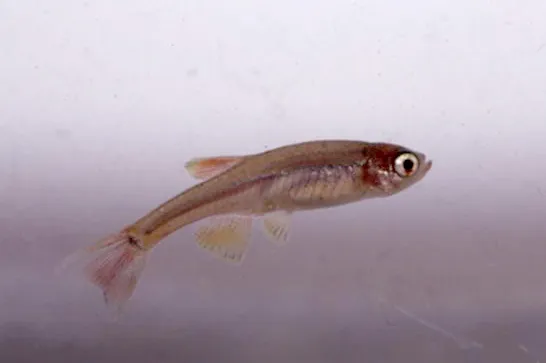
Eggs hatch in roughly 1–2 days at typical room temperature, and fry are large enough to take fine dry foods or freshly hatched brine shrimp within days of becoming free-swimming. Because the species tolerates a wide, cool-to-warm temperature range, breeding does not require the heated conditions many other egg-scatterers need, which is part of what makes it such a reliable beginner breeding project.
In the aquarium
The White Cloud Mountain minnow is often recommended as one of the best true beginner fish: hardy, peaceful, inexpensive, and — unusually for a popular tropical-looking aquarium fish — genuinely comfortable at room temperature, tolerating a range from roughly 64–79 °F without a heater in many climates, and reportedly surviving brief exposure to near-freezing conditions in the wild. It is an active schooling fish and should be kept in groups of six or more, in a planted tank of 10 US gallons or more, alongside other small, peaceful fish or invertebrates.
Its cold tolerance also makes it a popular choice for outdoor tubs and unheated ponds in temperate climates during warmer months, and for coldwater community setups alongside fish like White Cloud-tolerant shrimp species. It is not a fussy eater or a demanding fish in terms of water chemistry, adapting to a broad range of pH and hardness, which is part of its enduring popularity.
Conservation
Tanichthys albonubes carries a CARES Fish Preservation Program priority listing of Extinct in the Wild (CEW), reflecting the loss of the original White Cloud Mountain population to habitat degradation, pollution and overcollection during the twentieth century. The IUCN Red List takes a more cautious line: its assessment of 15 December 2010 lists the species as Data Deficient, because small populations are reported to persist at other localities in China and Vietnam and the status of those populations is not well enough known to judge. The type locality itself is generally considered lost.
The species is a textbook case of the gap between abundance in captivity and status in the wild: it is bred by the million on fish farms worldwide and is among the cheapest, most widely available aquarium fish anywhere, while the wild population that gave it its name and its story has all but disappeared. Hobbyists cannot meaningfully affect its wild fate through captive breeding alone, but maintaining genetically diverse wild-type stock — rather than only the heavily line-bred long-fin and gold strains — helps preserve some of the species' original character.