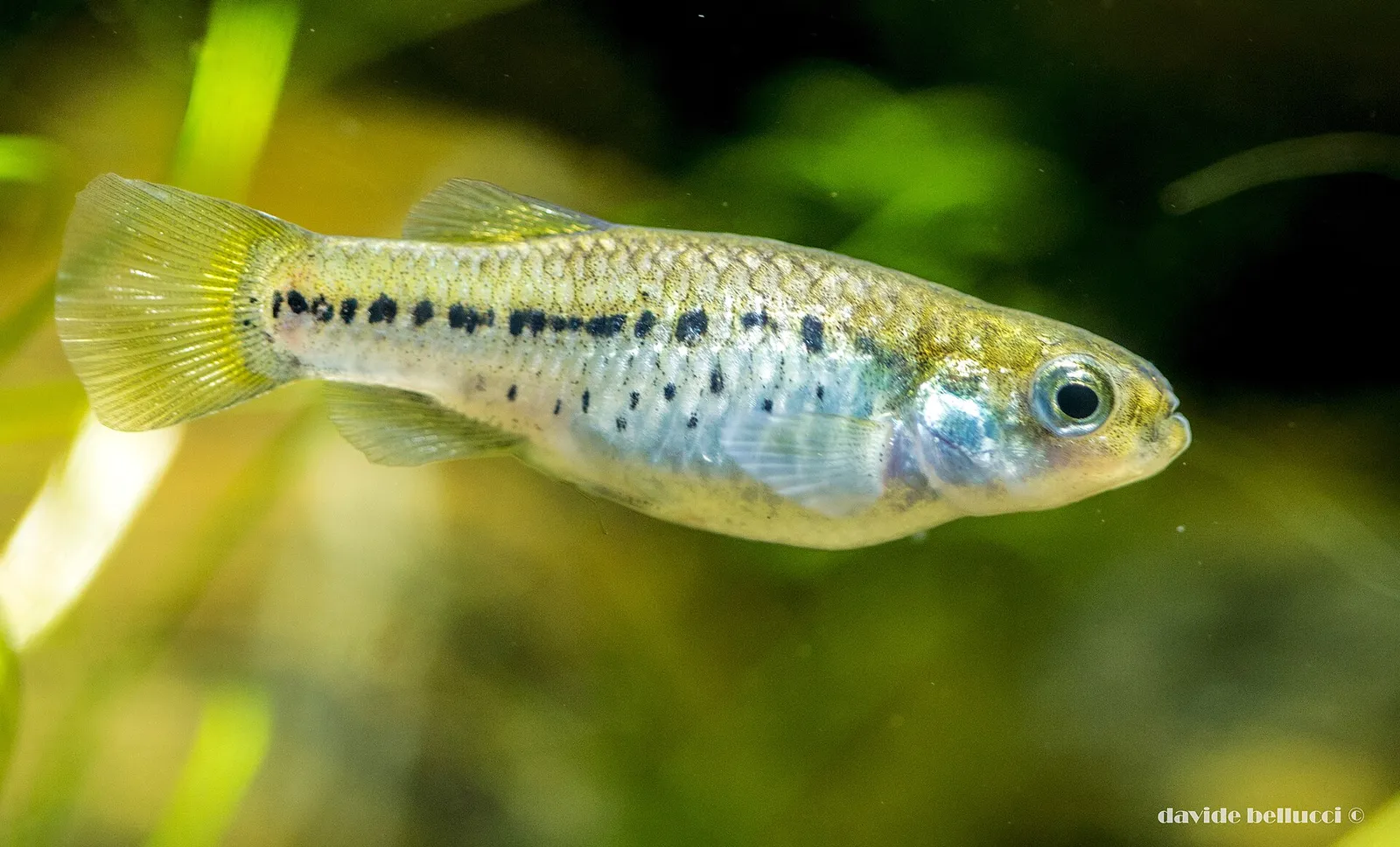
Taxonomy & naming
Aphanius almiriensis was described in 2007 by Maurice Kottelat, Costas Barbieri and Maria-Ekaterini Stoumboudi, part of a wider revision of the eastern Mediterranean Aphanius fasciatus species complex that split several previously lumped local populations into distinct species once morphological and genetic sampling covered the isolated spring systems of Crete and the Peloponnese individually. The specific epithet almiriensis is a toponym, referring to the Almiros wetland near Agios Nikolaos in eastern Crete, the only place the species is known to occur. Eschmeyer's Catalog of Fishes lists Aphanius almiriensis (Kottelat, Barbieri & Stoumboudi, 2007) as a valid species within the family Aphaniidae.
The genus Aphanius as a whole has been substantially reorganised over the past two decades, with several eastern and southern lineages split into satellite genera (Aphaniops, Apricaphanius, Anatolichthys and others). Aphanius almiriensis has, at the time of writing, remained in the core genus Aphanius, alongside the type species A. fasciatus and other Mediterranean-basin toothcarps.
Morphology
Like other members of the genus, Aphanius almiriensis is a small, deep-bodied killifish with a blunt head and an upturned mouth suited to feeding at or near the surface. Detailed published morphometrics specific to this species are sparse, but Aphanius fasciatus-complex fish typically reach 1.5–2.5 in, with males somewhat smaller and more brightly patterned than females.
Sexual dimorphism follows the pattern general to the genus: males carry a series of narrow silvery or bluish vertical bars on a darker body, sometimes with a yellow-orange wash to the fins, while females are plainer, greyish-brown, and rounder-bodied when carrying eggs. Precise counts of bar number or fin-ray formulae for A. almiriensis specifically were not confidently available from the sources consulted here.
Habitat
The species is confined to the Almiros wetland near Agios Nikolaos, a spring-fed brackish system on the north coast of eastern Crete where freshwater springs mix with seawater intrusion close to the coastline. This habitat type — small, warm, mineral-rich coastal springs and their associated marshes — is characteristic of several other narrowly endemic Aphaniidae around the Mediterranean and Aegean basins, most of which face similar threats from coastal development.
Water chemistry at Almiros-type sites is typically hard, alkaline and brackish, with salinity fluctuating seasonally as spring discharge and sea-water intrusion vary. As with related species, Aphanius almiriensis is presumed non-migratory and entirely dependent on this single wetland remaining hydrologically intact; there is no other documented population.
Feeding
No species-specific dietary study is available, but the genus Aphanius as a whole is omnivorous, taking algae, diatoms, detritus and small invertebrates such as chironomid larvae and micro-crustaceans from the substrate and water column. Given the productive, algae-rich nature of warm coastal spring wetlands, a similar diet is a reasonable inference for A. almiriensis, though this should be treated as an extrapolation from the genus rather than a confirmed fact for this species.
Mating
Detailed observations of courtship and spawning in Aphanius almiriensis specifically have not been published. Other Aphanius species are non-annual, iteroparous plant- and substrate-spawners: males display to females with intensified colour and flared fins, and pairs deposit small numbers of adhesive eggs on algae, gravel or vegetation over an extended breeding season rather than in a single mass-spawning event. There is no reason from the available literature to expect A. almiriensis to depart from this pattern, but it has not been directly confirmed.
Breeding
There is little published information on captive breeding of Aphanius almiriensis specifically. Congeners of similar size and habitat are considered straightforward to breed given hard, alkaline, mildly brackish water and fine-leaved plants or spawning mops as an egg-deposition substrate, with eggs hatching in roughly 10–14 days at warm-temperate temperatures. Given the species' critically small wild range, any captive population held for conservation purposes would be of considerable value as an insurance stock, but data sparse — no established hobbyist breeding protocol specific to this species could be confirmed here.
In the aquarium
Aphanius almiriensis is essentially absent from the mainstream aquarium trade and is known almost exclusively to specialist killifish keepers and conservation biologists working on Mediterranean endemic fish. Any captive stock in circulation would need to be sourced from an accountable conservation-breeding programme rather than wild collection, given the species' single-locality range and Critically Endangered status. For anyone maintaining related Aphanius species, a hard, alkaline, lightly brackish aquarium (a small addition of marine salt) with stable warm-temperate temperatures and dense fine-leaved planting reflects the general habitat type this genus favours.
Conservation
Aphanius almiriensis is listed by the CARES Preservation Program at the Critically Endangered (CCR) priority level, reflecting its confinement to a single small wetland on the Cretan coast — precisely the kind of extreme range restriction the CARES program was designed to flag for dedicated aquarium ark-keeping. The Almiros wetland near Agios Nikolaos faces the pressures typical of Cretan and wider Mediterranean coastal habitats: tourism infrastructure development, groundwater abstraction that reduces spring discharge, and the risk of introduced species such as mosquitofish (Gambusia spp.) altering the balance of a very small, closed system.
Because the entire species exists in one location, any single adverse event — a pollution incident, further habitat modification, or a sustained drop in spring flow — could have consequences for the whole population. Maintaining accountable captive populations through programs like CARES, alongside habitat protection at the Almiros site itself, is central to the species' long-term prospects. The IUCN Red List reaches a different verdict from a different question: its assessment of 10 November 2022 lists the species as Least Concern. The two are not in conflict — CARES ranks a species by how urgently the hobby should hold an ark population, while the Red List judges global extinction risk — but the gap is worth knowing when reading either label.