Taxonomy & naming
Cobitis delicata was described in 1937 by the Japanese ichthyologist Niwa, whose name the genus Niwaella honours. It belongs to the family Cobitidae, the true or spined-and-pond loaches — the group that also holds Cobitis, Sabanejewia and the dojo (weather loach) Misgurnus. Niwaella is a small genus endemic to Japan, and delicata remains its best-known member in the aquarium hobby, sold under the Japanese vernacular "ajime dojo" (roughly, "tasty loach"), a name that reflects its historical use as a food fish in its home rivers.
As with many Cobitoidea genera, the group has been reshuffled repeatedly by subsequent revision, but Cobitis delicata has remained a stable combination; the Catalog of Fishes governs the valid name, and no synonymy issue affects the species as currently recognised.
This fish was long listed as Niwaella delicata; Eschmeyer's Catalog of Fishes places the species in Cobitis, and the current combination Cobitis delicata is followed here.
Morphology
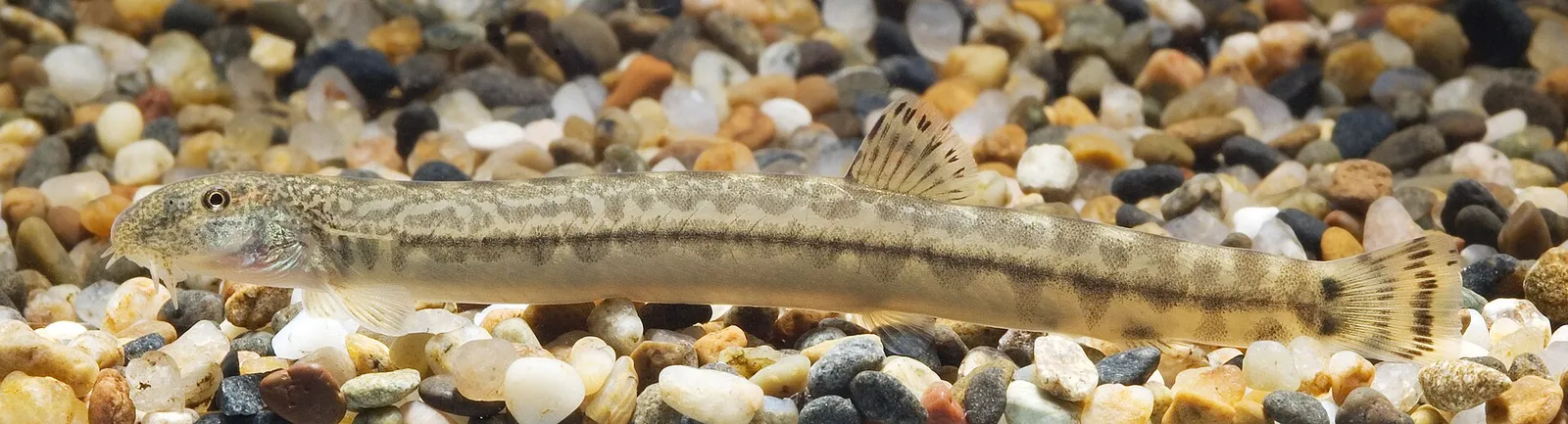
This is a true loach in every sense: a slender, subcylindrical body carrying the erectile suborbital spine that defines Cobitidae, tucked in a groove below the eye and flicked out defensively when the fish is threatened or handled. The skin is effectively naked, with tiny, deeply embedded scales rather than the visible scaling of many other freshwater fish — a trait that, as in its relatives, makes it markedly sensitive to medication.
Body patterning is variable across its small native range, with populations from the eleven documented river basins of central Honshu showing distinct marking variants along the flanks. Females run somewhat larger than males: reported sizes are around 3.5 in standard length in males and up to about 4.5 in total length in females, making this a modestly sized loach well suited to a moderate aquarium footprint.
Habitat
Cobitis delicata is endemic to central Honshu, Japan, known from the Agi River — a tributary system that also serves as the type locality — and roughly eleven river basins in the surrounding drainage. It lives in shallow, fast-flowing, highly oxygenated headwater streams over stone and gravel substrates, the kind of water more often associated with hillstream loaches than with the warm, slow rivers many other Cobitidae favour.
This is squarely a cool-water, temperate species — not tropical. It is adapted to relatively low, stable temperatures and strong current, and does poorly if treated as a warm tropical fish. Water is typically soft and slightly acidic to neutral. In the aquarium this translates into a need for strong circulation approximating the many turnovers per hour of its native riffles, rather than the gentle flow of a still community tank.
Feeding
In the wild, Cobitis delicata is a benthic grazer, browsing algae and the associated microorganisms and detritus from the surface of rocks in its fast-flowing home streams — a diet much closer to a hillstream algae-grazer than to the sand-sifting invertebrate hunting of many other loaches. It needs a mature aquarium with established algae growth on hard surfaces to forage naturally.
In captivity it accepts sinking pellets, algae wafers, quality flake, and frozen foods such as bloodworm, vitamin-enriched brine shrimp and daphnia, but excess protein should be avoided in favour of algae-based and vegetable foods that better match its natural browsing habit. Without a biofilm-covered surface to graze between feedings, this species can struggle to get adequate nutrition from prepared foods alone.
Mating
No reliable account of courtship or spawning behaviour exists for this species in the scientific literature or in aquarium records. Sexes can be told apart by size, with females growing larger and presumably heavier-bodied when in condition, following the general pattern seen in other Cobitidae, but no detailed dimorphic markers or courtship display have been documented.
Given its status as a temperate, spring-spawning family member by inference from close relatives, any breeding attempt would likely need to mimic seasonal cooling followed by a rise in temperature and flow — but this remains speculation, since the species has not been bred or observed spawning either in the wild or in the aquarium.
Breeding
Breeding in Cobitis delicata is unrecorded. As a member of the spined-and-pond loach family, the presumed mode — by analogy with related Cobitidae — is egg-scattering among plants or gravel with no parental care, the pattern documented in temperate relatives such as Cobitis and the dojo Misgurnus, several of which have been pond- or tank-spawned. The tropical members of Cobitidae, by contrast, generally have not been bred at all.
Cobitis delicata falls into neither camp with any documentation: no natural spawning has been described in the scientific literature, and no aquarium spawning has been reported. It should be treated, honestly, as a species that is essentially never bred in captivity — a specialist's display fish, not a breeding project.
In the aquarium
The single most important point in keeping this species well is temperature: it is a cool-water fish from fast Japanese headwaters, comfortable around 68–75 °F and reportedly at risk above 82 °F, so it should not be kept warm the way tropical loaches are. Strong water movement and high dissolved oxygen are equally important — aim for many times the tank volume in hourly turnover, replicating the riffle habitat it comes from, with soft, slightly acidic to neutral water (pH roughly 6.5–7.5).
A mature tank with algae-covered rock and gravel lets it forage as it would in nature; bare, sterile setups leave it underfed. Like other Cobitidae it is scaleless and sensitive to copper and full-strength medications, so any treatment should be at reduced dose and applied cautiously. At a modest adult size of well under 6 in it does not need a large footprint, but it does need current, cold-to-cool stability and clean, well-oxygenated water — conditions closer to a hillstream setup than a typical tropical community tank.
Conservation
Cobitis delicata is rated Vulnerable by the Japanese Ministry of the Environment's Red List, reflecting its very restricted natural range — confined to a handful of river drainages in central Honshu — rather than any single acute threat. The IUCN Red List's own global assessment currently lists the species as Least Concern.
As a narrow-range stream endemic tied to specific headwater drainages, the species is inherently vulnerable to habitat degradation, water quality decline and hydrological change within its limited home rivers. It has historically been used as a food fish locally (the name "ajime dojo" reflects this), and its presence in the aquarium hobby appears to rely on collection from these same wild populations rather than any established captive-breeding supply.