Taxonomy & naming
Salminus hilarii was described by the French zoologist Achille Valenciennes in 1850. It belongs to the family Bryconidae, subfamily Salmininae, within the order Characiformes, and to the small genus Salminus, which holds the true "dorados" — fast, predatory, salmon-like characins of South American rivers, of which the golden dorado Salminus brasiliensis (Paraná/La Plata) is the best known and largest. No prior or alternate valid genus combination is documented for this species; Salminus hilarii is the accepted name across taxonomic databases (EOL, GBIF, ITIS).
The genus name has occasionally been treated together with the trade name "dorado" for both S. brasiliensis and S. hilarii, and the two are sometimes confused in aquarium and fisheries literature since S. hilarii is essentially a smaller-bodied version of the same predatory, migratory life history. The type locality is the Rio São Francisco, Brazil.
Morphology
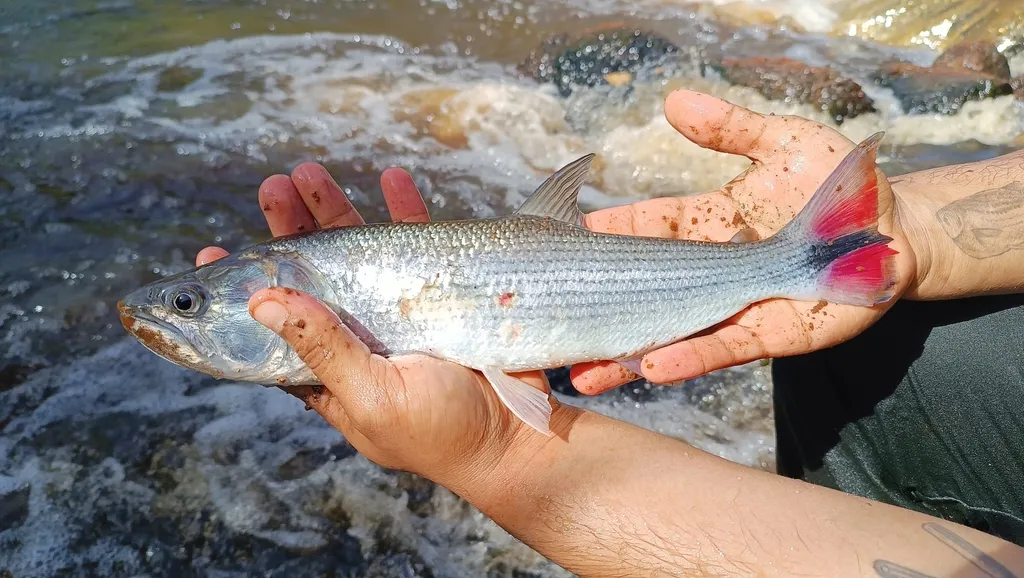
Salminus hilarii has the classic dorado build: a elongated, fusiform, laterally compact body suited to sustained fast swimming, a forked tail, and a mouth armed with well-developed, conical teeth reflecting its predatory habits. FishBase records a maximum length of 19.5 in standard length and a weight of up to 1.4 kg, making it a genuinely large characin, not a small tetra-sized fish — considerably smaller than the golden dorado, which can exceed 31.5 in and many kilograms, but still a substantial predator by aquarium standards.
Colouration is silvery overall with a golden-yellow sheen along the flanks and fins, giving rise to the "dorado" (golden) common name shared with its larger relative. The body is deep enough through the shoulders to show the powerful musculature typical of a strong-current, migratory fish.
Habitat
Salminus hilarii is native to South America, recorded from the Upper Paraná, São Francisco and Tocantins river basins, the upper Amazon, and the Orinoco basin, with confirmed occurrences in Argentina, Brazil and Paraguay. It is a freshwater, benthopelagic species and is potamodromous — it migrates entirely within fresh water, moving upstream into tributaries to spawn rather than moving to the sea.
Because its range spans both tropical Amazonian/Orinoco drainages and the more southerly, subtropical Upper Paraná and São Francisco systems, water temperatures it experiences in the wild vary more than a typical warm-Amazon species; populations in the southern part of the range see cooler seasonal water than Amazon tributaries. It favours flowing river habitat with strong current and high dissolved oxygen rather than still, sluggish water, consistent with its build and its need for open water to hunt and to complete upstream spawning migrations. In parts of its range, notably São Paulo State, habitat degradation from water pollution, dam construction and riparian destruction has led to regional conservation concern despite the species' otherwise wide range.
Feeding
Salminus hilarii is carnivorous, with FishBase assigning it a trophic level around 2.7, consistent with a fish that preys on smaller live fish as well as invertebrates. Aquarium and care-guide accounts describe it as a genuine predator: juveniles are typically brought onto cut tilapia, prawns, krill and bloodworms before being weaned onto large carnivore pellets, and most captive individuals can eventually be trained to accept prepared foods rather than requiring a diet of live feeder fish.
This is not an omnivorous grazer in the mould of the hemiodus or curimatid characins it shares habitat with — it is an active hunter, and its feeding regime in captivity needs to reflect that: meaty, protein-rich foods in quantity, matched to a metabolism built for sustained fast swimming in oxygen-rich water.
Mating
Courtship and pair formation in Salminus hilarii are not well documented in captivity, because reproduction in this species is tied to upstream migration rather than a controllable aquarium behaviour. Research on the species' reproductive physiology has found that ovulation in females does not occur without the upstream migratory trigger — the hormonal and physiological cascade that prepares this fish to spawn is bound up with the act of migrating into upper tributaries, not simply with temperature or water-chemistry cues that can be replicated in a tank.
No reliable external sexual dimorphism is documented for the species; data on the topic is sparse, and there is no consistent colour or fin-shape difference reported between males and females.
Breeding
Salminus hilarii is a potamodromous, long-distance migratory spawner: wild fish undertake upstream runs into tributary headwaters, and gonad maturation and ovulation are tied to that migration. This is not a species that spawns spontaneously in a home aquarium or even in a static pond — commercial and research aquaculture accounts describe reproductive dysfunction in captive broodstock kept without the migratory cue, meaning fish farms collect wild broodstock and transfer them to hatcheries where spawning is achieved only through artificial hormone induction and manual stripping, followed by controlled incubation of the eggs.
In short: Salminus hilarii is farm- and hormone-bred at a commercial aquaculture scale for food-fish and restocking purposes, and it is essentially not bred by hobbyists. Anyone encountering captive-produced fry or juveniles in the trade should assume they originated from a commercial hatchery programme rather than a home breeding project.
In the aquarium
Salminus hilarii is a large, fast, high-oxygen-demand predator and is not a beginner or small-tank fish. Care guides recommend a minimum footprint around 8 x 2 feet, with roughly 540 gallons (over 530 US gal) suggested as a realistic long-term home for one or two specimens — figures that place this species well outside typical home-aquarium scale and closer to a large specialist or public-aquarium setup. Strong flow and high dissolved-oxygen filtration are essential, mirroring the swift-current rivers it inhabits in the wild; stagnant, poorly oxygenated water is a poor match for this fish's physiology.
Diet should be varied and protein-rich — cut fish, prawns, krill and large pellets, with most individuals trainable off a live-food-only diet. Because of its size, speed and predatory nature, tankmates must be chosen carefully and should be robust, similarly fast fish too large to be viewed as prey; this is fundamentally a solitary-predator or very-large-system fish rather than a shoaling community species. As with any large predatory characin from migratory river systems, this species should never be released into open waterways.
Conservation
The IUCN Red List assessment for Salminus hilarii lists the species as Least Concern, reflecting its wide distribution across multiple major South American drainages (Paraná, São Francisco, Tocantins, upper Amazon and Orinoco basins) and its continued presence across that range. FishBase corroborates a Least Concern status, alongside a note of moderate vulnerability to fishing pressure and medium population resilience (an estimated population doubling time of 1.4 to 4.4 years).
The range-wide picture is not uniform, however: in São Paulo State the species has been locally classified as "Almost Threatened" due to water pollution, dam construction and riparian habitat destruction, pressures that are especially significant for a migratory fish whose reproduction depends on being able to reach upstream spawning grounds. Dams in particular are a documented threat pathway for potamodromous characins like this one, since they can block the very migrations the species needs to reproduce.