Taxonomy & naming
Hypostomus plecostomus was described by Carl Linnaeus in the tenth edition of Systema Naturae (1758), page 238, as Acipenser plecostomus — one of the remarkably few freshwater suckermouth catfishes to receive a Linnaean name. The type locality is the Suriname River, Suriname. A neotype (RMNH 182400) was designated by Boeseman in 1968, though FishBase notes that this designation 'may be invalid if the smallest specimen in NRM LP 32 is part of the type series.'
The species has accumulated a substantial synonymy over its naming history: Acipenser plecostomus (Linnaeus, 1758; original combination), Hypostomus guacari, Loricaria flava, Plecostomus bicirrosus, Plecostomus brasiliensis, Plecostomus plecostomus, and Pterygoplichthys plecostomus are all synonyms now subsumed under Hypostomus plecostomus. The genus Hypostomus was erected by Lacépède in 1803, from Greek hypo (under) + stoma (mouth) — 'under-mouth,' a direct reference to the ventral sucker-disc mouth.
The critical taxonomic issue is that 'plecostomus' has functioned as a vernacular name and a marketing label applied indiscriminately to virtually any large Loricariidae since the mid-twentieth century. In the aquarium industry, the trade name 'plecostomus' or 'pleco' covers at least five genera and several dozen species. The fish most commonly sold as 'common pleco' in retail shops worldwide are overwhelmingly Pterygoplichthys pardalis, P. multiradiatus, and to a lesser extent other Pterygoplichthys species — identifiable from true Hypostomus by their higher dorsal fin ray count (10 or more versus the 8 or fewer of Hypostomus). Other Hypostomus species (H. cochliodon, H. regani, H. punctatus, etc.) also circulate in trade under the pleco banner.
The true H. plecostomus has a restricted natural range in the coastal drainage of the Guianas and is not commonly collected for the trade; the fish most hobbyists call 'plecostomus' has probably never seen the Suriname River. Catalog of Fishes (Eschmeyer/CAS) lists H. plecostomus as valid with the Linnaean authority.
Morphology
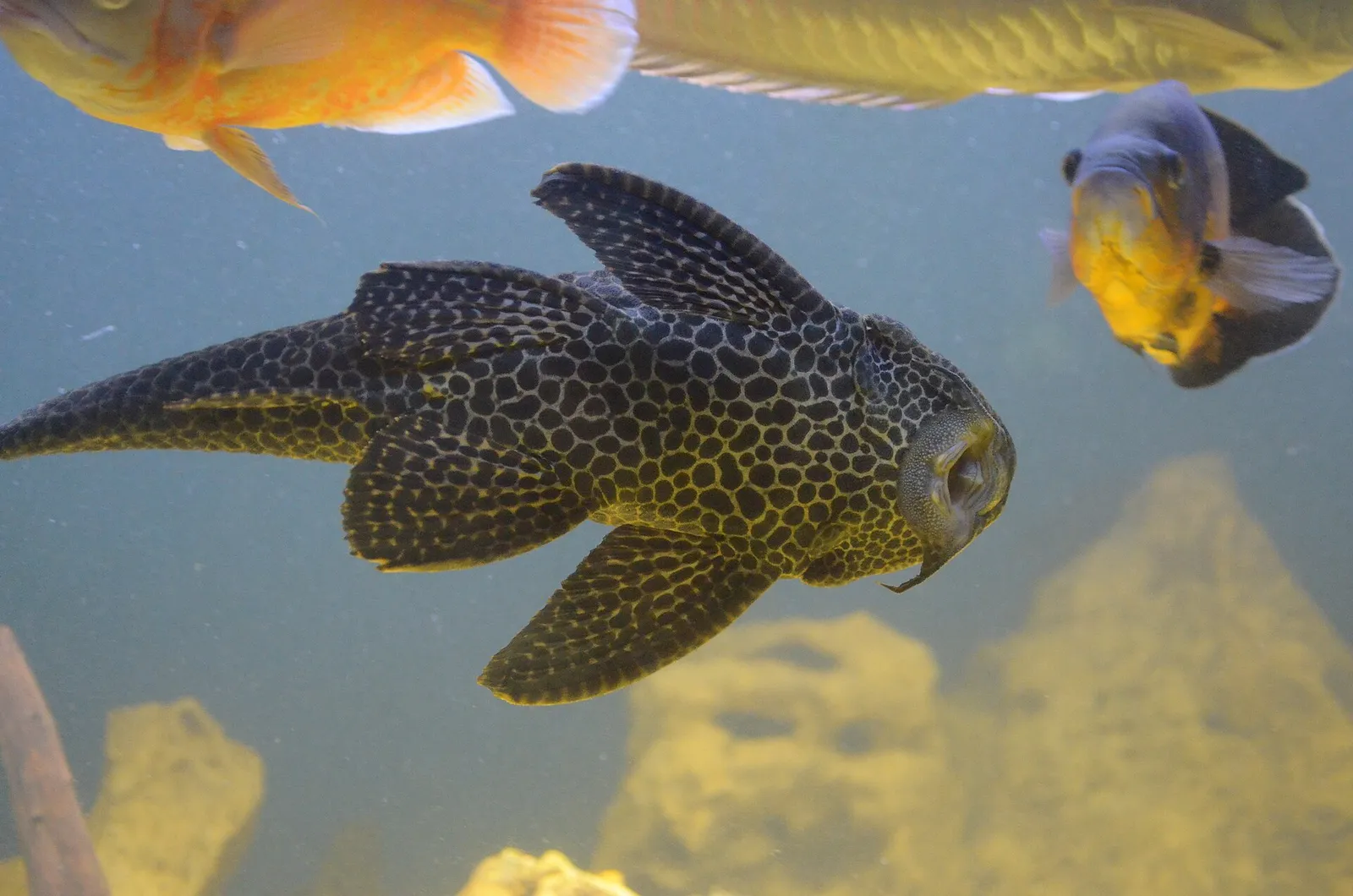
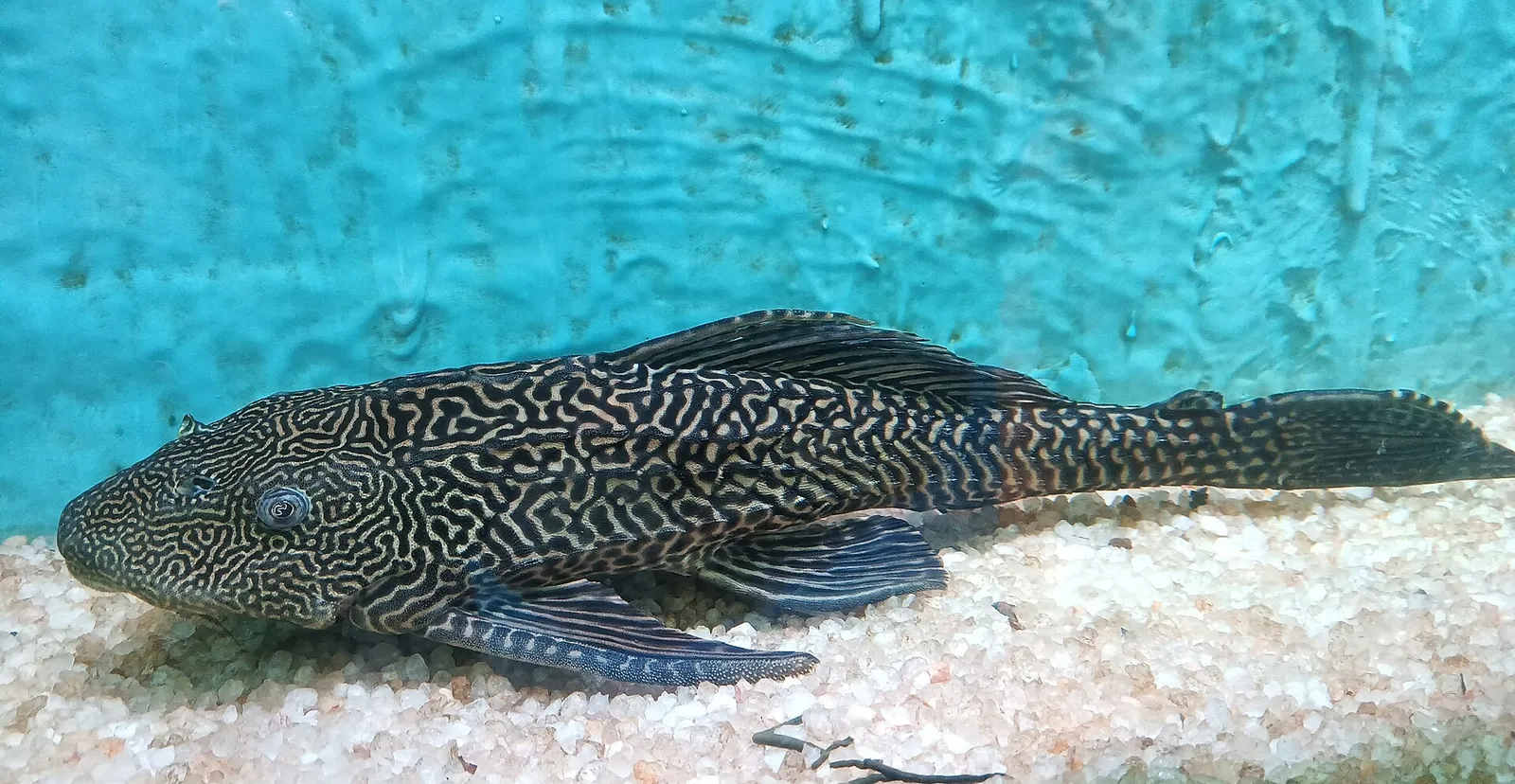
Hypostomus plecostomus reaches a maximum of 10 in SL according to FishBase (with common length given as 11 in TL for wild fish), and PlanetCatfish records 19.5 in SL. This is a large fish. The body is typical of the family: dorso-ventrally flattened, armoured with overlapping bony scutes on head and trunk, with an inferior sucker-disc mouth armed with spatulate, multicuspid teeth suited to rasping algae and biofilm.
Coloration is variable: the base is typically brown to grey-brown with darker spots or a roughly reticulate pattern, occasionally fading to tan. The belly is paler and unscaled. The dorsal fin is moderate to large with 8 soft rays (the key count separating Hypostomus from the similar-sized Pterygoplichthys, which has 10 or more).
The species is characterised by FishBase as having 'viliform teeth' (small, brush-like multicuspid teeth), distinguishing it from the cochliodon group with large spoon-shaped teeth. Within Guianese Hypostomus, it is further distinguished by specific scale counts and pattern characters described in Boeseman (1968). Identification of wild-caught specimens from the Guianas as H. plecostomus versus related Guiana Hypostomus species requires specialist examination.
Sexes are not readily distinguished externally without close inspection; males in breeding condition may show slight broadening of the head and intensification of odontodes on the pectoral spines, but dimorphism is subtle compared with groups like Ancistrus or Hypancistrus.
Habitat
The true Hypostomus plecostomus is native to the coastal drainages of the Guianas — Suriname and the surrounding region from the Oyapock River basin (French Guiana/Brazil border) to the Essequibo River basin in Guyana. FishBase records: 'South America: Guianas (coastal region from the Oyapock River basin to the Essequibo River basin).'
This is a lowland, coastal, and estuarine-influenced freshwater system. FishBase notes the species 'inhabits the lower part of rivers still under tide influence, and characterized by a quiet flowing water and muddy substrate, and swamps.' This is not a fast, turbulent Amazonian river environment — it is a slow, muddy, tidal-influenced coastal lowland system: a habitat that partly explains the species' tolerance of a wide pH and hardness range (FishBase records pH 6.2–8.2, dH up to 28, with even mild brackish tolerance).
Water temperatures in the Guiana lowlands range from approximately 68–82 °F seasonally; FishBase records 68–82 °F for this species. PlanetCatfish expands the range slightly to 68–86 °F. The fish is reported from 'riffles, the river banks, and driftwood snags' in slow stretches, consistent with the loricariid habit of clinging to hard surfaces and vegetation in current.
Identity of introduced populations reported from various Asian countries needs further confirmation (FishBase), as many Asian 'Hypostomus plecostomus' records likely represent Pterygoplichthys species.
Feeding
Hypostomus plecostomus is an aufwuchs grazer and benthic omnivore, consuming algae, biofilm, organic detritus, and associated microorganisms scraped from hard surfaces with its spatulate, multicuspid teeth. In estuarine and slow-river habitats, it also processes organic-rich mud and soft sediment, digesting the microbial and algal material therein.
In aquaria, H. plecostomus (and the Pterygoplichthys species sold as 'common pleco') are vigorous algae cleaners when young, removing film algae and green spot algae from glass and decor. As they grow, their feeding impact on algae is proportional to their size — a 15.5 in pleco can strip a tank, but also produces enormous quantities of waste. Supplemental feeding with sinking algae wafers, blanched zucchini, cucumber, spinach, peas, and similar vegetables is necessary in a clean aquarium where natural algae production is limited.
Unlike the Panaque group (which has strongly spoon-shaped teeth for wood-rasping and depends on xylophagy), Hypostomus plecostomus has viliform teeth not specialised for wood digestion. It will rasp at driftwood and consume some material, but it is not an obligate wood-eater.
Mating
Reproductive biology of Hypostomus plecostomus in the wild is incompletely documented in the accessible primary literature. The genus Hypostomus generally breeds by burrow-nesting in riverbanks, similar to the well-studied Pterygoplichthys, with the male guarding eggs and larvae inside a self-excavated or natural cavity. This is consistent with the broader pattern across the large hypostomines.
PlanetCatfish lists two breeding reports for H. plecostomus in captivity, but detailed information on spawning triggers, courtship behaviour, and egg characteristics for this specific species is sparse. It is probable, based on congeners, that courtship involves male establishment and defence of a burrow or rocky cavity, followed by female entry for egg deposition, after which the male provides all parental care.
As with most large Hypostomus and Pterygoplichthys, the species is likely to breed seasonally in the wild, tied to the dry-to-wet season transition, but seasonal cues for captive spawning are not well characterised.
Breeding
Captive breeding of the true Hypostomus plecostomus is extremely rarely achieved, reflecting both the species' large size requirements and the general difficulty of inducing reproductive behaviour in large Hypostomus in aquarium settings. PlanetCatfish records only two breeding reports, and they may reflect misidentified Pterygoplichthys rather than the true species.
The Pterygoplichthys species commonly sold as 'common pleco' are commercially bred at scale in tropical fish farms in Florida, Southeast Asia, and Brazil, where pond conditions provide the soft substrate, space, and seasonal cues needed for burrow-nesting and spawning. The aquarium trade's supply of 'common pleco' is overwhelmingly farm-raised Pterygoplichthys.
For any keeper who has confirmed they hold true H. plecostomus rather than Pterygoplichthys, breeding requires a very large aquarium or outdoor pond (several hundred litres minimum), soft substrate for burrowing, water conditions mimicking the Guiana lowland habitat (slightly acidic to neutral, moderate hardness, 75–82 °F), and a male–female pair. No reliable captive-breeding protocol for H. plecostomus specifically is available in the hobbyist literature.
In the aquarium
Hypostomus plecostomus — or the much more likely Pterygoplichthys that is being sold under that name — requires a very large aquarium. Both reach 15.5–19.5 in in length. This is the central and most important care fact, and it is systematically under-communicated in the retail trade.
PlanetCatfish lists the size as 19.5 in SL; FishBase records max 10 in SL with a common length of 11 in TL for wild fish (suggesting that very large aquarium individuals may represent other species). A fish of 10–19.5 in in a 60-litre 'starter' tank — a scenario that plays out in countless households every year — is chronically stressed, metabolically poisoned by its own waste, and developmentally stunted.
Minimum aquarium recommendations from the pleco-keeping community for a single large pleco of this size class run to 80–120 US gal, with heavy external filtration and regular large water changes. The fish is a major producer of biological waste; without adequate filtration, ammonia and nitrate will spike dangerously. Good water quality (pH 6.5–8.0, temperature 68–82 °F per PlanetCatfish for this species, 75–82 °F optimal) and a varied diet (algae wafers, vegetables, some meaty protein) are the care essentials.
Hobbyists purchasing a 'common pleco' should first ask: is this Hypostomus, and if so, which Hypostomus? More practically, they should count the dorsal fin rays: 10 or more strongly suggests Pterygoplichthys; 8 or fewer suggests Hypostomus. Both genera reach similar sizes. Neither is appropriate for a standard community tank long-term.
The ethical obligations are identical to those for Pterygoplichthys: do not release these fish into natural waterways. Surrender to specialist groups or aquatic institutions if the fish outgrows your capacity.
Conservation
Hypostomus plecostomus is assessed as Least Concern (LC) by the IUCN Red List, last evaluated in 2021. The species has a reasonable distribution through the Guiana coastal drainages and faces no acute species-level threat at present. Wild collection for the aquarium trade is not a significant pressure, since the trade 'common pleco' is overwhelmingly farm-raised Pterygoplichthys.
The broader genus Hypostomus is enormous — PlanetCatfish lists over 200 named and unnamed species — and many narrowly endemic species in the Amazon basin and Atlantic coastal drainages of Brazil face habitat degradation, dam construction, deforestation, and pollution. Several undescribed Hypostomus taxa may be at risk without yet having formal conservation assessments.
The conservation concern unique to the 'common pleco' trade is, again, the invasive species issue. Pterygoplichthys species sold as 'plecostomus' have established feral populations across tropical Asia, the Americas (outside their native range), and parts of Africa. Even if the fish sold as H. plecostomus is Pterygoplichthys, releasing it constitutes the same ecological risk. The message to keepers is identical regardless of which species is actually in the tank: never release aquarium plecos, of any species or size, into any natural water body.