Taxonomy & naming
The species was formally described by Franz Steindachner in 1880 in his monograph 'Zur Fisch-Fauna des Cauca und der Flusse bei Guayaquil', published in the Denkschriften der Kaiserlichen Akademie der Wissenschaften in Wien (volume 42, pages 55–104). The holotype, catalogued as NMW 55027, was collected at Guayaquil in the Guayas drainage of Ecuador. The original combination was Plecostomus spinosissimus Steindachner 1880. The name was later treated as Hypostomus spinosissimus by Armbruster (2004), and the current valid combination, Isorineloricaria spinosissima, traces to Isbrücker (1980), who erected the genus Isorineloricaria to accommodate large, long-snouted Hypostominae with a proportionally lengthening, nearly round-sectioned caudal peduncle.
The Catalog of Fishes (Eschmeyer, CAS; updated June 2026) recognises the valid name as Isorineloricaria spinosissima (Steindachner 1880). Major revisions include a generic-level analysis by Ray and Armbruster (2016, Zootaxa 4072) that formally defined Isorineloricaria against the sister genus Aphanotorulus on peduncle proportions and spot morphology. Synonyms include Plecostomus festae Boulenger and Isorineloricaria festae, both now subsumed.
Within subfamily Hypostominae, Isorineloricaria is placed in the tribe Hypostomini (sensu Armbruster 2004). No L-number has been assigned to this species; it is infrequently exported in the ornamental trade and is primarily known from local fisheries and ichthyological collections.
Morphology
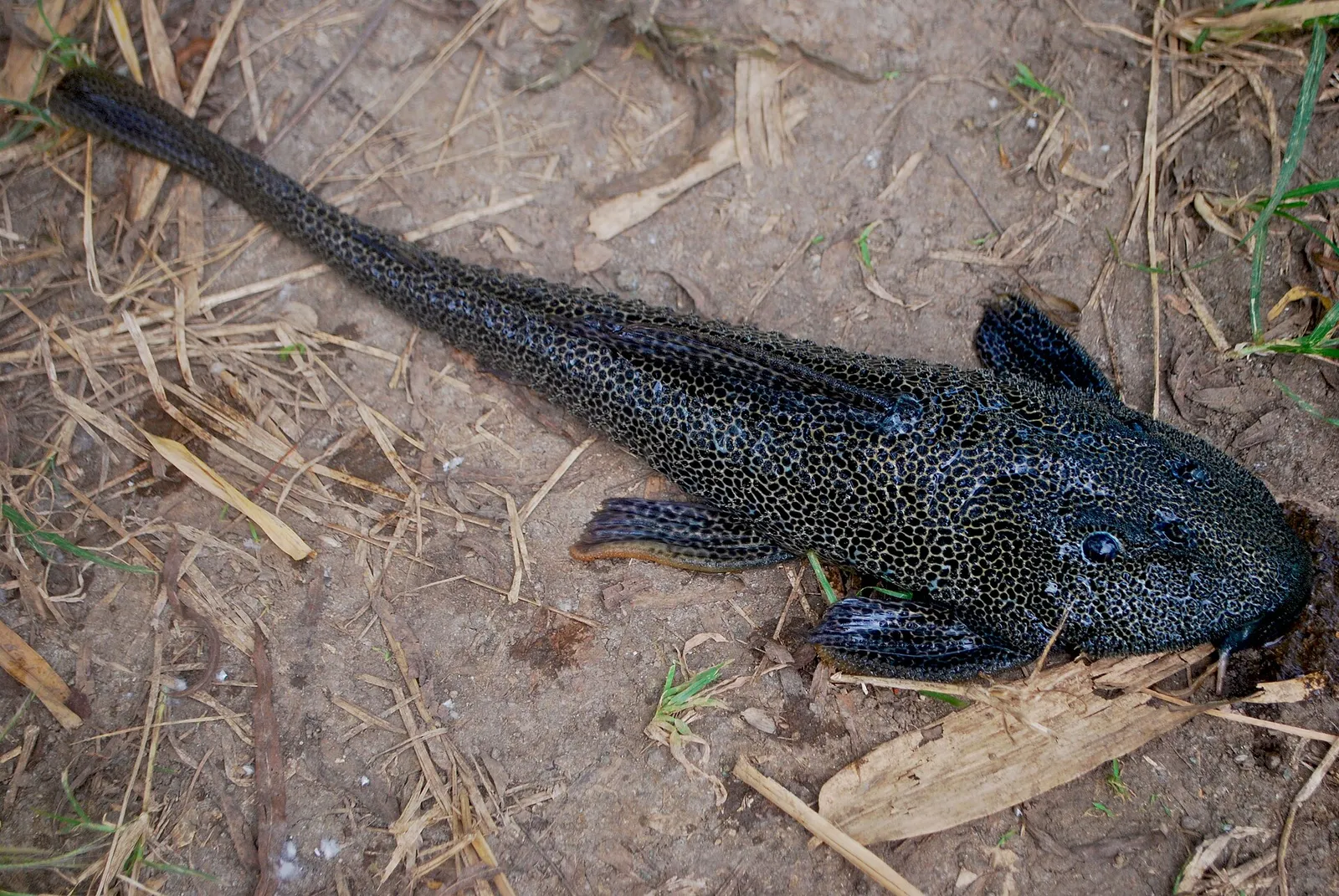
Isorineloricaria spinosissima reaches approximately 22 in total length in FishBase records, and local observers in the Guayas drainage report individuals approaching 31.5 in (Laaz et al. 2009). It ranks among the three or four largest loricariid species known. The body form is immediately recognisable: the trunk is compressed and heavily plated anteriorly but tapers into a dramatically elongated, almost cylindrical caudal peduncle — the round cross-section that Ray and Armbruster (2016) use to diagnose Isorineloricaria against the oval-sectiond peduncle of Aphanotorulus.
Ground coloration is pale cream to near-white, overlaid with dark brown to nearly black spots that on the flanks are nearly as large as the underlying lateral scutes — another key diagnostic character relative to Aphanotorulus, which has smaller spots on a tan background. Fin membranes carry similar dark spotting.
The most remarkable morphological feature is the sexual dimorphism of the odontodes. In most loricariids, breeding males develop the most elaborate odontodes. In this species, females carry conspicuously elongated, erecile odontodes on the scutes of the flanks and back — described by Isbrücker (1980) as 'excessively long', a condition exceptional within Loricariidae. Males are smoother-bodied and possess elongated interopercular odontodes. The broad, flattened head carries a large ventral oral disc with a finely papillate lower lip; teeth are bicuspid.
Habitat
Isorineloricaria spinosissima is endemic to the Guayas River basin of western Ecuador — one of the largest Pacific-draining river systems in South America, flowing through the coastal lowlands of Guayas, Los Ríos, and Manabí provinces before emptying into the Golfo de Guayaquil. The basin supports a distinct ichthyofauna isolated from the Amazonian slope, and I. spinosissima is the dominant large loricariid within it.
The species is very common in the Guayas drainage (Eigenmann 1922; Aguirre & Laaz 2011) and occupies both lowland and midland tributary streams, in addition to the main river channel. Habitat is typically slow to moderately flowing water over hard substrates — rock, submerged timber, and man-made structures including boat hulls and bridge pilings. Its presence on submerged wood and stonework gives rise to the local name raspabalsa.
Water parameters in the Guayas system are broadly tropical: FishBase cites a temperature range of 75–86 °F, pH 7.0 or above (softness data not established), and hardness up to approximately 15 dH. The lowland Guayas is not an Andean whitewater system; it is more turbid and warmer than the highland tributaries, and water chemistry varies seasonally with the strongly pronounced wet–dry cycle of the western Ecuadorian coast.
Feeding
Isorineloricaria spinosissima is an algivore and biofilm grazer — one of the ecological keystones of the Guayas floodplain. It feeds by rasping periphyton, algae, and associated organic films from hard surfaces including submerged rocks, trunks, roots, and the hulls of wooden boats and canoes. This habit gives it the common name raspabalsa ('boat-scraper') among local communities in western Ecuador (Prado 2009; Barnhill et al. 1974).
The oral disc is large and strongly muscularised, capable of maintaining suction on smooth surfaces even in moderate current. The bicuspid teeth rasp rather than bite, cropping algal mats and scraping biofilm efficiently. Gut content analysis of related large Hypostominae consistently shows algae, diatoms, detritus, and fine plant material; there is no indication of significant animal prey in the diet.
In the aquarium, the feeding ecology translates directly into husbandry requirements: copious algae, blanched vegetables (courgette, cucumber, sweet potato, peas), spirulina wafers, and high-quality sinking algae discs are all appropriate. The species is a voracious grazer when space and food supply are adequate, capable of stripping new algal growth from tank glass and décor within hours.
Mating
No published aquarium or field breeding account exists for Isorineloricaria spinosissima, and PlanetCatfish lists no breeding reports. Observations must therefore be inferred from the species' morphology and by analogy with other large Hypostominae.
The pronounced secondary sexual dimorphism — females with greatly elongated body odontodes, males with interopercular odontodes — suggests that the sexes play distinct roles during courtship. In most large Hypostominae, males establish territories around suitable spawning cavities, using odontodes in competitive encounters with rival males and in courtship interactions. The unusually elaborate female odontodes in I. spinosissima remain functionally unexplained; one hypothesis is that they function in male assessment or in defence of the female's own foraging territory during the breeding season.
Given the species' large adult size and the structure of lowland Ecuadorian rivers, it is likely that breeding is seasonal, tied to the pronounced wet–dry cycle. Many large South American loricariids spawn at the onset of the dry season when water levels drop and cavities in root tangles and eroded banks become accessible.
Breeding
No confirmed captive breeding account for Isorineloricaria spinosissima is on record, which is unsurprising given the species' extraordinary adult size — individuals potentially exceeding 19.5 in total length require tanks of several thousand litres to be maintained in appropriate condition, let alone bred. PlanetCatfish (Cat-eLog) registers no breeding reports.
By analogy with other large Hypostominae, the reproductive mode is presumed to be cave or crevice spawning with paternal guarding, as is near-universal across the subfamily. Males would select and defend a cavity — likely a substantial hollow in submerged timber or an undercut bank — and remain with the clutch, fanning eggs to maintain oxygenation. The large female body size suggests a correspondingly large clutch, potentially numbering several hundred adhesive eggs.
Field data from the Guayas basin on reproduction, clutch size, incubation duration, and larval development is not available in the published literature. This is a substantial gap: as a commercially harvested food fish and an ecologically dominant herbivore, basic reproductive biology would have significant conservation and management relevance.
In the aquarium
Isorineloricaria spinosissima presents extreme logistical demands as an aquarium fish. Adult sizes potentially approaching 19.5–31.5 in total length mean that the minimum practical aquarium for a single adult is in the range of 130–210 US gal, with proportionately sized filtration capable of managing the considerable waste output of a large grazer. Very few hobbyists outside specialist large-loricariid circles have kept this species.
The species is occasionally exported from Ecuador and appears in the German aquarium trade under the name Stachel-Harnischwels, but it is rare in the hobby. Despite its rarity, the basic husbandry parameters are predictable from its ecology: tropical temperature (75–86 °F), near-neutral to slightly alkaline pH, moderate hardness, high dissolved oxygen, and excellent mechanical and biological filtration. Strong water flow is not essential — the Guayas is not a rapids system — but good oxygenation is.
The species is an obligate herbivore and biofilm grazer; a diet heavy in algae and plant matter is non-negotiable. Hard décor (large smooth boulders, sections of smooth driftwood, slate) allows natural rasping behaviour. The fish are reported as generally peaceful toward other large fish but territorial toward conspecifics; keeping more than one individual requires substantial space and territory partitioning.
Given its adult size, this species is not appropriate for most home aquaria. Public aquariums, zoological collections, and specialist keepers with appropriately large systems are its natural audience in captivity.
Conservation
The IUCN Red List assessed Isorineloricaria spinosissima as Least Concern in 2020, based on its occurrence across the Guayas River basin, which remains largely intact, and on the absence of documented severe range contraction. Despite this assessment, the species faces real pressure: it is exploited as a food fish throughout rural western Ecuador, harvested from rivers and streams by local communities (Prado 2009; Laaz et al. 2009). This harvest is subsistence and small-scale commercial rather than industrial, but population data are insufficient to assess sustainability.
The Guayas lowlands have undergone substantial land-use change — much of the original floodplain forest has been converted to agricultural and aquaculture uses, with associated runoff, sedimentation, and altered flood regimes. Shrimp farming in the lower Guayas and Golfo de Guayaquil has substantially modified coastal wetlands. The species' dependence on hard substrates with algal growth means that high turbidity from agricultural runoff could reduce food availability and habitat quality.
As the dominant large grazer in a geographically isolated basin, I. spinosissima plays an important ecological role; local extirpation would have disproportionate ecosystem effects. Ongoing monitoring of Guayas basin fish populations and more nuanced harvest data would strengthen future IUCN assessments.