Taxonomy & naming
Paraloricaria vetula was described by Achille Valenciennes in 1835 in the Histoire naturelle des poissons series (co-authored with Georges Cuvier), the original combination being Loricaria vetula. The Catalog of Fishes (Eschmeyer, CAS) recognises the valid combination Paraloricaria vetula (Valenciennes, 1835) with Loricaria vetula as the basionym. The species was reviewed in Ringuelet et al. (1967), a standard ichthyological reference for the fishes of Argentina.
The genus Paraloricaria was erected for whiptail catfishes closely allied to Loricaria sensu stricto. The genus name fuses the Greek para (beside, near) with the Latin lorica/loricare (a corslet of leather armour), yielding 'near-Loricaria'. The species epithet vetula is Latin for 'old woman' or 'old female', a term historically applied in classical Latin to describe an old or withered individual; its precise application by Valenciennes to this species is not explained in the original text, but may allude to the fish's aged or worn appearance in the type specimen. Within Loricariinae, Armbruster's (2004) framework places Paraloricaria in the elongated whiptail clade, characterised by extreme anterior-posterior elongation of the caudal region and the development of caudal filaments in mature individuals.
Morphology
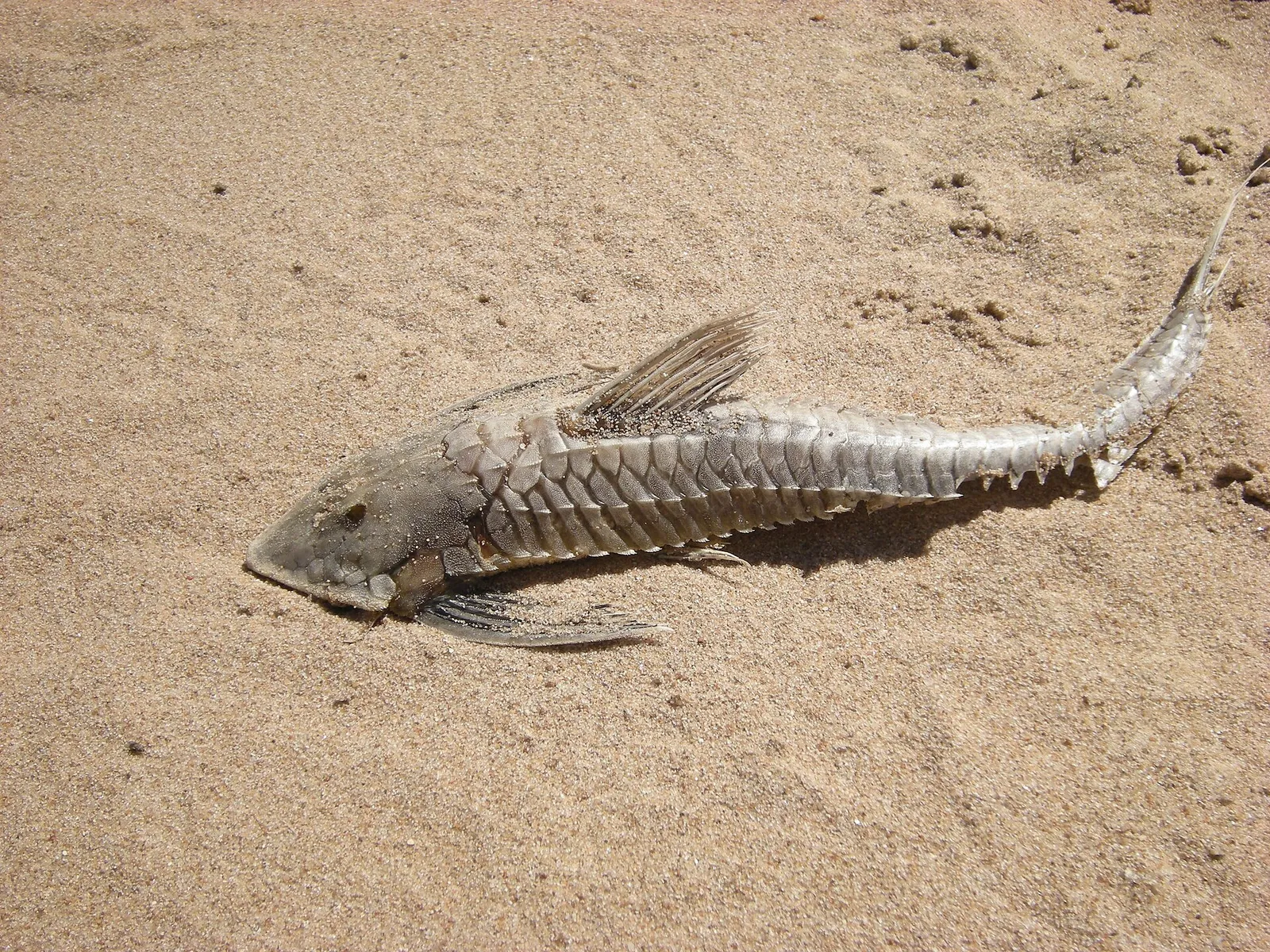
Paraloricaria vetula reaches a maximum total length of 22 in, with a maximum published weight of 361 g — the largest of the three species treated in this wave of articles and one of the larger whiptails in the family. The body plan is the archetypal loricariin form: extreme dorsoventral flattening, a broad depressed head, and a very long slender caudal region that tapers into a prominent caudal filament in adults. The dorsal and lateral surfaces are covered with interlocking bony scutes; the ventral surface of the head and abdomen is naked or only partially plated.
Dorsal coloration is brownish to olive-brown with variable darker mottling or faint banding, cryptically matching the sandy and silty substrates this species inhabits. The underside is pale cream. The mouth is ventral and disc-shaped, with fine teeth adapted for scraping algae, biofilm, and detritus from substrate surfaces. Otolith morphology has been described for the species: the lapillus is rounded with a short, wide sulcus; the asteriscus is piriform with a pronounced rostrum; and the sagitta is claviform with expanded basal wings — features consistent with a benthic demersal lifestyle. Mature males develop a broader, heavier head relative to females, and in Loricariinae generally the male's role in oral or substrate incubation is associated with hypertrophy of lip and chin structures.
Habitat
Paraloricaria vetula is distributed across the La Plata River basin of South America — one of the continent's largest drainage systems — with records from the Paraná and Uruguay rivers and their tributaries in Argentina, Brazil, and Uruguay. FishBase classifies the species as temperate, reflecting the southern latitude of much of its range: the La Plata system drains subtropical and warm-temperate zones where winter temperatures can drop to 54–59 °F or below in its southern reaches.
The species is demersal, inhabiting the sandy and silty bottoms of main-channel rivers, floodplain lagoons, and slower-moving tributaries. GBIF records and literature collections (reviewed in Ringuelet et al. 1967) place it in a variety of La Plata habitats including the main Río de la Plata estuary margins. Water chemistry varies widely across the La Plata basin: the Paraná and Uruguay rivers are primarily whitewater systems with moderate to high conductivity, turbid from Andean sediments in their upper reaches. The species's tolerance of temperate conditions and turbid water distinguishes it ecologically from tropical Amazonian whiptails.
Feeding
Paraloricaria vetula is a detritivore and grazer, scraping attached algae, biofilm, fine organic detritus, and associated invertebrates from sandy and silty substrates. The ventral disc mouth and fine dentition are well suited to processing loosely attached material from soft substrates rather than rasping hard rock surfaces. Trophic level estimates from FishBase place the species at 2.3 ± 0.2, consistent with a diet dominated by algae and detritus with a minor invertebrate component.
In captivity, the diet should mirror the natural preference for plant-derived and biofilm-analogue foods: sinking algae wafers, spirulina tablets, and blanched vegetables such as courgette (zucchini), cucumber, and lettuce. Occasional offerings of sinking carnivore pellets or small amounts of frozen bloodworm can supplement protein, particularly to condition breeding pairs. The species will actively work sandy substrate, sifting through it for fine food particles, and a deep sand layer in the aquarium facilitates this natural behaviour.
Mating
As with most Loricariinae, the reproductive biology of P. vetula in the wild is poorly documented, but the subfamily's general pattern provides context. Loricariine whiptails typically show pronounced sexual dimorphism in head breadth and lip morphology in mature fish, with males of many genera developing enlarged fleshy lips associated with egg incubation. Whether P. vetula employs lip-brooding (as Loricariichthys does) or substrate-guarding (as Rineloricaria does) has not been definitively established in the published literature for this species.
In the aquarium, large, well-conditioned males and females housed together in a spacious tank with appropriate substrate and sheltering areas may pair and display. Males typically become territorial and may chase or nudge females. Conditioning on a varied, high-quality diet with regular large water changes and a seasonal temperature reduction to simulate the La Plata winter cycle may be necessary to trigger reproductive behaviour. The species's temperate distribution suggests that temperature fluctuations are a meaningful spawning cue, unlike strictly tropical loricariids.
Breeding
Breeding records for Paraloricaria vetula in captivity are not well represented in the hobby literature — the species is infrequently kept and essentially absent from standard aquarium trade catalogues. Based on subfamily placement in Loricariinae and morphological features of the lips and head, the species most likely employs paternal egg incubation either orally (as in Loricariichthys) or in a substrate depression (as in Rineloricaria), but this has not been confirmed by published aquarium observations.
FishBase's resilience assessment for the species is 'Low', with a minimum population doubling time of 4.5–14 years, suggesting relatively slow reproduction and late maturity. This is consistent with the large adult size of the species: larger body size in loricariids generally correlates with later first reproduction and smaller clutches relative to body size. Aquarists who obtain this species should anticipate a long conditioning period and should prioritise stable, appropriate water conditions (temperate, clean, well-oxygenated) over attempting rapid breeding.
In the aquarium
Paraloricaria vetula is a specialist fish rarely available in the ornamental trade and better suited to the dedicated catfish keeper than the general community aquarist. Its large adult size (up to 21.5 in TL) demands a substantial aquarium — a minimum of 80 US gal for a single adult, and considerably larger for pairs or groups. Its temperate origin also means that standard tropical aquarium temperatures (79–82 °F) are higher than ideal; this species is most comfortable at 64–75 °F, making it unsuitable for genuinely tropical community tanks and better suited to temperate or subtropical set-ups.
Substrate should be fine sand, which the fish will search and sift continuously. Decoration can include smooth stones, driftwood pieces, and open sand areas. Strong current is not required — this is a river-plain species accustomed to moderate flow. The species is peaceful toward other fish but two large males may compete for space; ensure ample territory if multiple fish are kept. Water should be clean and well-oxygenated, with temperature 61–75 °F, pH 6.8–7.8, and moderate hardness. The species's tolerance of cooler water makes it a candidate for unheated or lightly heated tanks in temperate climates during warmer months.
Conservation
Paraloricaria vetula was most recently assessed by the IUCN Red List as Least Concern (Salvador, 2023, published in the 2023-1 update with assessment date November 2020), reflecting a wide distribution across the La Plata basin spanning Argentina, Brazil, and Uruguay, and no evidence of serious population decline. The species occupies three countries and a large river system that, while subjected to significant human modification, continues to support diverse fish communities.
The La Plata basin faces ongoing pressures from agricultural runoff, urbanisation along the Paraná and Uruguay rivers, hydroelectric development, and sedimentation from land-use change. Climate change may also affect seasonal temperature regimes that this temperate species depends upon for reproduction. At present, however, the species's broad range and apparent tolerance of modified habitats place it well outside threatened categories. No targeted conservation actions are in place or considered necessary.