Taxonomy & naming
Parotocinclus maculicauda was described by the Austrian ichthyologist Franz Steindachner in 1877, published in the Sitzungsberichte der Kaiserlichen Akademie der Wissenschaften, Mathematisch-Naturwissenschaftliche Classe (volume 76, first section, page 222 [6], plate 1, figures 2–2b). The type locality is broadly listed as 'southeastern Brazil'. The Catalog of Fishes (Eschmeyer, CAS) records the valid combination Parotocinclus maculicauda (Steindachner, 1877); the parenthetical authority indicates the original description was in a different genus — Steindachner placed it in Otocinclus, and it later acquired the synonym Parotocinclus steindachneri before the current combination was stabilised.
FishBase places the species in subfamily Hypoptopomatinae of Loricariidae — the same subfamily as Otocinclus — and the key character distinguishing Parotocinclus from Otocinclus is the presence of an adipose fin in Parotocinclus (absent in Otocinclus). This straightforward external character separates the genera at a glance. The genus Parotocinclus is diverse, spanning coastal Atlantic-draining rivers from northeastern to southern Brazil; PlanetCatfish's Shane's World section features a geographic article on Brazilian Parotocinclus.
Armbruster (2004) confirmed the placement of Hypoptopomatinae within Loricariidae, with this clade being the 'dwarf plecos' or 'oto-relatives' — small, biofilm-grazing loricariids characterised by the reduction of armour plating and body size relative to the large Hypostominae. No further junior synonyms beyond Otocinclus maculicauda and Parotocinclus steindachneri are recorded.
Morphology
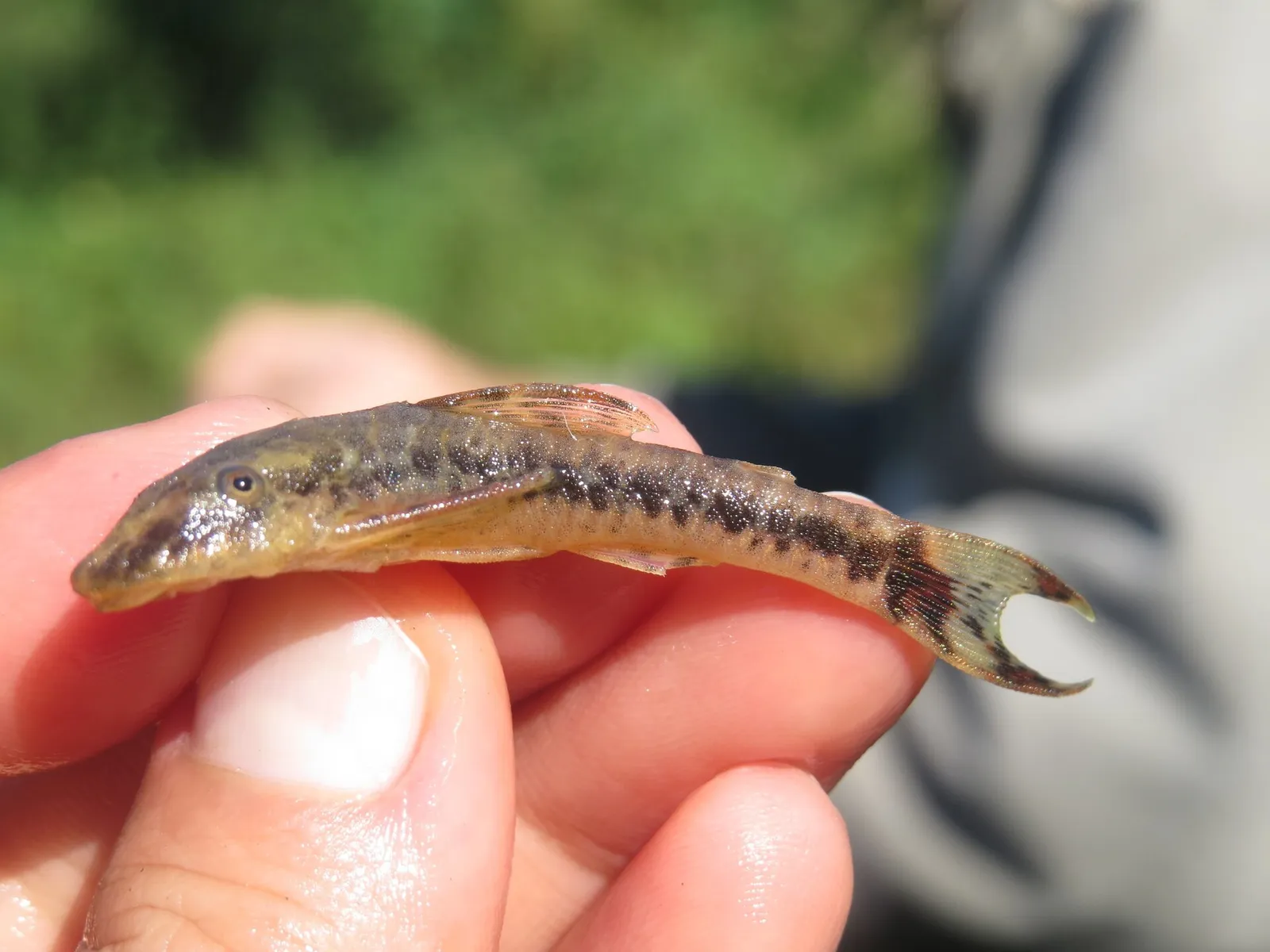
Adults of Parotocinclus maculicauda reach a maximum of approximately 2.5 in total length (TL) — FishBase gives 2.5 in TL for males; PlanetCatfish lists 2.5 in SL — making this one of the smaller loricariids available to hobbyists, comparable in size to large Otocinclus or the smallest Corydoras. The body is slender, moderately depressed, and covered in the characteristic overlapping bony scutes of Loricariidae, though the scutes in Hypoptopomatinae are less massive than in Hypostominae.
The common name 'red fin dwarf pleco' refers to the prominent orange-red colouration in the fins — particularly the dorsal and caudal fins — which is most vivid in well-conditioned adults. Ground colour is brown, with dark irregular blotches along the body and a complex mottled or spotted pattern. An xanthoric (yellow-pigment-predominant) colour form has been reported in wild imports: PlanetCatfish's photo gallery documents a 'xanthoric form' as an uncommon wild import.
The most important diagnostic character distinguishing P. maculicauda from the superficially similar Otocinclus species is the adipose fin — a small, fleshy fin between the dorsal and caudal fins — which is present in Parotocinclus and absent in Otocinclus. Sexing follows the general small-loricariid pattern: females are broader-bodied when viewed from above, particularly across the abdomen when gravid, and have a more rounded ventral profile. Males are more slender; minor odontode development on the pectoral-fin spine is sometimes noted but is subtle compared to larger genera.
Habitat
Parotocinclus maculicauda is endemic to southeastern Brazil, occurring in the small coastal rivers draining into the Atlantic between Santa Catarina state in the south and Rio de Janeiro state in the north. FishBase records coastal rivers between Santa Catarina and Rio de Janeiro; PlanetCatfish's distribution data adds records from Rio de Janeiro state rivers (including the Macaé drainage), São Paulo state rivers, and Santa Catarina state rivers.
These southeastern Brazilian coastal river systems are characteristically short, moderately fast-flowing, clear-to-slightly-turbid streams draining the Atlantic Plateau escarpment (Serra do Mar). They are geochemically distinct from Amazonian rivers: cooler (68–75 °F in many reaches), with moderate hardness reflecting the crystalline basement geology, and pH ranging from slightly acidic to near-neutral (FishBase records pH 6.5–7.5 and hardness up to 20 dH). The subtropical latitude brings genuine seasonal thermal variation — cooler winters (64–68 °F) and warmer summers — which appears to influence the species' reproductive behaviour.
Microhabitat is typically rock surfaces, pebble substrates, and submerged plant stems and wood in moderate current, where the fish grazes epilithic algae and biofilm. The Atlantic forest rivers of this region are characterised by relatively high water clarity and are part of a globally important but severely threatened freshwater biodiversity hotspot — the Atlantic Forest ecoregion — where species endemism is extremely high and habitat loss severe.
Feeding
Parotocinclus maculicauda is a periphyton and biofilm grazer, functionally similar to Otocinclus but with the benefit of the adipose fin and somewhat broader ecological flexibility. In the wild it rasps epilithic algae, diatoms, cyanobacteria, fine detritus, and associated micro-invertebrates from rock surfaces, plant stems, and submerged wood in clear, moderate-current streams. Its small size and sucker-mouth make it highly efficient at exploiting narrow current-shadow zones on rock faces that are inaccessible to larger loricariids.
In the aquarium, P. maculicauda is an eager algae grazer that will clean diatoms and soft green algae from glass and smooth surfaces. It is notably more effective than Otocinclus at softer, more varied surfaces, and its slightly larger size (2.5 in vs. the 1.5 in of most Otocinclus) gives it a marginal advantage in biofilm consumption per individual. Supplementary feeding with spirulina wafers, blanched courgette (zucchini), cucumber, spinach, and soft-cooked peas is important to ensure adequate nutrition, particularly in tanks where algae growth is controlled. Small amounts of meaty food (frozen bloodworm, micro-worms, Artemia) are accepted and help condition adults before breeding attempts.
As with all dwarf loricariids, the species must not be expected to subsist solely on tank algae — particularly in clean, low-nutrient planted tanks where algae growth is minimal.
Mating
Parotocinclus maculicauda has been kept and observed by hobbyists in Europe and Brazil, and aspects of its reproductive biology are known from captive observations, though no formal published breeding report appears on PlanetCatfish's database as of 2026. The spawning biology of the genus Parotocinclus is partially inferred from closely related Otocinclus and from keeper accounts.
Gravid females are easily identified: the abdomen becomes distended and rounded, noticeably wider than the male when viewed from above. Males may pursue females around the tank and press alongside them in typical loricariid pre-spawning behaviour. Unlike cave-spawning Hypostominae, small Hypoptopomatinae tend to deposit eggs on open surfaces — plant leaves, the underside of broad-leaved aquatic plants, smooth rocks, or the aquarium glass — rather than in enclosed cavities.
Triggering spawning in captivity typically involves replicating natural cues: a slight drop in temperature (to around 68–72 °F) followed by a gradual rise, large partial water changes with slightly cooler, well-oxygenated water, and a gradual increase in photoperiod — conditions analogous to the spring warming and increased rainfall that characterise the Atlantic Forest stream environment in southeastern Brazil.
Breeding
PlanetCatfish lists no registered breeding reports for P. maculicauda in its public database as of 2026. However, keepers who have observed spawning describe the following general pattern consistent with Hypoptopomatinae biology: females deposit small clutches of adhesive eggs on hard surfaces — often on the underside of a broad leaf, on aquarium glass, or on smooth flat rocks — typically in small groups of 5–20 eggs per spawn. Parental care is minimal or absent; eggs are left unguarded after deposition.
PlanetCatfish's photo gallery documents fry at 3–5 weeks and 6–7 weeks old, confirming that captive reproduction has occurred informally even if no formal breeding report has been filed. Newly hatched larvae are tiny and require infusoria or commercial micro-foods before progressing to finely powdered algae wafers and very small algae wafers. Water quality must be excellent for larvae: the small body mass means larvae are sensitive to nitrogen compounds.
For conditioning, providing a dedicated tank or a well-planted species tank, slightly lowering the temperature to 68 °F for several weeks before a slow return to 75 °F, and performing frequent large water changes with cool, well-oxygenated water are the most commonly reported approaches. The species' high resilience (FishBase: minimum population doubling time under 15 months) suggests it breeds readily under favourable conditions.
In the aquarium
Parotocinclus maculicauda is one of the most appealing dwarf loricariids for the community aquarium — small enough to suit 40-litre planted tanks, peaceful with all fish that cannot swallow it, and active enough to be visible during daylight hours. A group of 6–10 individuals in a 15–25 US gal aquarium is an ideal arrangement; the species is social and shows more natural behaviour in numbers.
Water chemistry should reflect the southeastern Brazilian coastal river origin: temperature 68–75 °F (the cooler end is strongly preferred — this is a subtropical, not tropical, species), pH 6.5–7.5, hardness up to 20 dH. The preference for clean, cool, well-oxygenated water is non-negotiable. At temperatures above 79 °F the fish becomes stressed and susceptible to disease; the 'tropical' tank settings typical of Amazonian species are not appropriate here. Weekly partial water changes of 25–30% with temperature-matched water maintain the oxygen levels and low nitrate the species requires.
The adipose fin is a helpful diagnostic character for new keepers who have confused this species with Otocinclus: look for the small fleshy fin between the dorsal and the caudal. The orange-red fin colouration, most vivid in healthy, well-conditioned fish, also distinguishes it clearly from the drabber Otocinclus.
Suitable tankmates are any small, peaceful fish sharing the temperature range: small tetras native to cooler Atlantic Forest streams (such as Hyphessobrycon species), small rasboras, and non-aggressive dwarf cichlids. Corydoras paleatus and C. aeneus — both cooler-water species from the same region — are excellent companions. Avoid large, aggressive fish, fin-nippers, or species requiring temperatures above 77 °F.
Conservation
Parotocinclus maculicauda is assessed as Least Concern on the IUCN Red List (November 2018 assessment), reflecting an apparently stable population across several coastal river drainages in southeastern Brazil. The species has a relatively wide range for an Atlantic Forest endemic — spanning coastal rivers from Santa Catarina to Rio de Janeiro — and PlanetCatfish records 13 individual 'spotter' observations and 11 registered keepers, suggesting modest but consistent availability in the ornamental trade.
However, the Atlantic Forest biome in which these coastal rivers occur is one of the world's most threatened biodiversity hotspots, with less than 12% of original forest cover remaining. The rivers draining this landscape are under pressure from deforestation-driven sedimentation, point-source pollution from urbanisation and agriculture, and low-flow periods intensified by reduced groundwater recharge. Small-bodied, cool-water species endemic to specific river systems are intrinsically more vulnerable to catchment-scale change than wide-ranging Amazonian species.
The ornamental trade in P. maculicauda is not considered a significant threat. Captive breeding, while not formally documented in the open literature, has occurred among enthusiasts, and the species' apparent ecological flexibility within its subtropical range suggests it is not immediately threatened. Continued monitoring of population status in key river systems — particularly in areas of intense land-use change in São Paulo and Rio de Janeiro states — would be valuable.