Taxonomy & naming
This species was originally described by Kner in 1863 and long circulated under the combination Rineloricaria uracantha. Modern taxonomy moves it to the genus Fonchiiichthys, and the Catalog of Fishes (Eschmeyer, CAS) recognises Rineloricaria uracantha (Kner, 1863) as the valid name, with Rineloricaria uracantha treated as the former combination. The parentheses around the authority record exactly this history: the species was first placed in a different genus before being transferred to Fonchiiichthys, so Kner's name is retained but bracketed.
Fonchiiichthys is a genus of the subfamily Loricariinae within the family Loricariidae. The genus name honours the Peruvian ichthyologist Fonchi Ingrid Chang Matzunaga (1963–1999). The epithet uracanthus derives from Greek roots referring to the tail and a spine or thorn. The transfer of this species out of the speciose genus Rineloricaria reflects ongoing reassessment of generic boundaries within the whiptail loricariines, where superficially similar fishes have proven to belong to distinct lineages.
This fish was long listed as Fonchiiichthys uracanthus; Eschmeyer's Catalog of Fishes places the species in Rineloricaria, and the current combination Rineloricaria uracantha is followed here.
Morphology
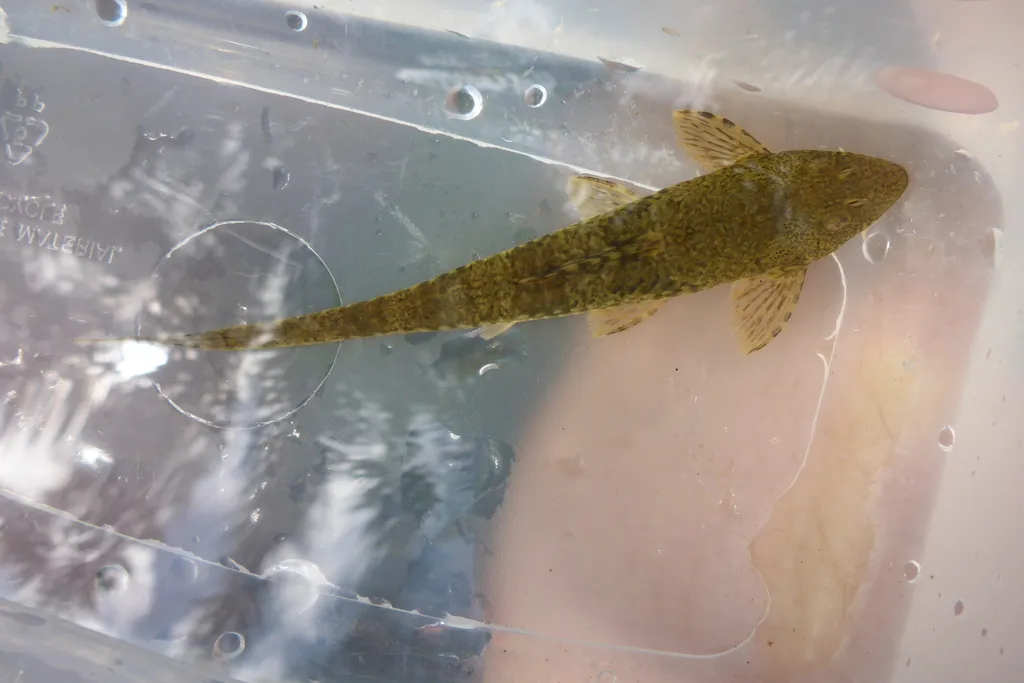
Rineloricaria uracantha reaches a maximum recorded size of about 6.5 in standard length. It has the elongate, depressed, whiptail-style body of a loricariine, armoured in longitudinal rows of bony plates and equipped with a ventral suckermouth for adhering to surfaces in current. As the epithet suggests, the tail region carries a spinous or thorn-like feature characteristic of the species.
Like other members of the subfamily it is a facultative air-breather. Detailed published data on sexual dimorphism for this species is not available here; whiptail loricariines often show males developing enhanced odontodes on the head and pectoral fins during the breeding season.
Habitat
Rineloricaria uracantha is one of the few loricariines native to Central America, occurring on both Atlantic and Pacific versant river systems. It inhabits rivers and creeks of moderate velocity at elevations between roughly 20 and 525 ft, where it clings to submerged branches and stones. Recorded water temperatures reach about 84 °F, consistent with warm tropical conditions.
Its attachment to hard substrates in flowing water — wood and rock in moderate current — is the defining feature of its microhabitat. Beyond elevation, temperature and current velocity, finely resolved water-chemistry data is not published here.
Feeding
The species scrapes algae and attached microbiota from branches and stones, and its diet is reported to consist mainly of detritus together with some aquatic invertebrates. The trophic level is around 2.7, slightly above pure herbivory, reflecting the incidental invertebrate component of its grazing.
Its feeding apparatus and behaviour are those of a substrate-clinging biofilm grazer, working hard surfaces in moderate current rather than soft sediment.
Mating
No mating behaviour has been documented for Rineloricaria uracantha. Whiptail loricariines in general are surface- or cavity-spawners in which the male prepares and defends the spawning site, but no species-specific account is available.
Breeding
Breeding has not been reported for Rineloricaria uracantha. In related whiptail loricariines, males guard a clutch of adhesive eggs deposited on a hard surface or within a crevice, fanning and defending them until hatching. No clutch-size, incubation or developmental data exists for this species.
In the aquarium
Rineloricaria uracantha is not a commonly seen aquarium fish, and no detailed husbandry record for it is available here. Its natural habitat — warm, moderately flowing rivers with hard surfaces to graze and cling to — points to the conditions a rheophilic loricariine would need: well-oxygenated water, steady current, smooth rock and wood structure, and a steady supply of algae and biofilm.
As a peaceful biofilm grazer it would be unsuited to competition with boisterous tankmates, and any keeping of it should rely on the assumption of warm, clean, current-rich water rather than on extrapolation from softwater South American species.
Conservation
The IUCN Red List assessed Rineloricaria uracantha as Least Concern on 18 December 2019. The listing reflects a comparatively broad Central American distribution spanning both Atlantic and Pacific versant drainages, with no evidence of a range-wide decline sufficient to warrant a threatened category.
As with many Central American river fishes, localised pressures from deforestation, agricultural runoff and changes to river flow could affect particular populations, but at the range-wide scale the species is not currently considered at risk. CITES has not evaluated the species.