Taxonomy & naming
Sphoeroides psittacus was described by Marcus Elieser Bloch and Johann Gottlob Schneider in 1801, originally under the combination Tetrodon psittacus. A later junior synonym, Tetrodon semispinosus, was applied to the same species and has long been suppressed. The Catalog of Fishes (Eschmeyer, CAS) recognises the current valid combination as Sphoeroides psittacus (Bloch & Schneider, 1801), with the parenthetical authority marking the transfer from Bloch and Schneider's original placement.
The genus Colomesus is South American in its entirety and belongs to the family Tetraodontidae (pufferfishes). The old catch-all genus Tetraodon, once used for pufferfishes worldwide, has been progressively dismembered by modern phylogenetic work: Tetraodon is now confined to African species, while Asian puffers have been redistributed across Dichotomyctere, Pao, Leiodon, Carinotetraodon and Auriglobus. Colomesus stands apart as the only tetraodontid genus native to the Neotropics. The species epithet psittacus is Latin for 'parrot,' almost certainly a reference to the fused, beak-like dentition shared by all pufferfishes — the same structure that gives rise to the colloquial name 'parrot puffer.'
This fish was long listed as Colomesus psittacus; Eschmeyer's Catalog of Fishes places the species in Sphoeroides, and the current combination Sphoeroides psittacus is followed here.
Morphology
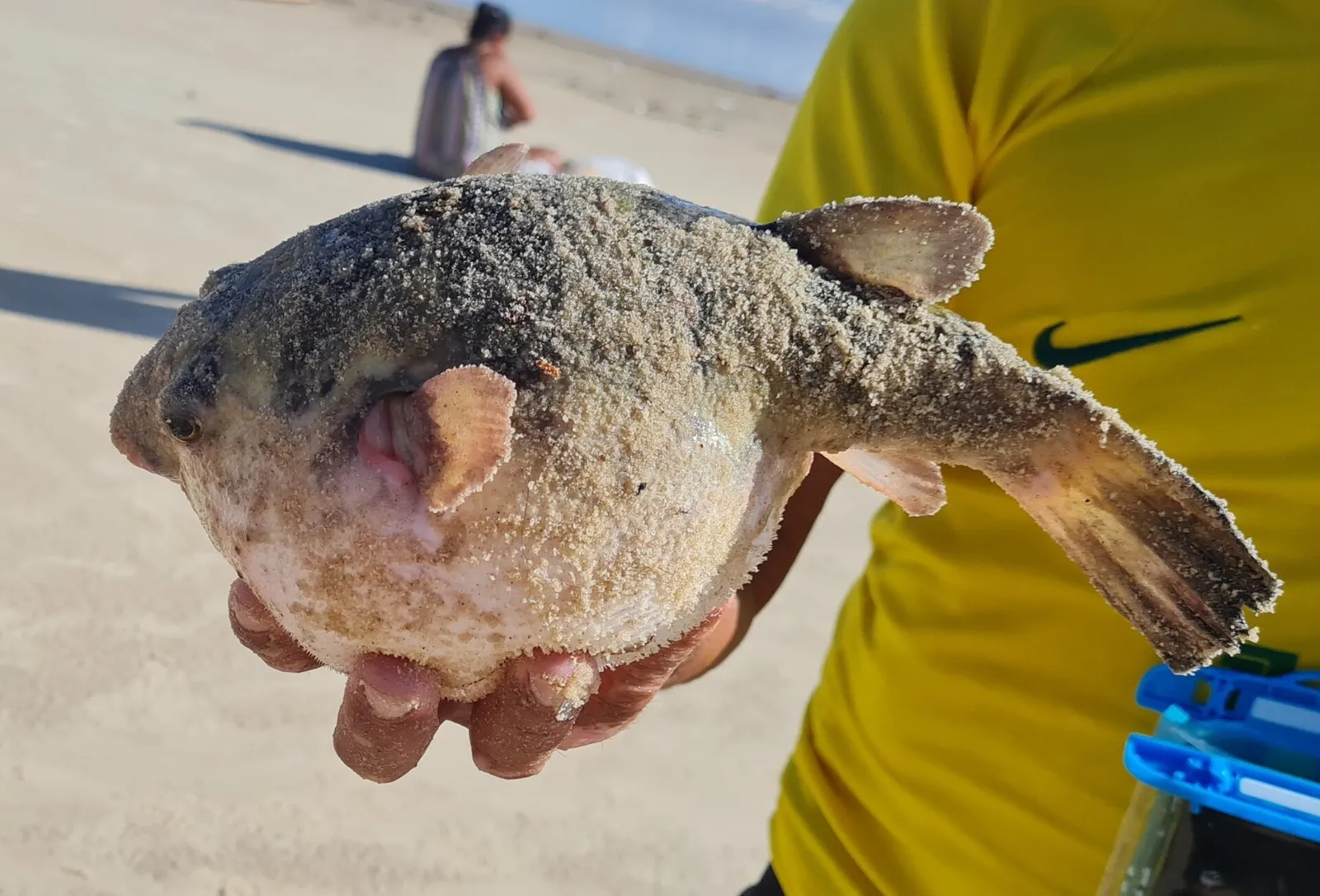
The banded puffer is one of the larger Colomesus species, commonly reaching 10 in total length and recorded to 11.5 in TL (FishBase). The body is the stocky, globose-capable form typical of tetraodontids: compressed laterally towards the caudal peduncle, with a broad, rounded head and a blunt snout. The skin carries small spinules on the belly and flanks in place of true scales, and the pectoral fins provide the primary locomotion while the small dorsal and anal fins — set far back on the body — serve as rudders.
The dentition is the defining structural feature of the genus: the four jaw bones are fused into a parrot-like beak divided by a median suture, with sharp cutting edges adapted for crushing molluscs, crustaceans and other hard-shelled prey. This beak grows continuously throughout life and must be worn down by regular contact with hard food items. Colouration consists of a pale creamy or yellowish ground crossed by a series of dark brown or olive-green saddle-like bands across the dorsum, giving the species its 'banded' English name; the venter is whitish. The pattern is broadly similar to that of C. asellus but the banded puffer's larger size and brackish habitat distinguish it in the field.
Habitat
Sphoeroides psittacus is a brackish and euryhaline species of the western Atlantic coast of South America, ranging from the Gulf of Paria (Venezuela/Trinidad) south through the Guianas to the Amazon estuary in Brazil. The type locality is associated with the Marajó Island area at the mouth of the Amazon. It inhabits mangrove swamps, estuaries, tidal channels, shallow inshore lagoons and the lower tidal reaches of rivers, where it is consistently associated with intertidal and subtidal substrates rich in molluscs and crustaceans.
Although the species is physiologically euryhaline and can tolerate a range from nearly fresh to near-marine salinities, it is fundamentally an estuarine fish and adults do not make sustained forays into true freshwater. Seriously Fish reports an aquarium water range of pH 7.0–9.0, hardness 179–447 ppm and temperature 68–79 °F, reflecting the alkaline, mineral-rich conditions of tidal influence. Specific gravity at or above approximately 1.010 is recommended for captive maintenance, despite occasional freshwater tolerance in the wild.
Feeding
The banded puffer is a dedicated durophage — a hard-shelled prey specialist. The parrot-like beak is engineered for cracking molluscs, crustaceans and similar armoured invertebrates encountered on the estuarine floor and intertidal flats. In the wild this means bivalves, gastropods, barnacles, small crabs and shrimp form the core diet.
In captivity this specialist diet has a critical husbandry dimension: the beak of all tetraodontids grows continuously and must be abraded by regular contact with hard food items. A diet of soft foods alone — even if nutritionally adequate — will allow the beak to overgrow until it prevents the fish from feeding, requiring manual trimming. Offering live or frozen snails, small shellfish, hard-shelled shrimp and similar items is therefore not optional enrichment but a functional requirement for long-term health.
Mating
Reproductive behaviour in Sphoeroides psittacus has not been recorded in either wild or captive settings. The congener C. asellus is understood to be an open or substrate spawner with no parental care, with spawning linked to the seasonal flood cycle of Amazonian white-water systems and possibly to tidal patterns in estuarine populations. It is reasonable to suppose that S. psittacus, as an estuarine species, may spawn in relation to tidal or seasonal salinity cues, but this remains undocumented.
No courtship behaviours, spawning sites or pair-bond formation have been described for the banded puffer. Given the planktonic or near-planktonic eggs inferred for related Colomesus species — and the extreme difficulty of raising C. asellus fry even in dedicated research contexts — the mating system of S. psittacus should be considered unknown pending field observation or captive documentation.
Breeding
Breeding in Sphoeroides psittacus is unrecorded. The species has not been bred in captivity, and no documented wild spawning observations are available in the published literature. The Puffer Forum database notes that even the Amazon puffer (C. asellus), a smaller freshwater relative held in hobbyist aquaria far more frequently, has not been successfully bred to free-swimming fry: eggs are believed to be planktonic and the larval requirements are unknown.
For S. psittacus the additional complexity of salinity management during spawning and larval development — if the species requires tidal or brackish conditions at any life stage — makes captive breeding prospects even more remote with current knowledge. The breeding mode is tentatively inferred as an open or substrate spawn with no parental care, following the pattern suggested for other Colomesus species by the cryptic-species study of Carvalho et al. (2013; NCBI PMC3770603), but this remains unconfirmed. The honest summary is: data sparse; breeding biology unknown.
In the aquarium
The banded puffer is an uncommon but periodically available brackish specialist and is not a fish for a general community aquarium. Its care requirements are specific and its temperament demanding.
Salinity is non-negotiable: this is not an occasional-freshwater fish but an estuarine species that requires brackish water — a specific gravity of at or above approximately 1.010 is the baseline for adult health, with some sources suggesting near-marine conditions are better tolerated long-term than fresh. Marine salt (not freshwater aquarium salt) should be used, and the tank should be cycled in brackish water. Temperature 68–79 °F and alkaline, hard water (pH 7.0–9.0) matching its tidal origins should be maintained.
The beak grows continuously and must be worn down by hard-shelled prey: snails, cockles, clams, small crabs and hard-shelled shrimp are dietary staples, not supplements. Soft food alone will lead to beak overgrowth and eventual inability to eat. The fish is messy and produces heavy biological waste; oversized filtration and regular, substantial water changes are mandatory. Being a tetraodontid, it is sensitive to copper-based medications — never dose copper in a puffer tank — and all medications should be used at reduced doses with caution. The fish should never be lifted into the air; if it inflates (a stress response), it gulps water, not air, and involuntary air inflation can be fatal. At 10–12 in, this species needs a large aquarium and is best kept singly or in a species-only setup: puffers are aggressive and predatory by nature, and fin-nipping or outright predation on tankmates is expected. Handle the fish carefully and minimise skin contact; like all tetraodontids, the tissues contain tetrodotoxin.
Conservation
Sphoeroides psittacus is assessed as Least Concern (LC) on the IUCN Red List, most recently confirmed in a 2022 assessment. The species has a broad estuarine distribution along the western Atlantic coast of South America, from Venezuela south to the Amazon delta, and there is no evidence of significant range-wide population decline.
The principal pressures on its habitat are those facing estuarine and mangrove systems generally across northern and north-eastern South America: coastal development, deforestation of mangrove belts, pollution from agriculture and urban runoff, and the disruption of freshwater-saltwater dynamics by infrastructure. The Amazon delta and adjacent coastline have seen significant mangrove loss in some areas. Collection for the aquarium trade is sporadic rather than systematic, and is unlikely to represent a significant demographic pressure on wild populations given the species' size, relative abundance in suitable estuarine habitat, and limited captive demand. The tetrodotoxin content of the skin and organs makes it inedible and protects it from most artisanal fishing pressure.