Taxonomy & naming
The Belgian ichthyologist Max Poll described both the species and its genus together in 1974, working from fishes collected by the aquarium-trade explorer Pierre Brichard. Chalinochromis was monotypic at first — one genus, one species — with Chalinochromis brichardi as its type. The genus name comes from the Greek chalina ("bit" or "bridle") and chromis (an old word for a perch-like fish), a nod to the three black "bridle" lines that run eye-to-eye across the forehead. The species epithet honors Brichard (1921–1990), who supplied the type material and did much to make Tanganyikan cichlids known to science and to hobbyists.
Poll set the genus apart from the superficially similar "julies" (Julidochromis) on four characters: three interorbital bridles instead of one or two, an unmarked adult body rather than the bold stripes of Julidochromis, a truncate-to-notched tail rather than a rounded one, and a deeper, more compressed body with a slight nape hump. Over the following decades the genus accumulated a few more members — the undescribed Chalinochromis sp. 'bifrenatus', Chalinochromis popelini, and the deeper-water Chalinochromis cyanophleps (Kullander, Karlsson, Karlsson & Norén, 2014).
That tidy picture has since unraveled. Patrick Tawil (2011) argued that most of Poll's diagnostic traits hold only for brichardi itself, and floated demoting Chalinochromis to a subgenus of Julidochromis. Ad Konings (2023), drawing on the large phylogenomic study of Tanganyikan cichlids by Ronco et al. (2020), went further: Chalinochromis species fall among Julidochromis on the molecular tree rather than forming a group of their own, making Chalinochromis a junior synonym of the older name Julidochromis. The Cichlid Room Companion now files this fish as Julidochromis brichardi, FishBase still carries it as Chalinochromis brichardi, and the Catalog of Fishes has adopted Julidochromis brichardi (Poll 1974) following Konings 2023 — and the IUCN's 2025 reassessment likewise lists it as Julidochromis brichardi, so even the major nomenclatural authorities are split. The atlas follows the Catalog of Fishes, but the dispute is genuinely unsettled.
Morphology
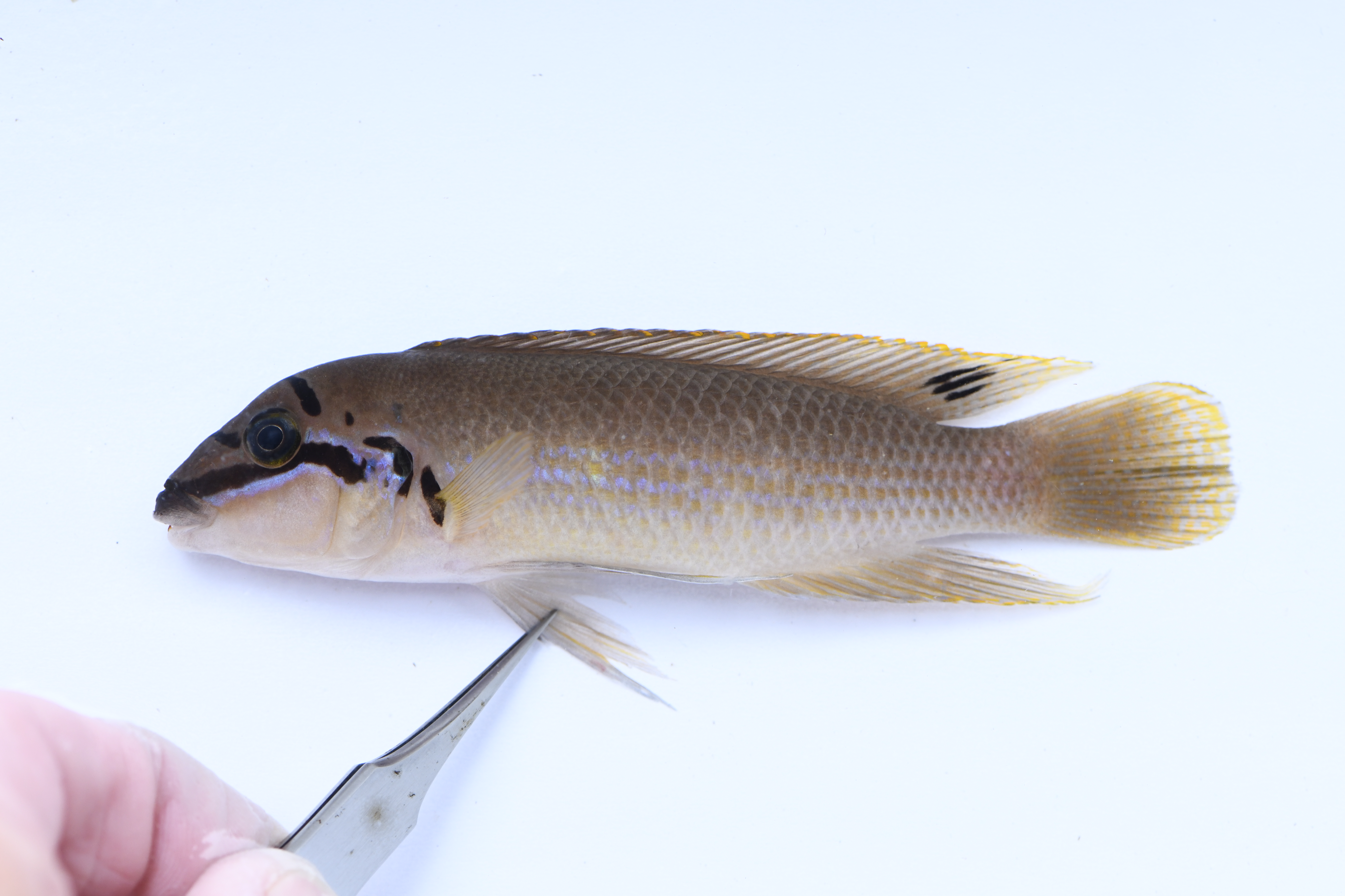
This is a modestly sized cichlid, reaching about 4.7 in (4.5 in) in length. The body is elongate and laterally compressed, built for sliding into rock crevices, and tipped with a pointed snout suited to picking food off stone. Most populations are a clean, near-uniform beige to light grey as adults — strikingly plain for a Tanganyikan cichlid — relieved mainly by the three crisp black bridle lines across the forehead, a dark opercular blotch, a black spot at the pectoral-fin base, and a dark mark toward the rear of the dorsal fin. The eye often carries an orange ring.
Not every population is plain. Forms traded as 'masked' or 'ndobhoi' wear three longitudinal rows of black spots or streaks along the flanks, and several regional variants circulate under names like 'bifrenatus' and 'Mabilibili.' Sexes look much alike; mature males tend to run slightly larger, but there is no reliable color difference, which makes pairing a matter of behavior rather than appearance. The fish is easily told from true Julidochromis by its unmarked (or spot-marked) body versus their ladder of bars, and from the related Julidochromis cyanophleps — a browner, dark-finned, deeper-living species — by color and by fine details of dentition and head markings.
Habitat
Julidochromis brichardi is endemic to Lake Tanganyika and, unlike many of the lake's rock-cichlids that fragment into local races, it is distributed essentially lake-wide, recorded along the shores of Burundi, the Democratic Republic of the Congo, Tanzania, and Zambia. It is an obligate creature of the rocky littoral: a rubble- and crevice-dweller that keeps to boulder fields and the broken-rock zone where caves and fissures are dense, generally within the well-lit upper waters of the shore (roughly the upper 10–66 ft) rather than the deep benthos.
The in-situ water reflects Tanganyika's famously stable chemistry — alkaline and hard, with pH around 8.6–9.3, temperatures of roughly 75–81 °F (75–81 °F), and hardness on the order of 10–20 dH. Compared with its shy congener Julidochromis cyanophleps, which hides in the darkest crevices, Julidochromis brichardi is relatively bold and more readily seen working the rock faces in the open. Its tie to rock is the central fact of its biology, and the central fact for thinking about its future: this is a shoreline specialist, not a fish of open water or sand.
Feeding
Functionally, Julidochromis brichardi is a browser of the rocky biocover — the "aufwuchs" film of algae, sponges, micro-crustaceans, insect larvae, and other small invertebrates that coats Tanganyika's stones. FishBase characterizes it as feeding on invertebrates that grow on the rocks and are hidden within that biocover, picked out with its pointed mouth, and places its trophic level near 3.5, consistent with a small, partly carnivorous grazer rather than a strict algae-eater. Its elongate shape lets it reach prey inside cracks that bulkier fish cannot enter, which is likely how it coexists with the many other invertebrate-pickers that crowd the same reefs.
In the broader community it sits among the dense guild of small, rock-associated cichlids that partition the littoral by microhabitat and feeding technique. It is not a fishery target — too small and too tied to rock to be caught in numbers — and FishBase rates its fishing vulnerability as low. Its ecological weight lies less in biomass than in being one more specialist thread in the lake's exceptionally fine-grained rocky-shore food web.
Mating
Read through keepers' accounts — treated as anecdote until they converge, and on the central points they do — Julidochromis brichardi is a pair-bonding, intensely territorial fish. Conspecific aggression is consistently described as high: groups thin themselves down to a dominant pair, and intolerance among rivals is the norm, so a bonded pair holds and defends a fixed rock territory around its chosen spawning site. Pair dynamics can be volatile, especially in the run-up to spawning. One detailed breeding account (nippyfish.net) describes a dominant male that, after several successful spawns, turned ferociously on both rival males and his own mate, forcing repeated separations before the group settled. Forum keepers echo the pattern of intense pre-spawn squabbling between partners that nonetheless cooperate once eggs are laid. Reports of overall aggression toward other species vary from "relatively peaceful for a Tanganyikan" to "can be a serious bully if allowed," which probably reflects differences in tank size, décor, and stocking more than a fixed temperament.
Breeding
Like its julie relatives, Julidochromis brichardi is a cave-spawning substrate brooder rather than a mouthbrooder. A pair selects a sheltered crevice or cavity, cleans a surface, and lays a modest clutch — FishBase gives a maximum of about 120 eggs — which both parents then guard and fan, defending the territory around the nest and shepherding free-swimming fry. Reported wild and aquarium behavior agrees that this is biparental care centered on a defended rock site, and the squabbling that marks a forming pair gives way to cooperation once eggs are present: even the notably aggressive male in the nippyfish.net account, which harassed rivals and mate alike, never harmed the fry. The combination of crevice-laid eggs, a small clutch, and sustained two-parent guarding is the classic Lamprologine pattern shared with Julidochromis.
In the aquarium
Julidochromis brichardi is a long-standing aquarium-trade fish, kept much like the julies it resembles, and it is not a difficult cichlid to maintain — but it is more demanding socially than its plain looks suggest. The honest plan is to buy a group of six or more young, let a pair form, and have a strategy for the fish that get pushed out, because conspecific intolerance will reduce the group over time. A single pair can be housed and bred in a fairly small footprint, but a community or grow-out group needs real length and a dense pile of rock — caves, fissures, and broken-line-of-sight structure — so subordinates can escape and territories can be drawn. Keepers commonly use stacked rock or flowerpot piles to that end.
Water should match the lake: hard and alkaline, pH around 8.5–9, temperatures in the high 70s °F (about 75–81 °F), with the clean, well-filtered conditions Tanganyikans expect. Tankmates are best chosen from the lake's own cast — shell-dwellers, Cyprichromis, calvus/compressiceps, featherfins and the like — avoiding anything small enough to be bullied at the rockwork or another crevice-spawner that will compete for the same caves. The most common mistakes are predictable: too little rock, too small a tank for more than a pair, and underestimating how hard a bonded pair will push back at spawning time. Treated as a territorial rock-cichlid rather than a peaceful "julie," it is a rewarding and readily bred fish.
The species' tolerance for a light bioload is well attested anecdotally: one long-kept pair was reported thriving for years in a 150-litre tank fitted with a filter sized for a 40-litre aquarium and never given a full water change, only topped up for evaporation. Fed only about once a month and otherwise grazing algae that grew in the tank, the pair still spawned regularly enough that the resulting fry had to be periodically removed to keep the aquarium from overcrowding. It is not a case for skipping maintenance — the tank was lightly stocked with a single pair, which is exactly the point — but it is a useful illustration of how forgiving this fish is when the bioload stays low.
Conservation
At the species level, Julidochromis brichardi is not a conservation concern in its own right. The IUCN Red List assessed it as Least Concern in its 2025 reassessment of Lake Tanganyika fishes (assessor Lloyd Haambiya; taxon 60481, listed under the name Julidochromis brichardi), reflecting its lake-wide range, broad tolerance, and lack of any targeted fishery; the population trend is recorded as unknown and it carries no CITES listing. Current FishBase pages render its status as unevaluated under their latest mapping, a database artifact rather than a downgrade. The main human pressure specific to it is light: ornamental collection for the aquarium trade, which for a widely distributed, readily bred species is not thought to threaten wild populations.
The more honest framing places this plain little rock-grazer inside the wider strain on its lake. Lake Tanganyika is warming, and that warming is biological, not just thermal: O'Reilly et al. (2003, Nature, doi:10.1038/nature01833) showed that reduced mixing has cut primary productivity by roughly 20%, with knock-on declines on the order of 30% in fish yields, while Cohen et al. (2016, PNAS, doi:10.1073/pnas.1603237113) documented a loss of about 38% of the lake's oxygenated benthic habitat as the oxygenated layer shrinks. Closer to this fish's home, shoreline deforestation and sedimentation degrade exactly the clean rocky littoral it depends on (Cohen et al. 1993), smothering the crevices and the biocover it feeds from. The lake's great commercial catch — the pelagic clupeids Stolothrissa and Limnothrissa and their Lates predators, feeding four nations — and its four-country governance under the Lake Tanganyika Authority sit largely apart from a rock-bound species like this one, but the underlying climate and land-use pressures do not. So the accurate statement is the careful one: Julidochromis brichardi itself is secure for now, yet it lives in a lake whose rocky shores and productivity are under measurable, documented strain.