Labidochromis caeruleus "Lundo Island"Electric yellow
Labidochromis caeruleus (Cape Kaiser, Chadagha, Kakusa, Lions Cove, Londo Bay, Lundo Island, Lundu, Manda, Mbowe Island, Nkhata Bay, Nkhoso Point, Ruarwe, Thumbi Point, Undu Reef)
Lundo Island — LOON-doh EYE-land (approx.)
The fish
How this cichlid is built, and everything about how it lives, eats and breeds, is shared with the species — this page doesn't repeat it.
Read the full Labidochromis caeruleus account →Specific to Lundo Island
- Collection locality & coordinates
- Local coloration — best judged from the living-fish photo
- Kept as a single-provenance line, never crossed with other collection points
Care facts below are the species' — shared with Labidochromis caeruleus.
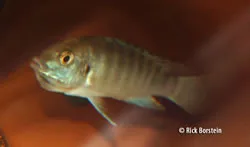
The Lundo Island population
Labidochromis caeruleus "Lundo Island" is the Lundo Island population of Labidochromis caeruleus, a geographic colour form from the Tanzania coast of Lake Malawi in the northern part of the lake. It is the same species as Labidochromis caeruleus, distinguished by its collection locality and local coloration; aquarists keep and breed it as a discrete, provenance-labelled line.
Colour reference: living Lundo Island fish at malawi.si →
About the species
Labidochromis caeruleus is a small, forceps-toothed mbuna from Lake Malawi's rocky reefs — and thanks to one bright-yellow population near Lion's Cove, it may be the single most kept African cichlid in the world. The name is a standing joke: caeruleus means 'blue,' because the fish Geoffrey Fryer described in 1956 from Nkhata Bay was a startling cobalt-and-white animal, not the canary-yellow 'electric yellow' that later conquered the hobby. Across the northern half of the lake the species is really a patchwork of colour forms — white, blue-barred, and yellow — that taxonomists still bundle, tentatively, under one name. Almost every fish in the trade is captive-bred, which is part of why this is the mbuna most often recommended to beginners.
Full Labidochromis caeruleus account →Sources
- malawi.si — Labidochromis caeruleus "Lundo Island"
- Eschmeyer's Catalog of Fishes — Labidochromis caeruleus Fryer 1956 (species record, type locality, holotype BMNH 1956.9.4.9)
- FishBase — Labidochromis caeruleus (Blue streak hap)
- GBIF — Labidochromis caeruleus Fryer, 1956
- The ETYFish Project — Pseudocrenilabrinae (l-o): Labidochromis caeruleus etymology
- malawi.si (M.K. Oliver / Stuart Grant database) — Labidochromis caeruleus 'Nkhata Bay': type locality, biotope, distribution, colour variants
- IUCN Red List — Labidochromis caeruleus "Lundo Island"