Taxonomy & naming
Geoffrey Fryer described Labidochromis caeruleus in 1956 in the Revue de Zoologie et de Botanique Africaines, from specimens collected at Nkhata Bay on the north-western shore of Lake Malawi (then Lake Nyasa). The holotype is held at the Natural History Museum in London as BMNH 1956.9.4.9, with paratypes BMNH 1956.9.4.10-11. Ethelwynn Trewavas had erected the genus Labidochromis two decades earlier (1935) for Labidochromis vellicans, and Digby Lewis's 1982 revision then expanded it substantially, recognising nineteen species and describing thirteen new ones. Labidochromis belongs to the mbuna — the rock-dwelling, maternally mouthbrooding cichlids of Lake Malawi, within the subfamily Pseudocrenilabrinae — and is diagnosed by its narrow, sharply pointed snout and small mouth, in which the elongated, forward-leaning (procumbent) outer teeth meet at their tips like a pair of forceps. The name records exactly that: Greek labis/labidos, 'a pair of forceps,' joined to chromis, an old catch-all term for cichlid-like fishes. The epithet caeruleus is Latin for 'blue' or 'sky-blue,' Fryer's reference to the 'startling light cobalt blue, approaching white in one specimen' he saw in life — a description that fits the lake's blue-and-white populations but not the famous yellow morph, which neither Fryer nor Lewis ever saw. Because the brilliant-yellow Lion's Cove fish looks so different, more than one author has wondered aloud whether it is a locally restricted xanthic variant or a separate species; without molecular evidence to the contrary, M.K. Oliver and Ad Konings both treat all the colour forms as one variable Labidochromis caeruleus.
Morphology
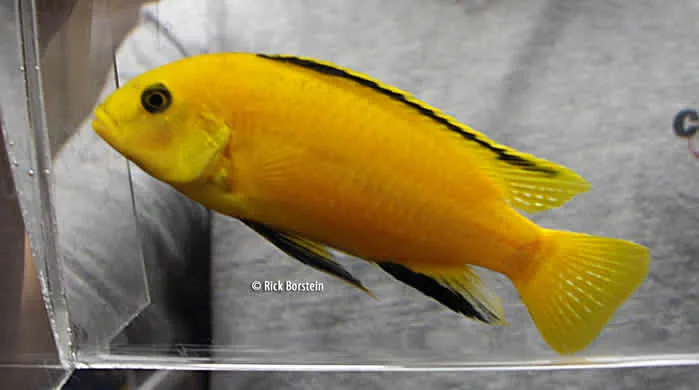
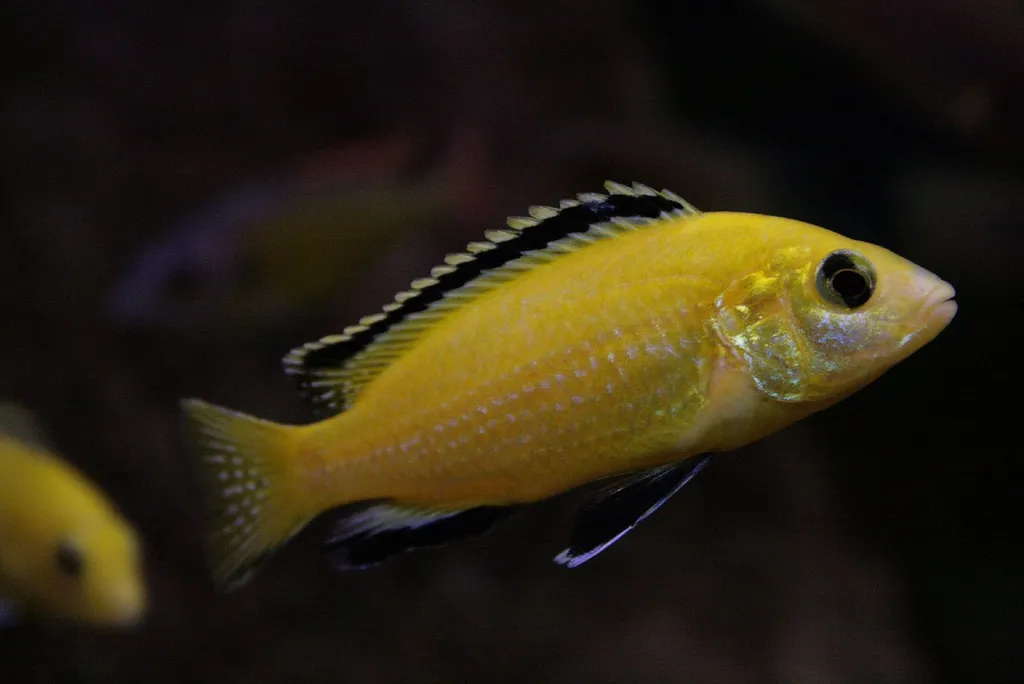
This is a small cichlid even by mbuna standards. FishBase records a maximum of about 3 in standard length, while Konings and the malawi.si database put wild adults at roughly 4 in total length, with aquarium fish occasionally a few centimetres longer — either way, one of the more modest fishes on the reef. The body has the typical elongate, laterally compressed mbuna shape, but the head tapers to a notably acute, almost beak-like snout housing the genus's signature forceps dentition. Colour is where the species refuses to behave. The Nkhata Bay type form and many northern populations are essentially white — Lewis, working from live and field specimens, found them 'pure white, occasionally with faint blue iridescence,' breeding males flushing a pale blue — set off by an intense black band running the length of the dorsal fin and black margins along the anal and pelvic fins. Other populations are a clean powder-blue with bold black flank bars (as at Lundo Island), or near-white with a black-striped dorsal (as at Londo, Mozambique). The hobby-famous form, from a small stretch of coast near Lion's Cove, is a saturated lemon-yellow carrying the same crisp black sub-marginal bands on the dorsal, anal and pelvic fins — a combination so clean it looks almost artificial. Sexual dimorphism is weak: in the wild, malawi.si notes, males and females show no difference in coloration, and the sexes are most reliably told apart by the genital papilla, with males tending to carry slightly larger anal-fin egg-spots.
Habitat
Labidochromis caeruleus is endemic to Lake Malawi, living on pure rocky coasts and reefs. Most Labidochromis are extreme local endemics, confined to one or a few adjacent reefs because the small fish cannot safely cross the predator-filled sand between rocky outcrops. Labidochromis caeruleus is a striking exception, ranging along both shores of the northern half of the lake and so spanning Malawi, Mozambique and Tanzania. Konings attributes this unusually broad reach to the species' ancient origin and the lake's past rises in water level rather than to recent dispersal, with the many isolated populations explaining its strong colour variability. The bright-yellow morph itself is geographically tiny, restricted to a short north-western stretch between roughly Charo and Kajizingi, south of Lion's Cove, and it is not even present in every population there. Within the rock habitat the species keeps to caves and crevices, typically from about 3–66 ft deep, with some populations reported as deep as 164 ft; the type-locality account gives a 33–164 ft band, and the fish has occasionally turned up among weed beds in shallow water. Its water is alkaline and well-buffered: across the lake's upper layers Konings gives a pH around 8.3, conductivity of 200-250 microsiemens, and temperatures that at about 23 ft swing between roughly 22 and 28 degrees C through the year (FishBase's narrower 23-26 degrees C sits inside this). Notably, despite being one of the commonest mbuna in aquaria, Labidochromis caeruleus is genuinely uncommon underwater — usually met singly or in small numbers inside caves — and heavy collection of the yellow form for export has made it scarcer still where divers look.
Feeding
Labidochromis caeruleus is an insectivore, and its anatomy is built for the job. Where many mbuna rasp algae from rock with broad, scraping teeth, Labidochromis caeruleus uses its narrow, pointed snout and forceps-like front teeth to probe the small cracks, pockets and sponge-filled crevices of the reef, plucking out small crustaceans, aquatic insects and their larvae — prey that bulkier-mouthed competitors cannot reach. FishBase places it low on the food web, with an estimated trophic level near 2.6. This micro-predator role, rather than grazing, is the genus's evolutionary calling card, and it lets Labidochromis share crowded reefs by exploiting a feeding niche the algae-scrapers leave open. In captivity it is an easy, unfussy feeder that takes prepared and frozen foods readily. The usual hobbyist caution applies, though: like other mbuna it tends toward obesity on a too-rich, protein-heavy diet and does better with a substantial share of vegetable matter.
Mating
For an mbuna, Labidochromis caeruleus is conspicuously mild. In the wild it shows little of the year-round site-holding common in rock cichlids: Konings reports that most Labidochromis males defend only a small cave among the rocks, and that spawning happens opportunistically wherever a male and a ripe female meet, the male leading her to his cave and displaying before she spawns. Because the sexes look alike, there is no strong nuptial colour change to advertise readiness. This low-key temperament carries over to the tank, where the species earns its reputation as one of the most peaceable Malawi cichlids — easy to combine with other moderately sized rift-lake fish and far less prone to the relentless aggression of typical mbuna. That said, captive Labidochromis do turn more territorial than their wild counterparts, with dominant males staking out and defending caves chiefly against rival males of their own kind; keeping several males together works only in a large, cave-rich tank where they are all introduced at once.
Breeding
Like all mbuna, Labidochromis caeruleus is a maternal (ovophilous) mouthbrooder. After the male leads her to his cave and fertilises the clutch, the female takes the eggs into her mouth almost at once and incubates them for around three weeks before releasing free-swimming fry into the shelter of the rocks. Clutches are small: direct wild fecundity for caeruleus is not well published, but in the closely comparable Labidochromis sp. 'Hongi,' aquarium observations recorded broods of roughly 7 to 18 fry, and Konings treats this small-clutch pattern as typical of the genus. The fish are semelcavous — once released, the fry are not taken back into the mother's mouth, or only very briefly within a day, and fry-guarding females have not been seen in the wild. The species breeds very freely in aquaria, which is exactly why the Lion's Cove yellow form became ubiquitous: Konings documents that the tens of thousands of 'electric yellow' labs in the hobby descend from just two fish exported to Stockholm around 1980-1981. A trio or harem of one male to several females in a rock-furnished tank will spawn readily, and the slow-developing, well-protected fry are easy to raise on finely crushed food.
In the aquarium
Labidochromis caeruleus is widely considered the best entry point into mbuna keeping, and the reputation is earned. The yellow Lion's Cove form, sold everywhere as 'Electric Yellow' or 'Yellow Lab,' is hardy, visually striking, and markedly less aggressive than the average mbuna — forgiving of the usual beginner errors while still delivering the authentic rock-cichlid experience. A single-species tank or a community of similarly sized rift-lake cichlids works equally well, which is unusual in a group where incompatibility is the norm.
Tank: a minimum of around 47 in (about 55 US gal) is the practical starting point for a small group. Footprint matters more than raw volume — mbuna need horizontal territory, so a long, shallow tank lets rockwork claim one end and an open sandy run the other. Build stable, cave-riddled stacks that reach the surface; caves are the currency of mbuna social life, and this fish especially likes a snug cavity to claim. Coarse coral sand or aragonite substrate buffers the water passively and stays neutral against the yellow body, and bright lighting shows the Electric Yellow to full effect while encouraging the rock algae it grazes between meals.
Water: chemistry must mirror Lake Malawi throughout the fish's life — pH 7.8-8.6, temperature 72–82 °F, and moderately high hardness (general hardness upward of 10 °dGH is typical in Malawi-style tanks). Partial water changes of around 25-30 % weekly keep nitrate and dissolved organics in check without large chemistry swings. Hard, alkaline tap water often needs only modest buffering; soften water should be hardened with crushed coral, limestone in the filter, or a Malawi buffer mix. Never let pH drift below 7.5 — prolonged acid conditions suppress the immune system and open the door to bacterial infection.
Diet: this is the single point where keepers most often go wrong. In the wild Labidochromis caeruleus is a crevice-picking insectivore, not an algae-grazer, but like all mbuna it will gorge on high-protein food its gut cannot process efficiently. Too much beef heart, bloodworm, or other animal protein promotes 'Malawi bloat,' a life-threatening metabolic and bacterial enteritis, with distressing regularity. Use spirulina-enriched mbuna flake or pellet as the base, supplemented a few times a week with small amounts of frozen daphnia, mysis, or brine shrimp; blanched spinach or courgette is accepted and beneficial. Feed small amounts two or three times a day rather than one large meal, and fast one day a week.
Tankmates: other moderately sized, high-pH cichlids suit it. Other yellow or pastel mbuna — Labidochromis sp. 'Hongi,' Iodotropheus sprengerae, Cynotilapia zebroides — are the safest companions, because colour contrast reduces cross-species aggression; crowding several yellow-bodied species together instead raises inter-species hostility. Avoid the highly aggressive zebra mbuna (Maylandia / Metriaclima spp.) unless the tank is large and over-stocked, and don't mix with the much smaller Chindongo saulosi or other fragile species that cannot hold their own.
Breeding is straightforward: a ratio of one male to two or three females spreads the male's attention. Move a brooding female to a quiet, cycled maternity tank only if the main tank is very rough — in a well-arranged community she often holds successfully in situ, releasing thirty or fewer well-developed fry after about three weeks. Fry grow on crushed flake and baby brine shrimp and are robust from day one.
Conservation
The IUCN Red List assesses Labidochromis caeruleus as Least Concern (assessed 22 June 2018, by J. Kazembe and A. Konings), reflecting its wide distribution across the northern half of Lake Malawi and the absence of any documented lake-wide decline. It carries no CITES listing, and because the hobby's demand is met overwhelmingly by captive breeding rather than wild capture, ornamental collection is not a population-level threat to the species as a whole. Two qualifications belong in the same breath. First, the prized yellow morph is a genuinely narrow-range population near Lion's Cove, and field observers note that intensified collection of that variant by exporters has measurably thinned it where it occurs — a localised pressure the global 'Least Concern' label does not capture. Second, the lake itself is under mounting strain: basin reviews document warming surface waters and reduced deep mixing, heavy sedimentation and nutrient loading from catchment deforestation and agriculture, and intense artisanal fishing, all of which bear on the shallow rocky habitats this cichlid depends on. None is recorded as an imminent danger to Labidochromis caeruleus specifically, but as a rock-restricted shallow-water endemic it sits squarely in the path of shoreline sedimentation and habitat degradation — its status best read against that wider basin backdrop, not from the species line alone.