Taxonomy & naming
The species was described by Albert Günther in 1867, in his survey of the freshwater and marine fishes of Central America built on collections by Salvin, Godman and Captain J. M. Dow, from a single specimen taken in Lake Managua, Nicaragua (the holotype, BMNH 1865.7.20.35, is unique). Günther figured it more fully the following year. He coined the new genus Neetroplus for it, the name signalling a presumed affinity with the Indian and Sri Lankan genus Etroplus — a resemblance in the incisor dentition and fin structure that we now read as convergence rather than kinship. For most of the next 140 years the fish was the sole, monotypic member of Neetroplus.
Its placement has since been the subject of an honest, ongoing disagreement that anyone reading older and newer sources will run into. In 2007 two independent studies — Chakrabarty & Sparks's molecular work and Schmitter-Soto's systematic revision of Archocentrus and its relatives — found nematopus nested inside the genus Hypsophrys (whose other member is the moga, Hypsophrys nicaraguensis), the two sharing distinctive skull features, and so synonymised Neetroplus into Hypsophrys. FishBase, GBIF and many aquarists adopted Hypsophrys nematopus. But Říčan and colleagues, in their large 2016 phylogenetic reclassification of the Middle American cichlids (tribe Heroini), resurrected Neetroplus as a valid genus, and Eschmeyer's Catalog of Fishes currently follows them, listing the fish as Neetroplus nematopus. Both names are therefore in active scientific use and refer to exactly the same fish; the choice turns on whether one treats the nematopus–nicaraguensis pair as one genus or two. The atlas follows the Catalog in using Neetroplus nematopus; Hypsophrys nematopus is the same fish. Junior synonyms include Neetroplus fluviatilis and Neetroplus nicaraguensis (Gill) as applied to this fish in older literature.
Morphology
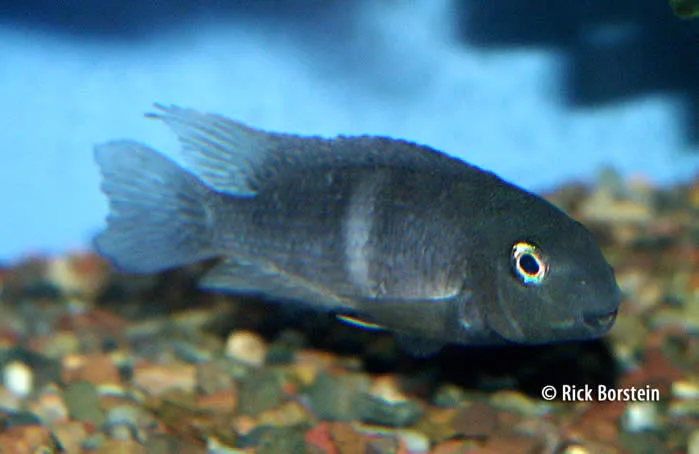
This is a small, stocky cichlid: FishBase gives a maximum of about 5.5 in standard length, and field and hobby reports agree that males reach roughly 4.5–5.5 in while females stay distinctly smaller, often around 3–3.5 in. The body is short, deep and laterally compressed, with a steep, almost vertical forehead and a blunt snout — a profile that, together with the underslung grazing mouth, gives it the squat, bulldog look of a Tanganyikan Tropheus and earns it its nickname. For most of the year the colour is unremarkable: a soft pearl-grey to tan flank crossed by a single dark vertical bar set a little behind the midbody, sometimes with a faint second smudge. It is the teeth that are diagnostic. Where almost all related cichlids carry conical or bicuspid teeth, nematopus has true incisors — flattened, chisel-edged, and distinctly incisiform even in juveniles — a specialisation for rasping algae off hard surfaces. The original description's other formal characters are skeletal: a distinctively shaped rear edge of the mesethmoid, a straight forward-leaning crest on the supraoccipital, and a broad rear expansion of the premaxilla. The dorsal fin carries 18–19 spines and 9–10 soft rays, the anal fin 7–8 spines and 6–7 soft rays. The specific name nematopus — "thread-foot" — refers to the filamentous outer ray of the pelvic (ventral) fin, which in mature fish trails out as long as the fin itself; males also extend the soft trailing edges of the dorsal and anal fins. Apart from size and these fin extensions the sexes look alike, and out of breeding condition they cannot be told apart by colour; a male's slightly larger nuchal hump is suggestive but unreliable. The dramatic dimorphism is not between the sexes but between states: see Breeding.
Habitat
Neetroplus nematopus is endemic to the Atlantic (Caribbean) slope of southern Central America, in the San Juan River system that drains the great Nicaraguan lakes to the Caribbean. It is found through Lake Nicaragua (Cocibolca) and Lake Managua (Xolotlán), in several of the volcanic crater lakes of the Managua region — among them Lake Xiloá and Lake Masaya, though it is conspicuously absent from crater Lake Apoyo — and throughout the rivers of the San Juan drainage into northern and western Costa Rica. It occupies both standing and flowing water, and unusually for a cichlid it thrives in current: it proliferates in rivers of medium to high velocity, clinging to and grazing the rocky beds, and is recorded from roughly 115–1,755 ft elevation. Its preferred microhabitat everywhere is hard substrate — rock, cobble, lava boulders and submerged wood — over which the algal turf it eats grows. FishBase summarises its chemistry as warm and hard-water: pH about 7.0–8.0, hardness 9–20 dH, and a wide temperature tolerance of 70–93 °F, fitting the often slightly alkaline waters of the Nicaraguan great lakes and the more mineral-rich crater lakes. No formal published depth band exists for the species; as a fish of shorelines, rocky shallows and flowing rivers it is effectively a shallow-water grazer, occurring from the surface down through the littoral rock zone (on the order of the upper few metres) rather than into deep open water.
Feeding
Trophically this is a herbivore and aufwuchs-grazer, and its whole head is built for the job. Using its incisor-like teeth it scrapes the felt of algae, diatoms, and the small invertebrates living within it from rocks and submerged trees, and it also crops filamentous algae directly — exactly the rock-biofilm niche filled by Tropheus in Lake Tanganyika, which is the substance behind the "poor man's tropheus" tag. FishBase places it at a low trophic level near 2.0, consistent with a largely plant-and-detritus diet. That said, like most "vegetarian" cichlids it is an opportunist: it takes animal matter when it can, and one of the more remarkable observations from the field is that nematopus is a significant predator of the eggs and fry of other cichlids, including the moga, Hypsophrys nicaraguensis, with which it shares its range. Its gut is correspondingly long and elaborately folded, the hallmark of an animal that processes a lot of low-value plant fibre. In the lake and river communities it is one of the principal grazers of the rocky littoral, a forager that converts encrusting algae into fish biomass and, in turn, becomes prey for larger predators such as the guapote Parachromis dovii.
Mating
Neetroplus nematopus is a monogamous, biparental species that forms strong, lasting pair bonds — and is notorious for the violence with which it defends them. Outside reproduction fish hold loose grazing ranges on the rock, but a ripe pair claims and fiercely guards a territory centred on a cave or crevice. Pair formation begins with the female: she is typically the first to shift into breeding dress, her grey body darkening to a dusky charcoal as she signals readiness, with the male following as spawning approaches. The bond, once made, is famously tight; keepers describe matched pairs that breed again and again with little prompting. The flip side is extreme intraspecific and interspecific aggression. The species has become a small model for research on aggression: a study of crater-lake pairs found that breeding nematopus reliably discriminate the level of threat posed by intruders and calibrate their response accordingly, rather than simply attacking everything equally. In practice a spawning pair will drive off fish many times their size, and within a group all but one pair are commonly harried, sometimes killed, until a single dominant couple holds the field — behaviour that shapes how the fish must be kept (see In the aquarium).
Breeding
This is a biparental cave spawner with one of the most striking reproductive colour changes of any New World cichlid: when a pair spawns its everyday pattern reverses. The pale grey body turns deep grey to jet black, and the single dark bar inverts to a brilliant chalk- or pearl-white band — a high-contrast "breeding negative" worn by both parents while they tend eggs and fry, and the reason the fish is prized despite its drab resting colours. The female leads the change, often days ahead of the male, who flips to the black-and-white pattern once the fry are free-swimming. Eggs are laid on the roof or wall of a cave, an overhang or a crevice in the rock. Clutches are small but the eggs are large for a Central American cichlid: hobby and field reports give on the order of 40–60 eggs, sometimes more in big well-conditioned females, and they are a distinctive olive-green. The female fans and guards the clutch while the male patrols the perimeter; eggs hatch in about five days and the wrigglers are free-swimming roughly eight days after spawning, emerging already large enough to graze. Parental care is intense and prolonged — both parents attack any intruder, the human hand included — and keepers report pairs shepherding fry for as long as two to three months. The young grow quickly on algae and small live foods and take on the adult grey-with-bar pattern within a couple of weeks.
In the aquarium
Neets, as hobbyists call them, are hardy, long-lived and easy to feed — the entire challenge of keeping them is managing aggression, which for a fish under 6 in is remarkable. Their reputation in the Central American cichlid community is blunt: pound for pound, among the meanest fish you can keep. A single pair needs a tank of roughly 4 ft (about 55 US gal / 50+ US gallons) at a sensible minimum, more if other fish share it, aquascaped with plenty of rock, caves and crevices that both define territories and give weaker fish somewhere to hide. Because the fish naturally grazes hard surfaces in moving water, they tolerate and even appreciate good flow and bright light that encourages algae; a film of algae left to grow on rock and glass is a feature, not a fault, and gives fry something to crop.
Water should mirror their near-neutral-to-alkaline, warm home waters: pH about 7.0–8.0, moderately hard (around 9–20 dH) as a keeping target, and warm (roughly 75–86 °F is ideal within their broad 70–93 °F tolerance). They are not fussy about chemistry and adapt to most tap water that is not soft and acidic. Feeding is simple — they take prepared foods readily — but the diet should lean herbivorous and high-fibre (spirulina- or vegetable-based flake and pellets, blanched greens), with occasional protein such as frozen invertebrates used mainly to condition females for spawning; an over-rich, all-protein diet is unwise for a dedicated grazer.
Tankmates are the hard part. Outside breeding the fish can be merely feisty, but a spawning pair becomes a wrecking crew that will bully or kill fish far larger than themselves and reduce a group of their own kind to a single pair. The usual approaches are to keep them as a single species-tank pair, or to house them with robust, fast Central Americans of similar temperament in a tank large enough to spread aggression — and many breeders deliberately add a hardy, large-bodied "target" fish (fast rainbowfish, for instance) for the pair to chase, which paradoxically settles them enough to spawn. The classic beginner mistakes are giving them too little space, too few caves, or timid tankmates; any of these turns a charming little fish into a murderer. Sexing outside breeding is genuinely difficult, so most keepers buy a group of six to eight juveniles and let a pair form naturally, then remove the rest before the casualties mount.
Conservation
The IUCN Red List assesses this fish — under the name Neetroplus nematopus — as Near Threatened (criterion B1ab(iii)), assessed on 30 July 2019 by Tim Lyons (ABQ BioPark) and published in 2020, with the population trend listed as unknown. The Near Threatened listing reflects a comparatively restricted range — the San Juan basin and associated lakes of just Costa Rica and Nicaragua — and an inferred decline in habitat quality, rather than any direct exploitation; it carries no CITES listing and is not a fishery target. The principal pressures on its waters are those bearing on the Nicaraguan great lakes and crater lakes generally: pollution and eutrophication (Lake Managua in particular has a long history of industrial and sewage contamination), shoreline and watershed development, and the spread of introduced species. Despite this the fish remains common and adaptable across much of its range, occurring in both lakes and fast rivers and tolerating a wide span of conditions, and it is bred routinely in the aquarium hobby — so while its conservation status warrants attention, it is in no immediate danger of disappearing.