Taxonomy & naming
Stomatepia pindu was described by the British ichthyologist Ethelwynn Trewavas in 1972, in the monograph 'Ecological studies on crater lakes in West Cameroon: Fishes of Barombi Mbo' (Trewavas, Green & Corbet, Journal of Zoology, London, vol. 167), which formally laid out the endemic cichlid fauna of the lake. The holotype (BMNH 1971.10.20.1) and twenty-one paratypes are held in the Natural History Museum, London, all collected from Lake Barombi-Mbo, the species' only known locality. The genus Stomatepia, also erected by Trewavas, is one of four cichlid genera endemic to the lake — alongside Konia, Pungu and Myaka — and contains just three species: Stomatepia mariae, Stomatepia pindu, and the very rare Stomatepia mongo. The three are so morphologically close, and intergrade so subtly, that they have been treated as a textbook puzzle in the study of how species form. Stomatepia is in turn nested within the tilapiine assemblage of the subfamily Pseudocrenilabrinae and is closely allied to Sarotherodon; the entire Barombi Mbo flock is thought to derive from a Sarotherodon-like riverine ancestor that colonised the lake and then diversified. That radiation has been repeatedly cited (Schliewen and colleagues, 1994 onward) as one of the best candidate examples of sympatric speciation — the splitting of one lineage into several within a single small body of water, without any geographic barrier — though later workers have debated just how 'sympatric' the process really was. No junior synonyms attach to the name; pindu has stood as valid since its description.
Morphology
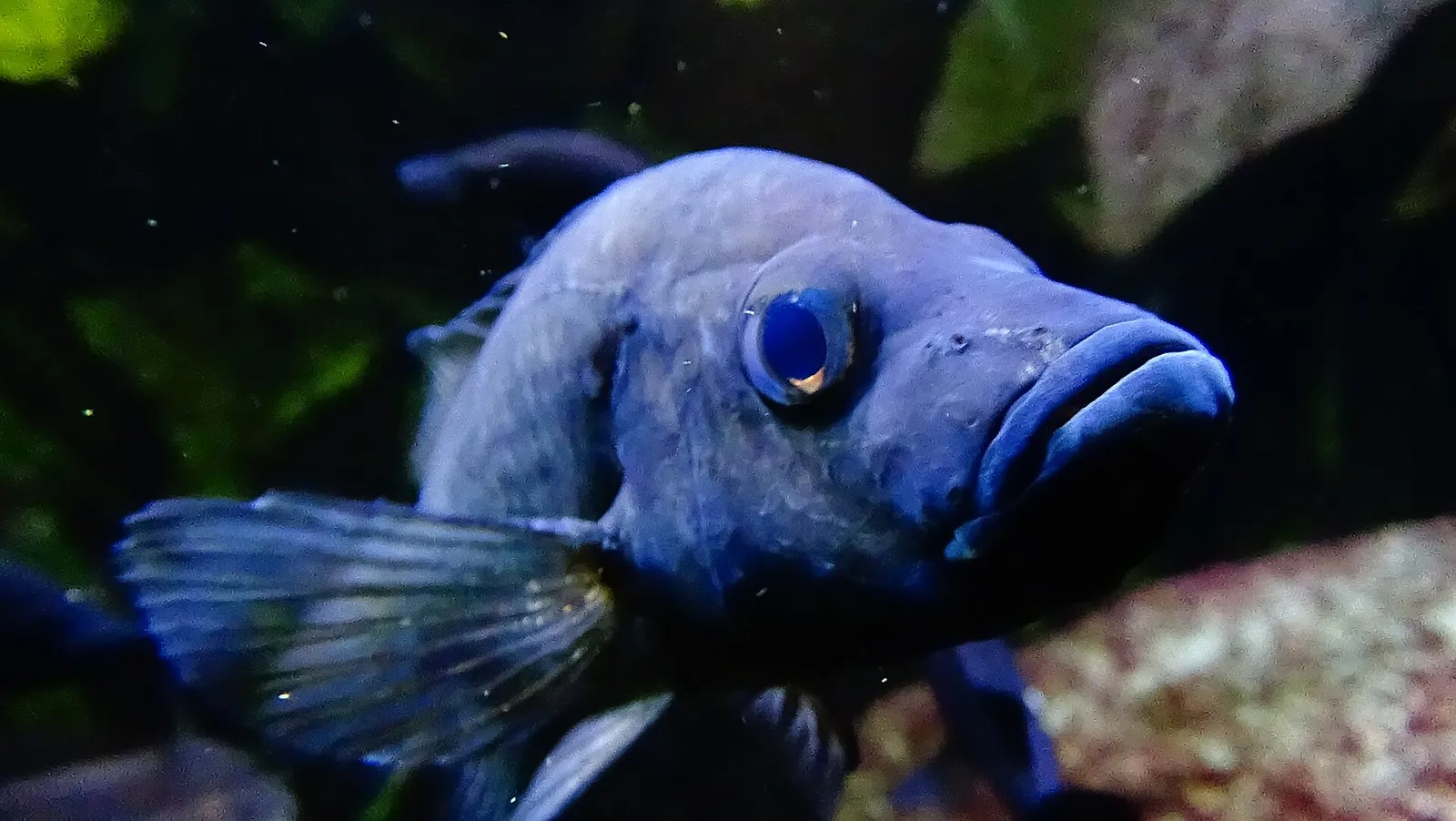
The pindu is a small cichlid, reaching about 3.5 in in standard length, with a relatively robust, fairly deep body (body depth roughly 30–37% of standard length). The fin counts run to 13–15 dorsal spines and 10–11 soft rays, with 3 anal spines and 8–9 anal soft rays. Two features stand out in Trewavas's diagnosis: the mouth is large (the upper jaw is 28.5–35.2% of head length), and the cephalic lateral-line (sensory pore) system on the head is markedly enlarged and inflated — a swollen, cavernous look around the snout and cheeks that is characteristic of the genus and is associated with sensing prey in the dim, deep water the flock occupies. Microbranchiospines are usually absent from the outer faces of the second through fourth gill arches, distinguishing the predatory pindu from the plankton-straining members of the flock. The common name is also the scientific one: 'pindu' is the local Barombi word for this fish, and it refers to its colour — in good condition the body can darken to a deep, nearly uniform black, the trait that most readily separates it in the field from its paler, more blotched congener Stomatepia mariae. Aquarists report that breeding and dominant fish, especially males, deepen to true black and may show a scatter of iridescent violet or purple speckles, while stressed or subordinate fish fade to grey-brown with darker blotches along the flanks. Sexual dimorphism is slight and is expressed mainly in this dominance colouration and in breeding behaviour rather than in any strong difference in fin shape or size.
Habitat
Lake Barombi Mbo is a roughly circular volcanic crater lake about 1.6 mi across, situated near the town of Kumba in Cameroon's Southwest Region at around 984 ft elevation. It is the largest and best-studied of the Cameroon crater lakes, with an open-water area of roughly 1.5–1.9 mi², a mean depth near 226 ft and a maximum depth of about 361–364 ft; the most recent lava flow into the basin is dated to around one million years ago, so the lake — and the species flock it holds — is at least that old. Crucially for the fishes, the lake is permanently stratified: there is little or no detectable dissolved oxygen below about 66 ft, so the entire cichlid community, the pindu included, is confined to the thin, warm, oxygenated upper layer over deep anoxic water. That surface layer is warm — field temperatures around 77–81 °F — and the water is soft to moderately mineralised and near-neutral to mildly alkaline, with reported aquarium-replicating values around pH 7 to 8.5. The pindu is a demersal, bottom-associated fish that, in the wild and in captivity, tends to school and shelter near submerged wood and structure, moving out to feed. Because the species exists in just this one small, closed basin, its global range is among the most restricted of any cichlid. The lake lies within the Western Equatorial Crater Lakes freshwater ecoregion and is a designated Ramsar wetland of international importance.
Feeding
Among the Barombi Mbo flock the pindu fills the role of a predator and insect-larva feeder. Its large mouth and reduced gill-raker armature mark it as a fish that takes prey items rather than filtering fine plankton: Trewavas and later workers describe a diet dominated by aquatic insect larvae and shrimp, with FishBase summarising it as 'predatory' and noting that it mainly feeds on shrimp and insect larvae. One of the more remarkable observations is that the pindu has been reported to kleptoparasitize the freshwater crab Potamonautes (Potamon) africanus — that is, to rob food from the crabs rather than only foraging independently, an unusual behaviour that fits its opportunistic, large-mouthed predatory habit. Within the flock this trophic specialisation is part of what keeps the closely related Stomatepia species ecologically distinct: where the pindu is an insect-larva and small-prey predator, its congener Stomatepia mariae trends toward fish and insect prey, and the rare Stomatepia mongo has a still more elongated head. The partitioning of the lake's limited food — insect larvae, shrimp, plankton, detritus, sponges and molluscs divided among the endemic genera — is the ecological backbone of the whole radiation.
Mating
The pindu is a maternal mouthbrooder, and its social and courtship behaviour is correspondingly understated compared with the vigorous territoriality of many substrate-spawning cichlids. Aquarium observers consistently describe groups that school together around shared cover — a single tall piece of driftwood, for example — and venture out only to feed or to spawn. Strikingly, spawning in this species is a calm affair: a ready pair simply moves a short distance from the group to an open patch of bottom, with no nest-building, no excavation and little of the chasing, fence-off aggression typical of mouthbrooding haplochromines or tilapiines. The rest of the group continues feeding nearby, apparently undisturbed, and the spawning pair pays them no attention. Pair formation appears loose and opportunistic rather than built around a strongly defended male territory; there is no evidence of the lek-like arena spawning seen in some African mouthbrooders. This low-key sociality is part of the species' appeal to the small number of hobbyists who keep it, but it also means the cues that separate willing pairs are subtle, and good breeding success seems to depend more on a settled, low-stress group than on aggressive male display.
Breeding
Stomatepia pindu is an ovophilic (egg-loving) maternal mouthbrooder: the female takes the fertilised eggs into her mouth and broods them there until the young are free-swimming. In the documented aquarium spawnings the female releases eggs onto the open substrate in small batches, the male circles in to fertilise them, and she immediately picks them up; there is no pit or nest. A clutch is modest — congeners and aquarium accounts indicate on the order of a few dozen eggs per spawning, in keeping with the small size of the fish — and individual records of stripping five to ten fully developed fry from a single female are reported, with full broods somewhat larger. Incubation runs roughly three weeks, after which free-swimming fry can be released or artificially stripped and reared; they grow readily on baby brine shrimp, microworms and finely crushed flake. Keepers note that inexperienced females frequently swallow or lose their first several clutches, holding only a day or two before the eggs vanish, and that brooding skill improves with successive spawns — a common pattern in mouthbrooders. Unusually for the genus, males have on rare occasions been observed mouthbrooding in aquaria, although the female is the normal incubating parent. There is no documented biparental care beyond the female's oral brooding.
In the aquarium
The pindu is a rare fish in the hobby, kept by a small circle of specialists and African-cichlid enthusiasts rather than traded in volume, and it is best regarded as a conservation-minded keeper's species. It is not difficult to house, but it is difficult to obtain, and because the wild population is Critically Endangered, maintaining captive breeding groups has genuine ark value.
A group is the right way to keep it: these are schooling, low-aggression fish that settle best in numbers of six or more, where natural spawning behaviour emerges without the bullying seen when too few are kept. A 40-gallon (roughly 150-litre) breeder-format tank has successfully housed and spawned a wild group, though a larger footprint is better for a long-term colony. The single most useful piece of décor is tall, vertical structure — driftwood or rock reaching toward the surface — which the group will adopt as a shared refuge; open swimming space and a substrate of sand or fine gravel complete the layout.
Water should be warm and on the hard, alkaline side, reflecting the crater lake: temperatures around 79–82 °F (high-70s to low-80s °F), pH around 7.5–8.5, and moderately hard, well-mineralised water are all well tolerated; one detailed breeding account ran the group at about 78–82 °F, pH 8.2 in relatively hard water. The species is, however, sensitive to deteriorating conditions — keepers have lost groups to sudden crashes and severe ich outbreaks following neglected maintenance — so stable parameters, strong biological filtration (large sponge filters work well) and consistent water changes matter more than precise chemistry. Feeding is straightforward: as a small predator it takes live and frozen foods enthusiastically — bloodworms, other insect larvae, small crustaceans — alongside good-quality prepared foods.
Tankmates are best limited to the other Barombi Mbo endemics (Stomatepia mariae, Konia, Pungu maclareni, Sarotherodon and the like), which recreates the natural community and is the way most serious keepers maintain the flock; a single robust catfish such as a Synodontis is sometimes included. Mixing pindu with unrelated, boisterous African cichlids is discouraged, both because the calm pindu is easily outcompeted and because hybridisation risk within Stomatepia makes keeping the species clean and unmixed a priority for anyone hoping to contribute fish back to the hobby's conservation pool.
Conservation
Stomatepia pindu is assessed as Critically Endangered on the IUCN Red List (criteria B1ab(iii)+2ab(iii); assessed 16 February 2009 by T. Moelants, published 2010), with an unknown population trend. The basis for the listing is simple and stark: the species exists in a single small crater lake, so its entire range and population can be wiped out by one local catastrophe. The assessment lists a long set of pressures bearing on Lake Barombi Mbo — expansion of oil-palm plantations, slash-and-burn agriculture and the sedimentation and pollution that follow, commercial tourism development, water abstraction for the growing nearby town of Kumba, and the more exotic but real geological hazard of a limnic eruption (a sudden 'burping' of dissolved carbon dioxide from the deep anoxic layer, of the kind that killed at Cameroon's Lake Nyos) potentially triggered by increasing wind-driven lake turnover. Because the cichlids are confined to the lake's thin oxygenated surface layer, any disturbance to the lake's stratification or water quality threatens the whole flock at once. Barombi Mbo's recognition as a Ramsar site affords some formal protection, but enforcement on the ground is limited and local fishing and watershed degradation continue. For the pindu, as for its Stomatepia congeners and the rest of the endemic community, the long-term outlook is tied entirely to the fate of this one lake — which is why captive maintenance of clean, unhybridised lines is treated by hobbyist conservationists as a meaningful safeguard.