Taxonomy & naming
Epalzeorhynchos bicolor was described by the American ichthyologist Hugh McCormick Smith in 1931, from material collected in central Thailand. It belongs to the family Cyprinidae, subfamily Labeoninae — the algae-grazing, sucker-mouthed river fishes of Asia and Africa — and to the small genus Epalzeorhynchos, which also contains the similarly shark-shaped rainbow shark, E. frenatum. The Catalog of Fishes (Eschmeyer, California Academy of Sciences) treats Epalzeorhynchos bicolor as the valid combination; the species has also circulated in the hobby under the older name Labeo bicolor, a name still occasionally seen in older literature and price lists.
The genus name Epalzeorhynchos combines Greek roots referring to the snout (rhynchos, snout or nose); the compound's precise classical sense is not settled in the literature available here. The species epithet bicolor is straightforward Latin — bi- (two) + color (colour) — describing the stark two-tone pattern of jet-black body against a vivid red-orange tail that makes this one of the most recognisable cyprinids in the hobby. Approximate pronunciation: eh-PAL-zee-oh-RIN-kos BY-kuh-lor.
Morphology
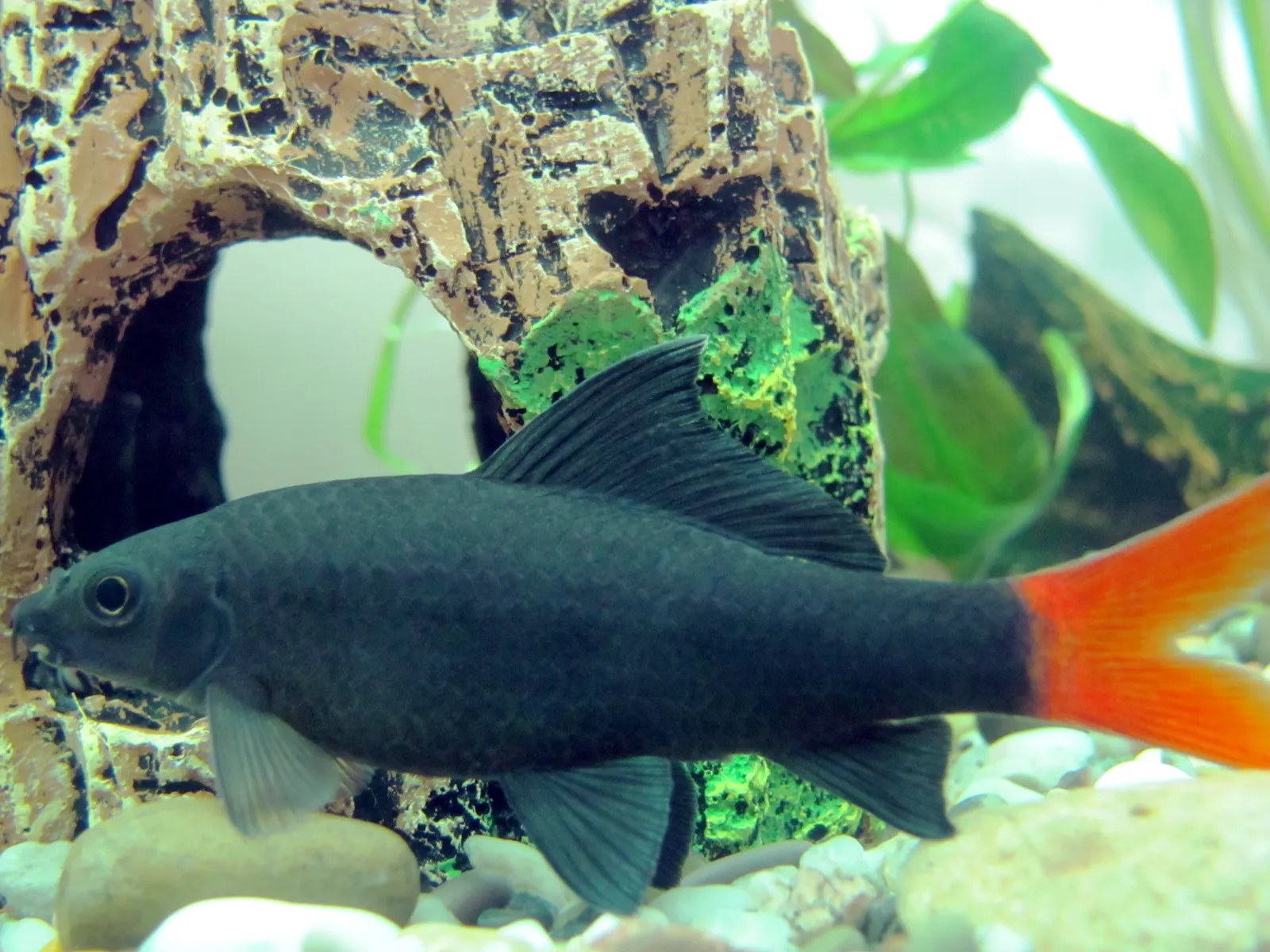
The redtail shark has an elongated, slightly compressed body, a flattened ventral surface, and a strongly upright, triangular dorsal fin that — together with its streamlined shape and constant cruising — gives it a passing resemblance to a shark, though it is a true cyprinid without a hint of cartilage. The mouth is ventral and disc-like, with two pairs of small barbels, an adaptation shared with other labeonines for scraping algae and biofilm from rock and wood.
Adult colouration is a deep, velvety black to charcoal body set off by a bright orange-red caudal fin; some individuals also show a thin pale margin along the dorsal fin. Maximum size in the aquarium is commonly cited around 4.5 in standard length (roughly 6 in total length), though wild-measured maxima are poorly documented given the species' presumed absence from the wild today. Juveniles are paler and more silvery-grey, developing full adult contrast with age.
Habitat
The type locality for Epalzeorhynchos bicolor lies in Thailand's Chao Phraya River basin, with the clearest historical records centred on Bueng Boraphet, a large floodplain wetland near Nakhon Sawan in central Thailand. It was a fish of slow-flowing lowland rivers, canals and seasonally flooded wetland habitat, over sand, mud and submerged vegetation.
Wild sightings had already become exceptionally rare by the mid-twentieth century as Bueng Boraphet and the surrounding Chao Phraya lowlands were drained, dammed and converted for agriculture. Some sources report unconfirmed or disputed records from the Mekong basin in later decades, but no verified, self-sustaining wild population is documented for this article; the species is treated here as functionally gone from the wild, its Chao Phraya type locality substantially altered from the habitat it once occupied.
Feeding
Epalzeorhynchos bicolor is an omnivorous grazer. In the wild it would be expected to graze algae, biofilm and organic detritus from submerged surfaces using its sucker-like mouth, supplementing this with small invertebrates encountered along the substrate — a pattern typical of labeonine cyprinids generally, though a dedicated dietary study for this species was not available for this article.
In the aquarium it is an easy and enthusiastic feeder, taking algae wafers, sinking pellets, and blanched vegetables such as courgette, cucumber and spinach as a staple, with occasional live or frozen foods (bloodworm, daphnia, brine shrimp) appreciated as variety. It will graze algae from tank surfaces and decor when available, though a varied prepared diet is needed to keep it in good condition once algae growth is exhausted.
Mating
Courtship and spawning behaviour of Epalzeorhynchos bicolor have not been documented from genuinely wild populations for many decades, and detailed behavioural accounts even from commercial breeding operations are scarce in the literature accessible for this article. Sexing is difficult: males are generally slimmer with a more streamlined profile, while ripe females appear noticeably deeper-bodied, particularly when carrying eggs, but these differences are subtle and unreliable in younger fish.
The species is also strongly territorial, especially toward its own kind and toward other bottom-dwelling fish of similar shape — a trait that complicates pairing multiple adults in the confined space of a home aquarium and is thought to be one reason home spawning is essentially unreported.
Breeding
Virtually the entire global aquarium supply of redtail sharks is produced on commercial fish farms, predominantly in Southeast Asia and Florida, using hormone-induced spawning techniques rather than natural pairing. This industrial-scale production is what has kept the species available and inexpensive in the trade even as the wild population has effectively disappeared — an unusual case where a species' captive population vastly outnumbers, and has entirely replaced, its wild one.
Spontaneous breeding in home aquaria is exceptionally rare and not reliably documented; the combination of territorial aggression between adults and the apparent need for hormonal induction makes this a species hobbyists should not expect to breed by conventional means. Eggs, where produced, are scattered and adhesive, with no parental care.
In the aquarium
The redtail shark is a long-standing community-tank staple prized for its bold red-and-black colour contrast, but it needs planning around its territorial nature. A single adult per tank is the standard recommendation: this species is notably intolerant of its own kind and of other similarly shaped, similarly coloured bottom-dwellers, and will often chase and harass tankmates it perceives as rivals for its chosen territory. A tank of at least 25 US gallons with plenty of rockwork, driftwood, and broken sightlines helps diffuse aggression by giving the fish (and its tankmates) places to retreat and establish separate territories.
Water should be kept clean and well-filtered, with a temperature around 72–82 °F and a slightly acidic to neutral to mildly alkaline pH (roughly 6.5–7.5); it is an active swimmer that appreciates open space along the lower and middle water column. It coexists well with mid-water and surface-dwelling community fish that do not compete for bottom territory, but is a poor choice alongside other sharks, loaches, or plecos likely to be seen as competitors. Because virtually all stock is captive-bred, buying from reputable suppliers supports the only viable population of this species left.
Conservation
Epalzeorhynchos bicolor carries a CARES Fish Preservation Program priority listing of Critically Endangered (CCR), reflecting its status as a species that persists essentially only in aquarium and aquaculture populations — precisely the situation the CARES program exists to address, by encouraging hobbyists to maintain and responsibly propagate species that have lost, or nearly lost, a viable wild population. The IUCN Red List treated this species as Extinct in the Wild for many years after the loss of its Chao Phraya wetland habitat around Bueng Boraphet, but the current assessment — 23 February 2011 — lists it as Critically Endangered under criteria B1ab(iii,v)+2ab(iii,v), following reports of a small surviving population; some more recent, disputed reports of Mekong-basin sightings have not been confirmed as a self-sustaining wild population, and the current Red List entry was not confirmed for this article.
The conservation irony of the redtail shark is stark: it is simultaneously one of the most commercially successful ornamental fish in the world and, by most assessments, absent from the wild altogether. Its continued presence anywhere depends entirely on the captive-breeding infrastructure of the aquarium trade, which makes hobbyist stewardship — keeping genetically healthy stock rather than treating the species as disposable — directly relevant to whatever future this species has.