Taxonomy & naming
Garra barreimiae was described in 1956 by Henry Weed Fowler and Heinz Steinitz. It belongs to the family Cyprinidae, subfamily Labeoninae, within the large genus Garra — sucker-mouthed, algae-grazing stream fishes distributed from West Africa through the Middle East to South and Southeast Asia. The Catalog of Fishes (Eschmeyer, California Academy of Sciences) treats Garra barreimiae as the valid combination.
The genus name Garra derives from a South Asian vernacular name for these disc-mouthed stream fish, Latinized as a genus name by Francis Hamilton (Buchanan-Hamilton) in 1822. The species epithet barreimiae is a toponym, most plausibly referencing a locality within the fish's Arabian Peninsula range; the precise place-name origin was not confirmed for this article. Approximate pronunciation: GAR-ra bar-EE-mee-eye.
Morphology
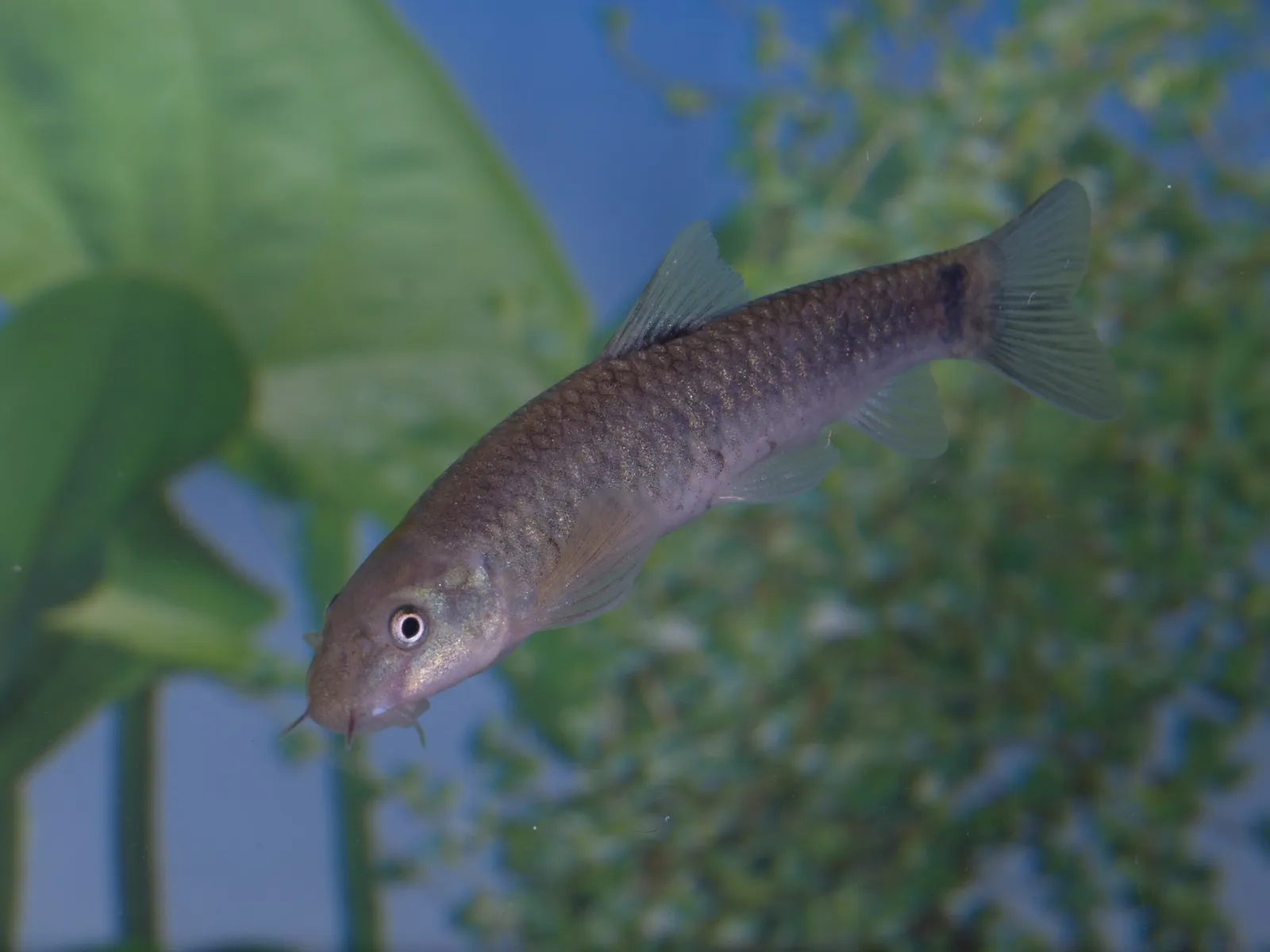
Like other Garra, G. barreimiae has an elongated, slightly compressed body and a ventral, disc-like mouth used to grip rock surfaces in flowing water while grazing. Surface-dwelling populations are typically olive to grey-brown with a silvery flank and unremarkable fin colouration, well camouflaged against wadi gravel and rock.
The species' most striking morphological feature is found not in the typical stream populations but in isolated cave-dwelling individuals, notably in Oman's Al Hoota Cave system, which show reduced pigmentation (partial depigmentation toward pink or pale colouration) and diminished eye development compared with surface fish — a pattern of troglomorphic change documented in several independent Garra barreimiae cave populations across the region. This makes the species a rare regional case study in the early stages of cave adaptation. Precise length measurements were not accessible for this article, but Garra barreimiae is a small fish, consistent with the modest size typical of the genus.
Habitat
Garra barreimiae is native to wadi systems of the Hajar Mountains, spanning northern Oman and the eastern United Arab Emirates — a mountain range of limestone and ophiolite terrain riddled with springs, seasonal streams, and karst cave systems fed by groundwater. Surface populations occupy clear, flowing wadi pools and streams, while a number of populations are found in the region's karst caves, most notably Al Hoota Cave near Al Hamra, Oman, where fish persist in permanently dark subterranean pools.
The Hajar Mountains' hydrology is highly seasonal and groundwater-dependent, and wadi flow can vary enormously between wet and dry periods. This makes the species' habitat inherently fragile: it depends on a limited, geologically constrained network of springs and wadi pools in one of the most arid regions inhabited by any freshwater cyprinid.
Feeding
As in other Garra, the ventral disc-mouth is adapted for grazing algae and biofilm (aufwuchs) from rock surfaces in flowing water, and this is presumed to be the primary feeding mode for surface-dwelling Garra barreimiae, supplemented opportunistically with small invertebrates. Cave-dwelling populations, lacking the light needed for algal growth, are thought to rely more heavily on organic detritus and invertebrate prey washed into the cave system or already present in its pools, though a dedicated dietary study of the cave populations was not accessible for this article.
Mating
No detailed account of courtship behaviour in Garra barreimiae was accessible for this article. Cyprinids in this genus are not generally reported to show pronounced external sexual dimorphism outside of the breeding season, and specific sexing characters for this species were not confirmed here.
Breeding
Reproductive biology of Garra barreimiae in the wild is not well documented in the sources accessible for this article. Garra species in general are egg-scattering broadcast spawners with no parental care, a family-level generalization rather than a confirmed account of this species specifically. The species has essentially no established presence in the aquarium hobby, so no captive-breeding record exists to draw on.
In the aquarium
Garra barreimiae is not established in the aquarium trade and has no meaningful husbandry record; it is occasionally of interest to specialist keepers of Middle Eastern or cave-adapted fishes rather than a mainstream ornamental species. Where kept, the genus-level expectation for Garra is a need for strong current, high dissolved oxygen and clean, well-oxygenated water mimicking flowing wadi or stream habitat, but this is a general inference rather than documented care guidance specific to G. barreimiae.
Conservation
Garra barreimiae carries a CARES Fish Preservation Program priority listing of Vulnerable (CVU). As one of very few native freshwater fish species on the Arabian Peninsula, it depends on a naturally small and fragmented network of wadi springs and pools that is acutely exposed to groundwater extraction, drought, and the broader aridification pressures facing the region's water resources — threats that fall hardest on narrow-range, water-dependent species with nowhere else to go. A precise current IUCN Red List category was not confirmed for this article.
The species' isolated cave populations, including that of Al Hoota Cave, add a further layer of vulnerability: subterranean populations are typically small, slow-growing, and highly sensitive to changes in groundwater level or quality, with essentially no capacity to recolonise from elsewhere if lost. Because the species has no meaningful presence in the aquarium trade, its conservation depends almost entirely on protection of its native Hajar Mountain wadi and cave habitats rather than on hobbyist stewardship.