Taxonomy & naming
Tor remadevii was formally described by Madhusoodana Kurup and Radhakrishnan in 2011, though it had been recognised as a distinct entity earlier — a 2007 paper initially applied the name T. remadevii to specimens from the Pambar River in Chinnar Wildlife Sanctuary, Kerala. The Catalog of Fishes treats the 2011 description as the valid authority for the current combination Tor remadevii (Madhusoodana Kurup & Radhakrishnan, 2011). The parenthetical form of the authority is not used here because the genus Tor itself was the original placement.
A 2018 PLOS One taxonomic study confirmed the species' distinctiveness from the syntopic T. khudree and T. mussullah and resolved its status within the Western Ghats Tor complex. The species belongs to the genus Tor — the mahseers of South and Southeast Asia — a group of large river barbs placed within the family Cyprinidae. The genus has not undergone the genus-level revision that reorganised many smaller South Asian barbs in the 2012 Pethiyagoda et al. work; Tor was already a distinct, well-defined genus before that revision and was unaffected by it.
The species epithet remadeviae honours K. Rema Devi, an Indian ichthyologist who contributed substantially to the study of freshwater fishes of the Western Ghats.
This fish was long listed as Tor remadeviae; Eschmeyer's Catalog of Fishes places the species in Tor, and the current combination Tor remadevii is followed here.
Morphology
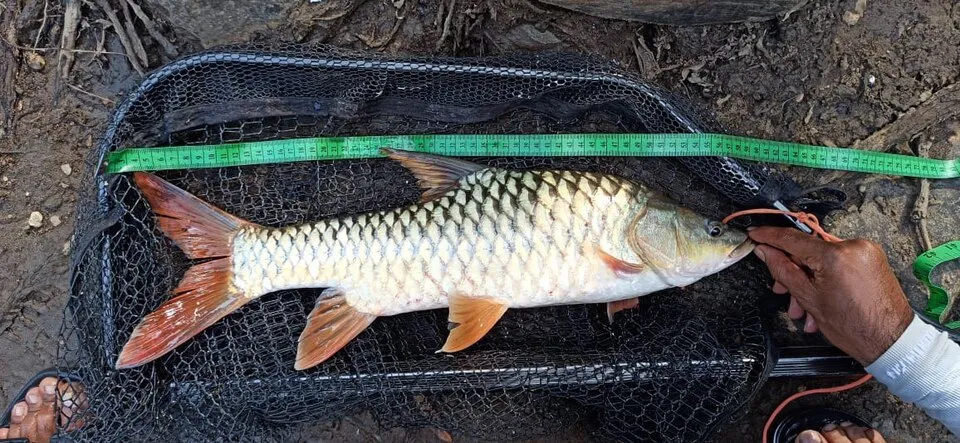
The hump-backed mahseer is among the largest freshwater fishes of peninsular India. FishBase records a maximum standard length of 69 in and a maximum weight of 54 kg, figures consistent with the largest individuals documented in the wild. The most distinctive character is a pronounced dorsal hump — a steep rise behind the head — that becomes more conspicuous with growth and distinguishes this species from the otherwise similar T. khudree at a glance.
Colouration is striking: the paired and unpaired fins are vivid orange, and this feature, combined with the hump, makes large adults unmistakable in the field. Like all mahseers the species has a protrusible, suctorial mouth furnished with pharyngeal teeth and prominent barbels, both adaptations for foraging on the rocky, fast-water substrate of hill rivers. The body is deep and laterally compressed, with large, cycloid scales.
The PLOS One taxonomic study noted that individuals can reach 59 in total length in the wild, an alternative measurement consistent with the FishBase standard-length maximum. No detailed meristic data from the original description are reproduced here.
Habitat
Tor remadevii is strictly endemic to the Kaveri river basin of the southern Western Ghats, with confirmed records from the Moyar, Kabini, Bhavani, and Pambar (Chinnar) rivers; historical records exist from the Arakavathy. The range spans the states of Karnataka, Tamil Nadu, and Kerala, all within the Eastern and Western Ghats ecoregion. The type locality is the Pambar River within Chinnar Wildlife Sanctuary, Kerala.
Within these rivers the species occupies the middle to upper reaches, moving between mesohabitats — from shallow, high-velocity rapids over bedrock and boulder substrate to deep, slow-flowing pools. It is a strongly altitudinal migrant: during the monsoon (June to October) adults move upstream into headwater reaches to spawn, then descend to lower, deeper pools in the post-monsoon dry season. This seasonal migration requires unobstructed river continuity.
Water in these hill rivers is fast-moving, well-oxygenated, and near-neutral; temperatures in the Western Ghats hill streams fluctuate seasonally but remain cool to moderate relative to the lowland rivers of the peninsula. The species is rheophilic and entirely dependent on intact, free-flowing riverine habitat.
Feeding
Like other large mahseers, Tor remadevii is broadly omnivorous, with a diet that shifts with age. The suctorial, protrusible mouth and strong pharyngeal teeth are suited to rasping algae and biofilm from rocks as well as crushing invertebrates and hard plant material. Adults appear more herbivorous — grazing algae and detritus from boulder and bedrock substrate — while juveniles take more animal matter, including aquatic invertebrates.
FishBase records that fry feed on zooplankton including Artemia and Moina, consistent with the pattern seen across the genus Tor in early life. In the wild, large adults are also known to take fallen fruits and organic matter entering the river from the riparian zone — a feeding behaviour common to big mahseers across their range and one reason traditional mahseer angling uses vegetable and grain-based baits.
Mating
Tor remadevii is a seasonal broadcast spawner following the same egg-scattering, non-guarding pattern seen across the barb and mahseer lineage. There is no pair bond, no nest construction, and no parental care of any kind. Courtship involves a driving male pursuing a gravid female; the two fish press together over suitable substrate as eggs and milt are released simultaneously.
The PLOS One study documents clear altitudinal spawning migration: adults move upstream into headwater reaches during the monsoon (June to October), behaviour consistent with seeking cooler, faster, more oxygenated water over clean gravel and bedrock for egg deposition. Competition among males for access to gravid females is likely given the large body size and the species' rarity, but no detailed field observations of courtship behaviour have been published.
Breeding
Spawning takes place during the monsoon migration in the upper reaches of the Kaveri tributaries. Eggs are scattered over gravel and rocky substrate in fast-flowing, well-oxygenated water, after which adults leave without guarding the spawn. There is no parental care — eggs and larvae develop entirely unattended.
No captive breeding of Tor remadevii has been reported in the scientific literature, and the species is not held in the ornamental trade. Its enormous adult size, requirement for cool, highly oxygenated water, and dependence on altitudinal migratory corridors make aquarium reproduction impractical. Conservation breeding programmes have been discussed in the context of Western Ghats mahseer recovery but had not been established for this species as of the most recent assessments.
In the aquarium
Tor remadevii is not an aquarium fish. Adults reach 69 in standard length and over 54 kg — far beyond the capacity of any private aquarium — and the species requires fast, cool, highly oxygenated hill-river water with seasonal altitudinal migration that cannot be replicated in captivity. It is not available in the ornamental trade, and no captive-kept specimens are recorded.
The species appears here in the interest of completeness within the mahseer group and because its Critically Endangered status and remarkable morphology are subjects of genuine interest to aquarists and conservation-minded hobbyists. Smaller mahseer relatives and young individuals of some Tor species do occasionally appear in specialist collections in South Asia, but Tor remadevii itself is not among them.
Conservation
Tor remadevii is assessed as Critically Endangered (CR) on the IUCN Red List (2018), making it the only species in the genus Tor to hold that category. The assessment reflects an extremely restricted range — essentially a single river system — combined with severe ongoing anthropogenic pressure. The species was identified from Chinnar Wildlife Sanctuary, and a portion of its range falls within protected areas, but much of the Kaveri basin is heavily modified.
The principal threats are habitat degradation and fragmentation from dam construction (which blocks the monsoon spawning migration), water extraction for agriculture and urban use, sand mining on river beds, and pollution from agricultural runoff. Illegal fishing, including the use of dynamite and poison in some reaches, has historically affected mahseer populations across the Western Ghats. The species' very large body size, late sexual maturity, and dependence on free-flowing migratory corridors make recovery slow even when direct exploitation is curtailed.
Conservation attention for Western Ghats mahseers has increased since the recognition of distinct species within what was previously treated as a single population of Tor khudree. Tor remadevii's formal description and CR status have helped focus protection efforts within the Kaveri system, but translating that attention into effective habitat management and migration-corridor restoration remains an unresolved challenge.