Taxonomy & naming
Arapaima gigas was first described by the Swiss naturalist Heinrich Rudolf Schinz in 1822; the parentheses around the authority signal that the species has since been moved out of its original genus. It sits in the family Arapaimidae, part of the order Osteoglossiformes — the bonytongues, one of the oldest surviving branches of the teleost (ray-finned) fish tree, so called because a toothed bone on the floor of the mouth (the "bony tongue") works against toothed plates on the roof of the mouth to grip and crush prey. Osteoglossiformes is a scattered, deep-time radiation found today on four continents — South American arapaima and arowanas, African butterflyfish, Asian arowanas, and Australasian saratoga among them — and Arapaima gigas is the South American giant of the group.
For most of the twentieth century the genus Arapaima was treated as a single, wide-ranging species. More recent taxonomic work has argued for splitting it into several species across the Amazon and neighbouring basins (among them A. gigas, A. agassizii, A. mapae and A. leptosoma), and which populations belong to "true" gigas in the strict sense is still debated in the literature. This account follows the widely used name Arapaima gigas for the species as historically described from the Amazon and Tocantins-Araguaia basins, but readers should treat the fine-grained taxonomy of the genus as unsettled rather than fixed. The common name pirarucu, used throughout Brazil, is generally explained as combining Tupi words for "fish" and "red", a reference to the vivid red-tinged tail and scales of breeding adults; the genus name Arapaima is likely of Amerindian origin from the fish's native range, though its precise derivation is not firmly documented.
Morphology
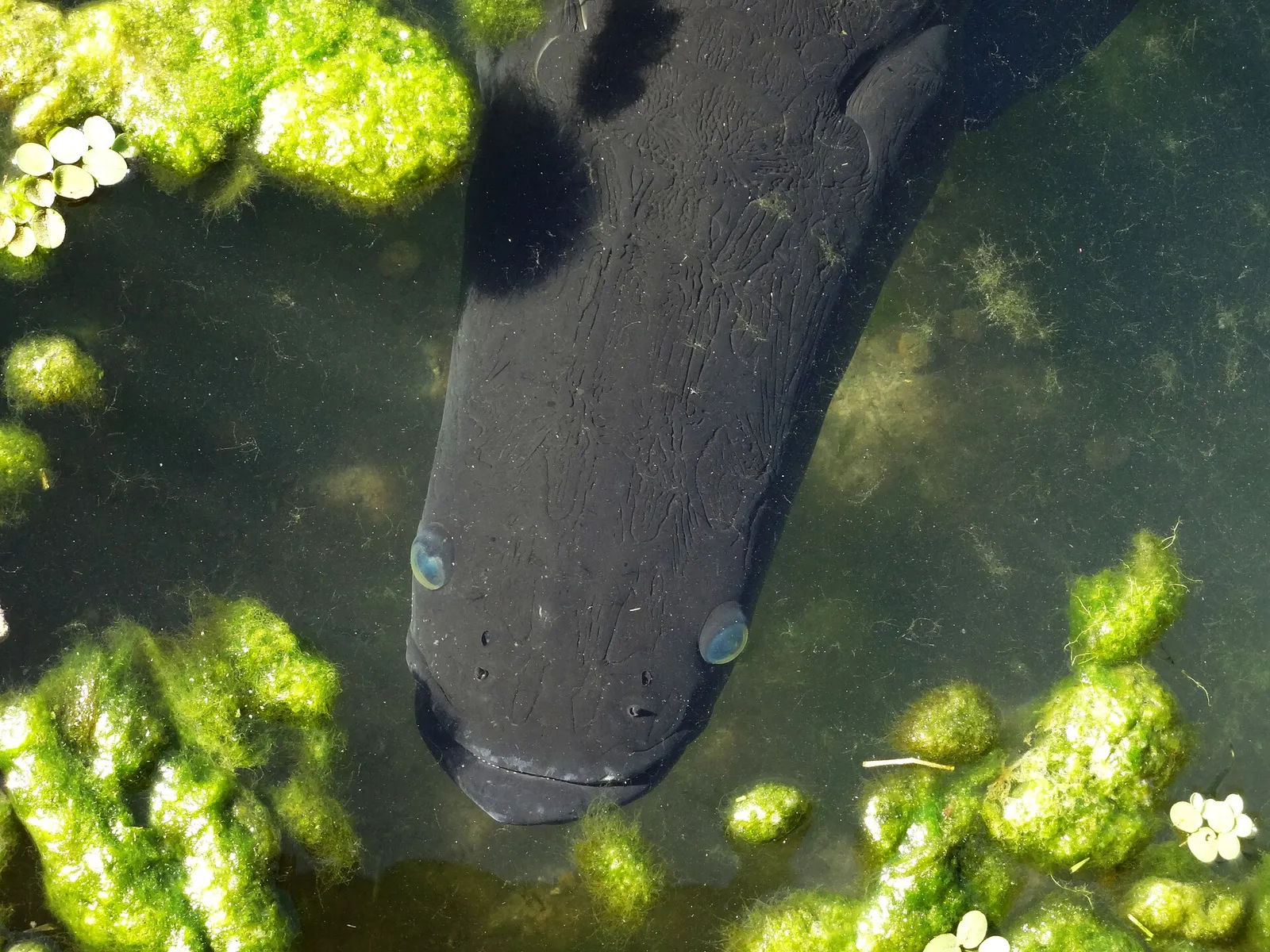
Arapaima gigas is reported to reach at least 177 in total length historically, with wild adults more commonly encountered around 78.5 in and farmed fish reaching roughly 200 kg — making it, by most measures, one of the largest exclusively freshwater fish alive. The body is long, cylindrical and torpedo-shaped, built for a slow cruise punctuated by explosive short-range strikes, and it is covered in large, thick, overlapping bony scales arranged in neat diagonal rows — armour so tough it has drawn scientific interest as a model for bite-resistant, piranha-proof natural armour. The head is broad and somewhat flattened, the dorsal and anal fins are set far back toward a rounded tail, and the overall colour is dark olive-grey to black through most of the body, shifting toward a striking coppery-to-crimson red on the rear third and tail — more intense in breeding condition, and the likely source of the name pirarucu.
The defining physiological trait, though, is the swim bladder, which is modified into a lung-like, heavily vascularised air-breathing organ. Gill surface area is reduced relative to body size, so an adult arapaima cannot survive on gill respiration alone: it must rise to the surface roughly every five to twenty minutes and gulp air with an audible, unmistakable cough-like sound, a behaviour so distinctive it is used to locate the fish in the wild. Deny it access to the surface and it will drown, regardless of dissolved oxygen in the water below.
Habitat
Arapaima gigas is native to the Amazon basin and the Tocantins-Araguaia basins of Brazil and Peru, where it lives in the floodplain (várzea) lakes and slow-moving river channels that expand and contract with the Amazon's dramatic annual flood pulse. FishBase records temperatures around 77–84 °F and a mildly acidic, soft-to-moderately mineralised pH of roughly 6.0-6.5 — warm, humid-tropical lowland water typical of Amazon whitewater and floodplain systems.
Many of the isolated floodplain lakes the species favours become oxygen-poor, especially as water levels fall in the dry season and vegetation decomposes in warm, still water — precisely the pressure its air-breathing physiology is built to solve. That same tolerance for low-oxygen water is what makes arapaima so amenable to crowded pond aquaculture, since fish that rely on atmospheric air can be stocked far more densely than gill-only species of similar size.
Feeding
Arapaima gigas is a carnivorous ambush predator, feeding predominantly on other fish. It hunts by cruising slowly through cover and open water before striking with a fast, short-range lunge, and its diet is rounded out with crustaceans and, during the flooded season when the forest itself becomes accessible fish habitat, terrestrial invertebrates and other prey that fall or wash in from the inundated forest edge.
In aquaculture and public-aquarium settings, arapaima are raised on whole forage fish and formulated pellets; their fast growth rate under farmed conditions is a major reason the species is cultured at scale across Brazil and Peru for food. There is no realistic scope for a hobby diet regime — a fish that starts life eating insect larvae and small fish is, within its first year or two, eating whole fish by the fistful, and portion sizes scale with its extraordinary growth.
Mating
Breeding in Arapaima gigas is timed to the Amazon's seasonal flood pulse, with different sources placing the spawning window anywhere from the start of the dry season through the following months — FishBase records spawning around April-May, while some aquarium references describe nest-building tied to the November-January period; accounts vary somewhat on the exact calendar, but the underlying logic is consistent: pairs spawn when water levels are low and stable enough for a nest to survive, so that hatching young emerge into the food-rich conditions of the rising flood.
A pair forms and the male excavates a shallow nest depression in soft substrate — on the order of 6 in deep and 19.5 in across, in shallow water near cover. The female then deposits a very large clutch, reported up to roughly 50,000 eggs, which the male fertilises in the nest. This is a fish built for scale even in its reproduction: a single successful spawn represents an enormous investment of eggs set against equally enormous parental vigilance once they hatch.
Breeding
Once the eggs hatch, Arapaima gigas becomes one of the more attentive parents among large fish. The male stays close by the nest and the emerging fry, guarding them from predators, while the young themselves shoal in a tight, ball-like cluster that stays close around the guarding parent's head — a formation that keeps them together and under active protection as they grow. Parental vigilance of this kind, sustained over an extended period as the fry mature, is a major reason arapaima broods can survive in a river system full of predators despite their slow individual growth in the first weeks of life.
Breeding in captivity is essentially unheard of in home aquaria — it requires the scale of a proper earthen or lined pond with a natural substrate and enough space for a pair to establish and defend a nest — but it is achieved routinely in commercial and research aquaculture. Brazil and Peru farm Arapaima gigas at significant scale for food, exploiting both its fast growth and its tolerance for dense, low-oxygen stocking; this farmed supply, rather than wild capture, is the backbone of the modern pirarucu food industry.
In the aquarium
Arapaima gigas is not a home aquarium fish, full stop. Adults require systems on the order of 3,000 US gallons (roughly 2,905 US gal) and up — tanks realistically limited to public aquaria, research institutions and dedicated grow-out ponds — and even a juvenile purchased small will, within a year or two of good feeding, outgrow any tank a private keeper could reasonably build or maintain. This is the size trap in its purest form: a fish sold at 6–8 in becomes a multi-hundred-kilogram animal that needs to breathe air on a schedule and cannot be kept from doing so.
Any system holding this species must guarantee unobstructed surface access at all times — no tight-fitting cover that blocks the fish from gulping air — while still preventing the animal from leaping or injuring itself against hard structure when it surfaces explosively, a real risk given its size and power. A soft, sandy substrate helps protect the belly and scales from abrasion, and filtration has to handle an extremely heavy bioload from a large, actively fed carnivore. In practice, arapaima belong to institutions with the space, plumbing and staffing to manage a multi-hundred-kilogram predator, not to the home hobby.
Conservation
The IUCN Red List currently lists Arapaima gigas as Data Deficient, based on an assessment from 1996 that predates much of the recent taxonomic and population work on the genus — in other words, the formal global status is genuinely unresolved rather than confirmed as safe. Within its native Brazilian range the species has a long history of population decline from overfishing: because arapaima must surface regularly to breathe, they are unusually easy to locate and harpoon compared with fish that never leave deep water, and that vulnerability drove serious depletion in many accessible floodplain lakes across the twentieth century. Community-based fisheries management in parts of the Brazilian Amazon, which restricts harvest and monitors stocks lake by lake, has been credited with recovering arapaima numbers in some managed areas, though pressure remains uneven across the basin.
International trade in Arapaima gigas has been regulated under CITES Appendix II since 1975, requiring permits and non-detriment findings for cross-border movement of wild-origin specimens — a reflection of exactly this overharvest history rather than a blanket import or ownership prohibition. Outside its native range the species has also been introduced and become established in parts of Southeast Asia, including Indonesia, where it is regarded as a concern for native freshwater ecosystems rather than a conservation asset. Most of the pirarucu in trade today, for food or otherwise, comes from farmed stock in Brazil and Peru rather than wild harvest.