Taxonomy & naming
Acanthicus hystrix was described by Spix and Agassiz in 1829 in the monumental Selecta genera et species piscium quos in itinere per Brasiliam (p. 3, Pl. 1, figs. 1–2), based on specimens from the Amazon River. The holotype, housed in Munich, was destroyed during World War II bombing in 1944; the species is anchored taxonomically through its original illustrations and the large body of museum material examined by subsequent workers. The Catalog of Fishes (Eschmeyer, CAS) lists the valid combination as Acanthicus hystrix Spix & Agassiz 1829, with distribution covering the Amazon, Tocantins-Araguaia, and Orinoco River basins of Brazil and Venezuela.
One synonym, Rinelepis acanthicus (Agassiz in Spix & Agassiz 1829), is recognised. A 2016 redescription by Chamon (Neotropical Ichthyology 14(4): e160019) provided updated morphological data and clarified the geographic variants. The genus Acanthicus Spix & Agassiz, 1829 is monotypic; no other valid species are currently recognised. Within subfamily Hypostominae, Acanthicus is placed in the tribe Acanthicini alongside the closely related Pseudacanthicus; the two genera share the absence of an adipose fin and heavily keeled flanks, but differ in body robustness and fin shape — Acanthicus hystrix has a more elongated, lunate or lyre-shaped caudal fin in adults, giving rise to the most widely used common name. L-number L155 applies to this species as traded; populations from the Orinoco/Apure (L193) and the Rio Branco/Takutu (L407) have been distinguished as colour morphs in the trade, but morphometric analysis confirms all three as geographic variants of a single species.
Morphology
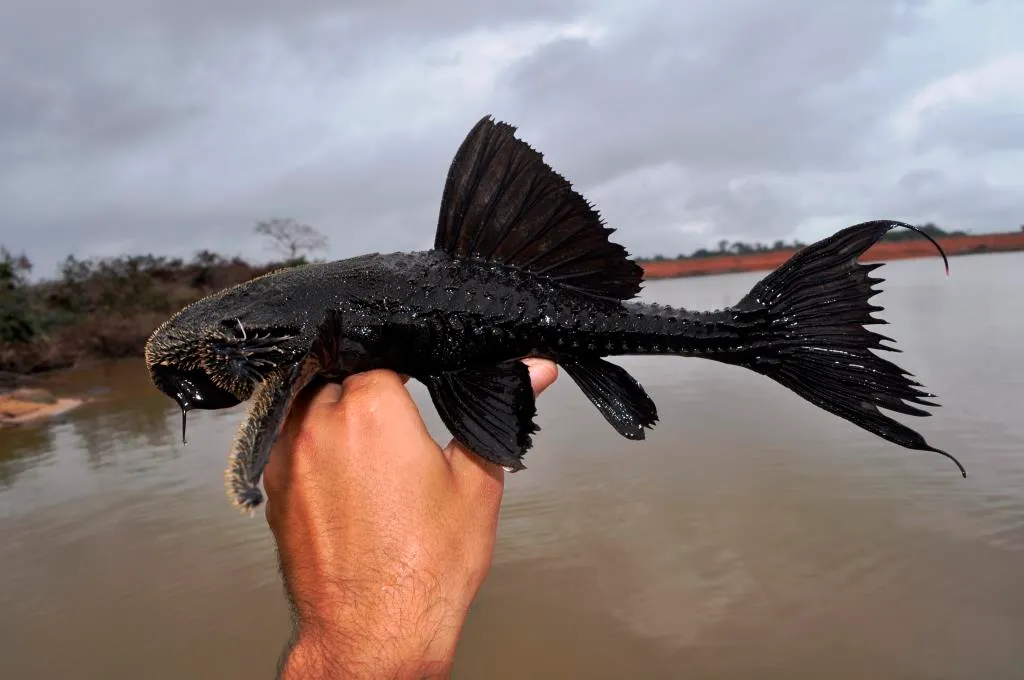
Adults reach approximately 21 in SL (Fisch-Muller in Reis et al. 2003) with total lengths reported to 27.5 in (FishBase ref. 2059); average aquarium and trade sizes are more typically 15.5–19.5 in. The body is powerfully built and covered in five rows of keels formed by enormously enlarged, sharp odontodes that give the fish its porcupine-like texture when handled. There is no adipose fin — a defining character of Acanthicus — and the pectoral spines are greatly enlarged and heavily armoured with their own odontodes.
Overall colouration is uniformly dark brown to near-black, lacking the spots or pale reticulations seen in Pseudacanthicus. The caudal fin in adults is distinctly lyrate — the upper and lower lobes extend into filamentous points while the central rays remain shorter — which is the origin of the 'lyre-tail' common name. Juveniles show a more forked but less elongated caudal fin. The caudal fin lobes carry ochre to pale grey banding. Geographic variants show subtle differences: Orinoco/Apure fish (L193) tend toward deeper body and darker overall tone; Branco/Takutu fish (L407) are similar but some aquarists report lighter patterning.
Sexual dimorphism is pronounced in adults. Mature males develop substantially more extensive and sharper odontodes on the pectoral spine, operculum, and cheeks than females; this elaboration is not merely quantitative but qualitatively different in density and spike length. Male odontode armature serves in territorial and mate-recognition contexts. Males also tend toward a slightly longer, narrower body profile compared to ripe females.
Habitat
Acanthicus hystrix is a wide-ranging Amazonian species with confirmed records from the main Amazon channel and numerous major tributaries: Rio Tapajós, Rio Xingu, Rio Solimões, Rio Trombetas, Rio Madeira, Rio Araguaia, and the Tocantins (CoF 2026; Fishipedia). The Orinoco basin range (Rio Orinoco, Rio Apure, Venezuela/Colombia) and the presence in the Rio Branco/Takutu system expand its reach considerably.
Microhabitat preferences are well characterised: A. hystrix is a demersal, benthic species of main river channels and large tributaries, strongly associated with rocky substrates, deep crevices, and large boulder conglomerates in areas of moderate to strong current. Depth of occupation is typically 7–10 ft or more. The fish shelters under or between medium to large rock formations during daylight and is most active nocturnally. Water temperatures across its range run approximately 72–81 °F (FishBase; PlanetCatfish), broadly typical of tropical Amazon whitewater and clearwater rivers. A key food resource — periphyton growing on submerged logs along wooded banks — is closely tied to the species' distribution near forested river margins.
The ornamental collection fishery, particularly intensive near Altamira on the Rio Xingu and the lower Tocantins, has historically involved professional divers using compressors to access fish from depth at known rocky outcrops.
Feeding
Acanthicus hystrix is omnivorous with an algal and periphyton bias — broadly described as 'alguivorous' in the Fishipedia database. In its natural habitat the primary food source is periphyton (algae, cyanobacteria, associated invertebrates, and fine organic matter) colonising the surfaces of submerged logs and large rocks along wooded riverbanks. Detritus and plant material are also consumed, and the species opportunistically takes invertebrates — both on the substrate and items drifting in the current.
In the aquarium, the diet should be diverse: a high-quality algae wafer or spirulina-based sinking pellet as the staple, supplemented with blanched green vegetables (courgette, cucumber, kale), and periodic offerings of protein-rich foods such as frozen brine shrimp, bloodworm, mussels, or shrimp. Fisch-Muller (2003) notes the species' detritivorous tendencies; gut content analyses from related Hypostominae plecos suggest significant plant and algal material is the core of the diet. Pure carnivore feeding regimens should be avoided — evidence from related large plecos points to reduced longevity and fatty organ accumulation when diet is disproportionately protein-heavy.
Mating
Courtship and mating behaviour in wild Acanthicus hystrix has not been formally described in the scientific literature, reflecting both the logistical difficulty of observing large benthic fish in deep, fast river habitats and the rarity of captive breeding attempts. No captive breeding report is listed on the PlanetCatfish Cat-eLog as of 2026.
From the pronounced sexual dimorphism, it can be inferred that males are the more active partners in mate assessment — the elaborate odontode armature on the pectoral spine, operculum, and cheeks of mature males is consistent with mate display and possibly male-male combat over den sites. In the closely related Pseudacanthicus species (such as P. leopardus), males defend caves or rock crevices aggressively around spawning time; a similar pattern is presumed for Acanthicus. Males of A. hystrix become markedly more aggressive and territorial at sexual maturity; the Fishipedia notes that the species 'does not form structured shoals but occupies its habitat dispersedly', suggesting a solitary, territory-based mating system.
Breeding
Captive breeding of Acanthicus hystrix remains unconfirmed as of 2026, a consequence of the practical barriers involved: the species requires an enormous aquarium or purpose-built pond to reach sexual maturity comfortably, and few hobbyists have maintained the species to adulthood under conditions conducive to reproduction. The PlanetCatfish Cat-eLog lists no breeding report, and the FishBase resilience estimate of 'Very Low' — minimum population doubling time greater than 14 years — underscores the slow reproductive pace implied by its size.
Based on the biology of closely related large Hypostominae plecos (notably Pseudacanthicus species), A. hystrix is presumed to be a cave-spawner: the male secures a deep crevice or large cavity in rocky substrate, the female deposits eggs on the cave wall or ceiling, and the male provides prolonged brood guarding, fanning eggs with his pectoral fins and protecting the clutch until fry become free-swimming. Sexual maturity in large plecos of this clade is typically not reached until the fish exceed 12–14 in TL, implying several years of growth under aquarium conditions. Triggering spawning would likely require a very large system (1,000+ litres), suitable spawning caves, and seasonal simulation of Amazonian water-parameter cycles.
In the aquarium
Acanthicus hystrix is strictly a species for dedicated large-pleco specialists. At an adult standard length of 21 in — with total length approaching 27.5 in — and a strongly territorial temperament in adults, this fish is inappropriate for tanks under 265 US gal and should be kept as the sole large bottom-dweller in any system. Public aquaria are among the few settings where the species is regularly displayed in appropriate conditions.
Water chemistry should reflect the warm, moderately soft Amazonian conditions of its natural range: temperature 72–81 °F, pH 6.0–7.5, moderate hardness (up to approximately 12 °dH), and vigorous filtration capable of handling the substantial waste output of a large, active fish. Strong oxygenation is important; the large gill area in adults necessitates well-aerated water. Heavy-duty external filtration with a high turnover rate is standard practice.
Decoration should include large, stable rocky caves or hollow ceramic pipes sized for an animal of 50+ cm — adequate hide sites are essential for the fish's wellbeing and reduce aggression. Driftwood is accepted and provides supplemental feeding surfaces. Compatible tankmates are limited to large, robust fish of the mid-water and upper zones — large characins, Arawana, or large cichlids — that the pleco will largely ignore. Any similarly sized bottom-dwelling fish risks territorial aggression from the male.
Handling poses a real physical hazard: the enlarged pectoral spines and sharp body odontodes can cause significant puncture wounds and abrasions; a net is insufficient containment for large specimens.
Conservation
Acanthicus hystrix was assessed as Least Concern by the IUCN Red List in 2020 (assessed 26 September 2020), underpinned by its wide distribution across multiple large South American river basins and its abundance at key collection sites such as the Altamira region of the lower Rio Xingu and the lower Tocantins. Quantitative population data are lacking, but the species is described as common throughout its range with no evidence of major range contraction (Fishipedia).
Despite its Least Concern status, there are legitimate medium-term concerns. The FishBase resilience estimate — 'Very Low', with population doubling time exceeding 14 years — means this species is inherently slow to recover from localised depletion. The ornamental fishery, which relies heavily on diver-caught adults from a limited number of productive rocky habitats, creates a dependence on the same productive adults year after year. Hydroelectric development has heavily altered the lower Xingu and lower Tocantins — the Belo Monte dam and the Serra da Mesa reservoir, respectively — and at least some historically productive collection areas have been inundated or experienced altered flow regimes. Monitoring of collection pressure, particularly near Altamira, is warranted given the species' slow recovery potential.