Taxonomy & naming
Osteoglossum bicirrhosum was described by the French naturalist Georges Cuvier in 1829. It belongs to the family Osteoglossidae — the true bonytongues — within the order Osteoglossiformes, a scattered, deep-time radiation of freshwater fishes found across South America, Africa, Southeast Asia and Australasia today but rooted in one of the oldest surviving lineages of teleost fish. The order's name and the family's common name both come from the same anatomical signature: a bony, toothed structure on the floor of the mouth (the "bonytongue") that occludes against toothed plates on the roof of the mouth, an ancient way of gripping and crushing prey. Catalog of Fishes (Eschmeyer, CAS) treats Osteoglossum bicirrhosum as the valid name.
The genus Osteoglossum contains just two recognised species, both South American: O. bicirrhosum, the widespread silver arowana of the main Amazon basin, and O. ferreirai, the black arowana confined to the blackwater Rio Negro and upper Orinoco. The genus name combines Greek osteon ("bone") and glossa ("tongue"), restating the bonytongue trait at the genus level, while the species epithet bicirrhosum is Latin for "two-barbelled", naming the pair of slender barbels on the tip of the lower jaw that is one of the fish's most obvious field marks. Because O. bicirrhosum and O. ferreirai overlap in general appearance, aquarium stock is sometimes mislabelled between the two — barbel length, fin-margin colour and the source river are the usual clues.
Morphology
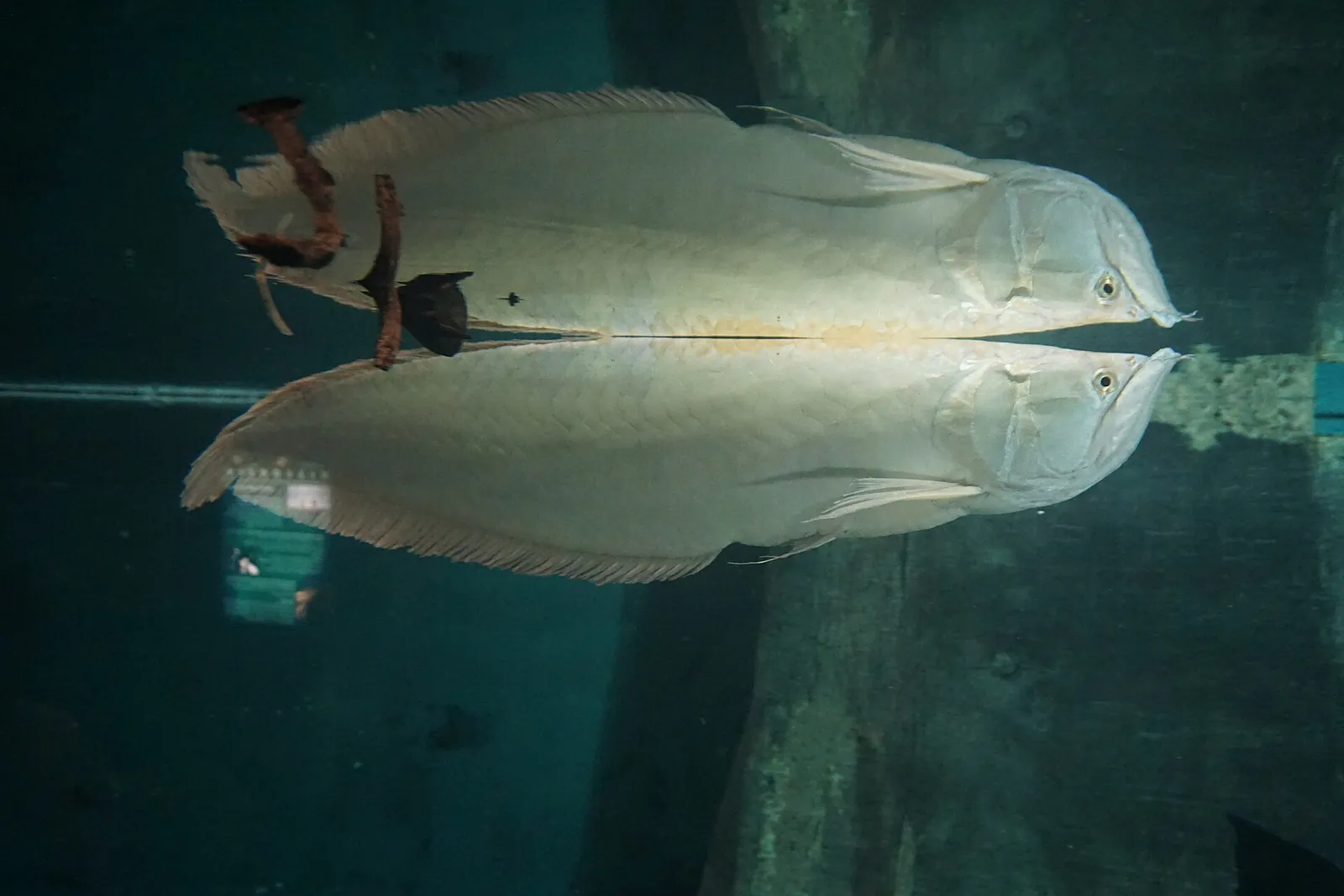
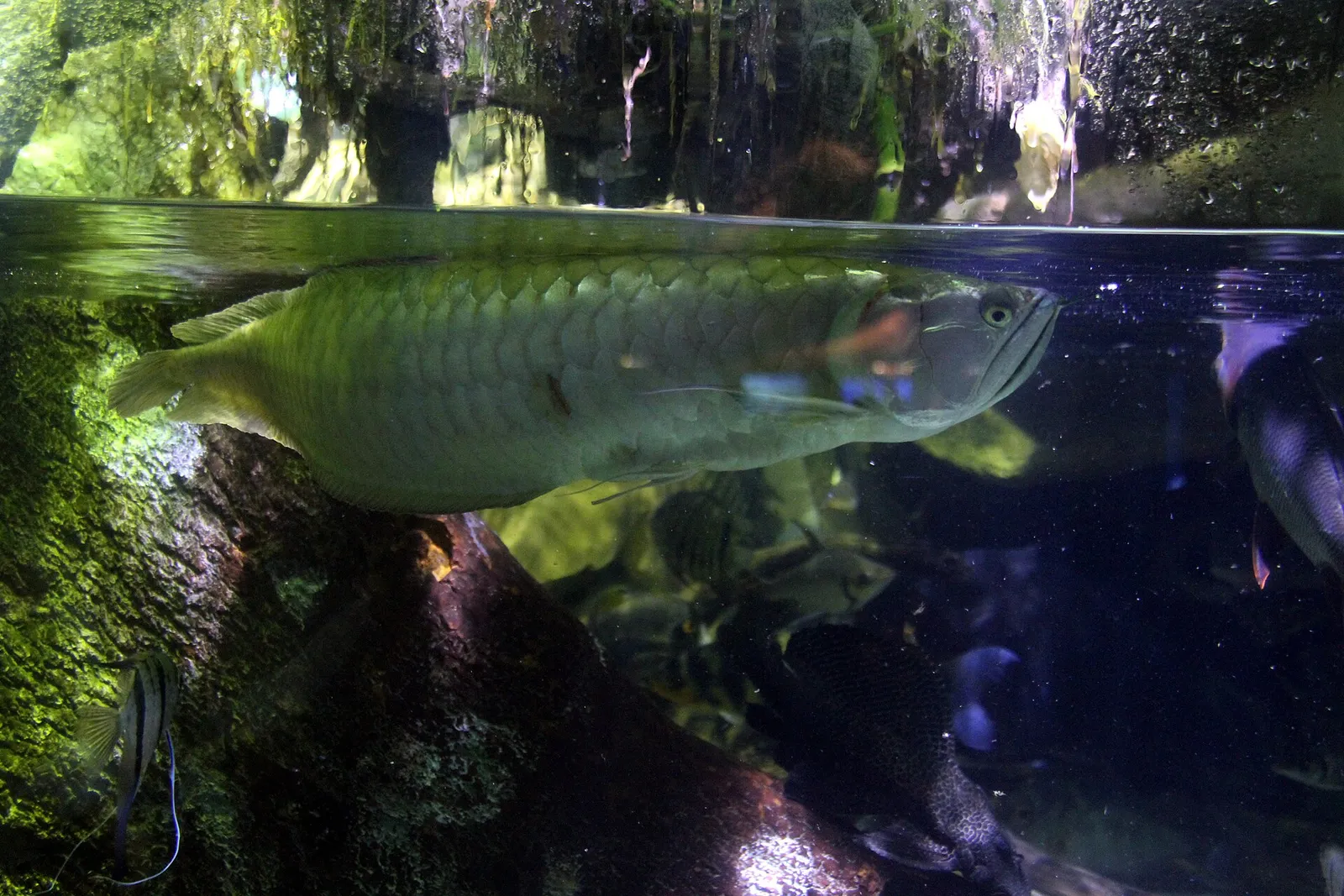
The silver arowana has an unmistakable shape: a long, laterally compressed, ribbon-like body carried on long-based dorsal and anal fins that run far back toward a comparatively small, rounded tail, giving the fish an almost eel-like undulating swimming style at rest and a burst of power for its signature leap. The head is small in proportion to the body, with a strongly upturned, hinged lower jaw — often described as a "drawbridge" mouth — built to snap shut on prey taken from the surface or from the air. Two slender barbels project from the tip of the lower jaw, the feature that gives the species its name.
Adults are covered in large, pearly-silver scales that can show a faint iridescent blue-green sheen, especially on juveniles, whose fins and body often carry a stronger blue-violet cast that fades with age. Reported maximum size is roughly 35.5–39.5 in total length in most references, with some sources (Animal Diversity Web) recording individuals to about 47 in TL; either figure describes a genuinely large fish, and aquarium specimens routinely reach 23.5–35.5 in given the years and space to grow. This is total length, not a compact "aquarium size" — a young 6 in juvenile in a shop tank is a fraction of its adult self.
Habitat
Osteoglossum bicirrhosum is widespread across the South American Amazon basin, recorded from Brazil, Peru, Colombia and Ecuador, with populations also known from the Rupununi River system in Guyana and the Oyapock River on the Guyana–French Guiana border. Within this huge range it occupies both whitewater and blackwater floodplain habitats — slow-moving tributaries, backwaters, oxbow lagoons and, critically, seasonally flooded forest (igapó/várzea), where it swims among submerged branches and vegetation rather than in open river channels.
Water in these habitats is warm and generally soft to moderately soft, with a near-neutral to slightly acidic pH; the species is not tied to a single water type the way its blackwater-specialist congener O. ferreirai is, but tracks the flood pulse, following rising water into the flooded forest to feed and spawn and retreating to river channels and lagoons as the water falls.
Feeding
The silver arowana is a carnivorous surface hunter. It cruises with its upturned mouth close to the surface, watching for movement above and below the waterline, and takes small fish, insects, and other invertebrates from the water column. Its most celebrated hunting behaviour is aerial: it can leap well clear of the surface — sometimes over a metre — to snatch insects, spiders and even small lizards, birds or bats from overhanging branches and low vegetation, a genuine and well-documented feeding strategy rather than hobby exaggeration.
In the aquarium it is a committed carnivore that will take appropriately sized whole prey items, sinking and floating pellets formulated for large carnivorous fish, and occasional feeder insects; it should not be fed a steady diet of feeder fish, which carries disease risk. Because it feeds and watches from just under the surface, tank furnishing that leaves that upper layer open, and a diet matched to its adult mouth size, both matter more for this fish than for most community species.
Mating
Silver arowanas breed as paternal mouthbrooders, a strategy shared with the rest of the genus. In the wild, spawning is tied to the flood pulse, typically around December–January as rising water opens up the flooded forest. Courtship and spawning produce a small clutch of unusually large, yolk-rich eggs — a world away from the thousands of tiny eggs scattered by many fish — and fertilisation happens externally in the open water, after which the male, not the female, takes charge of the brood.
The male gathers the fertilised eggs into his mouth immediately after spawning. Because the clutch is small and each egg large, mouth-brooding in this species is a serious commitment rather than a brief holding pattern, and it is the anchor behaviour that defines how the species reproduces at all.
Breeding
Once the eggs are in his mouth, the male silver arowana incubates them for an extended period — reported at around two months in the wild — continuing to shelter the fry there well past hatching, until the attached yolk sac is fully absorbed and the young are ready to feed and fend for themselves. Parental investment is therefore concentrated almost entirely in the male; this is the standout breeding trait for the genus and the reason arowanas are described as paternal, not maternal, mouthbrooders.
Home-aquarium breeding is essentially unheard of — the adult size and the need for large, secure pond-scale space mean silver arowanas sold in the trade are almost all farm-raised, mostly in large outdoor ponds in South America and Southeast Asia rather than bred by hobbyists in tanks. Unlike its relative the CITES-listed Asian arowana (Scleropages formosus), O. bicirrhosum carries no CITES listing and no special import/export protections, reflecting its wide range and lack of a global threat assessment.
In the aquarium
Be blunt about the size before anything else: a silver arowana reliably reaches 23.5–35.5 in and can approach 39.5–47 in, and it needs to swim, not just survive, in that length — this is not a fish for a standard community tank, and juveniles sold at 6–8 in will outgrow most home setups within a year or two. A single adult needs a very large, long footprint tank (many keepers work in the 6-foot-plus range and beyond) with open swimming space, especially near the surface where the fish spends most of its time.
The single most important piece of equipment is the lid. Silver arowanas are powerful jumpers that leap to hunt in the wild, and the same reflex triggers at anything startling in captivity — a heavy, tight-fitting, well-secured lid is mandatory, not optional, and even then gaps around equipment cutouts have cost keepers fish. Water should be kept warm (roughly 75–86 °F) and on the soft, near-neutral to slightly acidic side, mirroring its floodplain origins, though it tolerates a wider range than more specialised blackwater fish. Tankmates need to be too large to be swallowed and comfortable sharing open water; silver arowanas can also be territorial toward their own kind and toward other long-bodied surface fish, so stocking multiple individuals needs a genuinely large tank and careful observation.
Conservation
Osteoglossum bicirrhosum has not been globally assessed by the IUCN Red List and is currently Not Evaluated. Its congener O. ferreirai, restricted to the Rio Negro and upper Orinoco blackwater, has been assessed as Least Concern, and O. bicirrhosum's own wide Amazon-basin range, spanning Brazil, Peru, Colombia, Ecuador and the Guianas, suggests a similarly broad population — but the absence of a global assessment means that is an inference, not a rating. The species has been listed as Vulnerable in Colombia's national Red Book, a country-level, not global, concern.
The aquarium trade in silver arowanas relies heavily on pond-raised, farmed stock rather than wild collection, which limits direct pressure on wild populations from the hobby. The species carries no CITES listing. The longer-term concerns for wild populations are the general pressures on Amazon floodplain and flooded-forest habitat — deforestation, altered flood regimes and river development — rather than any specific documented decline in this species.