Taxonomy & naming
Diapteron fulgens was described by the Austrian ichthyologist and killifish specialist Arthur Christian Radda in 1975, originally as Aphyosemion georgiae fulgens — a subspecies of Aphyosemion georgiae — in the British Killifish Association's Killi-News. The type locality is a rainforest brook near Esenkelle, about 52 kilometres west of Makokou in northern Gabon, in the Ivindo River drainage; the holotype is held in the Naturhistorisches Museum Wien (NMW 77341). Eschmeyer's Catalog of Fishes records the current valid name as Diapteron fulgens (Radda, 1975), the parentheses reflecting the change of genus since the original description.
The genus Diapteron Huber & Seegers, 1977 was erected — initially as a subgenus of Aphyosemion Myers, 1924 — for a small cluster of dwarf, cool-water forest killifish of the Ivindo region: D. georgiae, D. fulgens, D. cyanostictum, D. abacinum, and D. seegersi. The name is formed from Greek roots meaning 'shifted fin', referring to the forward position of the dorsal fin relative to typical Aphyosemion. Later authors, including Seegers (1997) and Huber (1999), treated Diapteron as a full genus, and Eschmeyer's Catalog of Fishes follows that arrangement.
The specific epithet fulgens is Latin for 'shining' or 'gleaming' — a reference to the brilliant colouration of males, which combine deep blue with orange and red markings.
This fish was long listed as Aphyosemion fulgens; Eschmeyer's Catalog of Fishes places the species in Diapteron, and the current combination Diapteron fulgens is followed here.
Morphology
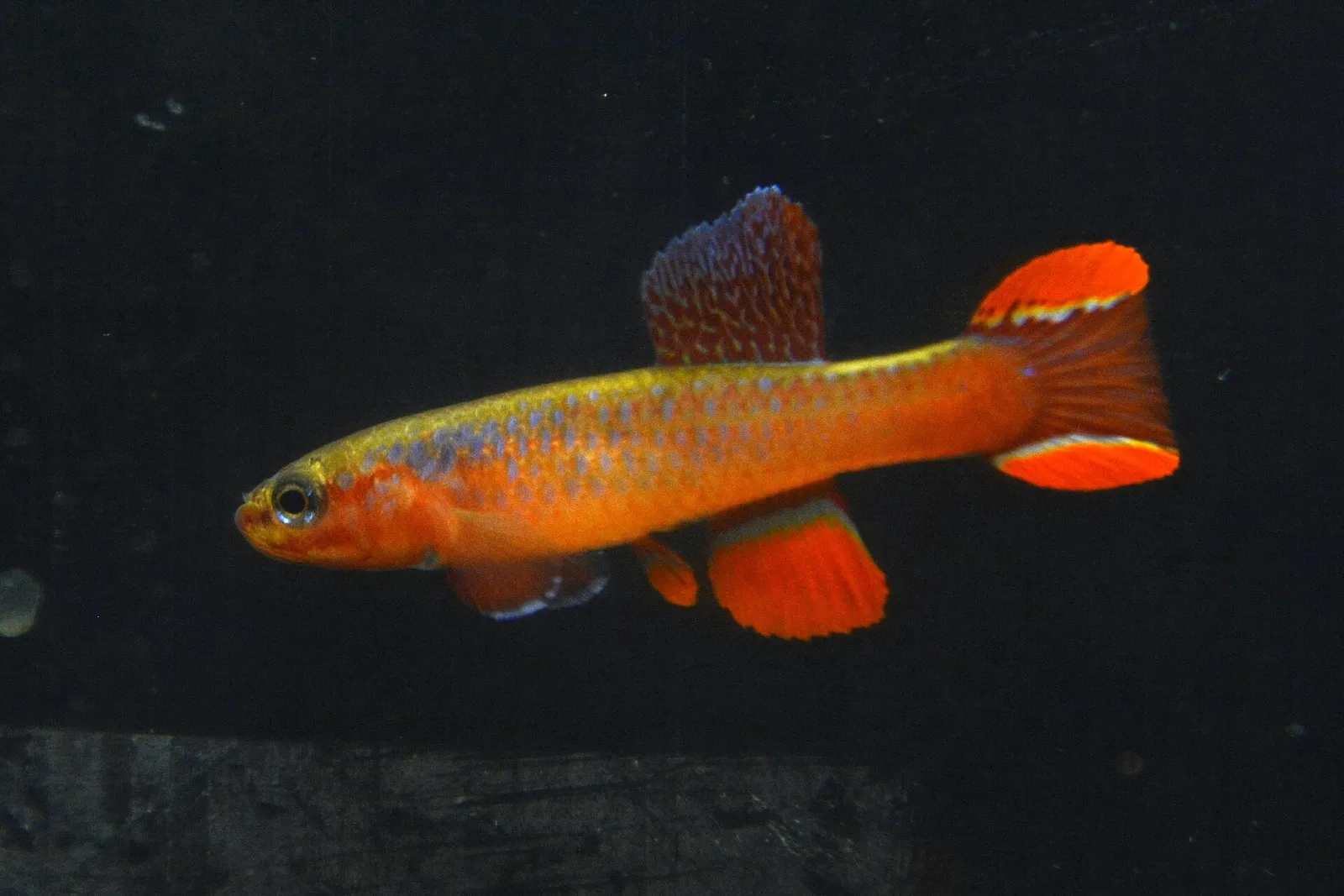
Diapteron fulgens is a slender, laterally compressed dwarf killifish reaching approximately 1.4 in total length. As in its relatives of the Aphyosemion group, there is pronounced sexual dichromatism: males are substantially more vivid than females, exhibiting deep blue flanks overlaid with orange and red markings and coloured fin patterning, while females are comparatively plain, showing an olive-brown base with reduced spotting and rounded, shorter fins.
The body form is typical of the genus: a slightly dorsoventrally flattened head with an upturned mouth suited to taking small prey at and just below the surface, a streamlined trunk, and a dorsal fin set noticeably far forward compared with typical Aphyosemion — the character behind the genus name Diapteron ('shifted fin').
The overall impression in displaying males — a deep blue ground patterned with orange and red — is the feature that draws specialist keepers to the genus.
Habitat
Diapteron fulgens is endemic to Gabon, where it is recorded from the Ivindo River drainage — part of the Ogooué system — in the rainforest of the northeast around Makokou. FishBase describes the habitat as small, mostly swampy brooks in the rainforest: shallow, heavily shaded waters with abundant leaf litter, soft and very low in dissolved minerals, and often stained amber by tannins from decomposing vegetation.
Water in these forest brooks stays cool for equatorial Africa. FishBase gives a temperature range of 64–72 °F for the species, and hobbyist guidance for Diapteron consistently emphasises that cool water matters — higher temperatures are tolerated short-term, but chronic warmth is stressful and shortens lifespan. General guidance for the species and its close congeners places the comfortable chemistry range at pH 5.5–7.0 in soft water.
As a forest killifish with a small range, D. fulgens is sensitive to canopy removal, siltation, and hydrological disruption. The IUCN Red List assessment records its extent of occurrence at less than 1,931 mi² and lists mining, logging, and agriculture as threats within the Ivindo basin.
Feeding
Diapteron fulgens is a micro-predator, feeding primarily on small invertebrates in the wild. In forest stream habitats this means aquatic insect larvae, small crustaceans, zooplankton, and any terrestrial invertebrates that fall onto the water surface — the upturned mouth typical of these killifish is well-suited to surface-feeding on such items.
In the aquarium the species readily accepts a range of small live and frozen invertebrate foods: daphnia, artemia (brine shrimp nauplii and adults), bloodworm (chironomid larvae), and tubifex are all suitable and widely used by specialist keepers. Small high-quality dried foods formulated for small carnivorous fish are accepted by most individuals once settled, though live and frozen items remain preferred for conditioning breeding fish and promoting full colour expression in males. Overfeeding with rich foods can lead to obesity, so variety and moderation are advisable.
Mating
Diapteron fulgens is a non-annual killifish and a plant spawner — it reproduces in permanent or near-permanent water bodies and does not bury eggs in substrate peat for diapause, as annual killifish do. Males court females with lateral displays that expose the full broadside of their iridescent flanks and extended fins; courtship can be persistent and males of small killies are capable of harassing females relentlessly in confined space, so cover and space for females to retreat are important in the aquarium.
Spawning occurs when the male guides or drives the female into fine-leaved vegetation, dense roots, or a spawning mop, where the pair briefly embrace and release a small number of adhesive eggs that adhere to plant strands or mop fibres. This event is repeated over days and weeks rather than in a single mass spawning, with the pair producing a steady trickle of eggs. This extended, continuous production of small clutches is characteristic of plant-spawning Aphyosemion and contrasts sharply with the single-season burst of annual species.
Breeding
Breeding Diapteron fulgens follows the standard non-annual Aphyosemion protocol. Eggs are deposited singly or in small groups on fine-leaved plants (Java moss, hornwort, Riccia) or synthetic spawning mops placed at mid-water or near the bottom. The eggs are adhesive, relatively large for the fish's body size, and incubate in water without diapause. Hatching occurs after approximately two to three weeks at temperatures in the 64–72 °F range; cooler conditions extend incubation somewhat.
Eggs can be collected by removing the mop or plant clump and either leaving them to hatch in a small container of conditioned water, or gently rolling the mop to dislodge eggs into a rearing vessel. Eggs may also be incubated slightly damp on damp cocoa coir or peat for a short period — the eggs of non-annual Aphyosemion can tolerate brief semi-dry conditions even without obligate diapause — but water incubation is the simpler default. Fry are relatively large at hatching and take micro-foods immediately: freshly hatched brine shrimp nauplii (artemia), micro-worms, and vinegar eels are standard first foods. Growth is steady, and young fish begin to show sex differences within a few weeks.
In the aquarium D. fulgens is reported to live three to four years — a considerably longer lifespan than annual killifish and typical of non-annual Aphyosemion kept in cool, clean conditions.
In the aquarium
Diapteron fulgens is a specialist fish suited to the dedicated killifish keeper rather than the general community aquarium. Its small size (1.5 in) and delicate nature mean it should be housed with equally small, peaceful tankmates or kept in a species setup. A pair or small group (one male, two or more females) does well in a small, well-planted aquarium of 10–15 US gal with a dark substrate, driftwood tannin, floating vegetation or surface cover, and gentle filtration — a mature sponge filter is ideal, as strong currents are not to the species' liking.
Water temperature should be kept in the 64–72 °F range; in many temperate climates no heater is needed for most of the year, which is advantageous. Soft, slightly acidic water (pH 6.0–7.0, low general hardness) replicates the forest stream conditions and promotes health and colour. Regular small water changes with conditioned water that has been allowed to reach ambient temperature before addition are beneficial. The tank lid must be secure — killifish are notorious jumpers.
The hobbyist appeal of D. fulgens lies in the male's brilliant colouration, the accessible non-annual breeding protocol, and the species' manageability at small tank sizes. It rates around 4 out of 5 for difficulty among hobbyist sources — not a beginner fish, but straightforwardly rewarding for the keeper willing to meet its temperature and water-quality preferences.
Conservation
Diapteron fulgens is assessed as Endangered (EN B1ab(iii)+2ab(iii)) on the IUCN Red List (assessed 2009, published 2010). The assessment records a restricted range — an extent of occurrence under 1,931 mi² in the Ivindo River basin of northeastern Gabon — and identifies mining, logging, and agriculture as the principal threats to its forest-brook habitat.
Much of the Ivindo basin remains forested, but small killifish tied to shallow, shaded brooks are vulnerable to even local canopy loss and siltation, and the species' known range is small enough that localised habitat change carries population-level risk. Field data are thin: the Red List records the population trend as unknown and calls for further survey work.
Hobbyist organisations — notably the American Killifish Association and its European equivalents — play a meaningful role in ex-situ conservation of restricted-range Diapteron through responsible maintenance of locality-documented captive strains and the exchange of captive-bred stock that reduces pressure on wild collection. Accurate population-locality data recorded by collectors also contributes to the biogeographic knowledge base behind future assessments.