Taxonomy & naming
Poecilia melanogaster was described by Albert Günther in 1866 from West Indian material, and Eschmeyer's Catalog of Fishes treats the name as valid in the genus Limia within the family Poeciliidae — the New World livebearers. The species sits in the subfamily Poeciliinae, alongside the guppies, mollies, platies and their relatives. Because the original description was based on material moved into and out of related genera over the years, the species name carries Günther's authority in parentheses, reflecting a later change of genus from the combination he first used.
The genus Limia is a West Indian radiation centred on the islands of the Greater Antilles — Hispaniola, Cuba, Jamaica and the Cayman Islands — with the greatest species diversity on Hispaniola. Limia is closely allied to Poecilia, and some authors have at times treated it as a subgenus of Poecilia; current usage, following the Poeciliidae checklists, recognises Limia as a distinct genus. The blackbelly limia is among the better-known species of the genus in the aquarium hobby, where the West Indian limias are kept by livebearer enthusiasts as a hardy, alkaline-water alternative to the more familiar mollies.
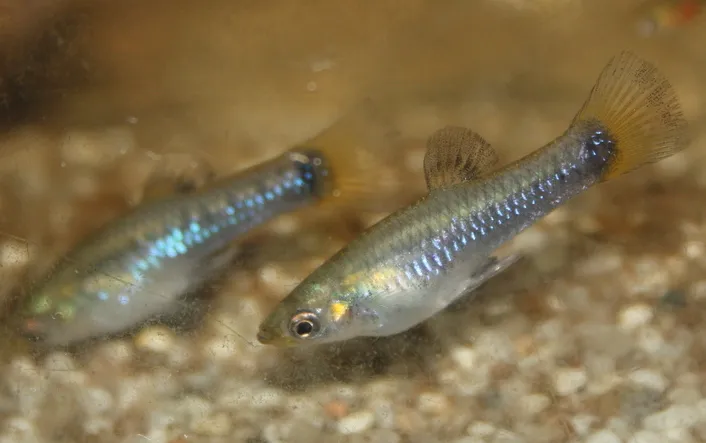
The common name "blackbelly limia" — and the specific epithet melanogaster — both refer to the dark coloration of the lower body and caudal region, the most distinctive field mark of the species. In the hobby the fish also circulates as the black-bellied or blue limia, the latter for the metallic steel-blue sheen the males develop in good condition.
This fish was long listed as Limia melanogaster; Eschmeyer's Catalog of Fishes places the species in Poecilia, and the current combination Poecilia melanogaster is followed here. The name Poecilia caudofasciata is treated as a synonym of this species in Eschmeyer's Catalog of Fishes.
Morphology
Poecilia melanogaster is a small, deep-bodied poeciliid with marked sexual dimorphism. Females are the larger sex, reaching roughly 2 in in standard length, while males are smaller and slighter, to around 1.5 in. As in other livebearers, the female is plainer and more robustly built, and develops a dark gravid spot near the vent when carrying young; the male is the more colourful sex and bears the gonopodium, the rod-like intromittent organ formed from modified anal-fin rays.
The species takes its name from its coloration. Both sexes show a series of dark vertical bars — commonly five to eight — across the posterior flanks, and a characteristically dark caudal peduncle. Well-conditioned males develop a greenish-grey base overlaid with a metallic steel-blue iridescence, with black markings on the dorsal fin and caudal peduncle and yellow tones in the fins, including a yellow caudal fin with a dark margin; sulphur-yellow and black patches appear on the head, fins and flanks. The blue-and-black sheen of a displaying male is the source of the alternative hobby name "blue limia."
The overall impression is of a compact, sturdy little fish rather than a long-finned ornamental — the limias have not been bred into the elaborate fin and colour strains of the domestic guppy, and P. melanogaster retains a wild-type form in the hobby.
Habitat
Poecilia melanogaster is a freshwater, benthopelagic fish of the streams of the Greater Antilles. FishBase records the species from Jamaica and Haiti, while hobbyist field accounts describe it as endemic to Jamaica, where it has been collected in the southern and western parts of the island — in the headwaters of the Black River drainage and in the Blue Hole River. It is a fish of small, shallow, often fast-flowing water, taken near the surface, and also occurs in temporarily flooded areas adjacent to the streams.
The habitats described vary in character. Some stream sites are shallow — on the order of 4–8 in deep — with muddy substrates, while the Blue Hole River has a rocky bed; in several sites there is little or no rooted aquatic vegetation, but the surfaces are rich in aufwuchs, the biofilm of algae and microorganisms that coats rocks and submerged structure and forms a key part of the fish's diet. Reported water conditions are warm and distinctly hard and alkaline: temperatures around 72–82 °F, pH roughly 7.5–8.5, and high hardness (general hardness around 15–30 dGH, with very hard values recorded).
This preference for hard, alkaline island streams is typical of the West Indian limias and shapes how the species should be kept — it is emphatically not a soft, acidic blackwater fish.
Feeding
In the wild, Poecilia melanogaster is an omnivore that grazes heavily on aufwuchs — the algal and microbial biofilm that coats rocks and submerged surfaces in its streams — supplemented by detritus and small animal prey. FishBase records feeding on worms, crustaceans, insects and plant matter, and places the species at a low trophic level of about 2.9, consistent with a diet weighted toward algae and detritus rather than active predation. Field accounts describe the wild diet as mainly algae and detritus, gathered from the biofilm-rich rocks and substrate of its habitat.
In the aquarium the species is undemanding and accepts a wide range of foods: good-quality flake and pellets, together with small live and frozen items such as brine shrimp, Daphnia and bloodworm. Because so much of its natural intake is plant and biofilm matter, a meaningful share of vegetable or algal food benefits the fish, and an established, well-lit aquarium that grows its own film of algae suits the species well. As with other small, constantly grazing livebearers, frequent small feedings are preferable to occasional large meals.
Mating
Like all poeciliids, Poecilia melanogaster reproduces by internal fertilisation. The male transfers sperm to the female using the gonopodium, a slender intromittent organ formed from modified rays of the anal fin; this is the defining reproductive feature of the live-bearing toothcarps and is present only in mature males. Females are able to store viable sperm internally, so a single mating can fertilise several successive broods over a period of months without the male being present.
Courtship in the blackbelly limia is active and male-driven. Males spend a large fraction of their time displaying to and pursuing females — hobbyist observation records males devoting more than 26 minutes of every hour to courtship — alternating display with attempts to inseminate. There is no pair bond, territory or nest; the male's strategy is persistent courtship of any receptive female. Because of this constant attention, keepers maintain the species with several females per male so that the pressure of male courtship is spread across the group rather than focused on a single fish.
There is no published evidence of superfetation — the simultaneous carrying of broods at different stages of development — in this species, a trait known in some other poeciliids but not documented here; on this point the data are sparse, and it should not be assumed.
Breeding
Poecilia melanogaster is a livebearer: after internal fertilisation the female carries the developing young and gives birth to free-swimming fry rather than laying eggs. Gestation lasts roughly four weeks, and brood size scales with the size and condition of the female, with reported broods ranging from about 20 to 80 fry. Newborns are fully formed miniature fish, about 0.5 in long, able to swim and feed from birth, and reach sexual maturity at around four to five months.
Unlike many livebearers, adult P. melanogaster are reported to be relatively restrained towards their young, only rarely cannibalising fry — so a well-planted aquarium can allow a self-sustaining colony to develop without heavy intervention. Even so, providing dense planting or floating cover improves fry survival, and the young grow readily on the same biofilm, finely powdered foods and newly hatched brine shrimp that suit other small livebearer fry. With high reproductive resilience — FishBase estimates a population doubling time of under fifteen months — a healthy group establishes itself quickly in the aquarium.
To keep stock true, breeders are careful not to house P. melanogaster with closely related Limia species, since the limias will hybridise; maintaining single-species groups is the rule for anyone wishing to preserve the species cleanly.
In the aquarium
The blackbelly limia is a hardy, peaceful, undemanding aquarium fish best suited to a hard-water community. It is kept in groups of at least six, with a sex ratio skewed toward females — about two or three females per male — to spread out the persistent courtship of the males. A longer aquarium of at least roughly 29.5 in gives the fish room and supports the established, biofilm-rich conditions it favours; moderate water movement and good planting suit it well.
Water chemistry is the one point on which the species is particular. It needs hard, alkaline water — pH around 7.5–8.5 and high hardness — at tropical temperatures of about 72–82 °F, conditions that mirror its island streams and that set it apart from soft-water tetras and similar fishes. An aquarium that has been running long enough to grow a coating of algae and biofilm provides both grazing and a natural look. A tight-fitting cover is advisable, as the fish are active near the surface.
The species' main husbandry caution is genetic rather than environmental: because Limia species interbreed readily, the blackbelly limia should be kept away from its close relatives if pure stock is to be maintained. Lifespans of up to around five years are reported, making this a long-lived and rewarding fish for the livebearer specialist.
Conservation
Poecilia melanogaster is assessed on the IUCN Red List as Near Threatened (NT), under criterion B1b(iii), in an assessment dated 11 May 2020. The Near Threatened category indicates a species that is close to qualifying for a threatened listing — here on the basis of a restricted range that is experiencing a continuing decline in the quality of its habitat — without yet meeting the thresholds for Vulnerable.
As an island endemic confined to the freshwaters of the Greater Antilles, the blackbelly limia is inherently vulnerable to localised pressures: its small streams are exposed to habitat degradation, water abstraction, pollution and land-use change, and a narrow geographic range leaves little buffer against such losses. These are the concerns that underlie the B1b(iii) listing, which is driven by the limited extent of occurrence combined with declining habitat quality rather than by direct exploitation.
The aquarium hobby plays a positive role here. Because Limia species are maintained as pure-bred colonies by livebearer enthusiasts and associations, captive populations serve as an informal genetic reserve for island endemics whose wild habitats are under pressure — provided keepers resist hybridising the species and keep accurate records of their stock's origin.