Taxonomy & naming
Poecilia vittata was described by the French zoologist Alphonse Guichenot in 1853 from Cuban material, and is today treated as the type species of the genus Limia within the New World livebearer family Poeciliidae (subfamily Poeciliinae, order Cyprinodontiformes). Eschmeyer's Catalog of Fishes governs the valid name; the combination is rendered Poecilia vittata (Guichenot, 1853), the parentheses reflecting the species' movement out of its original genus.
The Cuban limia has a tangled nomenclatural history. For much of the twentieth century it circulated under the name Poecilia vittata, after authors such as Rosen & Bailey (1963) and Rivas (1980) subsumed Limia into a broadly defined Poecilia; subsequent workers re-elevated Limia, and that genus is the arrangement followed here. Key taxonomic treatments include Rosen & Bailey's 1963 revision of the poeciliid fishes (AMNH Bulletin 126), Rivas & Fink (1970, Copeia) and Rivas (1980, Northeast Gulf Science). The fish has gone by an assortment of vernacular names — Cuban limia, banded limia, Cuban molly, Cuban topminnow, and in Hawaii where it was introduced, tabai.
The genus name Limia derives from the Latin limus, "mud," a reference to the muddy-bottom feeding habits of these fishes (an etymology attributed to Poey, 1854). The specific epithet vittata is Latin for "banded" or "striped," describing the markings of the body — the basis of the common name banded limia.
This fish was long listed as Limia vittata; Eschmeyer's Catalog of Fishes places the species in Poecilia, and the current combination Poecilia vittata is followed here.
Morphology
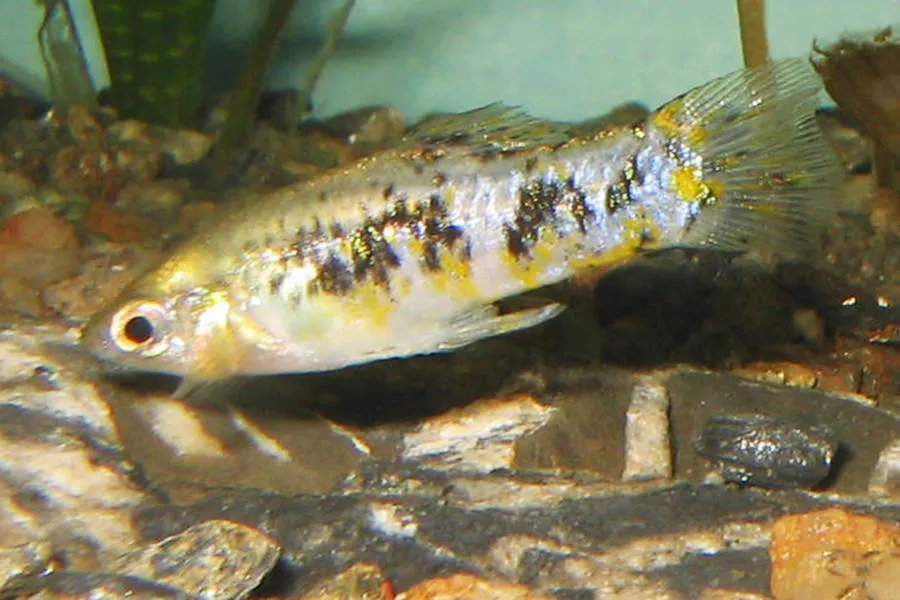
Poecilia vittata is a robust, fusiform livebearer that ranks among the larger Limia species. The sexes differ markedly in size: males reach about 2 in in standard length (to roughly 3 in total length), while females grow to more than double that bulk, commonly exceeding 4 in total length. This pronounced size dimorphism — females substantially larger than males — is typical of the poeciliids.
The colour pattern is understated but distinctive. The back is blue-grey, grading through silvery sides to a white belly, and each flank scale is edged in black, producing a fine reticulated "fishnet" appearance over the body. Males carry the brighter finnage: the dorsal fin and tail are washed yellow to orange and speckled with blue-black flecks. Females are plainer, their fins largely colourless, but a mature female shows a yellow patch near the vent. The body is deep and well-muscled rather than slender.
As in all poeciliids, the defining male feature is the gonopodium — the anal fin modified into a slender intromittent organ used to inseminate the female. Its presence, together with the male's smaller size and brighter fins, makes the sexes easy to tell apart once fish are mature.
Habitat
The Cuban limia is endemic to Cuba and the Isle of Pines (Isla de la Juventud), where it is widespread across the island's lowland waters. It occupies streams, lakes, estuaries, coastal lagoons and mangrove swamps, and is found most consistently in the lower reaches of streams and in coastal marshes near brackish or saline water. It is a demersal, non-migratory fish of the lowland fringe rather than the uplands.
Poecilia vittata is a brackish-tolerant species at home in fresh and slightly saline water alike, and it favours hard, alkaline conditions — FishBase records a pH range of roughly 7.5 to 8.2 and a hardness of about 25 to 30 dH, in tropical water broadly between 18 and 24 degrees Celsius. In these coastal habitats it commonly co-occurs with other poeciliids, including the sailfin molly (Poecilia latipinna) and the mosquitofish (Gambusia), with which it shares the shallow, vegetated, often slightly saline margins.
Its tolerance and fecundity have made the species a ready coloniser beyond its native range. Poecilia vittata was introduced to Hawaii — apparently via aquarium release in the early twentieth century — and was established there by 1950. On Oahu it has been implicated in the decline of endemic Megalagrion damselflies through predation on their larvae (Englund, 1999), a reminder that even a Least-Concern endemic can become a problem fish where it does not belong.
Feeding
Poecilia vittata is an omnivore with a slight herbivorous lean, occupying a low trophic level (FishBase estimates a trophic level near 2.9). In the wild it takes worms, crustaceans, insects and insect larvae, along with a substantial component of plant and algal matter and the detritus of its muddy lowland habitats — feeding habits that gave the genus its mud-referencing name.
In the aquarium the Cuban limia is undemanding and accepts a wide range of foods, but it does best on a diet that respects its grazing nature. A good-quality flake or pellet with appreciable vegetable content, supplemented with algae, blanched greens or a spirulina-based food, keeps the fish in condition, while small live and frozen foods — Daphnia, brine shrimp, bloodworm — provide animal protein and bring fish into breeding condition. As with most poeciliids, modest, frequent feedings suit a constant grazer better than a single heavy meal, and overfeeding is the more common error.
Mating
Reproduction in Poecilia vittata is internal and live-bearing, following the poeciliid pattern. The male inseminates the female using the gonopodium — the modified anal fin that delivers packets of sperm — rather than fertilising eggs externally. Males pursue and display to females persistently, and as in many livebearers a female can store viable sperm internally and produce several successive broods from a single mating.
Sexual dimorphism underlies the mating system: the smaller, brighter-finned male courts the considerably larger female, his yellow-orange, blue-speckled dorsal and tail serving as display signals. Detailed population-level data on female choice and alternative mating tactics in this particular species are sparse in the hobby literature, and are not elaborated here beyond what the general poeciliid biology supports — the species is a livebearer with internal fertilisation via the gonopodium and male-driven courtship of larger females.
Breeding
The Cuban limia is a prolific viviparous livebearer. After internal fertilisation the female carries the developing young and gives birth to free-swimming fry rather than laying eggs. Broods are large for the fish's size: typical litters run from about 20 to 50 young, and a large, well-fed female can produce upwards of 100 fry, repeating roughly every four to six weeks. This high output, together with rapid population doubling (FishBase rates the species' resilience as high, with a doubling time under fifteen months), makes the fish quick to fill an aquarium.
The newborn fry are fully formed and able to swim and feed immediately. As with other poeciliids the adults will eat fry given the chance, so dense planting, floating cover, or separating gravid females into a breeding setup improves survival. The fry grow readily on finely powdered foods, infusoria and newly hatched brine shrimp, and males begin to show fin colour and develop the gonopodium as they mature. Superfetation — the simultaneous carrying of broods at different developmental stages — occurs in some poeciliids but is not specifically documented for Poecilia vittata in the sources at hand, so it is not claimed here.
In the aquarium
Poecilia vittata is a hardy, peaceful aquarium fish well suited to a hard-water community. It is commercially traded and harmless to keep, undemanding in its requirements, and a good livebearer for an aquarist who wants something a little less familiar than a guppy or molly. Because females grow large — well over 4 in — and the species is actively social, it appreciates a roomy aquarium with open swimming space and some planting for cover.
Water chemistry should match the species' natural preference for hard, alkaline conditions: neutral-to-alkaline pH in the region of 7.5 to 8.2, hard water around 25 to 30 dH, and a tropical temperature of roughly 18 to 24 degrees Celsius. Its brackish-coastal origins mean it tolerates a little added salt, though it does not require it in fresh hard water. Keeping a group with a female-skewed sex ratio reduces persistent male harassment of any single female, and the main husbandry task quickly becomes managing the steady output of fry rather than coaxing the fish to breed.
Conservation
Poecilia vittata is assessed as Least Concern on the IUCN Red List (assessment dated 22 May 2020). It is a Cuban endemic but a widespread and abundant one, occupying a broad range of lowland and coastal habitats across Cuba and the Isle of Pines, and it faces no significant species-level threat.
As with many hardy, fecund livebearers, the conservation concern attached to this species runs the other way. Its tolerance of brackish water and its rapid reproduction make it an effective coloniser, and it has become established outside its native range — most notably in Hawaii, where it was present by 1950 and has been implicated in the decline of endemic Megalagrion damselflies through predation. The responsible position for an aquarist is therefore the familiar one for adaptable livebearers: enjoy the fish, but never release unwanted stock into local waters, where a robust generalist like the Cuban limia can establish itself all too easily.