Taxonomy & naming
Poecilia perugiae was described in 1906 by the American ichthyologists Barton Warren Evermann and Howard Walton Clark, from material collected on Hispaniola. The species was originally placed in the broad genus Poecilia — Poecilia perugiae is its principal synonym — and was later returned to the genus Limia, where Eschmeyer's Catalog of Fishes treats Poecilia perugiae (Evermann & Clark, 1906) as the valid combination. The parenthetical authority reflects exactly this history: the genus has changed since the original description, so the describers' names are bracketed.
The genus Limia is a tight, largely Caribbean radiation within the family Poeciliidae, the New World livebearers, and is centred on the Greater Antilles — above all on Hispaniola, where a cluster of closely related species has diversified across the island's streams and lakes. Limia is sometimes treated as a subgenus of Poecilia and sometimes as a full genus; the limias share the family's defining biology of internal fertilisation and live birth, but form a distinct, geographically circumscribed group apart from the mainland mollies and guppies.
The genus name derives from the Latin limus, meaning mud, a reference coined by the Cuban naturalist Felipe Poey in 1854 for the muddy-bottom feeding habits of these fishes. The species epithet perugiae is an eponym honouring Dr Alberto Perugia (1847–1897), the Italian ichthyologist associated with the Civic Museum of Natural History in Genoa.
This fish was long listed as Limia perugiae; Eschmeyer's Catalog of Fishes places the species in Poecilia, and the current combination Poecilia perugiae is followed here.
Morphology
Poecilia perugiae is a moderately large limia, reaching a maximum of about 4 in in total length in the wild, though aquarium fish are typically smaller — males roughly 2 in and the deeper-bodied females closer to 2.5 in. The body is robust and laterally compressed, the typical sturdy limia silhouette, and the species matures young, with males developing their adult finnage and colour at only a few centimetres.
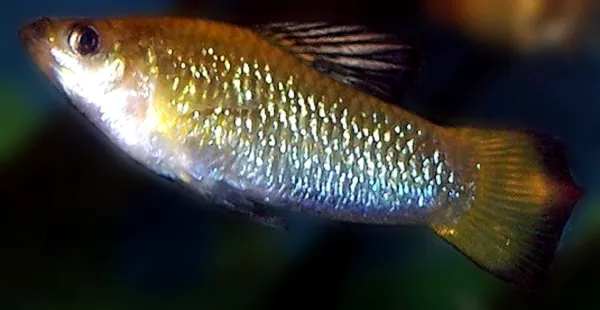
The sexes are strongly dimorphic, and the males are the showpiece. Mature males are polymorphic — colour and pattern vary individually — but are generally iridescent across the flanks, with a yellow or golden caudal fin edged in black and a dark, often black, dorsal fin. Females are altogether plainer, ranging from tan to a soft golden, with the deeper body and the gravid abdomen of a livebearing female.
As in all poeciliids, the diagnostic male structure is the gonopodium, a slender intromittent organ formed from modified rays of the anal fin and used to inseminate the female internally. Its presence is the clearest external sign of a male, appearing as the fish matures and accompanying the onset of the male's brighter colours.
Habitat
Poecilia perugiae is endemic to the island of Hispaniola, occurring in the Dominican Republic, where it inhabits streams and other small freshwater bodies. It is a demersal, non-migratory freshwater fish of tropical lowland waters, keeping to flowing and standing waters across its island range.
The water it favours is warm and hard. FishBase records a temperature span of roughly 75–82 °F, a pH of about 6.8–7.5, and a tolerance for very hard water, with hardness up to around 30 dH — a chemistry profile that mirrors the limestone-influenced waters of much of Hispaniola. This preference for hard, near-neutral to alkaline water is characteristic of the genus and shapes how the species is best kept in captivity.
Within its streams the fish occupies the upper part of the water column, an active swimmer in open water rather than a bottom-hugger despite the genus's mud-feeding namesake. Detailed habitat data for individual Dominican populations are sparse beyond these broad parameters.
Feeding
Perugia's limia is an omnivore. Its trophic level — around 2.9 on FishBase's scale — places it just below a true omnivore's midpoint, reflecting a diet that combines plant and animal matter with a meaningful share of algae and detritus, in keeping with the mud-grazing habits that gave the genus its name.
In the wild the species takes algae, detritus and small invertebrates from the substrate and water column. The diet is opportunistic and shifts with what each stream offers, but the fish is not a specialised predator; it grazes and gleans more than it hunts.
In the aquarium it is undemanding and accepts prepared foods readily, taking good-quality flake without hesitation. A varied diet that includes a vegetable or algal component suits its omnivorous leaning and keeps both colour and breeding condition strong; small live and frozen foods are taken eagerly and help condition breeding stock.
Mating
Like all poeciliids, Poecilia perugiae reproduces by internal fertilisation. The male transfers sperm to the female using the gonopodium, the modified anal fin that serves as an intromittent organ; there is no external spawning and no egg-laying. Males are active and persistent in pursuit of females, a continual courtship rather than a seasonal event.
The brightly coloured, polymorphic males signal their quality through iridescence and fin colour, and as in related livebearers female choice and male competition both play a part in mating. Females are able to store sperm internally, so a single insemination can fuel more than one brood — a common poeciliid trait that lets isolated females continue to produce young.
Reproduction is continuous under warm conditions rather than tied to a narrow breeding season, and the species is notably prolific, readily pairing and producing brood after brood in suitable water.
Breeding
Poecilia perugiae is viviparous: the female carries the developing young internally and gives birth to free-swimming fry rather than laying eggs. Gestation lasts about 24 days, after which a female delivers a brood reported at anywhere from roughly 10 to 100 young, the larger counts coming from big, well-conditioned females.
The species is an easy and prolific breeder, and a particular virtue among livebearers is that adults of this species generally do not hunt their own fry — a trait that markedly raises survival without intensive intervention. Even so, breeders provide cover: a modest breeding tank with floating plants or dense fine-leaved cover such as guppy grass (Najas guadalupensis) gives the newborns refuge and lets good numbers grow out.
The fry are fully formed miniature fish, able to swim and feed at once. They take crushed flake immediately and require no special first foods, growing quickly with little fuss. This combination of a fixed short gestation, large broods, non-predatory parents and self-sufficient fry makes the species one of the more rewarding limias to propagate.
In the aquarium
Perugia's limia is an easy, rewarding aquarium fish and a long-standing favourite among livebearer specialists — it took Best in Show among Wild Livebearers at the American Livebearer Association convention in 2018. It is active and occupies the upper water column, which also makes it a useful dither fish, its confident open-water movement helping to settle shy or retiring cichlids.
Care is straightforward. The fish does best in warm water, around 75–82 °F, and will tolerate cooler conditions down to about 68 °F, though it is most comfortable warm. The key to keeping it well is water chemistry: like its genus it thrives in very hard, near-neutral to slightly alkaline water and should not be kept in soft, acidic conditions. A planted setup with floating cover suits both adults and the steady stream of fry the species produces.
Given its prolific breeding and non-predatory parents, population control becomes the real management task rather than coaxing the fish to spawn. A small, well-planted aquarium will quickly fill with young, so keepers should plan for grow-out space or homes for the surplus.
Conservation
Poecilia perugiae is assessed as Least Concern on the IUCN Red List (assessment dated 15 May 2020, IUCN Global assessment). It is not listed under CITES or the Convention on Migratory Species, and it is harmless to humans.
The species shows high biological resilience, with a population doubling time estimated at under 15 months — a reflection of its early maturity, live-bearing reproduction and large broods. These traits, together with a tolerance for a range of stream conditions, underpin its secure conservation status across its Dominican range.
As an island endemic confined to Hispaniola, however, the species is ultimately tied to the health of the Dominican Republic's freshwater streams, and the long-term welfare of such narrowly distributed fishes depends on those habitats remaining intact. A robust captive presence among livebearer hobbyists provides an additional measure of security for the species.