Taxonomy & naming
Aphanotorulus unicolor was originally described by Franz Steindachner in 1908, in volume 45(11) of the Anzeiger der Kaiserlichen Akademie der Wissenschaften, Wien (Mathematisch-Naturwissenschaftliche Klasse), page 164, as Plecostomus unicolor. The type locality is Rio Purus, Brazil. The Catalog of Fishes (Eschmeyer, CAS, spid 52076) accepts the current valid combination Aphanotorulus unicolor (Steindachner, 1908).
The species accumulated a substantial number of synonyms under Plecostomus and later Hypostomus across the twentieth century: Plecostomus chapare / Hypostomus chapare (Fowler, 1940), Plecostomus madeirae, Plecostomus micropunctatus, Plecostomus popoi, and the more recently proposed combination Aphanotorulus frankei (which PlanetCatfish lists in bold as a synonym). All are now placed in synonymy with A. unicolor under the current valid combination established by Ray and Armbruster (2016).
The genus Aphanotorulus itself was resurrected and revised in Ray and Armbruster (2016), Zootaxa 4072(5): 501–539. That paper also reviewed the complex history of the 'Hypostomus emarginatus species complex' and clarified the six valid Aphanotorulus species: A. ammophilus, A. emarginatus, A. gomesi, A. horridus, A. phrixosoma, and A. unicolor. Earlier, Armbruster himself had reviewed the genus and described Aphanotorulus as containing two valid species (A. ammophilus and A. unicolor); subsequent work by Ray and Armbruster expanded this to six. A. unicolor belongs to subfamily Hypostominae (Armbruster, 2004).
Morphology
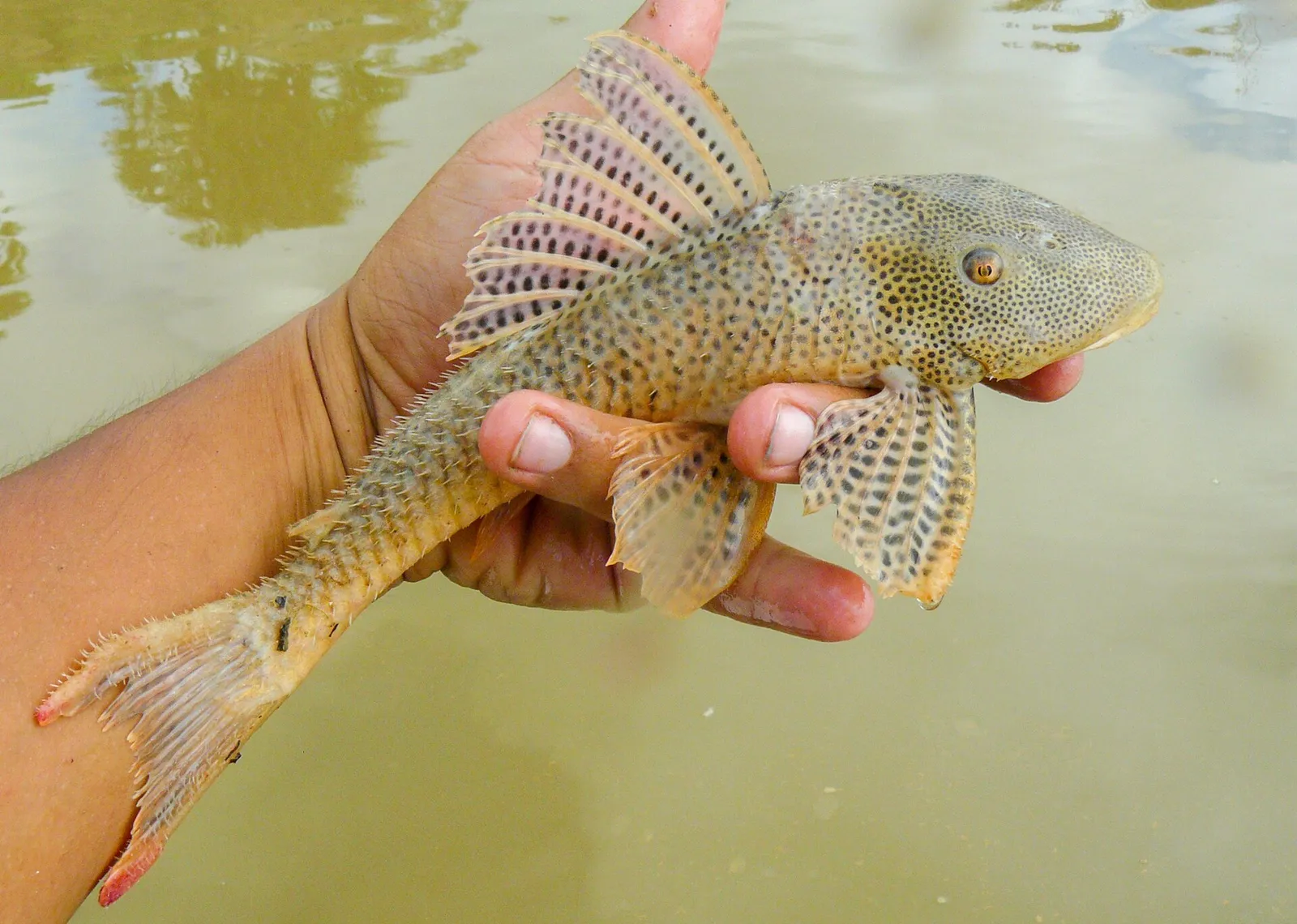
Aphanotorulus unicolor is the smallest species in the genus by current records, with PlanetCatfish listing a maximum of 5.5 in SL — placing it in the compact-to-mid range for Hypostominae, substantially smaller than the 30+ cm A. emarginatus and A. horridus. The body is depressed and generally flatter in cross-section than most Hypostominae — a shared genus character in Aphanotorulus — with a broad, low head profile.
Coloration in the species name is instructive: unicolor means 'single colour' or 'uniform'. In practice, the fish is generally plain tan to light brown with small dark spots less than half the diameter of the lateral scutes — the diagnostic spotting pattern of the genus Aphanotorulus (distinguishing it from Isorineloricaria, which has spots almost as large as the lateral plates on a nearly white background). Preserved specimens appear more uniformly brownish; in live fish there may be subtle patterning that fades. The posterior edge of the oral disc is jagged rather than smooth, a shared diagnostic character for Aphanotorulus.
Breeding males develop the characteristic Aphanotorulus secondary sexual character: exceptionally elongate, bristle-like odontodes covering the entire back and sides behind the dorsal fin, giving a striking 'bristled' or 'hedgehog' appearance. These are greatly developed compared with the modest odontodes of non-breeding males. Females are broader-bodied when gravid. The caudal peduncle is oval in cross-section and does not become proportionately longer with size (distinguishing Aphanotorulus from Isorineloricaria, where the peduncle becomes proportionately elongated in large adults).
Habitat
The Catalog of Fishes gives the distribution as 'South America: upper Amazon' and lists the type locality as Rio Purus, Brazil. PlanetCatfish distributional data record the species from the upper Amazon and its associated drainages. FishBase confirms South American distribution in the upper Amazon basin. GBIF occurrence records support the species' presence in the Purus drainage and related upper Amazon tributaries — the headwater-influenced, generally soft and slightly acidic to neutral waters of western Amazonia.
The upper Purus and its tributaries carry whitewater to clearwater characteristics depending on tributary source, with temperatures broadly in the 77–82 °F range year-round at low elevations. The riverine habitats occupied by Aphanotorulus in general involve rocky and root-associated substrate, with the fish using the undersides of rocks, root tangles, and submerged tree bases as daytime refuge and nocturnal foraging substrate.
No detailed field habitat studies specific to A. unicolor appear to have been published. The genus Aphanotorulus is broadly distributed across several major drainages in tropical South America and shows general tolerance of the clearwater and whitewater habitats typical of the western and central Amazon. As with other mid-sized Hypostominae, A. unicolor is expected to be a facultative air-breather, using intestinal air-breathing to tolerate hypoxic conditions during the dry season.
Feeding
Aphanotorulus unicolor is an aufwuchs and algae grazer in the Hypostominae mould, using its ventral sucker mouth to scrape biofilm, periphyton, and fine organic detritus from hard substrates — rocks, submerged wood, compacted sediment surfaces. The flattened body of Aphanotorulus is well-adapted to pressing tightly against flow-exposed rock surfaces; the low centre of gravity and broad oral disc maximise contact and purchase against current.
In common with other Aphanotorulus and related hypostomines, A. unicolor likely grazes nocturnally, emerging from daytime shelters beneath rocks and roots to forage more actively across open substrate at night. Fine organic material and diatoms constitute a significant fraction of the natural diet alongside macroalgae.
In the aquarium, the feeding requirements are straightforward: algae wafers, spirulina-based sinking foods, blanched vegetables (courgette, cucumber, sweet potato), and the opportunity to rasp driftwood. A varied diet with adequate plant-based nutrition supports long-term health. The species is unlikely to require protein-supplemented diets and does well on a predominantly vegetable-based regime consistent with its natural trophic position.
Mating
No courtship observations specific to Aphanotorulus unicolor are documented in the hobby literature; PlanetCatfish carries no breeding or observation records for the species. Based on what is known for A. emarginatus and on the genus characters described by Ray and Armbruster (2016), the breeding system involves pronounced male–male competition mediated through the spectacular odontode development that gives conditioned males their bristled appearance.
Breeding-condition males of all Aphanotorulus species develop exceptionally elongate, bristle-like odontodes covering the back, flanks, and posterior body behind the dorsal fin — a degree of odontode hypertrophy that appears designed for both visual signalling and tactile agonistic contact during male–male encounters. The jagged posterior edge of the oral disc may serve a secondary role in male territorial contests, analogous to the mouth-locking behaviour described in some other large Hypostominae.
Females, being plainer-bodied and broader when gravid, would assess cavity-holding males before spawning. At the species' modest adult size (under 5.5 in SL), suitable cave structures for a successful spawning are manageable in a reasonably sized aquarium — smaller than the massive cave requirements of A. emarginatus.
Breeding
No captive breeding of Aphanotorulus unicolor has been documented in the published hobby literature, and PlanetCatfish lists no breeding reports. The species is rarely kept and even less frequently maintained in groups of sufficient size and complementary sex ratio to attempt deliberate breeding. Based on the genus biology — all Aphanotorulus species are presumed cave-spawners with paternal brood care — the reproductive template is the same as for other hypostomines: male guards a clutch of adhesive eggs in a defended cavity, fanning them to maintain oxygen and removing infertile material.
A breeding setup at A. unicolor's size would require a tank of at least 40–55 US gal, structured caves approximately 2–3 in in diameter (matching the fish's body diameter), good water flow and oxygenation, and well-conditioned adults fed a varied diet over an extended pre-breeding period. Seasonal cues — a modest temperature drop followed by warming to simulate the Amazonian flood pulse, or increased water changes and flow — might serve as breeding triggers.
The rarity of wild-caught imports and the near-absence of hobbyist attempts mean that the reproductive biology of this species remains essentially undocumented in aquarium conditions. It represents a genuine gap in loricariid hobby husbandry that could be addressed by a specialist keeper with access to paired adults.
In the aquarium
At a maximum of approximately 5.5 in SL (perhaps 7–8 in TL), Aphanotorulus unicolor is a practical size for an intermediate loricariid aquarium. A single adult can be maintained comfortably in a 30–40 US gal aquarium; a pair or trio would do better in 200+ litres with clearly defined cave territories to buffer male–male competition. This size advantage over its larger congeners makes A. unicolor a more accessible Aphanotorulus for hobbyists without the space for 105–160 US gal species-only tanks.
Decoration should mirror the rocky Amazonian riverine origin: smooth or tumbled rocks stacked to form caves and overhangs, driftwood pieces for rasping and shelter, and open sandy-gravelly areas for foraging substrate. Moderate to strong filtration and water flow are appropriate. Temperature 77–82 °F, pH 6.0–7.2, soft to moderately soft water. Avoid stagnant conditions; the species benefits from good oxygenation.
A. unicolor is an inconspicuous, largely crepuscular fish that may spend much of the daylight hours wedged beneath rocks or inside caves. Its most striking display — the breeding-condition male with full odontode development — is rarely seen by hobbyists unless the fish is well-conditioned. The species is essentially absent from the mainstream trade and appears only very occasionally as a specialty import or through specialist keeper networks.
Tank companions should be non-aggressive species of similar or larger size that will not harass a retiring pleco: peaceful large characins, Geophagus or similar mid-water cichlids, and robust Corydoras are suitable. Avoid aggressive loricariids in the same territory.
Conservation
Aphanotorulus unicolor is assessed as Least Concern by the IUCN Red List as of 2020, reflecting its distribution across the upper Amazon basin — a broad geographic footprint that reduces overall extinction risk — and the absence of documented population-level declines.
The species' distribution in the upper Amazon and Purus basin places it in a region that remains more intact than some lower-Amazon tributaries but that faces persistent and growing pressure from deforestation, soy and cattle agriculture expanding across the cerrado and Amazon frontier, and associated increases in sedimentation and water temperature in smaller tributaries. Gold mining activity in parts of the western Amazon introduces mercury contamination that affects benthic fish communities.
The species is effectively absent from the commercial ornamental trade, removing one pressure that affects more commonly collected congeners. It does not appear to have been evaluated for invasive potential outside South America, consistent with its rarity in the trade. Monitoring of benthic loricariid communities in the Purus drainage would be needed to detect any change in A. unicolor's status; at present the data are sparse.