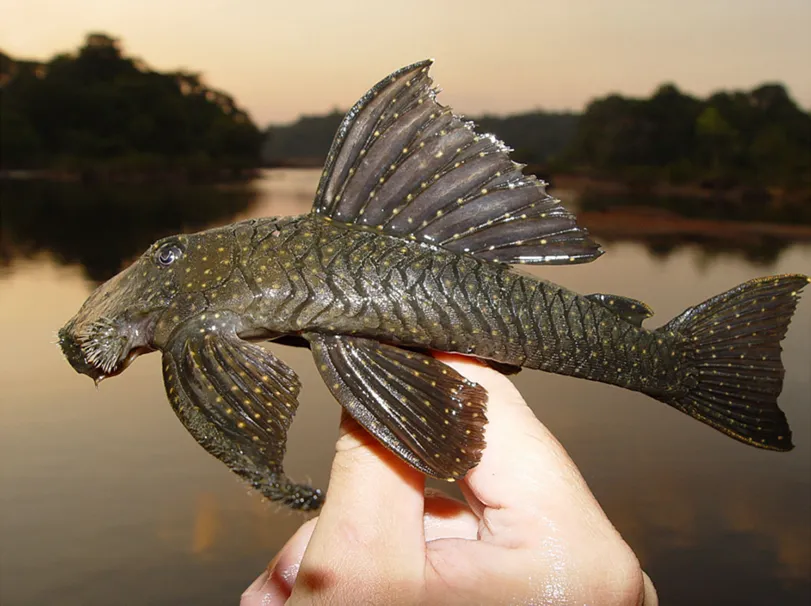
Taxonomy & naming
Guyanancistrus niger was originally described by Norman in 1926 as Lasiancistrus niger, from material collected in the Oyapock River, French Guiana. Isbrücker transferred it to Pseudancistrus in 1980 (Beaufortia 30(1):45), the combination currently recognised by the Catalog of Fishes (Eschmeyer, CAS) as the valid name. The species has also appeared in the literature as Hemiancistrus niger, reflecting historical uncertainty over generic boundaries in the Hypostominae.
PlanetCatfish lists this taxon under Guyanancistrus niger (Norman, 1926), citing the synonyms Hemiancistrus niger and Lasiancistrus niger alongside Guyanancistrus niger. The genus Guyanancistrus was erected to accommodate Guiana-shield Pseudancistrus-like taxa, and that placement reflects phylogenetic interpretations not yet adopted by the Catalog of Fishes. This article follows the Catalog of Fishes: Guyanancistrus niger (Norman, 1926).
This fish was long listed as Pseudancistrus niger; Eschmeyer's Catalog of Fishes places the species in Guyanancistrus, and the current combination Guyanancistrus niger is followed here.
Morphology
Adults reach approximately 6.5 in standard length (SL) — around 6.5 in overall — making this a mid-sized loricariid. The body bears the typical overlapping bony scutes of the family. FishBase notes that odontodes on the extreme tip of the snout and on the pectoral spines are particularly well developed, a trait associated with rheophilic genera in which the pectoral apparatus anchors the fish against fast current. The species is described as occurring in rapid zones, consistent with a morphology that foregrounds spine and odontode elaboration over streamlined mass.
Detailed colouration records are not documented in the available literature for this species.
Habitat
Guyanancistrus niger is known from the Oyapock River basin, which straddles the border between French Guiana and the Brazilian state of Amapá. The type locality is Saut Cafesoca on the Oyapock River. The Oyapock drains the Guiana Shield — ancient, geologically stable granite that produces clear, warm, soft, and generally acidic blackwater and clearwater rivers with frequent rapids and cascades.
The species' occurrence in rapid zones, as noted by FishBase, places it among the rheophilic Hypostominae that use enlarged pectoral spines and facial odontodes to maintain position on smooth boulders and bedrock in fast current. Water chemistry for the Oyapock system is typical of Guiana Shield rivers: soft, low-mineral water, warm year-round, well-oxygenated by turbulence. Precise recorded parameters for this species are not available in the literature.
Feeding
No diet data specific to Guyanancistrus niger are documented in the available sources. Based on general Pseudancistrus and related-genus biology, the species is expected to be a grazer of periphyton — the dense biofilm of algae, bacteria, and fine organic matter that coats submerged boulders in fast-flowing Guiana Shield rivers. The ventrally-placed scraping mouth and robust body plan are consistent with this feeding guild.
In captivity, rheophilic Hypostominae of similar body plan typically accept algae wafers, blanched vegetables, and biofilm-rich surfaces; the exact dietary requirements of G. niger in an aquarium context have not been documented.
Mating
No mating or courtship data are available for Guyanancistrus niger. General observations from close relatives suggest that rheophilic Hypostominae are substrate-spawners associated with rock crevices or submerged woody debris in areas of moving water. Males of related taxa typically defend site territories and develop elaborated odontodes during the breeding season. Nothing specific to this species is documented in the literature.
Breeding
No breeding data are documented for Guyanancistrus niger in either the wild or captivity. The species has not been reported to have bred in the aquarium trade. Given its rheophilic habitat requirements and the specialised fast-water conditions of the Oyapock River, it is unlikely to have been maintained in aquaria long enough for breeding observations to have accumulated. No clutch size, incubation period, or parental care mode is on record.
In the aquarium
Guyanancistrus niger does not appear in hobby literature as an established aquarium fish. The species has no recorded trade or hobbyist breeding history, and there are no aquarium husbandry accounts in the available sources. Its rheophilic specialisation — adapted to oxygenated, fast-moving, soft Guiana Shield water — suggests that replicating appropriate conditions in captivity would be non-trivial.
Anyone working with this or related Guiana Shield Hypostominae should provide strong current, excellent oxygenation, rock and hard substrate, and very clean soft water. Specific guidance for G. niger beyond these general principles cannot be offered from the available record.
Conservation
Guyanancistrus niger has not been evaluated by the IUCN Red List as of the date of this article. The species appears to be endemic to the Oyapock River basin — a relatively intact Guiana Shield system — but no formal population assessment or threat analysis has been conducted. The Oyapock basin is less industrially developed than many South American drainages, which may afford some incidental protection, but the lack of any assessment means vulnerability to localised threats (gold mining, deforestation) cannot be quantified.
FishBase records the species as known from the Oyapock River system, straddling the French Guiana–Brazil border. No trade records or exploitation data are documented.