Taxonomy & naming
Leporacanthicus heterodon was described by Isbrücker and Nijssen in 1989 in the Die Aquarien- und Terrarienzeitschrift (DATZ), volume 42, number 9, page 547. The type locality is cited as Cachoeira von Martius on the upper Rio Xingú, Mato Grosso State, Brazil. The Catalog of Fishes (Eschmeyer, CAS) lists the name as valid, with no subsequent synonyms. The combination has been stable since original description; no later revisionary work has moved the species.
The genus Leporacanthicus, also erected by Isbrücker and Nijssen (1989), takes its name from the Latin lepus/leporis (hare or rabbit) and the Greek akantha (thorn), a reference to the large, somewhat rabbit-tooth-like anterior teeth visible when the fish is viewed from the front — the same anatomical feature that inspired the hobbyist name 'vampire pleco' for the genus. FishBase etymology notes the genus as 'rabbit-thorn'. In the trade, L. heterodon circulates under the hobby code L172, though some German sources note that the original fish photographed and assigned to L172 in DATZ may represent a distinct Ancistrinae taxon, and the name L172 has been applied loosely; PlanetCatfish's positive list and the broader hobby nonetheless associate the code primarily with L. heterodon. The epithet heterodon is Greek for 'different tooth' — héteros (different, other) + odous/odontos (tooth) — and refers to the distinctly heterogeneous dentition: a few enlarged, projecting anterior teeth contrasting with smaller lateral teeth.
Morphology
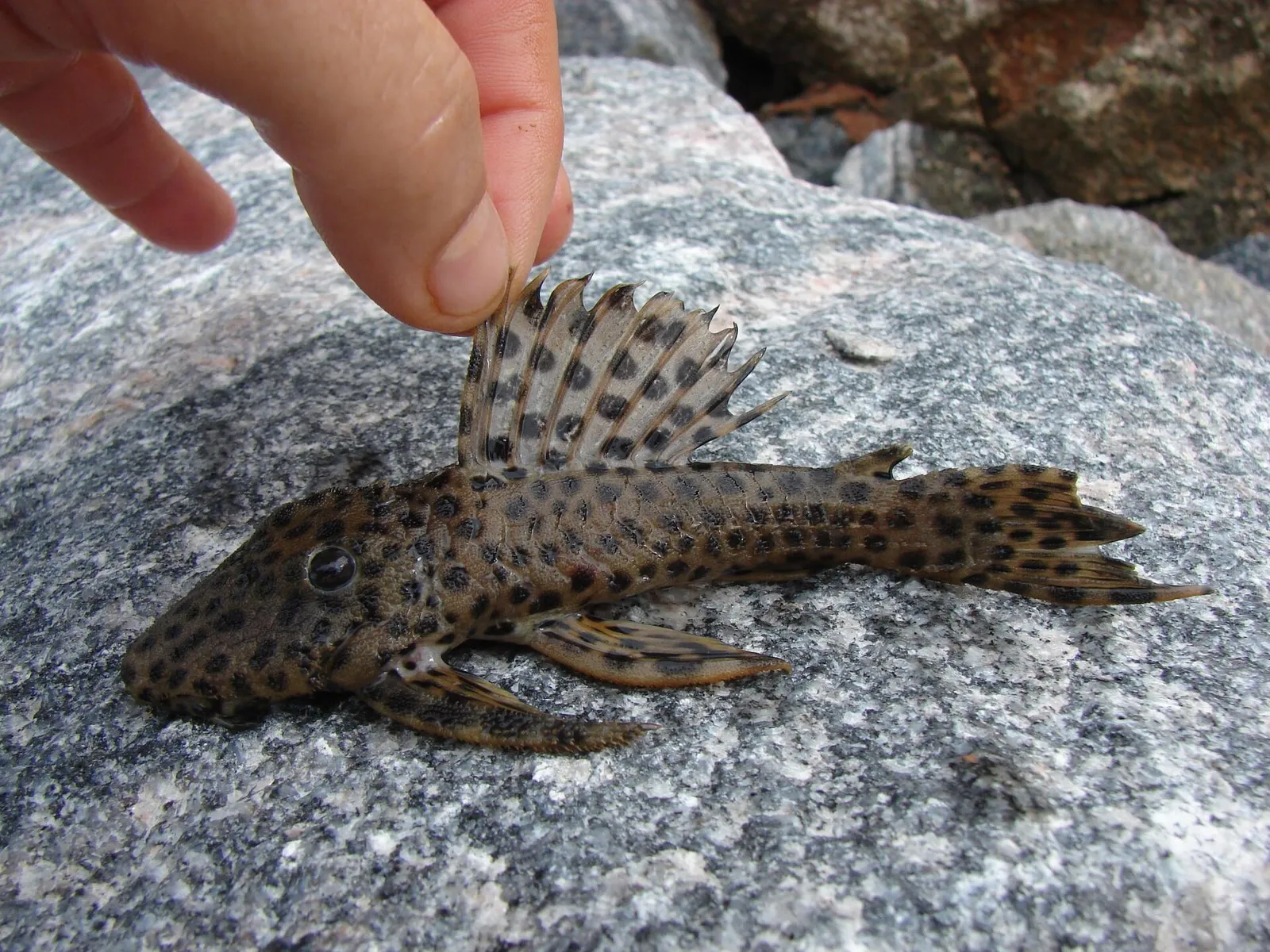
Leporacanthicus heterodon is among the smallest species in its genus, reaching approximately 4 in standard length (SL) per the type series; FishBase lists a maximum published total length of 6.5 in, while some hobbyist sources cite up to 8–8.5 in, likely reflecting differences in measurement method or larger wild specimens. The body is moderately elongate and fully armoured in loricariid scute plates. The ground colour of juveniles and adults is a warm golden to yellow-brown, densely and evenly covered with dark brown to black spots of roughly uniform size — a pattern that makes the fish exceptionally attractive and superficially reminiscent of a leopard.
The diagnostic feature of the genus is the dentition: the jaws bear a small number of conspicuously long, projecting, curved anterior teeth that protrude beyond the lip margins when the mouth is closed, giving the fish its 'vampire' or 'fang' appearance. This contrasts with the numerous fine multi-cusped teeth of algae-grazing loricariids; these enlarged teeth are adapted for gripping and puncturing hard-shelled prey such as snails. A small, backwards-facing, blunt nuchal spine on top of the head is shared by all Leporacanthicus species and is diagnostic for the genus.
Sexual dimorphism in L. heterodon is more subtle than in some Pseudacanthicus relatives. Mature males develop a broader head and more robust pectoral spines; breeding males also develop short, thick interopercular and snout-margin odontodes. Males tend toward a slimmer, more elongate body profile from above, while gravid females are noticeably broader between the pectoral and pelvic fin bases. Coloration in males is reportedly somewhat more contrasted.
Habitat
Leporacanthicus heterodon is endemic to Brazil, occurring in the Xingu River basin, primarily from the middle to lower Xingu and extending into the Rio Iriri, a major left-bank tributary. The type locality on the upper Xingu in Mato Grosso places the species in the high-gradient, rocky sections of the system that are characteristic of Xingu loricariid diversity. The Xingu is a clearwater river — relatively transparent, moderately acidic to near-neutral — that flows over ancient Precambrian shield rock, creating the complex of rapids, boulder fields, and bedrock runs that host the highest density of endemic loricariid species on earth.
Microhabitat is rocky substrate in fast-flowing, well-oxygenated sections. Water temperatures in the middle and lower Xingu typically range from 79–84 °F year-round; pH is broadly 6.0–7.5; hardness and conductivity are low. The species shares habitat with a remarkable suite of loricariid species (Hypancistrus, Baryancistrus, Leporacanthicus galaxias, various Hypostomus) and competes for crevice and cave sites in the rocky biotope. During the Xingu low-water season, boulder exposures increase and dissolved oxygen concentration in fast sections is very high, which appears to be the preferred seasonal condition for many Xingu loricariids including Leporacanthicus.
Feeding
Leporacanthicus heterodon is a carnivore, not an algae-grazer or wood-eater. The enlarged, fang-like anterior teeth are purpose-built for extracting invertebrate prey — in the wild this almost certainly means freshwater snails (which are abundant in Xingu rocky biotopes), small crustaceans, insect larvae, worms, and carrion rather than plant material. Observations from the German hobbyist literature (L-Welse.com) note that prawns and mussels are readily consumed and promote healthy growth, and that the species will also accept high-quality granulate and pellet foods, which produce less waste than wet meaty foods.
In the aquarium a protein-dominant diet is essential for long-term health. Frozen or fresh prawns, chopped mussel, cockle, krill, and quality sinking carnivore pellets are the staples. Supplementary vegetable feeding (algae wafers, blanched courgette) can provide dietary fibre and is accepted, but should not form the bulk of the diet. Overfeeding with very fatty foods is inadvisable. Because L. heterodon is not a wood-eater, driftwood in the tank serves primarily as décor and shelter rather than as a nutritional requirement — a meaningful difference from Panaqolus or Panaque kept in similar setups.
Mating
Courtship and pre-spawning behaviour in Leporacanthicus heterodon follows the general loricariid pattern of cave-site competition and female coaxing. Males become territorial around preferred rocky crevices or tube-shaped hollows, displaying the enlarged pectoral odontodes of the breeding season and engaging in mouth-lock contests with rival males. The German breeding accounts in the l-welse.com database note that males with wider heads and more robust pectoral spines tend to be dominant territory holders.
Conditioned females are visibly fuller-bodied when viewed from above, particularly between the pectoral and pelvic fins. Pre-spawning conditioning with regular partial water changes using slightly cooler, softer water — simulating the seasonal inflow of highland rains that dilutes and cools the Xingu during the wet season — is reported by European breeders to be the most reliable spawning trigger. Increasing current flow and maintaining low conductivity (below 100 µS/cm) during the breeding attempt are also noted as beneficial. The species is generally described as calm toward conspecifics and other tank inhabitants outside the immediate breeding period.
Breeding
Leporacanthicus heterodon has been bred in captivity on multiple occasions; PlanetCatfish lists two breeding reports, and additional accounts appear in German-language hobbyist literature (l-welse.com, Ingos Harnischwelszucht). The species is a cave spawner with paternal brood care. The male selects a tight, preferably side-entered hollow — a spawning tube, a crevice between rocks, or a dedicated cave ornament — and after coaxing the female in, guards the clutch through incubation. Clutch size is relatively small for the genus: accounts cite up to about 40 eggs per spawn, and the eggs are noted to be proportionally larger than those of L. galaxias.
Incubation at typical tank temperatures (81–82 °F) takes approximately 5–7 days. The male fans the eggs continuously and removes infertile or fungused ones. Fry emerge as miniature adults, darkly coloured at first, with the adult spotting pattern developing over the following weeks. Rearing fry on artemia nauplii and finely crumbled high-quality pellets is straightforward; separate rearing in a dedicated growout tank or breeding box is recommended to improve survival rates. Water change using slightly softer water and increased current at the time of breeding attempts is the most consistent conditioning recommendation.
In the aquarium
Leporacanthicus heterodon's modest adult size — typically 4.5–6.5 in total length — makes it one of the more aquarium-manageable members of its genus, a meaningful distinction in a group that otherwise includes species reaching 12–15.5 in or more. A well-filtered 120-litre aquarium can house a pair or trio, with a 200-litre or larger tank preferred for groups. The species tolerates reasonable social densities if caves and crevices are provided in abundance; with sufficient shelter, territorial interactions rarely escalate to injury.
Water quality must closely reflect the Xingu origin: temperature 79–84 °F, pH 6.0–7.5 (slightly acidic preferred), low hardness (GH 0–10°dH), and importantly, strong water movement and high dissolved oxygen. The species is sensitive to stagnant conditions and low oxygen, which are common in over-stocked or poorly maintained tanks; this is perhaps the single most frequent cause of decline in L. heterodon kept outside specialist facilities. Weekly partial water changes of 30–40% with temperature-matched water are advisable.
Decoration should focus on cave provision: rocky structures with tight crevices or ceramic breeding tubes are ideal. Plants are optional and will not be eaten (this is not a herbivore), but robust rooted species or epiphytes like Anubias and java fern on rock are practical. Tankmates should be chosen for compatibility with warm, fast water: other Xingu loricariids, mid-water tetras, Geophagus cichlids, and similar community fish co-exist well. Avoid slow-water or cool-water species. Like all Leporacanthicus, some individuals may rasp at silicone seams; monitoring is advisable.
Conservation
The IUCN Red List assessed Leporacanthicus heterodon as Near Threatened (NT) in 2018 under criterion A3c, reflecting projected future population decline due to ongoing habitat deterioration in the Xingu basin. The single greatest threat is the Belo Monte hydroelectric complex, a massive dam project on the Xingu in Pará State that fundamentally altered the hydrology, flow regime, and rocky-rapids microhabitat of the middle Xingu — exactly the habitat to which L. heterodon and many of the Xingu's other endemic loricariids are adapted. The altered flow, warming, and sediment deposition downstream of Belo Monte have reduced habitat quality for rheophilic species across the middle Xingu.
L. heterodon is part of the Brazilian ornamental export trade and is collected from the Xingu; the species is not on Brazil's negative export list. The combination of habitat loss and collection pressure on a species with restricted range and specific ecological requirements places it in a more precarious position than the LC designation of many congeners. Captive breeding, while established in European hobbyist circles, is not yet at a scale that would meaningfully buffer wild populations. Aquarists keeping this species are encouraged to source tank-bred specimens where available.