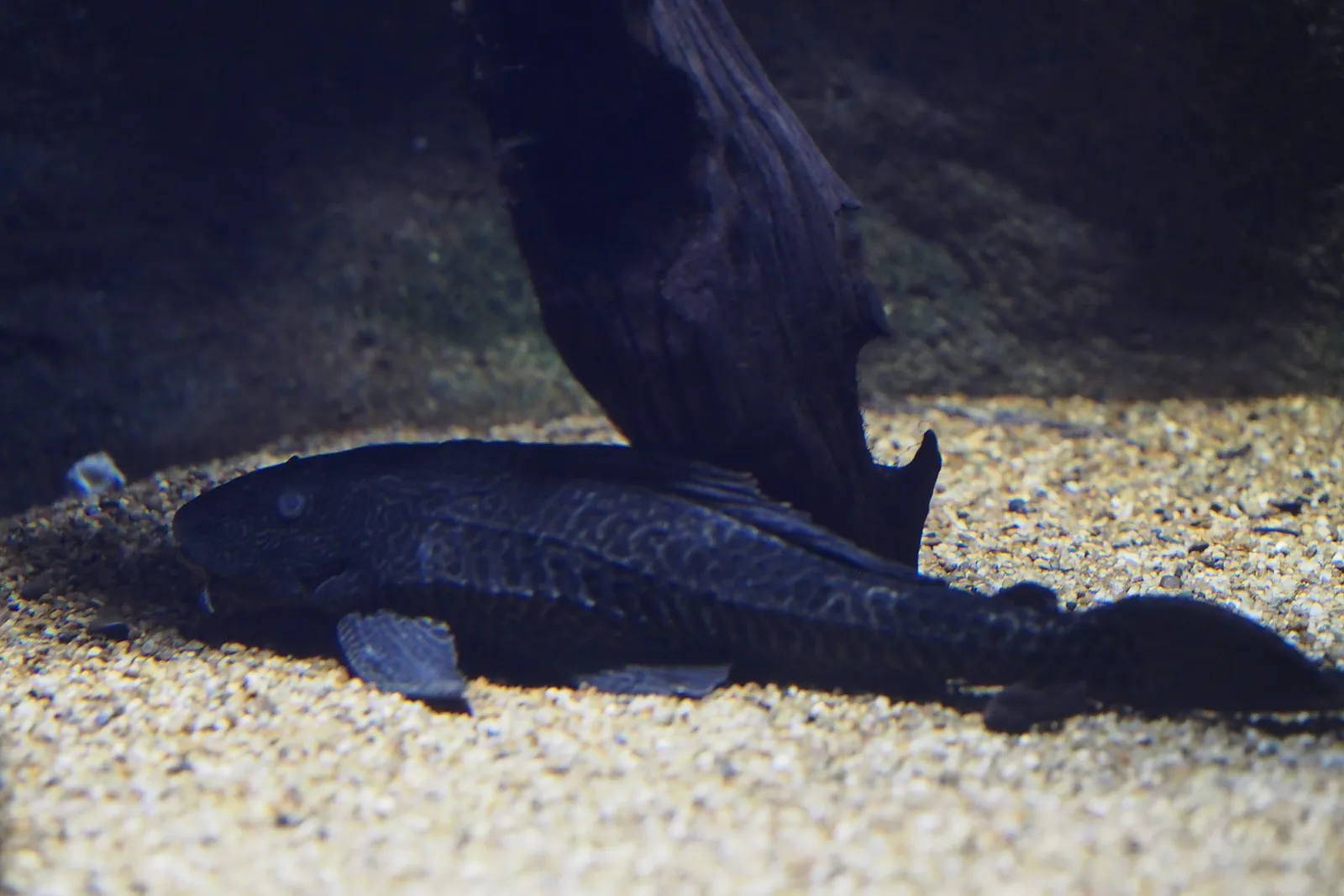
Taxonomy & naming
Pterygoplichthys disjunctivus was described by Claude Weber in 1991 in the Revue Suisse de Zoologie (volume 98, number 3, page 638), with a complementary description published in 1992. The type locality is the Río Madeira at Restauração, Amazonas, Brazil — the heart of the central Amazon basin. The Catalog of Fishes (Eschmeyer, CAS) records the valid combination as Pterygoplichthys disjunctivus (Weber, 1991), with the author name parenthesised because the original combination was Liposarcus disjunctivus.
Several synonyms complicate the literature: Ancistrus anisitsi (Eigenmann & Kennedy, 1903), Liposarcus anisitsi, Pterygoplichthys anisitsi, Ancistrus multiradiatus alternans, and Pterygoplichthys juvens have all been sunk into synonymy with this species. The genus Pterygoplichthys Gill 1858 is characterised by an exceptionally sail-like dorsal fin bearing 10 or more rays — a reliable field character that separates it from Hypostomus and related genera, which have 8 or fewer dorsal rays.
Within Loricariidae, Pterygoplichthys belongs to the tribe Hypostomini in subfamily Hypostominae, positioned by Armbruster (2004) as closely allied to Glyptoperichthys and the similarly large-bodied South American sailfin catfishes. The genus is native to tropical South America (Amazon, Orinoco, and La Plata drainages) but is now established as a feral species on multiple continents through aquarium release.
Morphology
Pterygoplichthys disjunctivus is a large, robust Loricariidae: FishBase records a maximum of 27.5 in total length (TL) with a maximum published weight of 1.3 kg. PlanetCatfish records 27.5 in SL. The body is strongly compressed dorsoventrally, heavily armoured in coarse odontode-bearing scutes, and broadest across the pectoral region. In cross-section the fish is distinctly shield-shaped — flat ventrally, arched dorsally.
The diagnostic feature of the genus is the expansive, sail-like dorsal fin, which in a healthy adult spans much of the body width and bears 10–14 branched soft rays following the hardened leading spine. Coloration is the character that gives this species its 'vermiculated' common name: the body is covered in a dense, intricate reticulated or worm-track pattern of dark lines on a pale background — sometimes described as resembling a maze or topographic contour map. The precise pattern intensity and background colour vary with diet and condition.
Sexual dimorphism is subtle in this species. PlanetCatfish notes that the genital papilla provides the most reliable cue: in sexually mature males it is a small, thick, projecting stump; in females it is recessed or lies flat against the body. Females also tend to be broader-bodied at reproductive maturity. There are no external bristle structures (cf. Ancistrus) in this genus.
Habitat
The native range of P. disjunctivus centres on the Madeira River basin in the western Amazon of Brazil, but extends into the broader Amazon system, the La Plata basin (Paraná, Paraguay, and Uruguay rivers), and adjacent drainages. FishBase summarises its distribution as South America: Madeira River basin, with introductions across multiple continents now substantially expanding its documented range.
In its native range the species occupies floodplain lakes, swamps, oxbow lakes, and borrow pits — typically slow-moving, shallow, and often poorly oxygenated environments. FishBase notes that this species is facultatively air-breathing and possesses a specialised enlarged stomach that functions as an accessory respiratory organ, allowing it to survive in hypoxic conditions that would be lethal to most other fish. This physiology also explains the ease with which it establishes in degraded, eutrophic environments worldwide.
Feral populations are now documented in Florida, Texas, Hawaii, Malaysia, the Philippines, Indonesia, Singapore, Thailand, Taiwan, and numerous other regions where aquarium releases have allowed establishment in warm waters. In Florida the species has been present since the 1990s and is considered ecologically damaging to native benthic communities.
Feeding
Pterygoplichthys disjunctivus is omnivorous, with a dietary emphasis on algae, detritus, biofilm, and decaying organic matter when young, shifting to a broader omnivory as it grows. PlanetCatfish describes it as 'a good algae eater, especially when young' — a qualification worth emphasising, because large adults consume enormous quantities and produce correspondingly large quantities of waste, tipping the balance from 'useful algae controller' to 'tank polluter' in most domestic aquaria.
In natural floodplain habitats, gut content studies of large Pterygoplichthys consistently reveal a mixed diet: algae, vascular plant fragments, detritus, aquatic invertebrates, and sediment. The enlarged, specialised stomach likely aids in digesting the fibrous, low-nutrient material that characterises much of its diet. In the wild, massive nocturnal activity periods involve rasping biofilm from submerged roots, wood, and muddy substrates.
In captivity, high-quality sinking catfish pellets, algae wafers, blanched vegetables (courgette, cucumber, sweet potato, peas), and occasional meaty supplement form an appropriate diet. The sheer size of large adults means their nutritional requirements are substantial — a 19.5 in fish in a 500-litre tank will consume significant food and produce ammonia loads that smaller plecos do not. Adequate biological filtration is essential.
Mating
Courtship in P. disjunctivus has been documented in natural populations in Brazil and in introduced populations in Florida, where the species breeds prolifically in earthen burrows. In the wild, males excavate tunnels in soft river banks — typically 19.5–35.5 in deep, sometimes exceeding 3 ft — and defend these sites as breeding territories. The male's papilla serves as the primary visual sex cue for conspecifics approaching the burrow.
In captivity, P. disjunctivus has not been reliably bred in standard aquarium conditions: PlanetCatfish records no captive breeding reports for this species. The excavation of burrows in earthen substrate is a biological requirement for spawning — a condition that standard glass or acrylic tanks with gravel or sand cannot replicate. Some specialist keepers in tropical outdoor ponds have achieved spawning, but indoor captive breeding remains essentially unreported.
The species does show strong site fidelity in both natural and feral contexts: in Florida field studies, territorial males were repeatedly recaptured at the same burrow sites across multiple seasons, demonstrating the stability of their breeding territories once established.
Breeding
Breeding in P. disjunctivus requires soft-substrate burrow conditions that are essentially impossible to replicate in domestic aquaria. In natural populations on the Madeira River and in feral Florida populations, males excavate tunnels in soft earthen banks, frequently in steep riverbanks or levee walls. The female deposits adhesive, bright orange eggs in a dense mass inside the burrow — egg masses numbering in the hundreds to several thousand eggs have been documented in Florida studies. The male guards the nest, fanning and protecting the egg mass.
Fry are demersal and begin foraging on algae and aufwuchs almost immediately after the yolk sac is absorbed. Growth is rapid in warm, food-rich environments: feral juveniles in Florida have been recorded reaching 12 in within their first year under optimal conditions.
The biological inability to breed this species in conventional aquaria is, in conservation terms, a meaningful data point: the overwhelming majority of the enormous global trade in P. disjunctivus involves wild-caught or pond-raised (not tank-bred) animals. Aquarists should be aware that responsible disposal of this fish if it outgrows the tank does not mean release to outdoor waterways — even in apparently unsuitable climates, warm-water discharges near power plants or in subtropical regions can sustain feral populations.
In the aquarium
Pterygoplichthys disjunctivus is sold at juvenile sizes of 2–4 in across the global ornamental trade, often labelled simply as 'pleco' or 'common pleco'. At that size it is a vigorous algae cleaner and an attractive fish. The critical problem for hobbyists — and the species' ecosystems — is that it grows rapidly to 19.5–27.5 in and requires correspondingly large volumes of water to thrive.
A single adult P. disjunctivus requires a minimum of 130 US gal of aquarium volume with powerful filtration capable of handling the substantial nitrogenous waste load. Water temperature should be 75–82 °F; the species tolerates a broad pH range (FishBase records no specific limits, though tropical conditions in the 6.5–7.8 range are appropriate). It is highly tolerant of low dissolved oxygen due to its accessory respiratory capacity, but high-quality water with good turnover is still preferable.
This fish produces significant territorial aggression toward other large bottom-dwellers. Two adult P. disjunctivus in the same tank require genuinely large volumes and multiple visual barriers. It should not be kept with small, slow, or fragile fish it can physically damage by suction-rasping.
The most honest aquarium advice for this species is a responsible caveat: if a tank of at least 105–130 US gal (and ideally more) cannot be committed to long-term, this fish should not be purchased. The fish's ecological impact as an invasive species in Florida, Southeast Asia, and elsewhere is directly attributable to aquarium releases. Surrendering an outgrown specimen to a fish store, species-appropriate rescue programme, or responsible hobbyist is the only responsible option.
Conservation
The IUCN Red List assessed Pterygoplichthys disjunctivus as Least Concern in November 2020, reflecting broad native range distribution and no evidence of population decline within the Madeira basin and La Plata system. Within its native range, the species is commercially fished for food in some areas of Brazil and consumed locally.
The more complex conservation story involves its invasive status worldwide. Feral populations in Florida have been studied extensively: they burrow into river banks, destabilise stream margins, consume algae and detritus that native species depend on, and compete directly with native armoured catfishes (in South America) and benthic feeders elsewhere. In Florida, P. disjunctivus and its congener P. pardalis are considered significant invasive species with measurable ecosystem impacts in the Peace, Hillsborough, and Alafia river systems.
In Southeast Asia — Malaysia, Thailand, the Philippines, and Indonesia — established feral populations in rivers and rice paddy systems are considered agricultural pests and threats to native fish diversity. The species' hardiness, its capacity to air-breathe, and its prolific reproduction in earthen burrows all make eradication from established feral populations essentially impossible.
For the aquarium trade, the takeaway is unambiguous: P. disjunctivus must never be released into any natural waterway, and the trade should adopt clearer disclosure of ultimate adult size at point of sale.