Taxonomy & naming
Rudolf Kner described this fish in 1863 as Acara coeruleopunctata, from specimens taken in the Río Chagres on the Atlantic slope of Panama — the same river that now feeds the Panama Canal. Part of the original syntype series survives at the Naturhistorisches Museum Wien (NMW 33635-36 and 22168, ex Zoologische Staatssammlung München); the five Munich syntypes from the old collection were destroyed in the Second World War, and Neumann revised the type catalogue in 2006.
Through most of the twentieth century the species drifted between the catch-all genera of the day. It was first moved to Astronotus, then held for decades as Aequidens coeruleopunctatus — the name in Bussing's standard 'Peces de las aguas continentales de Costa Rica' (1998) and in Kullander's cichlid chapter of the 2003 'Check List of the Freshwater Fishes of South and Central America.' The break came in 2009, when Musilová, Říčan, Novák and Novák published their phylogeny of the tribe Cichlasomatini (Journal of Zoological Systematics and Evolutionary Research) and erected the genus Andinoacara for the old 'Aequidens' pulcher–rivulatus group: six species of trans-Andean South America and lower Central America that molecular and morphological data separated from the true Aequidens of the Amazon. Andinoacara coeruleopunctatus went into the new genus, where Eschmeyer's Catalog of Fishes still lists it as valid, in the subfamily Cichlinae.
Within Andinoacara the species belongs to the pulcher complex — the group centred on the blue acara (Andinoacara pulcher) — rather than the more aggressive rivulatus (green-terror) complex. Its closest relatives are a tangle of trans-Andean forms (Andinoacara pulcher, Andinoacara latifrons, Andinoacara sapayensis, Andinoacara biseriatus) whose limits stay blurry, and the deep genetic structure found within coeruleopunctatus itself (see Habitat) hints that the name may one day be split. Hobby literature has muddied things further, since wild-caught 'Aequidens coeruleopunctatus' was long a loose trade label for several look-alike acaras.
Morphology
This is a medium-sized, deep-bodied acara built on the usual cichlasomatine plan: laterally compressed, with a gently sloping forehead, a fairly large mouth, and the rounded, paddle-like unpaired fins of a fish that works the bottom. Size reports vary with the source and with how the fish is measured. FishBase carries a maximum of 7.5 in standard length, the upper extreme; field and aquarium accounts more often put adults at 5–6 inches total length, with males the larger, heavier sex.
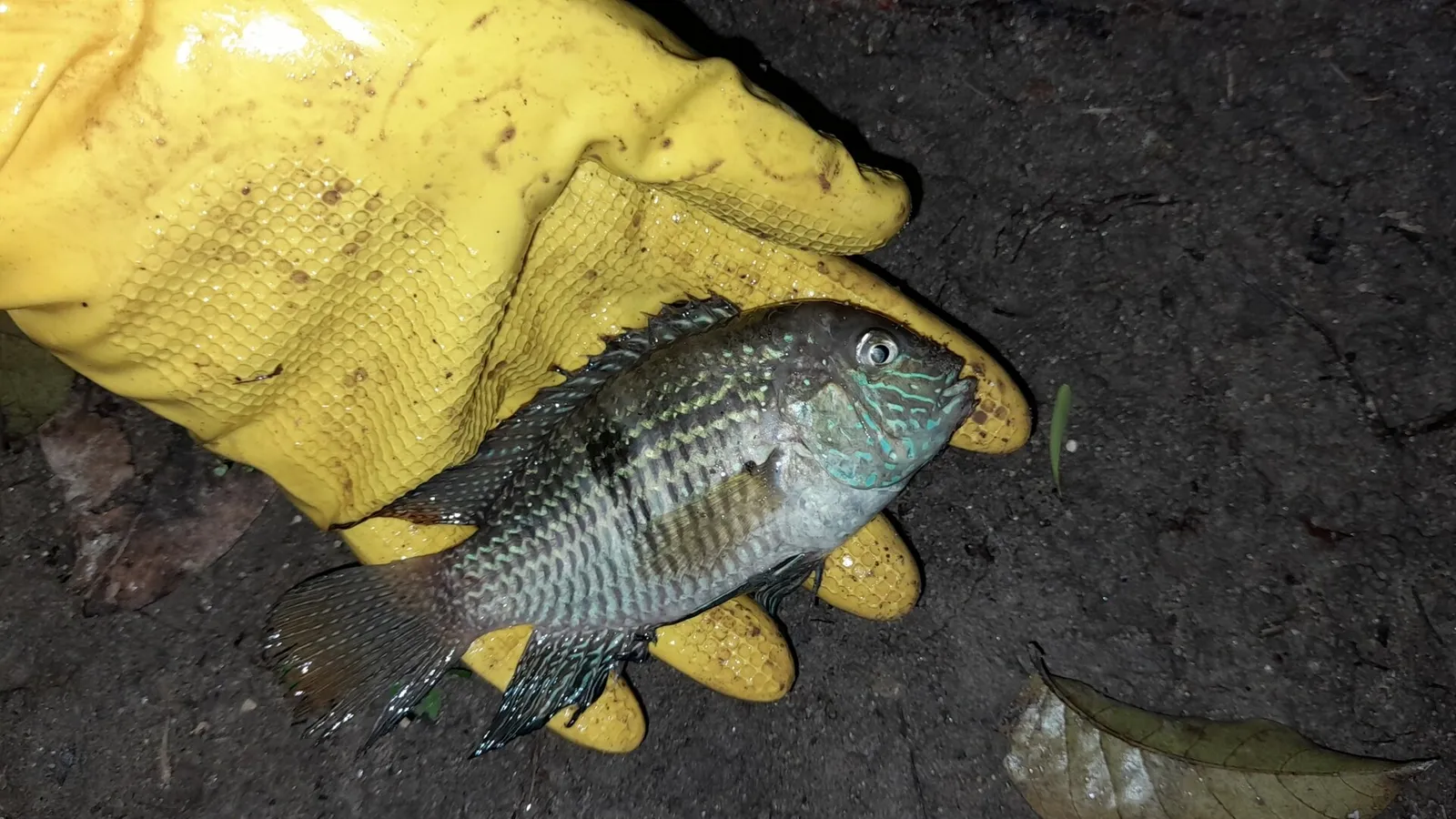
The ground colour is an olive to brownish-grey that shifts darker or paler with mood. The name-giving feature is the scatter of small iridescent blue to blue-green spots and short streaks over the flanks, cheeks, gill covers, and into the dorsal and caudal fins — brightest on a displaying male. A dark midlateral blotch and faint vertical bars appear and fade with the fish's state. One quirk causes real confusion: the dorsal and anal fins are edged in a pale to coloured margin, and this species turns up with either a white or an orange-to-red dorsal seam, which invites mix-ups with the orange-trimmed Andinoacara rivulatus and may reflect either misidentification or genuine regional colour variation. Dimorphism is moderate and typically acara: mature males grow larger, take on a steeper nuchal hump and more produced (extended) tips on the dorsal and anal fins, while females stay smaller and rounder-finned. Otherwise the sexes look alike enough that pairing is read from behaviour and vent shape rather than colour.
Habitat
Andinoacara coeruleopunctatus is a fish of the lowland streams of the lower Central American isthmus. The Catalog of Fishes gives its range as both the Atlantic and Pacific slopes of Panama and the Pacific slope of Costa Rica (the Río Coto and neighbouring drainages); FishBase frames it the same way, and the species runs on south into the rivers of northwestern Colombia, so its native range straddles Panama, Costa Rica, and Colombia. That spread across both sides of the continental divide is exactly why the species matters to biogeographers — a South American cichlid lineage that crossed onto the isthmus and now occupies drainages emptying into two different oceans.
It prefers slow, structured water over open current. FishBase describes it in stagnant waters and the shallow margins of smaller rivers rich in organic material and low in flow, especially abundant in creeks packed with leaf litter and debris, but also in the quiet shallows of larger rivers, where it gathers in small groups over the bottom; the IUCN assessment adds rivers and lagoons with rocky substrate. Recorded chemistry is soft to moderately hard and slightly acid to slightly alkaline — FishBase gives a pH of roughly 5.5–8.0 and hardness of about 1.5–8 dH — at warm tropical temperatures of around 72–84 °F.
The most remarkable thing about its habitat is the history written into its genes. McCafferty, Martin, and Bermingham (2012) sequenced mitochondrial ATPase 6/8 from 318 individuals across the species' lower Central American range and recovered eight distinct, geographically partitioned clades. That deep structure tracks the making of the isthmus — river-capture events, ancient drainage links, and the limited over-land dispersal of a modestly mobile fish all left a mark — making coeruleopunctatus a textbook case of how Pliocene–Pleistocene geology shaped the freshwater fauna of Panama. Building on Bermingham and Martin's 1990s work on lower Central American fishes, the species now serves as a model for reading the assembly of the region's aquatic life straight out of one animal's DNA.
Feeding
The blue-spotted acara is an opportunistic benthic omnivore, working the stream bottom and the leaf litter rather than chasing prey in open water. FishBase records a wild diet built around aquatic insects and places the fish at a trophic level of about 3.2 — a small predator that also takes plant and detrital matter. In practice that is a generalist's menu: insect larvae and other small invertebrates plucked from the substrate and from among submerged roots and leaves, rounded out with worms, micro-crustaceans, and incidental plant and organic material. Its abundance in detritus-rich creeks fits the profile, since such waters teem with the invertebrate fauna that breaks down fallen leaves. In the aquarium it is easy to feed, thriving on varied quality prepared foods with live and frozen items and some vegetable matter — just what its catholic wild feeding would predict. As a mid-sized, mid-trophic fish it sits in the middle of its stream community: a consumer of invertebrates and detritus, and in turn prey for the larger piscivores and fish-eating birds of the lowland Neotropics.
Mating
Like the better-known blue acara, Andinoacara coeruleopunctatus is a monogamous, pair-bonding cichlid that forms a lasting partnership for the length of a breeding cycle. Close field studies of courtship in this particular species are scarce, so most of what can be said reliably comes from the consistent pattern across the pulcher complex and from aquarium observation. Pairs split off from a loose social group — the small bottom-hugging aggregations FishBase describes — with a male and female claiming a patch of substrate and defending it together. The run-up to spawning follows the standard acara script: mutual displays with flared fins and intensified spotting, lateral tail-beating, jaw-locking trials of strength, and the joint clearing and cleaning of a flat surface to serve as the spawning site. The bond is genuinely shared rather than run by one sex, and the pair's territoriality sharpens as spawning nears. Aquarists find the species relatively peaceable for an acara — nearer the docile blue acara than the combative rivulatus complex — outside of breeding, when, like all substrate-spawners, a guarding pair turns pointedly aggressive toward anything near the nest.
Breeding
Andinoacara coeruleopunctatus is a biparental, open-substrate spawner with extended care of the young by both parents — the classic acara mode. FishBase puts it plainly: an open-bottom spawner that produces hundreds of eggs, with both parents tending the clutch and guarding the brood until the fry are about a week into free-swimming life. The female lays her adhesive eggs on a cleaned, exposed surface — a flat rock, a root, a leaf, or a slab of submerged wood — rather than hiding them in a cave, and the male fertilises them as he passes. Both then share guard and upkeep: fanning the eggs to keep them oxygenated, mouthing away any that die or fungus over, and driving off intruders. Once the eggs hatch the parents shepherd the wrigglers, often moving them between shallow pits dug in the substrate, until the larvae finish their yolk and rise into a tight, guarded school. The fry are escorted and defended through that first vulnerable week and beyond, the pair herding the shoal over the streambed and heading off predators. In captivity the species breeds readily on this template and is regularly tank-bred — the source of most hobby specimens — while the exact clutch counts, egg-development timing, and spawn frequency of wild fish stay poorly documented in the primary literature and are reported here only to the level the sources support.
In the aquarium
Found and settled in, this is one of the more forgiving acaras: hardy, adaptable, and much quieter than the green terror while still showing the parental behaviour that draws people to acaras. The catch is availability — it is uncommon in the trade, most vendors still moving it under old 'Aequidens coeruleopunctatus' or umbrella 'acara' labels, and the captive stock in circulation may be mixed with close relatives.
Tank: a 120-litre (roughly 30 US gallon) tank is a workable minimum for a single pair, but experienced keepers and breeders go larger — 50–65 US gal — to soak up spawning aggression and to house tankmates with less stress all round. Footprint beats raw volume: a long, relatively shallow tank with plenty of bottom area suits this benthic, roaming fish better than a tall column.
Decor: reflect the leaf-littered, mixed-substrate creeks of Panama and Costa Rica. Sand or fine gravel lets the fish forage naturally; smooth stones, rounded slate, driftwood, and a scatter of dried Indian almond or oak leaves add cover and a gentle acidifying buffer. Flat rocks and broad, stable wood double as spawning sites once a pair is ready. Robust, well-rooted plants (Vallisneria, Echinodorus, Microsorum) hold up next to a fish that digs less than many Central American cichlids, though expect some rearranging around spawns; floating plants that dim the light suit its liking for shaded lowland water.
Water: unusually forgiving for a Neotropical cichlid. The native range spans both isthmus slopes across a wide band of soft-to-moderately-hard, slightly acid-to-slightly-alkaline water (pH 5.5–8.0, hardness roughly 1–8 dH, 72–84 °F), and captive-bred stock holds up across that whole span. A practical target is neutral to very slightly soft and slightly acid — pH 6.8–7.4, hardness 4–8 dH, 75–81 °F — comfortably inside the wild range and free of any need for RO preparation. Steady filtration and a reliable weekly water change matter more than an exact chemistry reading.
Tankmates: by Central American cichlid standards it is relatively peaceable outside spawning, but a guarding pair will defend several square feet of substrate and can intimidate or injure anything that wanders in. Pair it with similarly sized, robust fish rather than small tetras or peaceful dwarfs — mid-sized characins, sturdy barbs, larger livebearers, or comparably sized South or Central American cichlids that can hold their own, all in a spacious tank. Avoid highly aggressive or fin-nipping species, and don't put two rival pairs together in anything short of a large, heavily broken-up tank.
Common mistakes: expecting green-terror fireworks, or at the other extreme treating it as a peaceful community fish that can share space with dwarfs through a spawn. Breeding follows the open-substrate pattern under Breeding — a well-conditioned pair (a quality pellet or flake base plus frozen bloodworm, earthworm, and the odd vegetable) will spawn on a cleaned flat surface and guard the brood to free-swimming with both parents on duty, which is why tank-raised fish are both easier to find and preferable to wild imports.
Conservation
The IUCN Red List rates Andinoacara coeruleopunctatus as Least Concern, assessed on 7 November 2019 by Angulo and Lyons and published in the 2020 cycle. The reasoning is the usual one for a widespread, adaptable lowland fish: a broad range across the lower Central American isthmus, an extent of occurrence on the order of 34,363–45,560 mi², no sign of overall decline, and a population judged stable. The species carries no CITES or CMS listing, is taken only in minor subsistence fisheries with a low fishing-vulnerability score, and is harmless to people.
The assessment still flags the ordinary pressures on Central American lowland streams — habitat change from agriculture, water management and pollution, and the spread of introduced species — though none yet amounts to a range-wide threat for so resilient a generalist. A subtler point comes from the genetics: because the species splits into eight deeply divergent, geographically restricted clades (McCafferty et al. 2012), much of its evolutionary diversity is locked up in individual drainages. A 'Least Concern' verdict for the species as a whole can therefore hide the risk that distinct, irreplaceable regional lineages are lost piecemeal as particular watersheds degrade — the same feature that makes the fish a model of isthmian biogeography also makes its drainage-by-drainage diversity worth protecting.