Taxonomy & naming
Franz Steindachner described the fish as Acara latifrons in 1878, in the Anzeiger der kaiserlichen Akademie der Wissenschaften in Vienna (v. 15, no. 12, for 9 May 1878). Its type material is a series of four syntypes at the Naturhistorisches Museum Wien (NMW 79185), taken from a ciénaga — a floodplain marsh — on the Río Magdalena, a locality Eschmeyer's Catalog of Fishes records simply as 'Cienaga, Río Magdalena, Colombia.' Over the next century the species passed through the broad, catch-all genera that ichthyologists once used for New World cichlids: it appears as Acara latifrons, was treated as a variety of Acara coeruleopunctata and of Apistogramma pulchra by early workers, and from Eigenmann (1910) on was carried as Aequidens latifrons.
Its modern placement dates to 2009. Working on the phylogeny of the Neotropical tribe Cichlasomatini, Zuzana Musilová, Oldřich Říčan and Jindřich Novák found the 'Aequidens' pulcher–rivulatus group to be a distinct lineage and erected the genus Andinoacara for it — a name built around the Andes, on whose cis- and trans-Andean flanks the group is spread. They designated Acara latifrons as the type species, which makes this fish the nomenclatural anchor of the entire genus. Both the Catalog of Fishes and FishBase list Andinoacara latifrons (Steindachner, 1878) as valid within the subfamily Cichlinae.
The lasting muddle is with Andinoacara pulcher, the 'blue acara' of the hobby. The two are close, broadly similar trans-Andean fishes, and for decades aquarium and even some scientific accounts used the names almost interchangeably; older books likewise confused Andinoacara pulcher with Andinoacara coeruleopunctatus, sometimes treating them as synonyms. The practical result, repeated by specialist hobby sources, is that a great many fish sold as Andinoacara pulcher — Colombian stock from the Magdalena and neighbouring drainages in particular — are actually Andinoacara latifrons. Telling them apart often comes down to provenance: knowing the river system a fish came from is frequently the only sure way to separate latifrons from pulcher, and the diagnostic differences blur from drainage to drainage.
Morphology
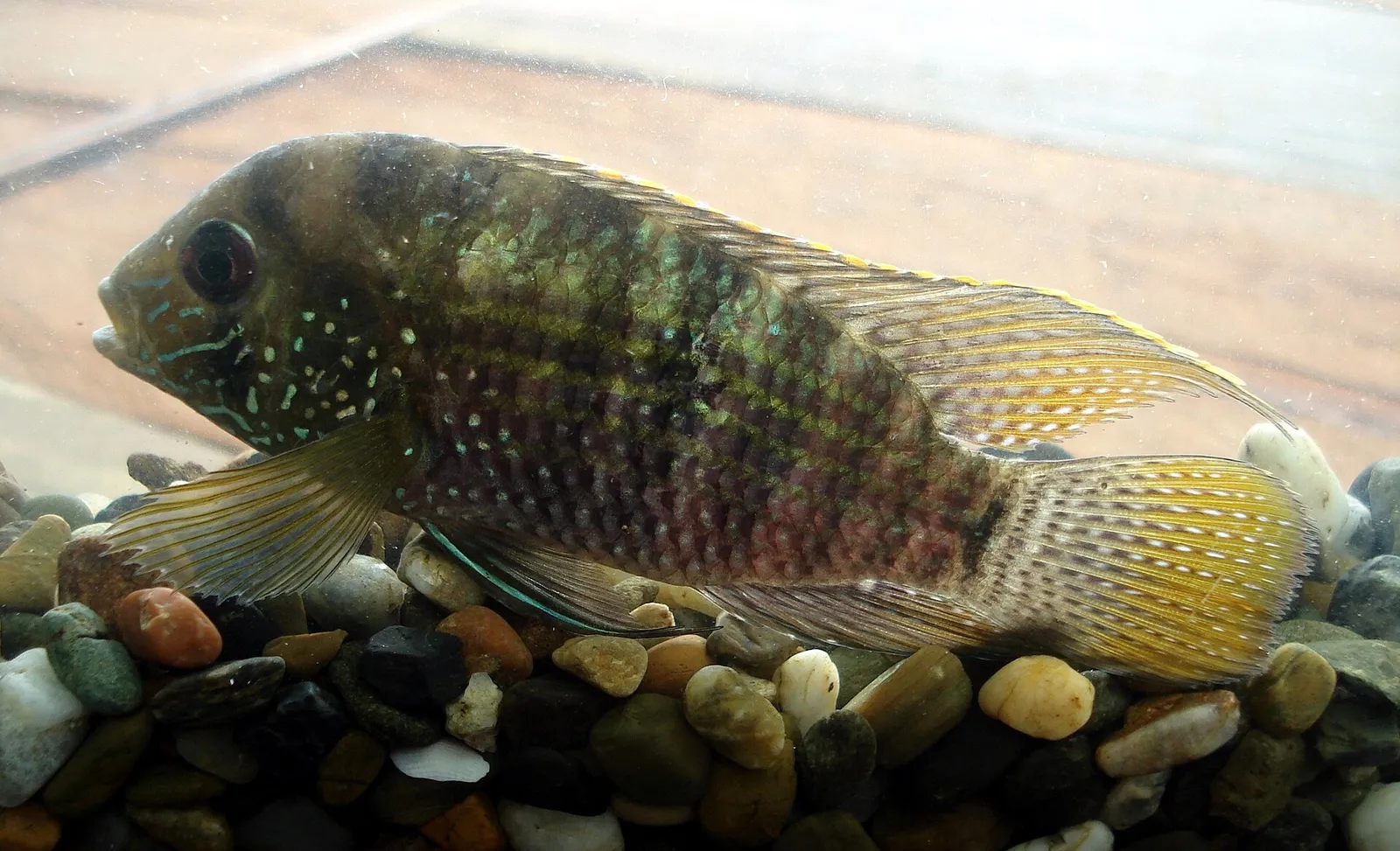
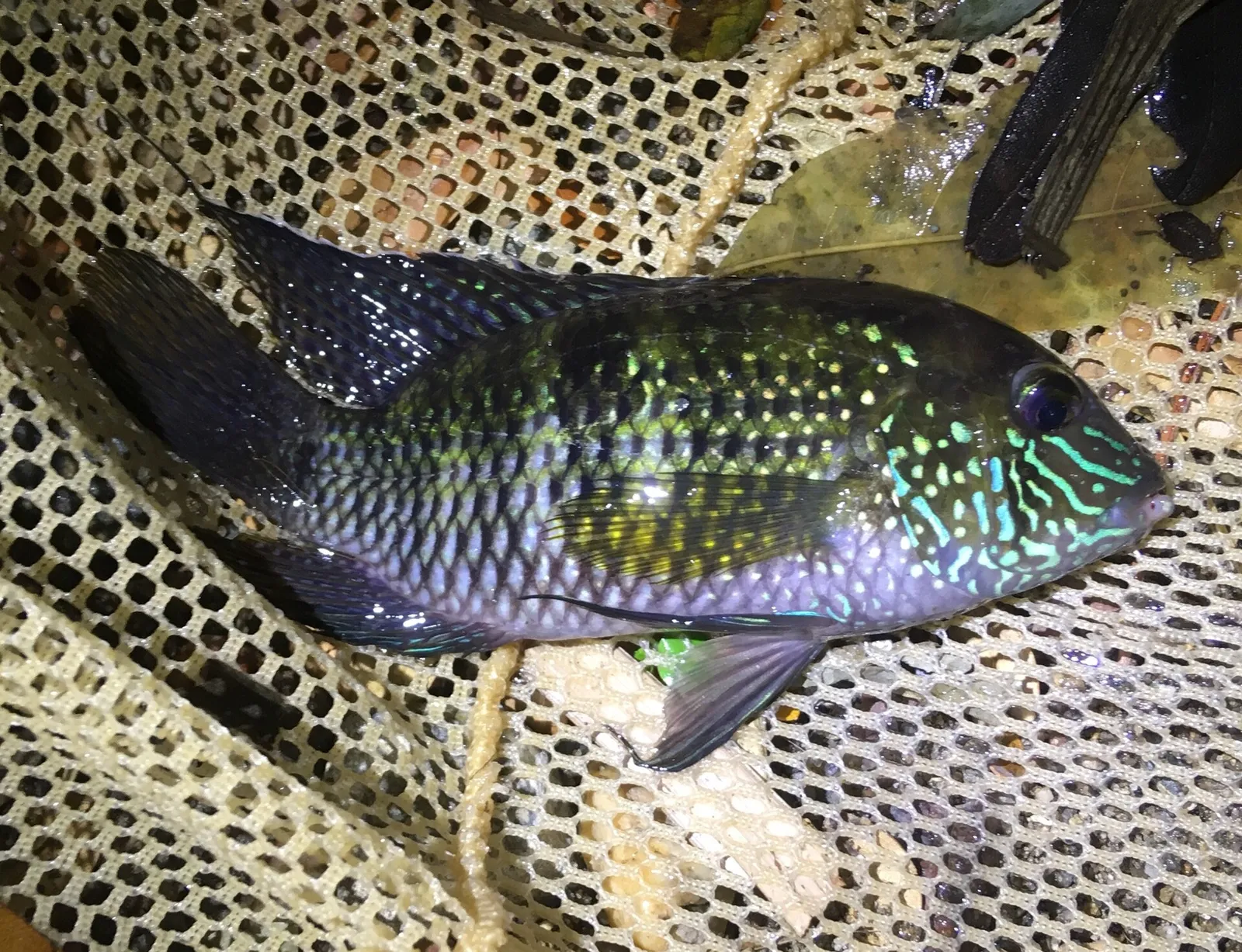
Andinoacara latifrons is a medium-sized, robust, laterally compressed acara built on the familiar 'blue acara' plan: a deep, oval body, a steep forehead, and a large head with thick lips. FishBase gives a maximum of 8 in standard length and a maximum published weight near 327 g, while field and aquarium accounts more often cite adults of roughly 5–6.5 in; the genetic-diversity study of Colombian populations reports a maximum of about 6.5 in. Most wild-caught and captive fish therefore fall in the 5–7 in range, with males running larger.
The colours are the standard acara scheme. A grey-green to brassy or steel-blue ground is scattered across the flanks, gill covers and head with iridescent blue-green spots and squiggles, and a set of darker vertical bars that the fish intensifies or washes out with its mood. A dark lateral blotch and a spot at the base of the tail are usually present, and the unpaired fins carry rows of blue-green spangles, often edged in pale orange or white along the dorsal and caudal margins. The name captures the one truly consistent structural feature — latifrons, 'broad-browed,' for the wide, scaleless, gently sloping forehead.
Sexual dimorphism is modest and of the usual acara kind. Mature males grow larger and heavier, develop more produced, pointed dorsal and anal-fin tips, and tend to be the more intensely coloured sex; females stay smaller and rounder, especially when in spawning condition. Those differences are reliable in a settled pair but not in young fish — one more reason the species is so easily mistaken for its relatives. The 'platinum' or white morph sometimes offered is a line-bred ornamental, not a wild colour, and the same caution applies: much of what reaches shops as a platinum 'blue acara' traces back to latifrons stock.
Habitat
This is a fish of Colombia's Caribbean- and Pacific-slope lowlands, and essentially a Colombian endemic. FishBase and the Catalog of Fishes give its range as the Magdalena, Atrato, Sinú and San Juan basins; the detailed population survey by Restrepo-Escobar and colleagues adds the Cauca and Catatumbo systems and the coastal rivers of the Sierra Nevada de Santa Marta, spanning the upper and lower Magdalena, upper Cauca, San Jorge, Nechí, Cesar, Sinú, Atrato, San Juan and Catatumbo drainages. In FEOW terms its core is the Magdalena–Sinú ecoregion, with the Atrato populations reaching into the adjacent North Andean Pacific–Río Atrato region.
It is a floodplain and still-water specialist rather than a fish of fast current. FishBase calls it benthopelagic, living in swamps and lakes, and the Colombian field work places it 'on flood plains and in water that is directly influenced by sedimentation and oxygenation processes' — the ciénagas, oxbows, marsh margins and sluggish channels of the big lowland rivers. It is explicitly non-migratory, which ties each population to its own stretch of floodplain and helps explain the strong genetic structuring found among isolated drainages such as the Catatumbo and the Sierra Nevada coastal rivers.
The reported water is warm, near-neutral lowland water: a temperature range of about 73–93 °F, pH roughly 6.5–7.5, and hardness from about 6 °dH upward. Within those bounds the species can be very abundant where habitat stays intact, behaving as a tolerant generalist of turbid, warm, weakly flowing floodplain water.
Feeding
Andinoacara latifrons is an opportunistic omnivore that forages over and through the substrate of its floodplain habitats. FishBase puts it at a trophic level of about 3.3, squarely in the omnivore band, and it feeds in the usual acara way: working the bottom and the leaf litter for aquatic insect larvae, worms, small crustaceans and other benthic invertebrates, and rounding the diet out with detritus and plant material. Much of that is taken by mouthing and sifting mouthfuls of sediment and spitting out the inedible fraction. The same catholic appetite is obvious in aquaria — it readily takes prepared cichlid foods alongside live and frozen earthworm, prawn and mussel — though hobby accounts caution against over-rich, high-protein staples.
In the floodplain community this generalist diet makes latifrons a middle-of-the-web fish: an invertebrate predator and detritivore common enough in healthy ciénagas to be a real link between bottom invertebrates and larger predators, yet minor enough to local fisheries that it is caught by artisanal fishers without being valued as food. That dietary flexibility is part of why it persists across such a range of turbid, variable floodplain waters.
Mating
Like other members of the blue-acara group, Andinoacara latifrons is a pair-bonding cichlid: it forms monogamous breeding pairs and defends a territory together. Pairs usually self-select from a group, and once formed they work closely together to clear and guard a spawning site. Outside breeding the fish is fairly gregarious and, by cichlid standards, comparatively peaceable — hobby sources rate the pulcher-group acaras among the more tolerant medium cichlids — but a settled pair turns distinctly territorial around the nest, and individuals grow more aggressive and site-attached as they age.
Detailed quantitative work on courtship and mate choice in wild latifrons is limited, partly because so much of the relevant literature sits under the names of its relatives. The broad pattern across the group is consistent, though: a male and female set up a joint territory, court at and around a chosen hard surface, and clean it together before spawning, with both sexes joining the threat displays and lateral, fin-spread posturing that warn off rival conspecifics and other bottom fish. The pair bond — not a harem or a lek — is the organizing unit of reproduction.
Breeding
Andinoacara latifrons is a biparental, open-substrate spawner — the classic acara strategy. The pair cleans a flat, exposed surface (a stone, a submerged log, a firm leaf, or in tanks a slate or broad plant leaf), and the female lays her eggs onto it in neat rows for the male to fertilize. FishBase reports clutches of up to roughly 800 oval eggs about 0.5 in across, and notes that both parents defend the eggs and larvae. This is substrate brooding, not mouthbrooding: the eggs stay in the open, fanned and guarded where they were laid.
Both parents share the work. The female does much of the close tending, fanning the clutch to keep it oxygenated and free of fungus, while the male patrols the wider territory and drives off intruders — though the roles are flexible and the pair coordinates throughout. Once the eggs hatch, the parents move the wrigglers to pits dug in the substrate and keep guarding them, and when the young become free-swimming they are herded through the shallows as a tight school, both adults steering the fry and snapping at anything that comes near. Field observations of wild-caught pairs tending fry confirm the same attentive biparental care seen across the genus. The species breeds readily wherever warm, stable floodplain conditions hold — and that, with its large clutches and diligent guarding, is much of why it reaches such local abundance in intact ciénaga habitat.
In the aquarium
For anyone already comfortable with medium-sized South Americans, this is an approachable cichlid — hardier than its reputation, though not a beginner's fish if a mixed community is the goal. Because so much latifrons stock has sold as Andinoacara pulcher, much of the husbandry written for 'blue acara' applies directly, and dedicated care accounts specific to Andinoacara latifrons stay thin in the English-language hobby literature.
Tank: a pair of adults — roughly 5–6.5 in — needs a footprint of about 120 × 17.5 in (around 55 US gal). A single fish manages in something smaller, but a breeding pair needs territorial room, and a male can be rough with a female in cramped quarters; a 240-litre or larger display allows a more varied community with less friction. Use sand or fine rounded gravel, since latifrons is a habitual digger that rearranges coarse material and sifts the fine stuff as it feeds. Place smooth stones and driftwood to break sightlines and offer spawning sites — flat, broad stones are ideal. Rooted plants are usually dug up, so décor-attached species (java fern, Anubias, bolbitis) or floating plants are safer.
Water: aim for warm, near-neutral lowland conditions — 75–82 °F, pH 6.5–7.5, moderate hardness (roughly 5–15 °dH / 90–270 ppm). The wild figures (pH 6.5–7.5, temperatures up to 93 °F) show this is no chemistry specialist. Keep filtration efficient: like other warm-water, low-flow cichlids it wants clean, well-oxygenated water and is sensitive to ammonia and nitrite spikes, so weekly partial water changes and a reliable biological filter are the baseline.
Tankmates: temperament sits in a comfortable middle. Outside breeding, latifrons tolerates mid-sized companions — medium characins (bleeding heart tetras, larger Hyphessobrycon), sturdy catfishes (Corydoras, Ancistrus, smaller loricariids) and similarly sized peaceful cichlids. Anything small enough to swallow will eventually be eaten, and any bottom-dweller read as a rival for a spawning site will be harassed. Common mistakes: pairs grow more possessive with age, so an arrangement that works with young fish can fall apart once a settled pair decides to breed — they will hold a several-hundred-litre territory assertively, and tankmates need somewhere to retreat. On the whole this is a solid intermediate: bred in captivity for decades (mostly as 'blue acara'), it eats a wide range of prepared, frozen and live foods and settles into a well-kept tank without drama.
Conservation
The IUCN Red List assesses Andinoacara latifrons as Least Concern (Sanchez-Duarte & Mesa-Salazar, 2016). The rating rests on a wide distribution across several large Colombian basins — Magdalena, Cauca, Sinú, Atrato and beyond — and no evidence of a range-wide decline; the fish stays common, even very abundant, in unaltered floodplain and river habitat. It carries no CITES listing, and although it is caught in artisanal fisheries and traded heavily as an ornamental, it is not a prized food fish and its fishing vulnerability is low.
The real pressures are local and habitat-based rather than direct harvest. Because latifrons is non-migratory and tied to particular floodplains, each population is exposed to whatever degrades its own stretch of water: mining and petroleum activity, especially in the upper Magdalena, which Restrepo-Escobar and colleagues flag as a potential driver of biodiversity loss; the vast sediment load of the Magdalena, which carries roughly a tenth of all the sediment discharged from South America's eastern seaboard; and the deforestation, agriculture and livestock that come with them. The same isolation that leaves the species genetically structured — with distinctive lineages in the Catatumbo and the Sierra Nevada de Santa Marta — also makes those peripheral populations the most vulnerable to localized harm, even while the species as a whole stays secure. The honest summary: latifrons is a resilient, abundant floodplain generalist whose main long-term risks are the steady erosion of Colombian lowland water quality and the genetic costs of fragmenting its basins.